Loading page, please wait…
Vaidra Logo
Vaidra

Top 4 items + smart groups

UPSC GPT
New
Current Affairs
Daily Solutions
Daily Puzzle
Mains Evaluator

Version 2.0.0 • Built with ❤️ for UPSC aspirants

Loading...
Loading...
Loading...
Loading...
Loading...
Loading...
Loading...
Loading...
Loading...
Loading...
Loading...
Loading...
Loading...
Back
All Subjects

Topics

0 topics • 0 completed

Loading topics...
Loading...
Loading...
Loading...
Loading...
Loading...
Overall Progress0%
This property enables phenomena like superconductivity and superfluidity - UPSC Science And Technology

This property enables phenomena like superconductivity and superfluidity - UPSC Science And Technology

What is This property enables phenomena like superconductivity and superfluidity in UPSC Science And Technology?

This property enables phenomena like superconductivity and superfluidity is a key topic under Science And Technology for UPSC Civil Services Examination. Key points include: Bosons are particles that can occupy the same quantum state, enabling phenomena like superconductivity and superfluidity.. Fermions, like electrons, obey the Pauli Exclusion Principle, which governs matter's structure.. Bose-Einstein Condensate (BEC) is a unique state of matter formed when bosonic atoms are cooled near absolute zero, behaving as a single quantum entity.. Understanding this topic is essential for both UPSC Prelims and Mains preparation.

Why is This property enables phenomena like superconductivity and superfluidity important for UPSC exam?

This property enables phenomena like superconductivity and superfluidity is a Medium-level topic in UPSC Science And Technology. It is tested in both Prelims (factual MCQs) and Mains (analytical answer writing). Previous year UPSC questions have frequently covered aspects of This property enables phenomena like superconductivity and superfluidity, making it essential for comprehensive IAS preparation.

How to prepare This property enables phenomena like superconductivity and superfluidity for UPSC?

To prepare This property enables phenomena like superconductivity and superfluidity for UPSC: (1) Study the comprehensive notes covering all key concepts on Vaidra. (2) Practice previous year questions on this topic. (3) Connect it with current affairs using daily updates. (4) Revise using key takeaways and mind maps available for Science And Technology. (5) Write practice answers linking This property enables phenomena like superconductivity and superfluidity to related GS Paper topics.

Key takeaways of This property enables phenomena like superconductivity and superfluidity for UPSC

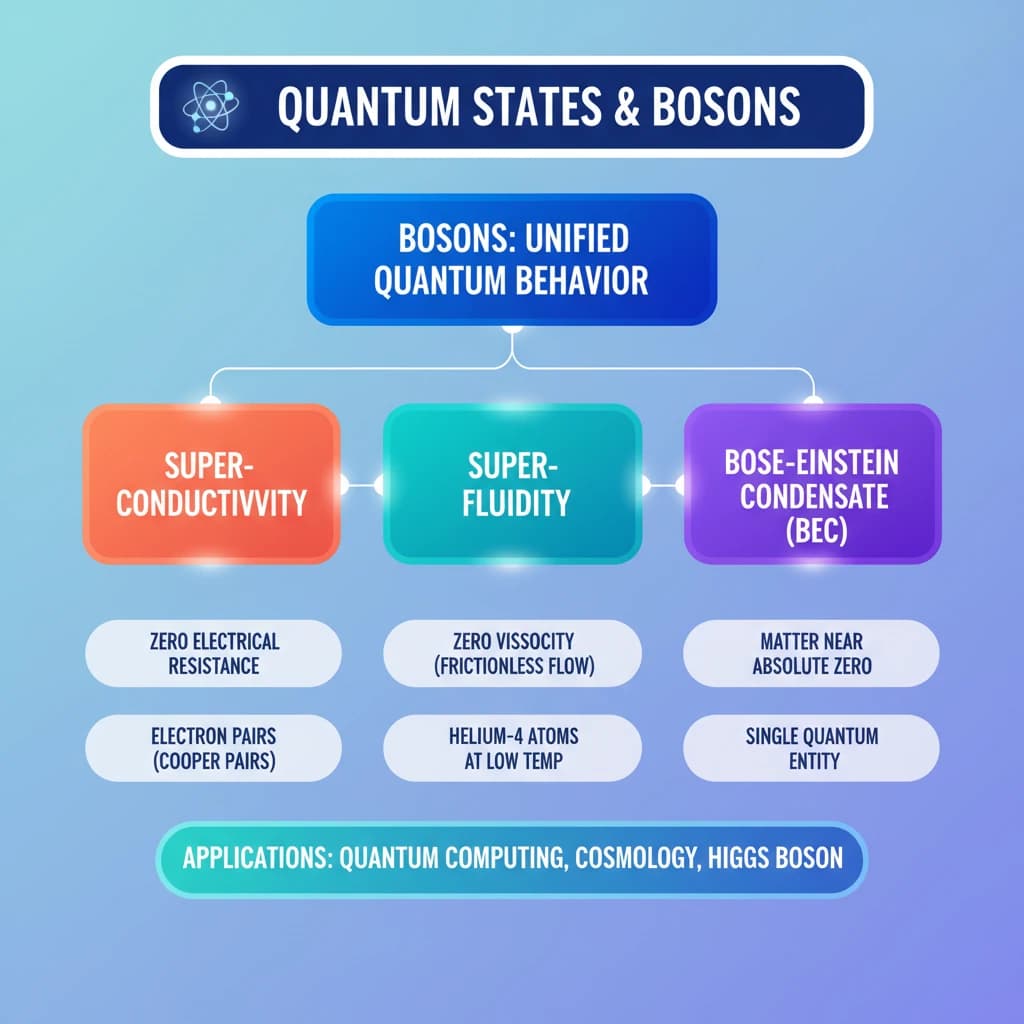
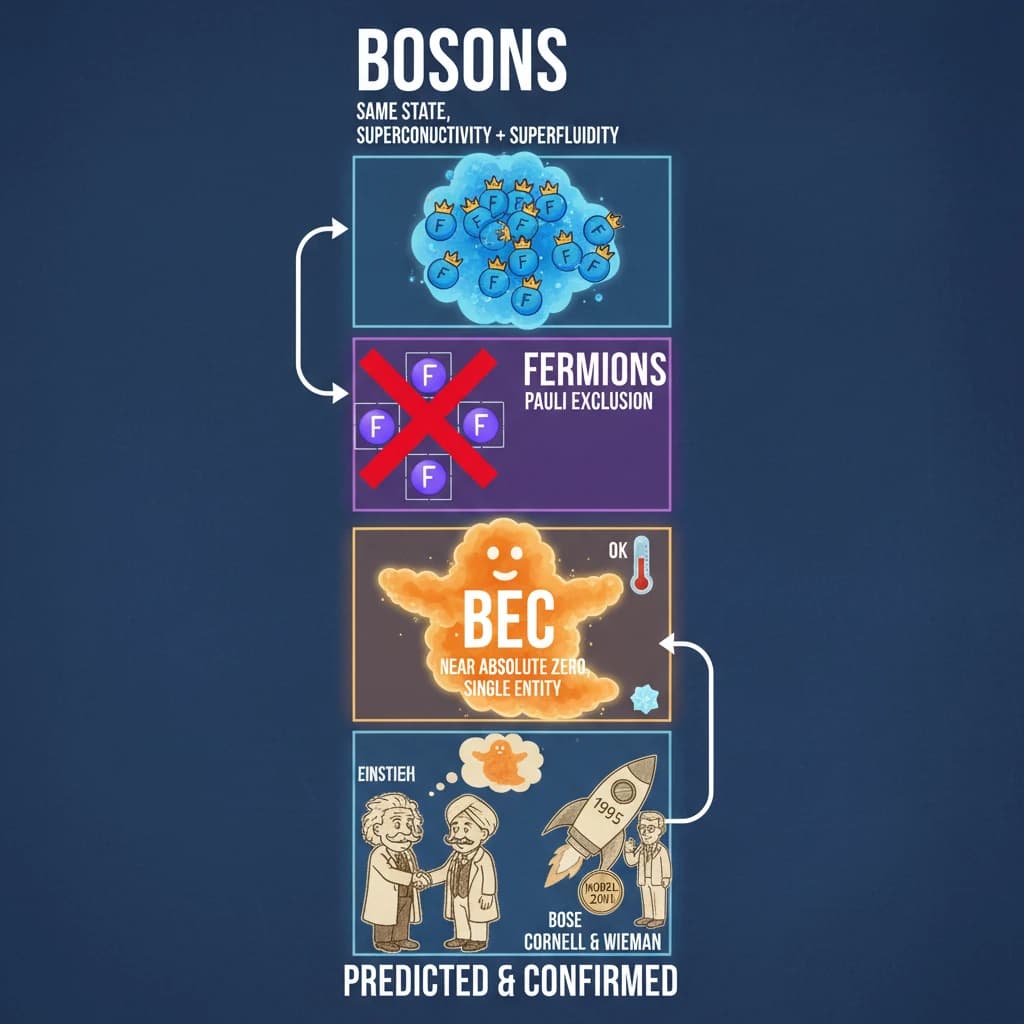
  • Bosons are particles that can occupy the same quantum state, enabling phenomena like superconductivity and superfluidity.
  • Fermions, like electrons, obey the Pauli Exclusion Principle, which governs matter's structure.
  • Bose-Einstein Condensate (BEC) is a unique state of matter formed when bosonic atoms are cooled near absolute zero, behaving as a single quantum entity.
  • BEC was theoretically predicted by Bose and Einstein and experimentally confirmed in 1995 by Cornell and Wieman (Nobel Prize 2001).
  • Bose-Einstein principles are crucial for understanding the Higgs boson, quantum computing, cosmology, and condensed matter science.
  • Satyendra Nath Bose received the Padma Vibhushan (1954) and was India's National Professor (1959) for his foundational contributions.
This property enables phenomena like superconductivity and superfluidity

This property enables phenomena like superconductivity and superfluidity

Medium⏱️ 7 min read✓ 98% Verified
science and technology

📖 Introduction

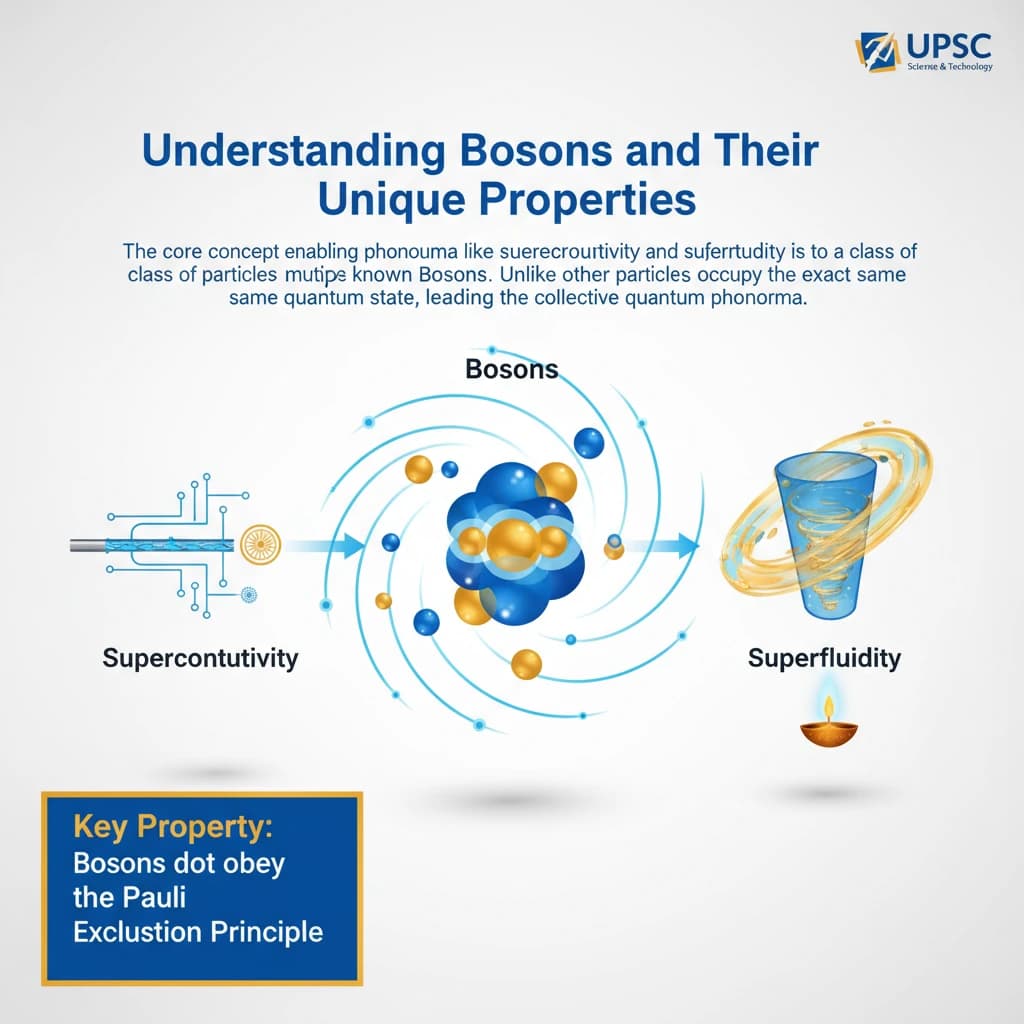
<h4>Understanding Bosons and Their Unique Properties</h4><p>The core concept enabling phenomena like <strong>superconductivity</strong> and <strong>superfluidity</strong> is the behavior of a class of particles known as <strong>Bosons</strong>. Unlike other particles, multiple bosons can occupy the exact same quantum state, leading to collective quantum phenomena.</p><div class='key-point-box'><p><strong>Key Property:</strong> <strong>Bosons</strong> do not obey the <strong>Pauli Exclusion Principle</strong>, allowing them to condense into a single quantum state at very low temperatures. This collective behavior is fundamental to <strong>superconductivity</strong> and <strong>superfluidity</strong>.</p></div><h4>Fermions and the Pauli Exclusion Principle</h4><p>In stark contrast to bosons, <strong>Fermions</strong> are particles that strictly adhere to the <strong>Pauli Exclusion Principle</strong>. This fundamental principle states that no two identical fermions can occupy the same quantum state simultaneously.</p><p>This principle is crucial for understanding the structure of matter, as it governs how electrons arrange themselves in atoms and molecules. Electrons, protons, and neutrons are all examples of <strong>Fermions</strong>.</p><h4>Bose-Einstein Condensate (BEC): A Unique State of Matter</h4><p>The theoretical work of <strong>Satyendra Nath Bose</strong>, later expanded by <strong>Albert Einstein</strong>, predicted the existence of a unique state of matter known as the <strong>Bose-Einstein Condensate (BEC)</strong>. This state forms under extreme conditions.</p><p>A <strong>BEC</strong> is created when a gas of <strong>bosonic atoms</strong> is cooled to temperatures extremely close to <strong>absolute zero</strong> (approximately <strong>-273.15°C</strong> or <strong>0 Kelvin</strong>). At this point, the individual atoms lose their separate identities and merge into a single <strong>quantum entity</strong>.</p><div class='info-box'><p><strong>BEC Formation:</strong> When bosonic atoms are cooled to near <strong>absolute zero</strong>, their wave functions overlap significantly, causing them to behave as a single, coherent <strong>wave-like entity</strong>. This is a macroscopic manifestation of quantum mechanics.</p></div><h4>Experimental Confirmation and Nobel Prize</h4><p>The concept of <strong>Bose-Einstein Condensate</strong> remained a theoretical prediction for many decades. Its experimental confirmation was a monumental achievement in physics.</p><p>In <strong>1995</strong>, physicists <strong>Eric Cornell</strong> and <strong>Carl Wieman</strong> successfully created the first <strong>BEC</strong> using rubidium atoms. This groundbreaking experiment provided empirical evidence for Bose's and Einstein's predictions.</p><div class='info-box'><p><strong>Nobel Recognition:</strong> For their pioneering work in achieving <strong>Bose-Einstein condensation</strong> in dilute alkali gases, <strong>Eric Cornell</strong>, <strong>Carl Wieman</strong>, and <strong>Wolfgang Ketterle</strong> (who achieved it independently shortly after) were awarded the <strong>Nobel Prize in Physics</strong> in <strong>2001</strong>.</p></div><h4>Relevance in Modern Physics</h4><p>The principles laid down by <strong>Satyendra Nath Bose</strong> and the understanding of <strong>Bose-Einstein statistics</strong> continue to have profound relevance across various fields of modern physics.</p><p>Discoveries such as the <strong>Higgs boson</strong>, often referred to as the 'God Particle', are deeply connected to the statistical framework developed by Bose. The <strong>Higgs boson</strong> itself is a boson and plays a crucial role in the Standard Model of particle physics.</p><p>Furthermore, advancements in cutting-edge technologies like <strong>quantum computing</strong> and the study of <strong>condensed matter science</strong> heavily rely on the understanding of bosonic behavior and quantum statistics. These principles also impact theoretical frameworks in <strong>cosmology</strong>.</p><h4>Satyendra Nath Bose: Awards and Honours</h4><p><strong>Satyendra Nath Bose</strong> is widely recognized for his foundational contributions to quantum mechanics, particularly for his work on <strong>Bose-Einstein statistics</strong> and the prediction of the <strong>Bose-Einstein Condensate</strong>.</p><p>He is sometimes referred to as the “<strong>Father of the God Particle</strong>” due to the theoretical connection between his work and the discovery of the <strong>Higgs boson</strong>.</p><div class='info-box'><p><strong>Key Honours:</strong><ul><li><strong>1954:</strong> Awarded the <strong>Padma Vibhushan</strong>, India's second-highest civilian award.</li><li><strong>1959:</strong> Appointed <strong>India’s National Professor</strong>, the highest honour for a scholar in India, a position he held for <strong>15 years</strong>.</li></ul></p></div>
Concept Diagram

💡 Key Takeaways

  • •Bosons are particles that can occupy the same quantum state, enabling phenomena like superconductivity and superfluidity.
  • •Fermions, like electrons, obey the Pauli Exclusion Principle, which governs matter's structure.
  • •Bose-Einstein Condensate (BEC) is a unique state of matter formed when bosonic atoms are cooled near absolute zero, behaving as a single quantum entity.
  • •BEC was theoretically predicted by Bose and Einstein and experimentally confirmed in 1995 by Cornell and Wieman (Nobel Prize 2001).
  • •Bose-Einstein principles are crucial for understanding the Higgs boson, quantum computing, cosmology, and condensed matter science.
  • •Satyendra Nath Bose received the Padma Vibhushan (1954) and was India's National Professor (1959) for his foundational contributions.

🧠 Memory Techniques
Memory Aid
98% Verified Content

📚 Reference Sources

•Nobel Prize official website (for Nobel laureates and their work)
•NCERT Science textbooks (for basic quantum physics concepts)
•Encyclopaedia Britannica (for definitions and historical context)

Related Topics

Loading related topics...
Explore:Science And Technology Topics·All Subjects·Daily Current Affairs·Editorial Analysis·Previous Year Questions·UPSC GPT