Loading page, please wait…
Vaidra Logo
Vaidra

Top 4 items + smart groups

UPSC GPT
New
Current Affairs
Daily Solutions
Daily Puzzle
Mains Evaluator

Version 2.0.0 • Built with ❤️ for UPSC aspirants

Loading...
Loading...
Loading...
Loading...
Loading...
Loading...
Loading...
Loading...
Loading...
Loading...
Loading...
Loading...
Loading...
Water Footprint of AI - UPSC Science And Technology
Back
All Subjects

Topics

0 topics • 0 completed

Loading topics...
Loading...
Loading...
Loading...
Loading...
Loading...
Overall Progress0%

Water Footprint of AI - UPSC Science And Technology

What is Water Footprint of AI in UPSC Science And Technology?

Water Footprint of AI is a key topic under Science And Technology for UPSC Civil Services Examination. Key points include: AI's water footprint is the total water used for electricity and cooling in data centres running AI models.. It comprises direct (cooling) and indirect (electricity production) water consumption.. Factors like AI model size, data centre location, and electricity sources significantly influence the footprint.. Understanding this topic is essential for both UPSC Prelims and Mains preparation.

Why is Water Footprint of AI important for UPSC exam?

Water Footprint of AI is a Medium-level topic in UPSC Science And Technology. It is tested in both Prelims (factual MCQs) and Mains (analytical answer writing). Previous year UPSC questions have frequently covered aspects of Water Footprint of AI, making it essential for comprehensive IAS preparation.

How to prepare Water Footprint of AI for UPSC?

To prepare Water Footprint of AI for UPSC: (1) Study the comprehensive notes covering all key concepts on Vaidra. (2) Practice previous year questions on this topic. (3) Connect it with current affairs using daily updates. (4) Revise using key takeaways and mind maps available for Science And Technology. (5) Write practice answers linking Water Footprint of AI to related GS Paper topics.

Key takeaways of Water Footprint of AI for UPSC

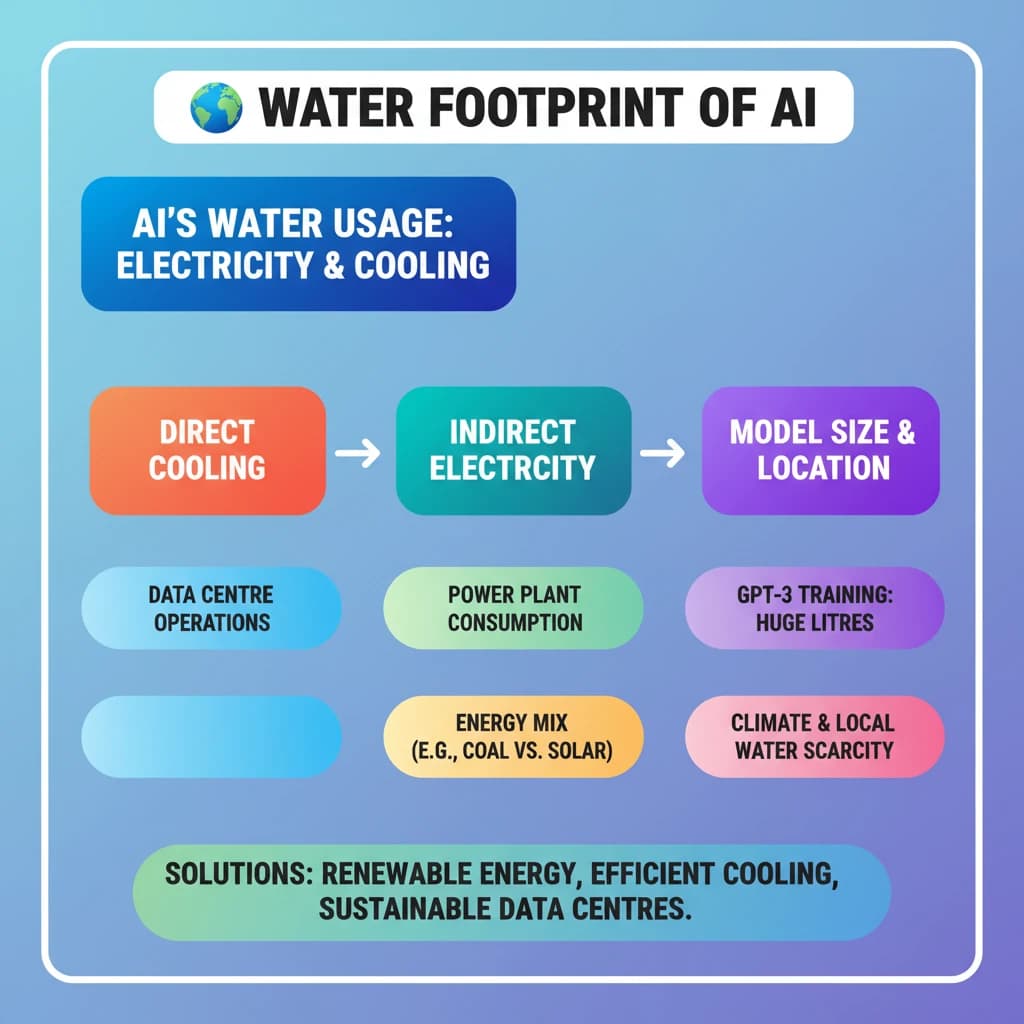
  • AI's water footprint is the total water used for electricity and cooling in data centres running AI models.
  • It comprises direct (cooling) and indirect (electricity production) water consumption.
  • Factors like AI model size, data centre location, and electricity sources significantly influence the footprint.
  • Training a large model like GPT-3 can consume hundreds of thousands of litres of water.
  • Addressing this requires sustainable data centre practices, renewable energy, and water-efficient cooling.
Water Footprint of AI

Water Footprint of AI

Medium⏱️ 7 min read✓ 95% Verified
science and technology

📖 Introduction

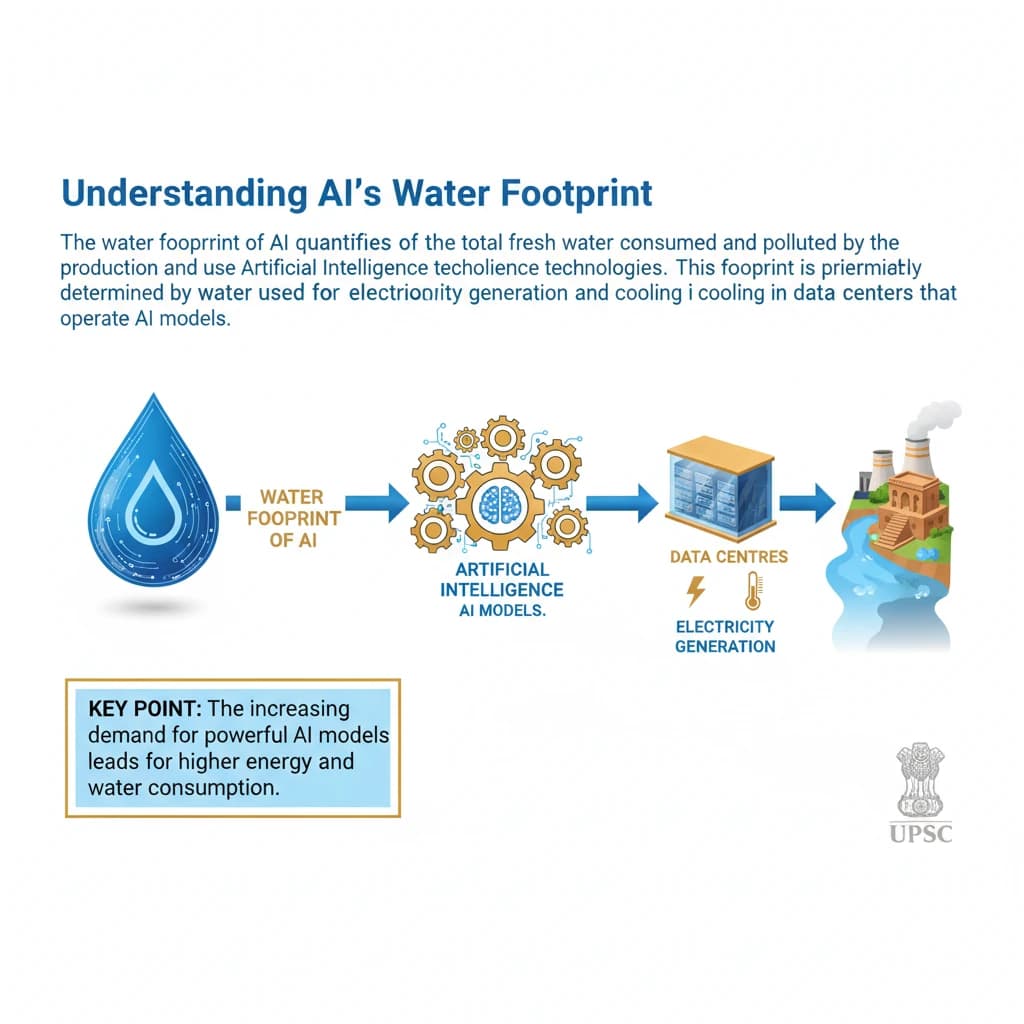
<h4>Understanding AI's Water Footprint</h4><p>The <strong>water footprint of AI</strong> quantifies the total fresh water consumed and polluted by the production and use of <strong>Artificial Intelligence</strong> technologies. This footprint is primarily determined by the water used for <strong>electricity generation</strong> and <strong>cooling</strong> in <strong>data centres</strong> that operate <strong>AI models</strong>.</p><div class='key-point-box'><p>The increasing demand for powerful <strong>AI models</strong> directly translates to a greater demand for energy and, consequently, water.</p></div><h4>Components of AI's Water Footprint</h4><p>The water footprint of <strong>AI</strong> comprises two main categories of water consumption:</p><ul><li><strong>Direct Water Consumption:</strong> This refers to the water directly used in <strong>cooling processes</strong> within <strong>data centres</strong>. Large-scale cooling systems are essential to prevent overheating of servers, often relying on water-intensive methods.</li><li><strong>Indirect Water Consumption:</strong> This accounts for the water used in the production of <strong>electricity</strong> that powers <strong>data centres</strong>. Different energy sources have varying water intensities, with thermal power plants, for example, requiring significant water for cooling.</li></ul><h4>Factors Influencing AI's Water Footprint</h4><p>Several critical factors can significantly impact the overall water footprint of <strong>AI operations</strong>:</p><ul><li><strong>AI Model Type and Size:</strong> Larger and more complex <strong>AI models</strong>, such as advanced <strong>Large Language Models (LLMs)</strong>, require substantially more computational power and, thus, more energy and water for training and operation.</li><li><strong>Data Centre Location:</strong> The geographical location of a <strong>data centre</strong> plays a crucial role. Regions with hotter climates or those relying on water-intensive cooling technologies will have a higher water footprint. Access to renewable energy sources also varies by location.</li><li><strong>Electricity Generation Sources:</strong> The method by which electricity is produced directly influences the indirect water footprint. Power grids heavily reliant on thermal power (e.g., coal, natural gas) will contribute more to water consumption than those powered by renewable sources like solar or wind, which generally have lower operational water requirements.</li></ul><h4>Significant Water Consumption Examples</h4><p>Training advanced <strong>AI models</strong> can lead to staggering amounts of water consumption. These figures highlight the scale of the environmental challenge.</p><div class='info-box'><p>Training a large <strong>AI model</strong> like <strong>GPT-3</strong> can consume up to <strong>700,000 litres of fresh water</strong>. This amount is equivalent to the water needed to produce approximately <strong>370 BMW cars</strong> or <strong>320 Tesla electric vehicles</strong>.</p></div><div class='exam-tip-box'><p><strong>UPSC Insight:</strong> Questions on the environmental impact of emerging technologies are increasingly common in <strong>GS-III (Environment & Technology)</strong>. Understanding the <strong>water footprint of AI</strong> provides a concrete example for such discussions.</p></div>
Concept Diagram

💡 Key Takeaways

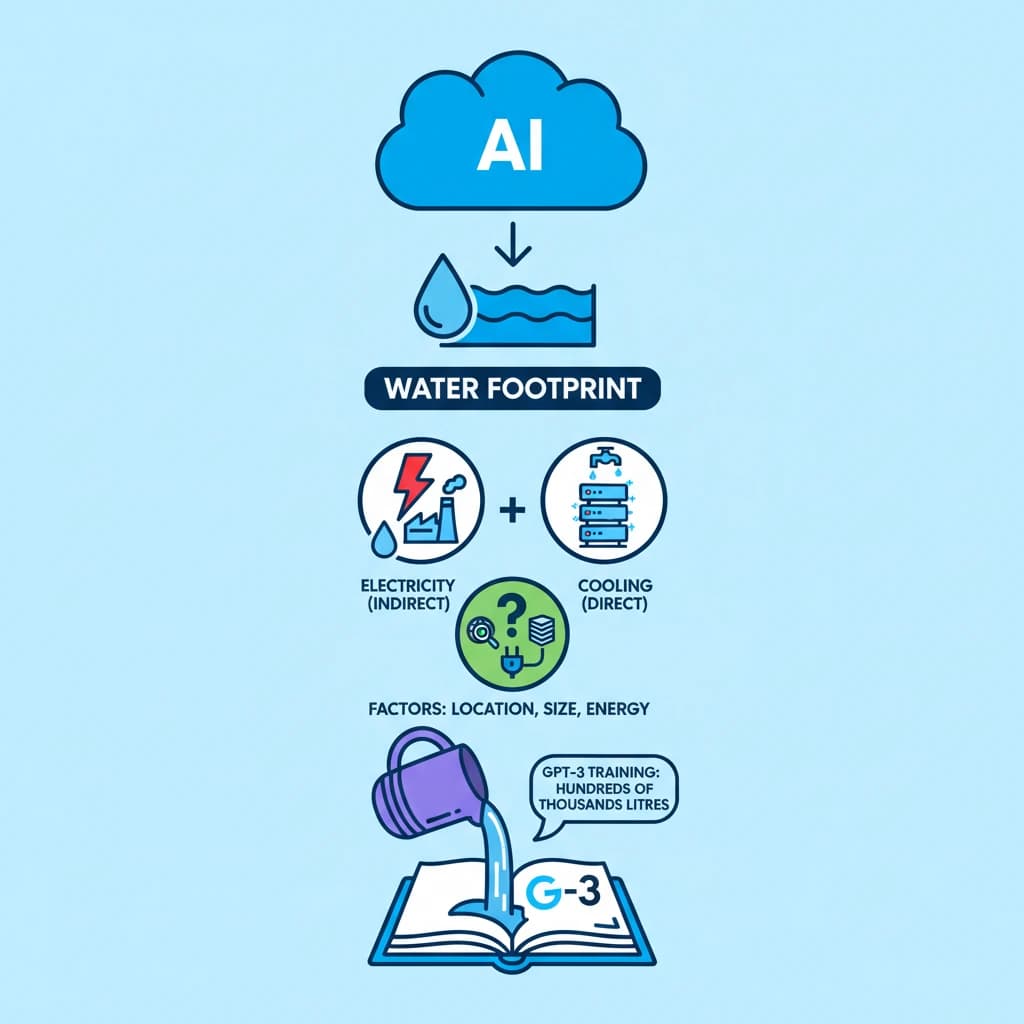
  • •AI's water footprint is the total water used for electricity and cooling in data centres running AI models.
  • •It comprises direct (cooling) and indirect (electricity production) water consumption.
  • •Factors like AI model size, data centre location, and electricity sources significantly influence the footprint.
  • •Training a large model like GPT-3 can consume hundreds of thousands of litres of water.
  • •Addressing this requires sustainable data centre practices, renewable energy, and water-efficient cooling.

🧠 Memory Techniques
Memory Aid
95% Verified Content

📚 Reference Sources

•Academic research on AI's environmental impact (e.g., University of California, Riverside studies on LLM water consumption)
•Reports from major tech companies on data centre sustainability

Related Topics

Loading related topics...
Explore:Science And Technology Topics·All Subjects·Daily Current Affairs·Editorial Analysis·Previous Year Questions·UPSC GPT