Loading page, please wait…
Vaidra Logo
Vaidra

Top 4 items + smart groups

UPSC GPT
New
Current Affairs
Daily Solutions
Daily Puzzle
Mains Evaluator

Version 2.0.0 • Built with ❤️ for UPSC aspirants

Loading...
Loading...
Loading...
Loading...
Loading...
Loading...
Loading...
Loading...
Loading...
Loading...
Loading...
Loading...
Loading...
Back
All Subjects

Topics

0 topics • 0 completed

Loading topics...
Loading...
Loading...
Loading...
Loading...
Loading...
Overall Progress0%

What is Diabetes? - UPSC Science And Technology

What is What is Diabetes? in UPSC Science And Technology?

What is Diabetes? is a key topic under Science And Technology for UPSC Civil Services Examination. Key points include: Diabetes Mellitus (DM) is a disorder of elevated blood sugar (glucose) due to insufficient insulin or abnormal insulin response.. Insulin is a hormone produced by the pancreas, crucial for glucose uptake by cells.. Fasting blood glucose levels define normal (70-110 mg/dL), prediabetes (100-125 mg/dL), and diabetes (≥126 mg/dL).. Understanding this topic is essential for both UPSC Prelims and Mains preparation.

Why is What is Diabetes? important for UPSC exam?

What is Diabetes? is a Easy-level topic in UPSC Science And Technology. It is tested in both Prelims (factual MCQs) and Mains (analytical answer writing). Previous year UPSC questions have frequently covered aspects of What is Diabetes?, making it essential for comprehensive IAS preparation.

How to prepare What is Diabetes? for UPSC?

To prepare What is Diabetes? for UPSC: (1) Study the comprehensive notes covering all key concepts on Vaidra. (2) Practice previous year questions on this topic. (3) Connect it with current affairs using daily updates. (4) Revise using key takeaways and mind maps available for Science And Technology. (5) Write practice answers linking What is Diabetes? to related GS Paper topics.

Key takeaways of What is Diabetes? for UPSC

  • Diabetes Mellitus (DM) is a disorder of elevated blood sugar (glucose) due to insufficient insulin or abnormal insulin response.
  • Insulin is a hormone produced by the pancreas, crucial for glucose uptake by cells.
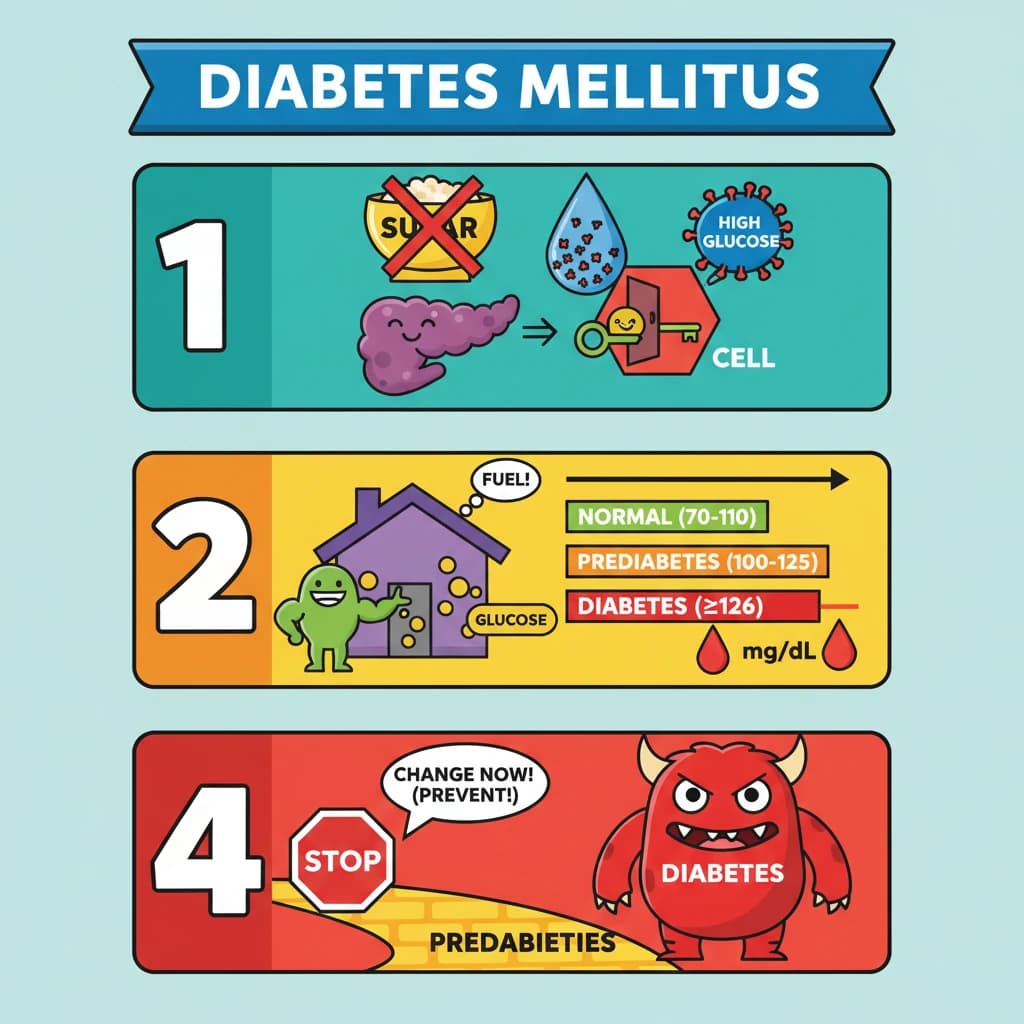
  • Fasting blood glucose levels define normal (70-110 mg/dL), prediabetes (100-125 mg/dL), and diabetes (≥126 mg/dL).
  • Prediabetes is a critical stage indicating a high risk of developing full diabetes.
  • Diabetes is a major global health challenge, linked to lifestyle, requiring effective management and public health interventions.
What is Diabetes?

What is Diabetes?

Easy⏱️ 8 min read✓ 95% Verified
science and technology

📖 Introduction

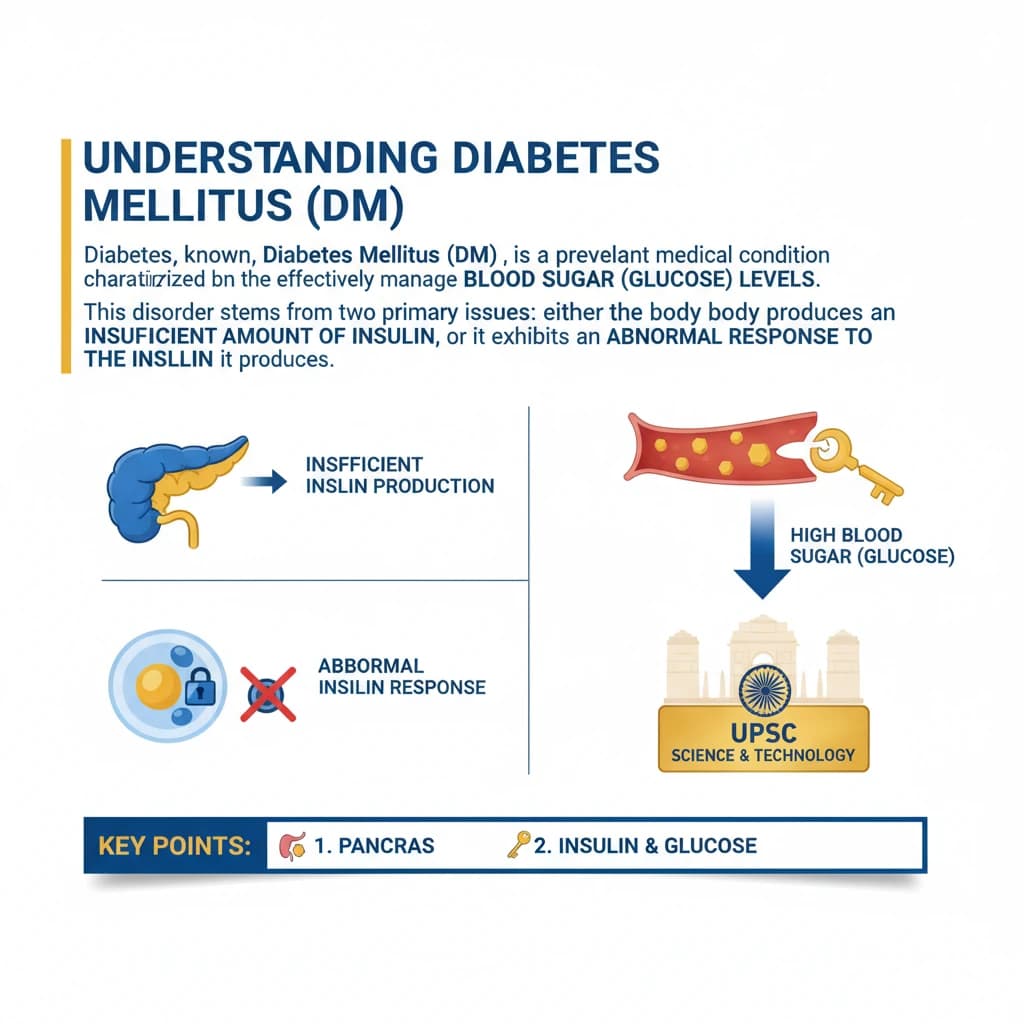
<h4>Understanding Diabetes Mellitus (DM)</h4><p><strong>Diabetes</strong>, also known as <strong>Diabetes Mellitus (DM)</strong>, is a prevalent medical condition characterized by the body's inability to effectively manage <strong>blood sugar (glucose) levels</strong>.</p><p>This disorder stems from two primary issues: either the body produces an <strong>insufficient amount of insulin</strong>, or it exhibits an <strong>abnormal response to the insulin</strong> it produces.</p><div class='key-point-box'><p>The core problem in <strong>Diabetes Mellitus</strong> is the dysregulation of <strong>blood glucose</strong>, leading to persistently high levels in the bloodstream. <strong>Insulin</strong> is the crucial hormone responsible for allowing glucose to enter cells for energy.</p></div><h4>Blood Glucose Level Classifications</h4><p>To diagnose and categorize an individual's glucose metabolism, specific <strong>blood glucose level</strong> thresholds are used, particularly for <strong>fasting blood glucose</strong> measurements.</p><p>These levels help differentiate between a normal state, a pre-diabetic condition, and confirmed diabetes.</p><div class='info-box'><ul><li><strong>Normal Fasting Blood Glucose:</strong> Levels between <strong>70–110 mg/dL</strong> are considered healthy.</li><li><strong>Prediabetes:</strong> Blood glucose levels ranging from <strong>100 mg/dL to 125 mg/dL</strong> indicate prediabetes, a warning stage.</li><li><strong>Diabetes:</strong> A fasting blood glucose level of <strong>126 mg/dL or higher</strong> is officially diagnosed as diabetes.</li></ul></div><div class='exam-tip-box'><p>For <strong>UPSC Prelims</strong>, remember the exact numerical ranges for <strong>normal</strong>, <strong>prediabetes</strong>, and <strong>diabetes</strong>. For <strong>UPSC Mains</strong>, understand the underlying mechanisms of <strong>insulin insufficiency</strong> and <strong>abnormal insulin response</strong>.</p></div>
Concept Diagram

💡 Key Takeaways

  • •Diabetes Mellitus (DM) is a disorder of elevated blood sugar (glucose) due to insufficient insulin or abnormal insulin response.
  • •Insulin is a hormone produced by the pancreas, crucial for glucose uptake by cells.
  • •Fasting blood glucose levels define normal (70-110 mg/dL), prediabetes (100-125 mg/dL), and diabetes (≥126 mg/dL).
  • •Prediabetes is a critical stage indicating a high risk of developing full diabetes.
  • •Diabetes is a major global health challenge, linked to lifestyle, requiring effective management and public health interventions.

🧠 Memory Techniques
Memory Aid
95% Verified Content

📚 Reference Sources

•World Health Organization (WHO) Guidelines on Diabetes
•Indian Council of Medical Research (ICMR) Data

Related Topics

Loading related topics...
Explore:Science And Technology Topics·All Subjects·Daily Current Affairs·Editorial Analysis·Previous Year Questions·UPSC GPT
What is Diabetes? - UPSC Science And Technology