Loading page, please wait…
Vaidra Logo
Vaidra

Top 4 items + smart groups

UPSC GPT
New
Current Affairs
Daily Solutions
Daily Puzzle
Mains Evaluator

Version 2.0.0 • Built with ❤️ for UPSC aspirants

Loading...
Loading...
Loading...
Loading...
Loading...
Loading...
Loading...
Loading...
Loading...
Loading...
Loading...
Loading...
Loading...
What are the Contributions of Dr. APJ Abdul Kalam to DRDO? - UPSC Science And Technology
Back
All Subjects

Topics

0 topics • 0 completed

Loading topics...
Loading...
Loading...
Loading...
Loading...
Loading...
Overall Progress0%

What are the Contributions of Dr. APJ Abdul Kalam to DRDO? - UPSC Science And Technology

What is What are the Contributions of Dr. APJ Abdul Kalam to DRDO? in UPSC Science And Technology?

What are the Contributions of Dr. APJ Abdul Kalam to DRDO? is a key topic under Science And Technology for UPSC Civil Services Examination. Key points include: Dr. APJ Abdul Kalam, the 'Missile Man of India', spearheaded the Integrated Guided Missile Development Program (IGMDP) at DRDO.. IGMDP, launched in 1983, led to the successful indigenous development of Prithvi, Trishul, Akash, Nag, and Agni missiles.. The program fostered self-reliance in critical missile technologies like propulsion, navigation, and control systems, reducing foreign dependency.. Understanding this topic is essential for both UPSC Prelims and Mains preparation.

Why is What are the Contributions of Dr. APJ Abdul Kalam to DRDO? important for UPSC exam?

What are the Contributions of Dr. APJ Abdul Kalam to DRDO? is a Easy-level topic in UPSC Science And Technology. It is tested in both Prelims (factual MCQs) and Mains (analytical answer writing). Previous year UPSC questions have frequently covered aspects of What are the Contributions of Dr. APJ Abdul Kalam to DRDO?, making it essential for comprehensive IAS preparation.

How to prepare What are the Contributions of Dr. APJ Abdul Kalam to DRDO? for UPSC?

To prepare What are the Contributions of Dr. APJ Abdul Kalam to DRDO? for UPSC: (1) Study the comprehensive notes covering all key concepts on Vaidra. (2) Practice previous year questions on this topic. (3) Connect it with current affairs using daily updates. (4) Revise using key takeaways and mind maps available for Science And Technology. (5) Write practice answers linking What are the Contributions of Dr. APJ Abdul Kalam to DRDO? to related GS Paper topics.

Key takeaways of What are the Contributions of Dr. APJ Abdul Kalam to DRDO? for UPSC

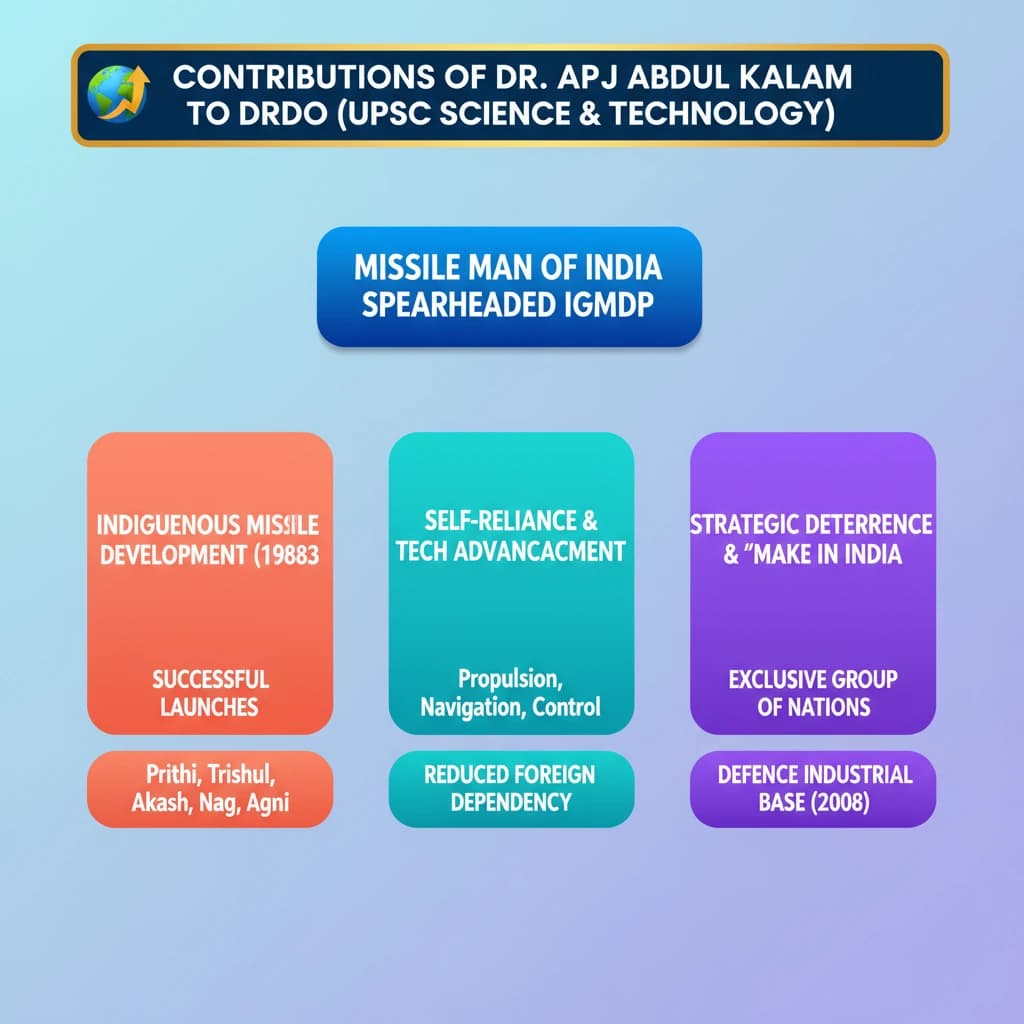
  • Dr. APJ Abdul Kalam, the 'Missile Man of India', spearheaded the Integrated Guided Missile Development Program (IGMDP) at DRDO.
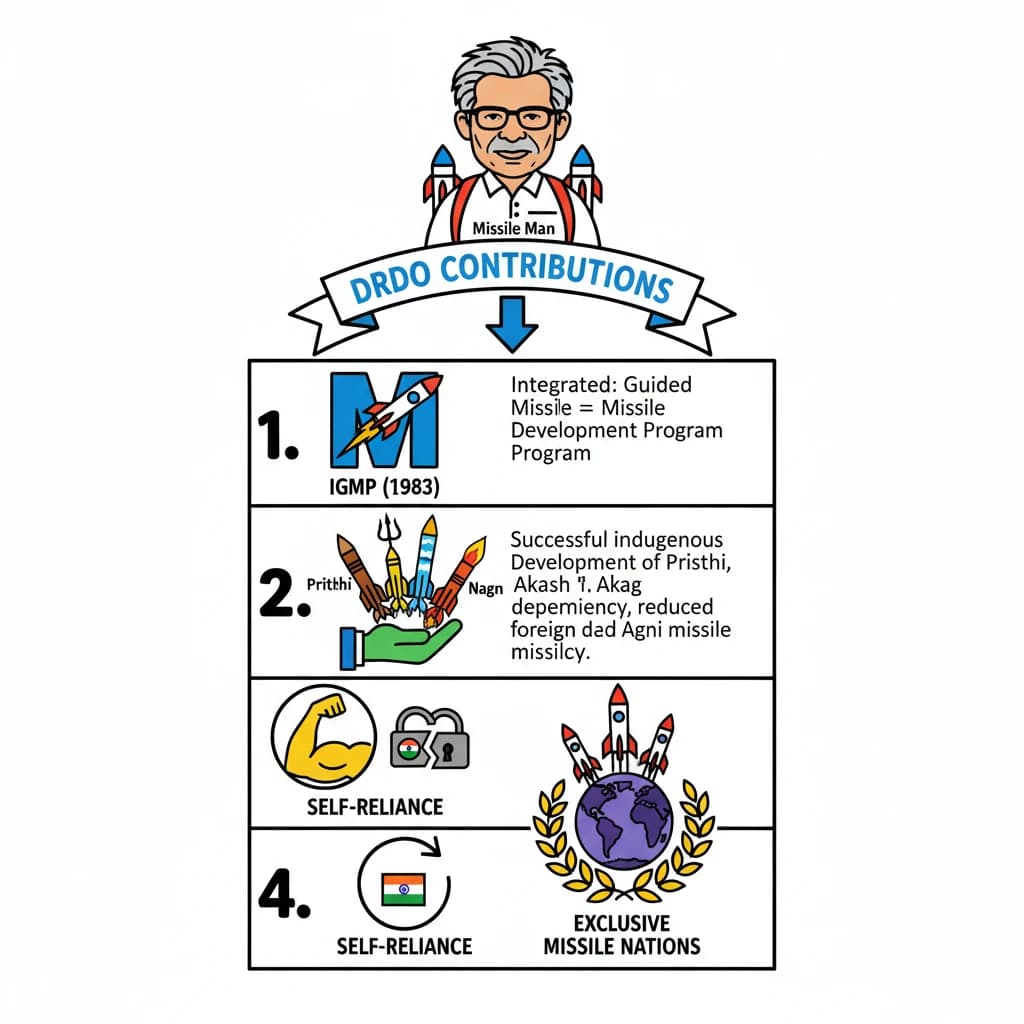
  • IGMDP, launched in 1983, led to the successful indigenous development of Prithvi, Trishul, Akash, Nag, and Agni missiles.
  • The program fostered self-reliance in critical missile technologies like propulsion, navigation, and control systems, reducing foreign dependency.
  • India joined an exclusive group of missile-producing nations due to IGMDP's success.
  • IGMDP, concluded in 2008, strengthened India's strategic deterrence and contributed to the defence industrial base, aligning with 'Make in India'.
What are the Contributions of Dr. APJ Abdul Kalam to DRDO?

What are the Contributions of Dr. APJ Abdul Kalam to DRDO?

Easy⏱️ 5 min read✓ 98% Verified
science and technology

📖 Introduction

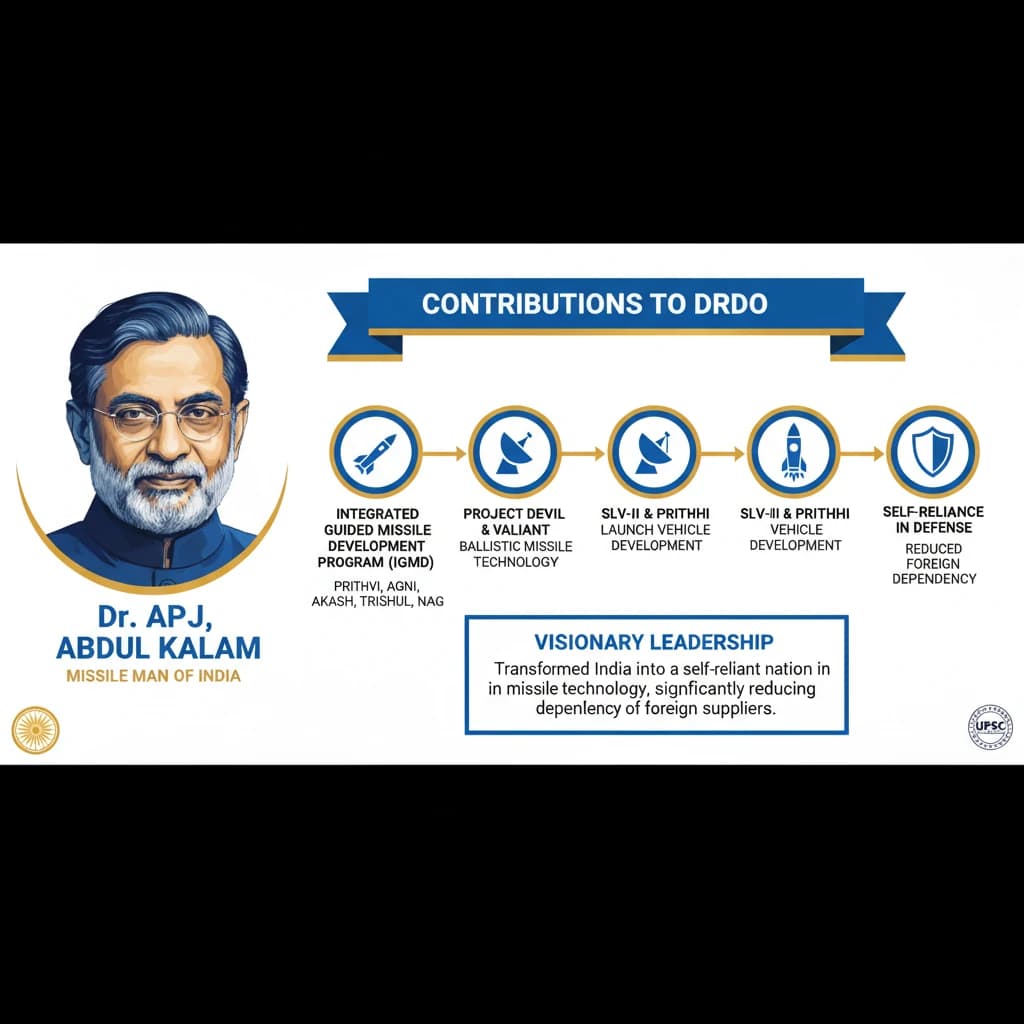
<h4>Introduction to Dr. APJ Abdul Kalam's Contributions to DRDO</h4><p><strong>Dr. APJ Abdul Kalam</strong>, widely revered as the <strong>'Missile Man of India'</strong>, played a pivotal role in strengthening India's defense capabilities through his work at the <strong>Defence Research and Development Organisation (DRDO)</strong>.</p><p>His visionary leadership transformed India into a self-reliant nation in missile technology, significantly reducing dependency on foreign suppliers.</p><h4>Leadership in Integrated Guided Missile Development Program (IGMDP)</h4><p><strong>Dr. Kalam</strong> was the driving force behind the conception and successful execution of the <strong>Integrated Guided Missile Development Program (IGMDP)</strong>.</p><div class='info-box'><p>The <strong>IGMDP</strong> was launched in <strong>1983</strong> with the ambitious goal of achieving self-sufficiency in missile technology.</p></div><p>Under his guidance, the program achieved significant milestones, laying the foundation for India's indigenous missile systems.</p><h4>Key Missile Systems Developed under IGMDP</h4><p>The <strong>IGMDP</strong>, under <strong>Dr. Kalam's</strong> leadership, led to the development of several critical missile systems that became the backbone of India's strategic defense.</p><ul><li><strong>Prithvi</strong>: India's first indigenously developed ballistic missile.</li><li><strong>Trishul</strong>: A short-range surface-to-air missile.</li><li><strong>Akash</strong>: A medium-range surface-to-air missile system.</li><li><strong>Nag</strong>: An anti-tank guided missile, also known as "Prospina".</li><li><strong>Agni</strong>: A family of intermediate-range ballistic missiles, crucial for strategic deterrence.</li></ul><div class='key-point-box'><p>The successful development of these missiles placed <strong>India</strong> in an exclusive group of missile-producing nations globally, earning <strong>Dr. Kalam</strong> the title of <strong>'Missile Man of India'</strong>.</p></div><h4>Technological Breakthroughs and Self-Reliance</h4><p><strong>Dr. Kalam's</strong> tenure at <strong>DRDO</strong> marked a period of intense innovation and technological advancement.</p><p>Breakthroughs were achieved in several critical areas of missile technology, fostering indigenous expertise.</p><ul><li><strong>Propulsion Systems</strong>: Development of advanced rocket engines.</li><li><strong>Navigation Systems</strong>: Precision guidance and control mechanisms.</li><li><strong>Control Systems</strong>: Ensuring accurate trajectory and target engagement.</li><li><strong>Aerodynamics</strong>: Optimized missile designs for enhanced performance.</li></ul><p>These advancements were instrumental in building <strong>indigenous missile systems</strong> and significantly <strong>reducing India's dependency on foreign supplies</strong> for defense hardware.</p><h4>Conclusion of IGMDP and its Enduring Legacy</h4><p>The <strong>Integrated Guided Missile Development Program (IGMDP)</strong> officially concluded in <strong>2008</strong>.</p><p>Its impact extended beyond just missile development, providing significant technological spin-offs and strengthening India's overall defense capabilities.</p><div class='exam-tip-box'><p>The success of <strong>IGMDP</strong> is often cited as a prime example of India's commitment to <strong>strategic deterrence</strong> and its journey towards self-reliance, aligning with initiatives like <strong>'Make in India'</strong> in the defense sector.</p></div>
Concept Diagram

💡 Key Takeaways

  • •Dr. APJ Abdul Kalam, the 'Missile Man of India', spearheaded the Integrated Guided Missile Development Program (IGMDP) at DRDO.
  • •IGMDP, launched in 1983, led to the successful indigenous development of Prithvi, Trishul, Akash, Nag, and Agni missiles.
  • •The program fostered self-reliance in critical missile technologies like propulsion, navigation, and control systems, reducing foreign dependency.
  • •India joined an exclusive group of missile-producing nations due to IGMDP's success.
  • •IGMDP, concluded in 2008, strengthened India's strategic deterrence and contributed to the defence industrial base, aligning with 'Make in India'.

🧠 Memory Techniques
Memory Aid
98% Verified Content

Related Topics

Loading related topics...
Explore:Science And Technology Topics·All Subjects·Daily Current Affairs·Editorial Analysis·Previous Year Questions·UPSC GPT