📖 Introduction
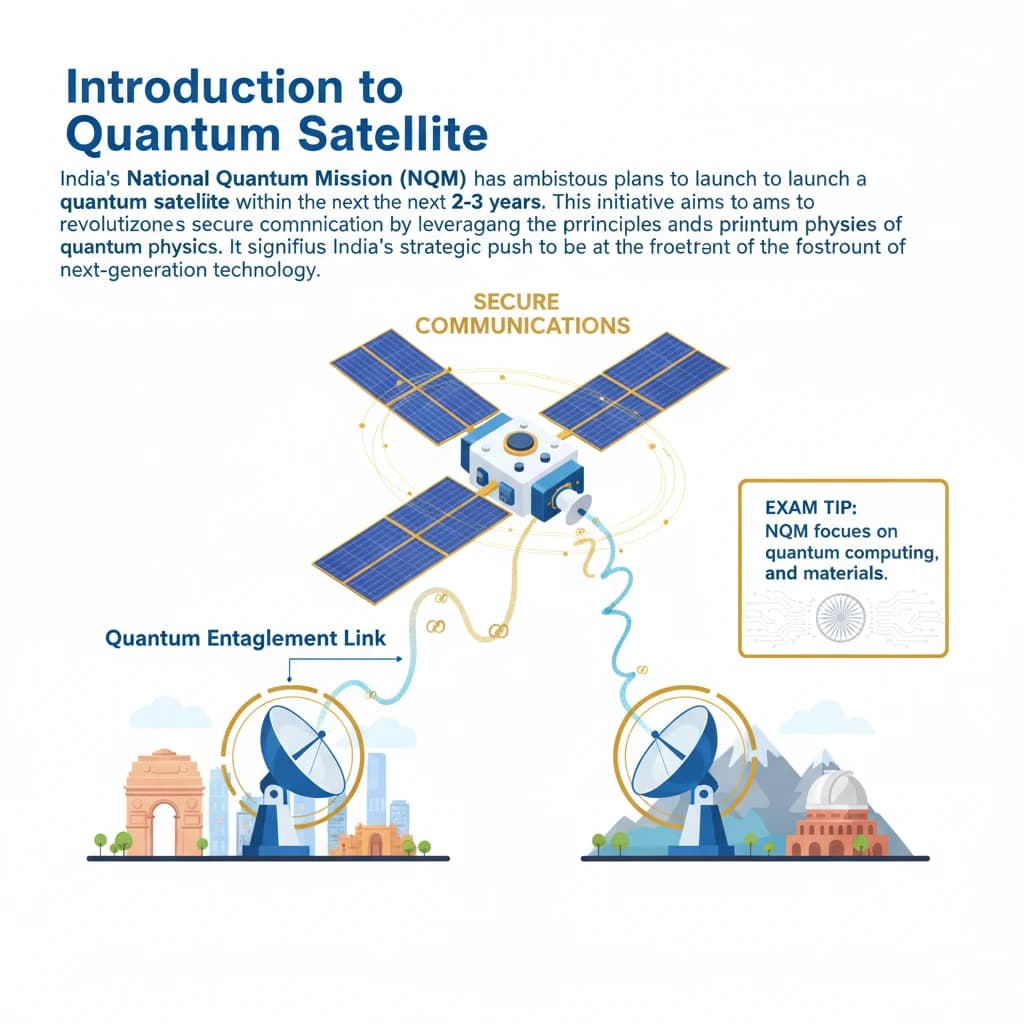
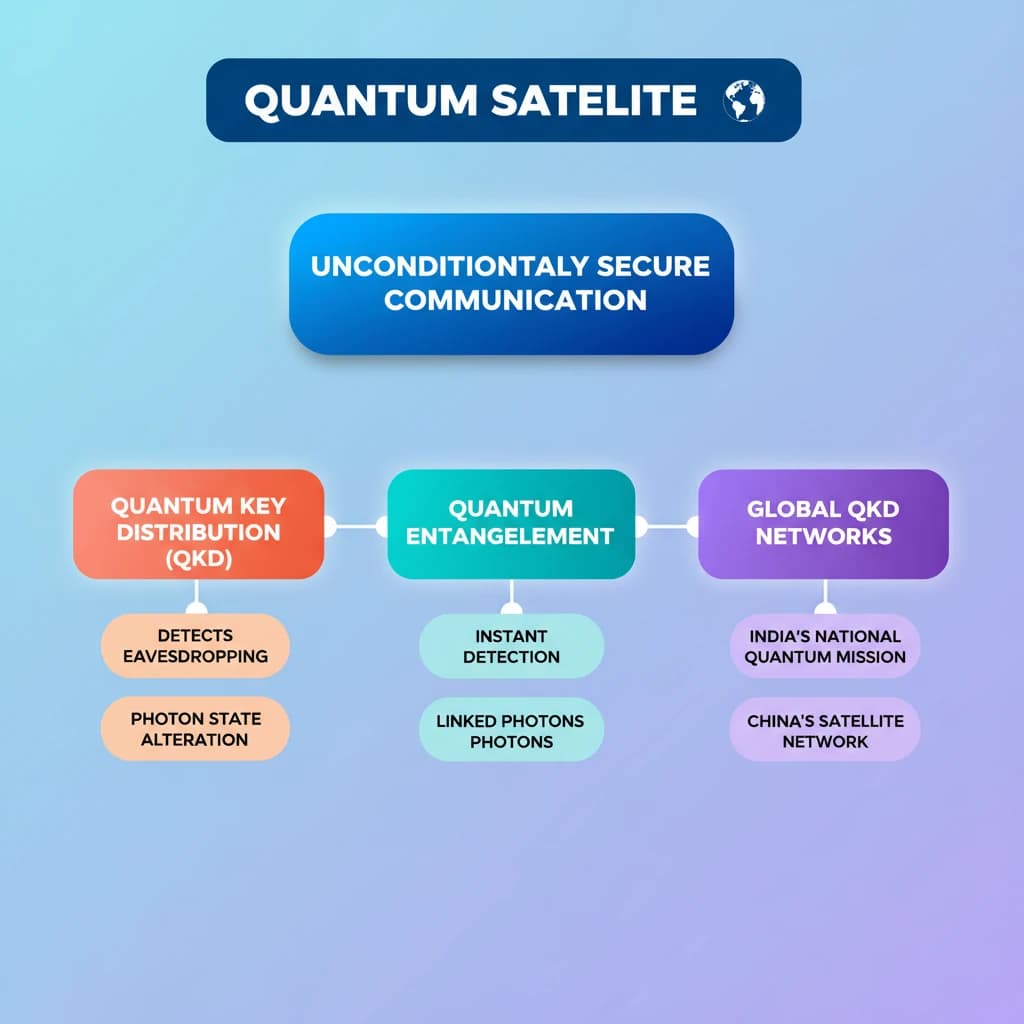
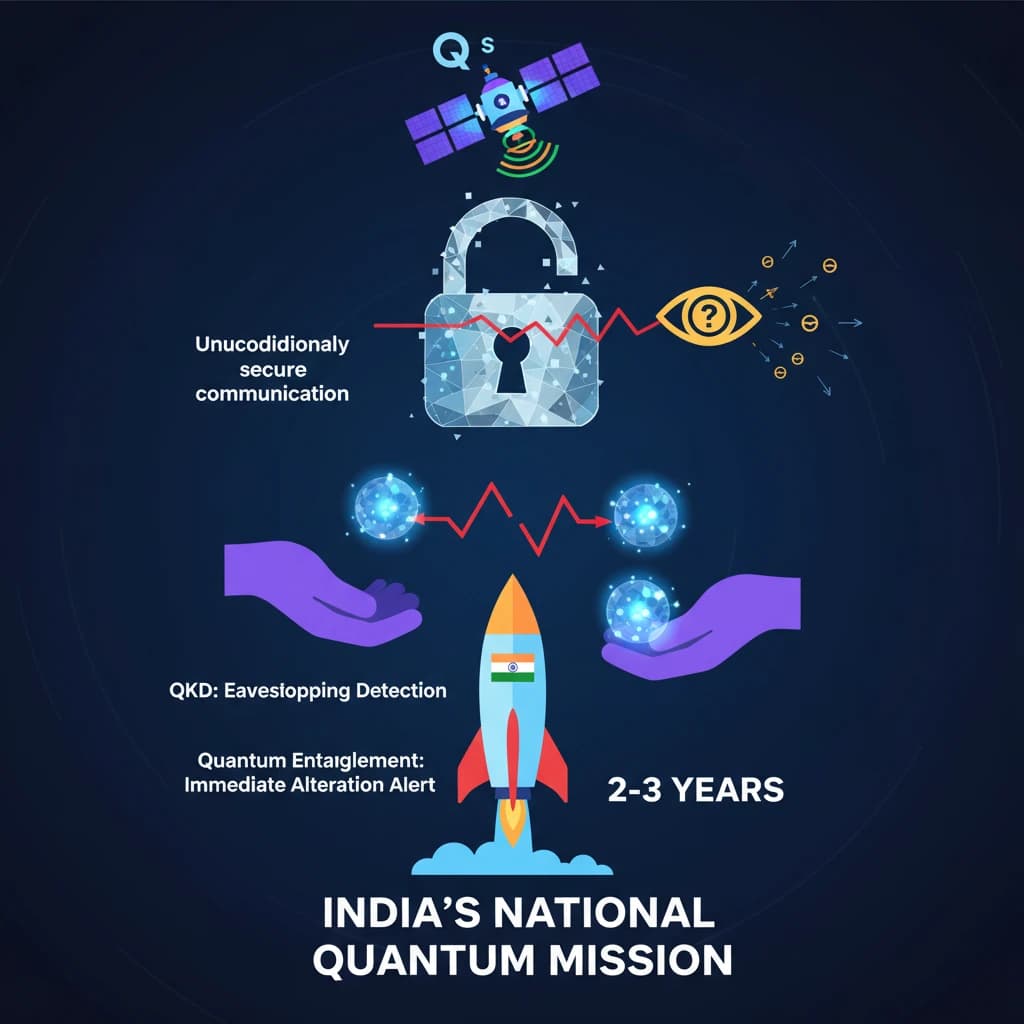
<h4>Introduction to Quantum Satellite</h4><p>India's <strong>National Quantum Mission (NQM)</strong> has ambitious plans to launch a <strong>quantum satellite</strong> within the next <strong>2-3 years</strong>. This initiative aims to revolutionize <strong>secure communications</strong> by leveraging the principles of <strong>quantum physics</strong>. It signifies India's strategic push to be at the forefront of <strong>next-generation technology</strong>.</p><div class='exam-tip-box'><p><strong>UPSC Relevance:</strong> The <strong>National Quantum Mission</strong> and India's advancements in <strong>quantum technology</strong> are crucial for <strong>GS-3 Science & Technology</strong>, particularly under 'Developments and their Applications and Effects in Everyday Life'.</p></div><h4>What is a Quantum Satellite?</h4><p>A <strong>quantum satellite</strong> is a specialized communications satellite that employs <strong>quantum physics</strong> to secure its signals. This inherent security makes it exceptionally resistant to traditional interception methods.</p><div class='info-box'><p><strong>Definition:</strong> A <strong>quantum satellite</strong> uses <strong>quantum cryptography</strong>, specifically <strong>Quantum Key Distribution (QKD)</strong>, to encrypt and transmit data, ensuring unparalleled security against eavesdropping.</p></div><h4>Understanding Quantum Cryptography</h4><p><strong>Quantum cryptography</strong> is a method that utilizes the principles of <strong>quantum mechanics</strong> to encrypt and transmit data. Its primary application is in securing communication channels.</p><h5>Classical Encryption vs. Quantum Encryption</h5><p><strong>Classical encryption methods</strong>, such as the well-known <strong>Caesar cipher</strong>, encode messages using a secret code. Without the correct key, it is theoretically difficult for eavesdroppers to decipher the message.</p><div class='key-point-box'><p>However, <strong>classical encryption</strong> is vulnerable to advanced computational power. <strong>Quantum computers</strong>, with their immense processing capabilities, could potentially crack these codes much faster than even the most powerful traditional supercomputers.</p></div><p><strong>Quantum encryption</strong>, in contrast, uses <strong>Quantum Key Distribution (QKD)</strong> to establish an unconditionally secure key for messages. This method fundamentally changes how security is maintained.</p><h5>Quantum Measurement and Eavesdropping Detection</h5><p>In <strong>quantum mechanics</strong>, the act of <strong>measuring a quantum system</strong>, such as a <strong>photon</strong> (a tiny particle of light), inherently changes its state. This principle is central to QKD's security.</p><div class='info-box'><p>If an <strong>eavesdropper</strong> attempts to measure the <strong>photons</strong> carrying a <strong>quantum key</strong>, this interference will inevitably alter the state of those photons. The legitimate communicating parties will immediately detect this alteration, signaling that the key has been compromised.</p></div><h5>Role of Quantum Entanglement</h5><p>Additionally, <strong>quantum entanglement</strong> plays a crucial role. This phenomenon ensures that two entangled particles remain connected, meaning any change to one <strong>photon</strong> instantly affects its entangled partner.</p><div class='key-point-box'><p>This interconnectedness makes it impossible for an <strong>eavesdropper</strong> to alter the information carried by entangled photons without immediate detection by the communicating parties. Consequently, <strong>QKD</strong> offers '<strong>unconditional security</strong>' by making any interception detectable.</p></div><h4>Global Developments in Quantum Key Distribution (QKD)</h4><p>Globally, several nations are advancing in <strong>quantum communication</strong>. <strong>China</strong> currently leads with the world's largest <strong>QKD network</strong>.</p><div class='info-box'><p><strong>China's QKD Network:</strong> This extensive network includes <strong>three quantum satellites</strong> and approximately <strong>700 ground stations</strong>, demonstrating significant operational capability.</p></div><p><strong>India</strong> is also making substantial progress in its <strong>quantum communications experiments</strong>. There are concrete plans for developing a <strong>satellite-based QKD network</strong>.</p><div class='info-box'><p><strong>Indian Research:</strong> Studies conducted by the <strong>Raman Research Institute, Bengaluru</strong>, suggest that the <strong>Indian Astronomical Observatory in Hanle, Ladakh</strong>, offers ideal environmental conditions for establishing such a system.</p></div><p>The <strong>Indian Space Research Organisation (ISRO)</strong> has already achieved a significant milestone by successfully demonstrating <strong>free-space Quantum Communication</strong> over a distance of <strong>300 meters</strong>.</p><p>The <strong>United Nations (UN)</strong> has recognized the growing importance of <strong>quantum science</strong> by designating the year <strong>2025</strong> as the '<strong>International Year of Quantum Science and Technology</strong>'. This initiative aims to increase public awareness of quantum science and its diverse applications.