Loading page, please wait…
Vaidra Logo
Vaidra

Top 4 items + smart groups

UPSC GPT
New
Current Affairs
Daily Solutions
Daily Puzzle
Mains Evaluator

Version 2.0.0 • Built with ❤️ for UPSC aspirants

Loading...
Loading...
Loading...
Loading...
Loading...
Loading...
Loading...
Loading...
Loading...
Loading...
Loading...
Loading...
Loading...
Back
All Subjects

Topics

0 topics • 0 completed

Loading topics...
Loading...
Loading...
Loading...
Loading...
Loading...
Overall Progress0%

What We Lose With Age - UPSC Science And Technology

What is What We Lose With Age in UPSC Science And Technology?

What We Lose With Age is a key topic under Science And Technology for UPSC Civil Services Examination. Key points include: Cellular senescence (Hayflick Limit) dictates how many times cells divide, influencing species lifespan.. Telomeres are protective DNA caps on chromosomes that shorten with each cell division.. Critical telomere shortening signals cells to stop dividing, contributing to aging.. Understanding this topic is essential for both UPSC Prelims and Mains preparation.

Why is What We Lose With Age important for UPSC exam?

What We Lose With Age is a Medium-level topic in UPSC Science And Technology. It is tested in both Prelims (factual MCQs) and Mains (analytical answer writing). Previous year UPSC questions have frequently covered aspects of What We Lose With Age, making it essential for comprehensive IAS preparation.

How to prepare What We Lose With Age for UPSC?

To prepare What We Lose With Age for UPSC: (1) Study the comprehensive notes covering all key concepts on Vaidra. (2) Practice previous year questions on this topic. (3) Connect it with current affairs using daily updates. (4) Revise using key takeaways and mind maps available for Science And Technology. (5) Write practice answers linking What We Lose With Age to related GS Paper topics.

Key takeaways of What We Lose With Age for UPSC

  • Cellular senescence (Hayflick Limit) dictates how many times cells divide, influencing species lifespan.
  • Telomeres are protective DNA caps on chromosomes that shorten with each cell division.
  • Critical telomere shortening signals cells to stop dividing, contributing to aging.
  • Telomerase is an enzyme that can rebuild telomeres, active in cancer cells allowing indefinite division.
  • While telomerase holds anti-aging potential, its link to cancer complicates therapeutic application.
What We Lose With Age

What We Lose With Age

Medium⏱️ 4 min read✓ 95% Verified
science and technology

📖 Introduction

<h4>Introduction to Cellular Senescence and Lifespan</h4><p>The concept of <strong>cellular senescence</strong>, or the irreversible cessation of cell division, plays a crucial role in understanding the aging process across different species. This natural biological limit influences an organism's overall lifespan.</p><div class='info-box'><p>For instance, cells from <strong>Galapagos turtles</strong>, renowned for their longevity, can divide approximately <strong>110 times</strong> before reaching senescence. This correlates with their remarkable lifespan of over <strong>200 years</strong>.</p><p>In stark contrast, cells from typical <strong>laboratory mice</strong> become senescent after only about <strong>15 divisions</strong>. This significantly lower number aligns with their much shorter lifespans.</p></div><h4>The Role of Telomeres in Cell Division</h4><p>Further scientific investigations in the <strong>1970s</strong> led to a significant discovery: <strong>telomeres</strong>. These are specialized, repetitive sequences of <strong>Deoxyribonucleic acid (DNA)</strong> found at the very ends of <strong>chromosomes</strong>.</p><div class='key-point-box'><p>The primary function of <strong>telomeres</strong> is to protect the genetic information contained within <strong>chromosomes</strong> during the process of <strong>cell division</strong>. They act like caps, preventing the loss of vital DNA sequences.</p></div><p>However, with each successive round of <strong>cell division</strong>, <strong>telomeres</strong> progressively become shorter. This shortening continues until they reach a <strong>critical length</strong>, which then signals the cell to stop dividing.</p><p>This mechanism of <strong>telomere shortening</strong> is widely understood to be a significant contributor to the phenomenon of <strong>ageing</strong> and the eventual decline of cellular function.</p><h4>Telomere Length: A Complex Indicator of Lifespan</h4><p>While a clear link exists between <strong>telomere shortening</strong> and the process of <strong>ageing</strong>, the precise correlation between an organism's initial <strong>telomere length</strong> and its ultimate <strong>lifespan</strong> is not straightforward or absolute.</p><div class='info-box'><p>A notable example is the comparison between humans and mice. Despite having significantly longer <strong>telomeres</strong> than humans, <strong>mice</strong> exhibit considerably shorter lifespans. This suggests other complex factors are at play.</p></div><p>Some researchers propose that <strong>telomere loss</strong> and the <strong>Hayflick limit</strong> (the finite number of times a normal human cell population will divide in vitro) may not be direct causes of <strong>ageing</strong>. Instead, they might be considered symptoms or manifestations of the broader <strong>ageing process</strong> itself.</p><h4>Telomerase and the Hayflick Limit</h4><p>In the <strong>1980s</strong>, scientists made another groundbreaking discovery: a protein called <strong>telomerase</strong>. This remarkable enzyme possesses the unique ability to produce new <strong>telomeres</strong>, effectively counteracting the shortening process.</p><div class='key-point-box'><p><strong>Telomerase</strong> is notably active in <strong>cancer cells</strong>. Its presence allows these cells to bypass the natural <strong>Hayflick limit</strong>, enabling them to continue dividing indefinitely and contributing to uncontrolled growth.</p></div><p>As famously stated by <strong>Hayflick</strong> himself, this is precisely why <strong>cancer cells</strong> are not subject to the normal limitations imposed by the <strong>Hayflick Limit</strong>, allowing them to achieve immortality in a laboratory setting.</p><h4>Challenges in Telomerase Application for Anti-Aging</h4><p>Despite its potential, the primary activity of <strong>telomerase</strong> in <strong>cancer cells</strong> presents significant challenges for its therapeutic application in healthy cells. Harnessing its power without risking cancerous growth is a major hurdle.</p><p>Although scientists have successfully synthesized <strong>telomerase</strong> in laboratories, and some <strong>in vitro studies</strong> have shown promise in slowing down <strong>telomere loss</strong> in normal human cells, practical application remains a distant goal.</p><div class='exam-tip-box'><p>Understanding the dual nature of <strong>telomerase</strong> – its role in both <strong>cancer</strong> and potential <strong>anti-aging therapies</strong> – is crucial for <strong>UPSC Mains GS Paper 3</strong> questions on <strong>biotechnology</strong> and <strong>health research</strong>. Focus on the ethical and practical challenges.</p></div>
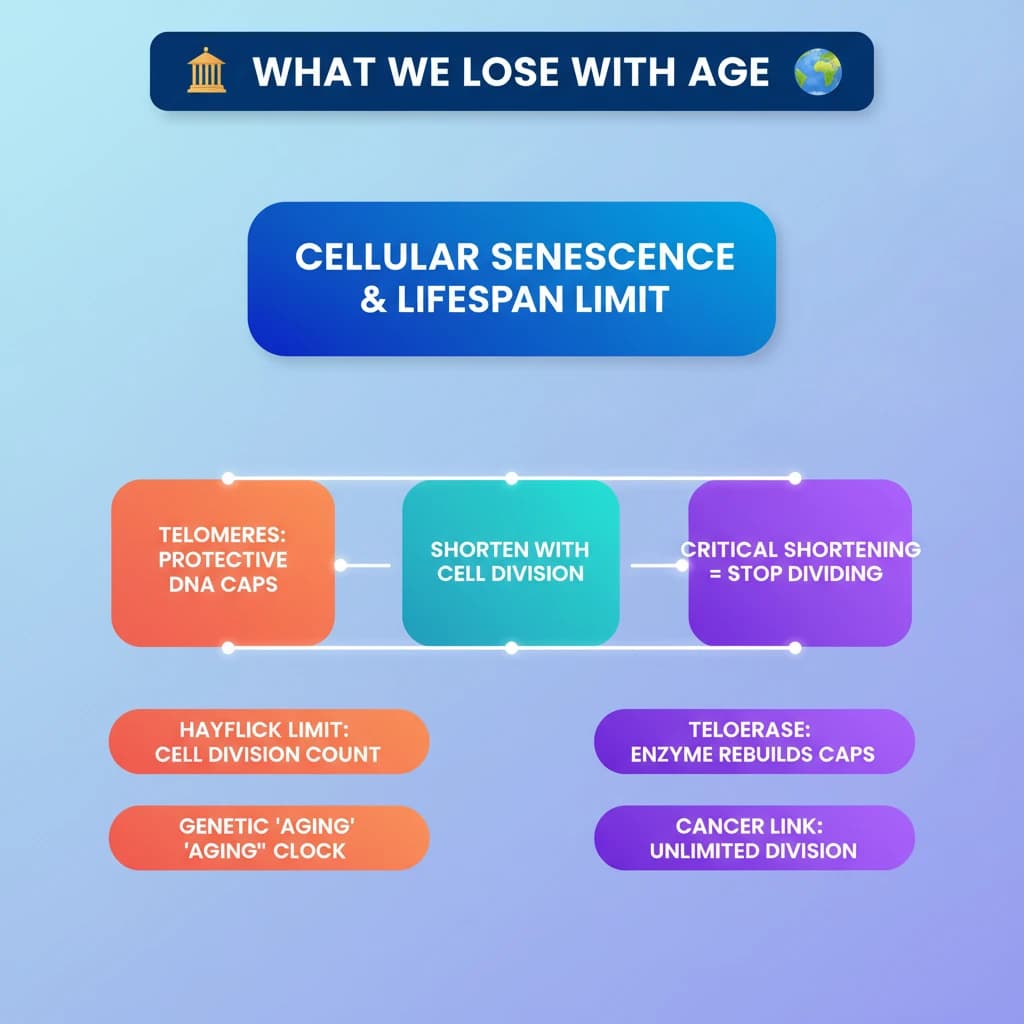
Concept Diagram

💡 Key Takeaways

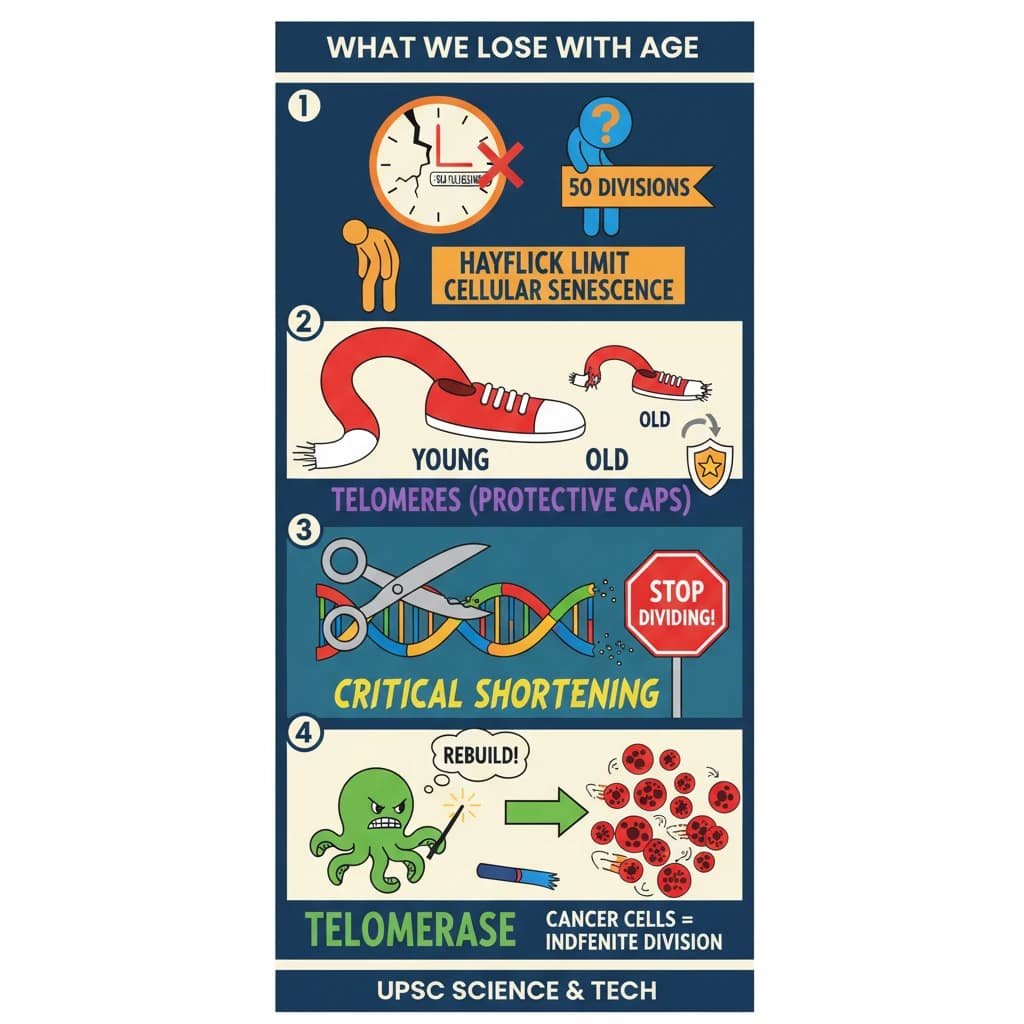
  • •Cellular senescence (Hayflick Limit) dictates how many times cells divide, influencing species lifespan.
  • •Telomeres are protective DNA caps on chromosomes that shorten with each cell division.
  • •Critical telomere shortening signals cells to stop dividing, contributing to aging.
  • •Telomerase is an enzyme that can rebuild telomeres, active in cancer cells allowing indefinite division.
  • •While telomerase holds anti-aging potential, its link to cancer complicates therapeutic application.

🧠 Memory Techniques
Memory Aid
95% Verified Content

📚 Reference Sources

•General scientific literature on telomeres, telomerase, and cellular senescence

Related Topics

Loading related topics...
Explore:Science And Technology Topics·All Subjects·Daily Current Affairs·Editorial Analysis·Previous Year Questions·UPSC GPT
What We Lose With Age - UPSC Science And Technology