Loading page, please wait…
Vaidra Logo
Vaidra

Top 4 items + smart groups

UPSC GPT
New
Current Affairs
Daily Solutions
Daily Puzzle
Mains Evaluator

Version 2.0.0 • Built with ❤️ for UPSC aspirants

Loading...
Loading...
Loading...
Loading...
Loading...
Loading...
Loading...
Loading...
Loading...
Loading...
Loading...
Loading...
Loading...
Back
All Subjects

Topics

0 topics • 0 completed

Loading topics...
Loading...
Loading...
Loading...
Loading...
Loading...
Overall Progress0%

The Nobel Prize in Physics 2024 - UPSC Science And Technology

What is The Nobel Prize in Physics 2024 in UPSC Science And Technology?

The Nobel Prize in Physics 2024 is a key topic under Science And Technology for UPSC Civil Services Examination. Key points include: The 2024 Nobel Prize in Physics recognized John J. Hopfield and Geoffrey E. Hinton.. Their work laid the foundation for modern Artificial Neural Networks (ANNs) and Machine Learning (ML).. Hopfield's contributions focused on network memory (Hopfield Network).. Understanding this topic is essential for both UPSC Prelims and Mains preparation.

Why is The Nobel Prize in Physics 2024 important for UPSC exam?

The Nobel Prize in Physics 2024 is a Medium-level topic in UPSC Science And Technology. It is tested in both Prelims (factual MCQs) and Mains (analytical answer writing). Previous year UPSC questions have frequently covered aspects of The Nobel Prize in Physics 2024, making it essential for comprehensive IAS preparation.

How to prepare The Nobel Prize in Physics 2024 for UPSC?

To prepare The Nobel Prize in Physics 2024 for UPSC: (1) Study the comprehensive notes covering all key concepts on Vaidra. (2) Practice previous year questions on this topic. (3) Connect it with current affairs using daily updates. (4) Revise using key takeaways and mind maps available for Science And Technology. (5) Write practice answers linking The Nobel Prize in Physics 2024 to related GS Paper topics.

Key takeaways of The Nobel Prize in Physics 2024 for UPSC

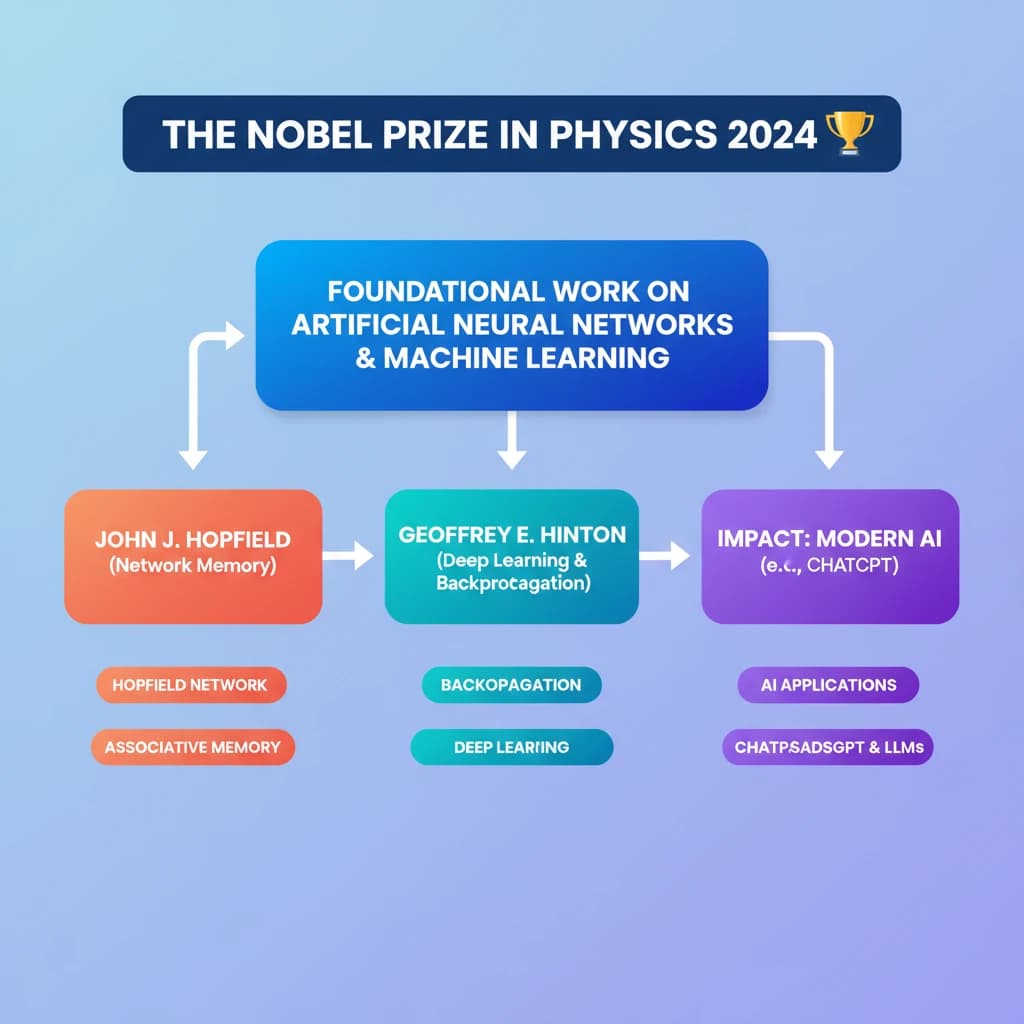
  • The 2024 Nobel Prize in Physics recognized John J. Hopfield and Geoffrey E. Hinton.
  • Their work laid the foundation for modern Artificial Neural Networks (ANNs) and Machine Learning (ML).
  • Hopfield's contributions focused on network memory (Hopfield Network).
  • Hinton's work was crucial for deep learning and the backpropagation algorithm.
  • Their research enabled the development of current AI applications like ChatGPT.
  • AI has profound implications across physics, biology, medicine, finance, and chat AI apps.
The Nobel Prize in Physics 2024

The Nobel Prize in Physics 2024

Medium⏱️ 7 min read✓ 98% Verified
science and technology

📖 Introduction

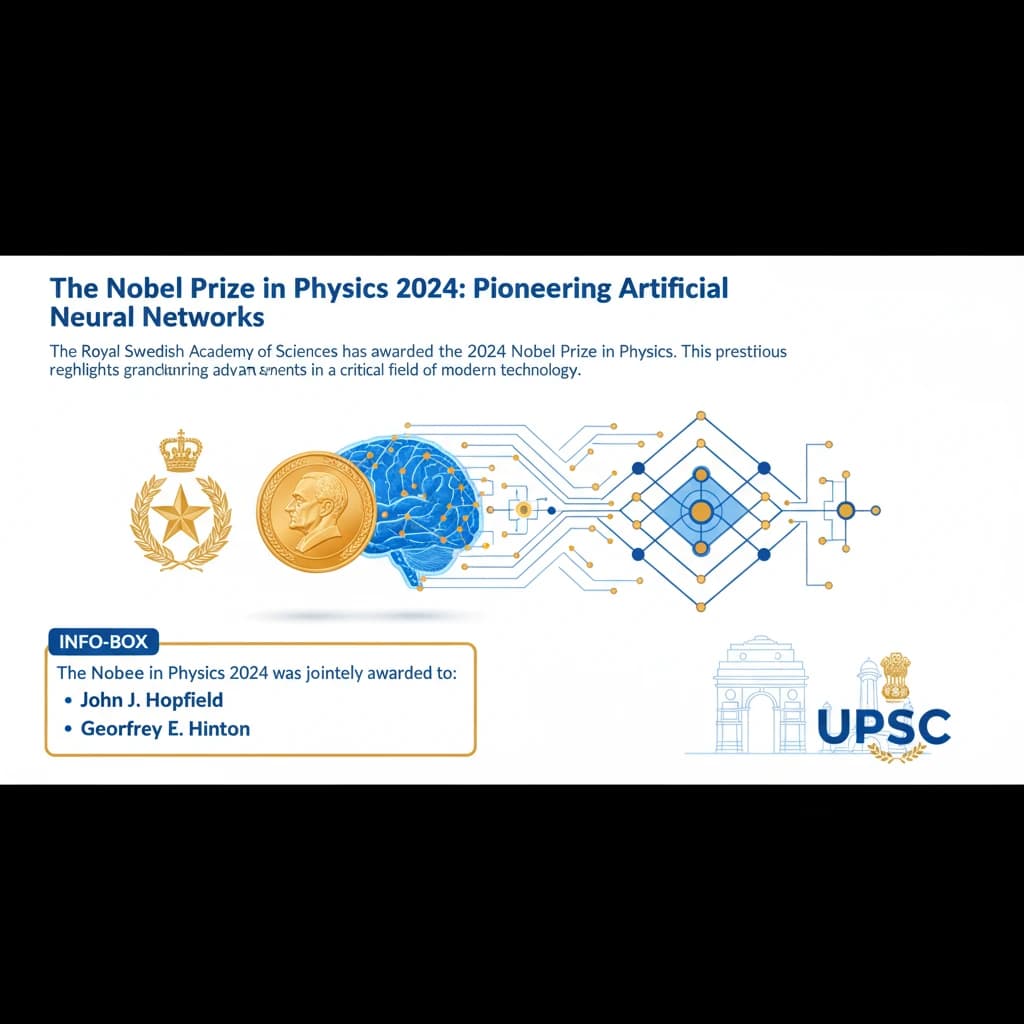
<h4>The Nobel Prize in Physics 2024: Pioneering Artificial Neural Networks</h4><p>The <strong>Royal Swedish Academy of Sciences</strong> has awarded the <strong>2024 Nobel Prize in Physics</strong>. This prestigious recognition highlights groundbreaking advancements in a critical field of modern technology.</p><div class='info-box'><p>The Nobel Prize in Physics 2024 was jointly awarded to:</p><ul><li><strong>John J. Hopfield</strong></li><li><strong>Geoffrey E. Hinton</strong></li></ul><p>They were recognized for their foundational work on <strong>artificial neural networks (ANNs)</strong> and <strong>machine learning (ML)</strong>.</p></div><p>Their contributions have fundamentally reshaped our understanding and capabilities in artificial intelligence. Their research laid the essential groundwork for the sophisticated AI systems we see today.</p><h4>Impact on Modern Artificial Intelligence</h4><p>The work of <strong>Hopfield</strong> and <strong>Hinton</strong> is directly responsible for the development of modern <strong>AI applications</strong>. These range from complex scientific simulations to everyday consumer technologies.</p><div class='key-point-box'><p>Their research has had profound implications across numerous fields, including:</p><ul><li><strong>Physics</strong> and material science</li><li><strong>Biology</strong> and drug discovery</li><li><strong>Finance</strong> and algorithmic trading</li><li><strong>Medicine</strong> and diagnostics</li><li><strong>Chat Artificial Intelligence (AI) apps</strong>, such as <strong>OpenAI’s ChatGPT</strong> (Generative Pre-trained Transformer)</li></ul></div><p>This wide-ranging impact underscores the transformative nature of their theoretical and practical contributions to computing and cognitive science.</p><div class='exam-tip-box'><p><strong>UPSC Relevance:</strong> Understanding the foundational figures and concepts behind <strong>Artificial Intelligence (AI)</strong> and <strong>Machine Learning (ML)</strong> is crucial for <strong>GS Paper 3 (Science & Technology)</strong>. Questions can relate to the history, applications, ethical implications, and future of AI.</p></div>
Concept Diagram

💡 Key Takeaways

  • •The 2024 Nobel Prize in Physics recognized John J. Hopfield and Geoffrey E. Hinton.
  • •Their work laid the foundation for modern Artificial Neural Networks (ANNs) and Machine Learning (ML).
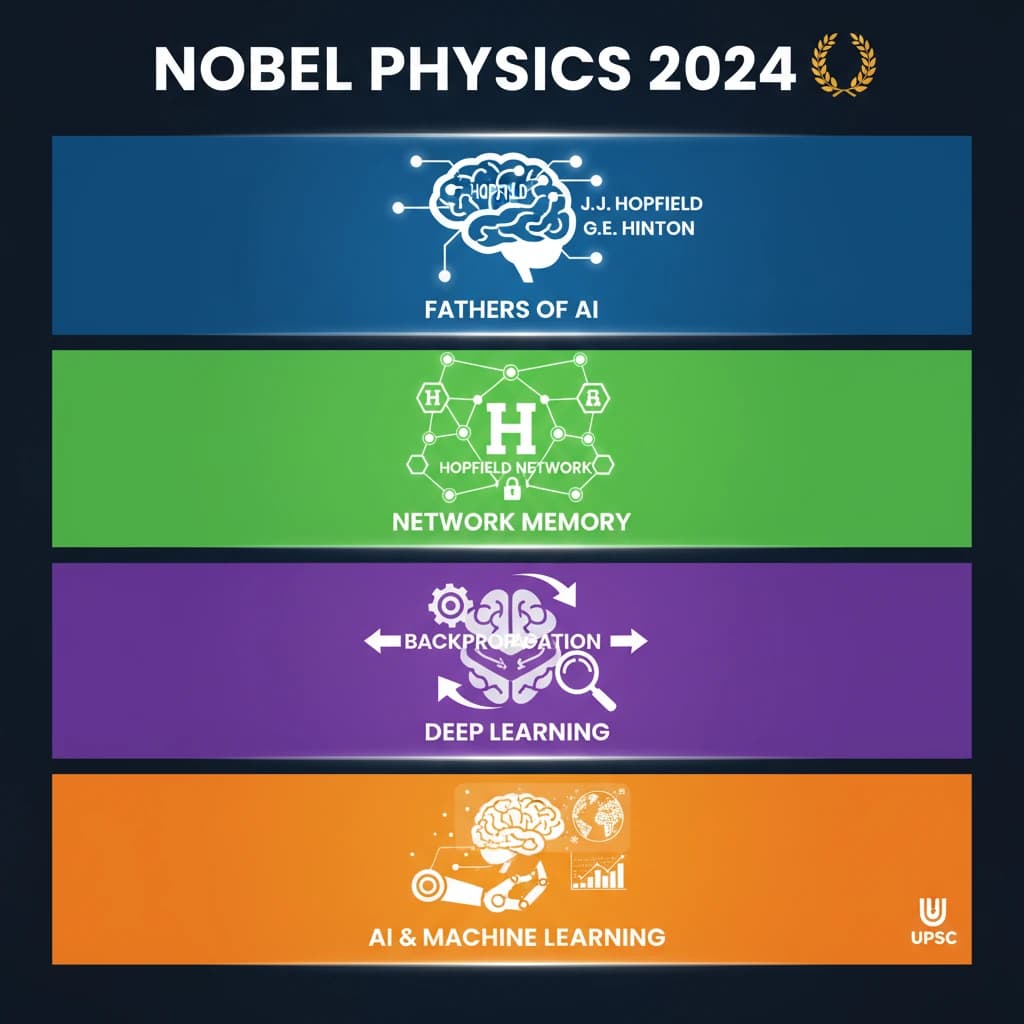
  • •Hopfield's contributions focused on network memory (Hopfield Network).
  • •Hinton's work was crucial for deep learning and the backpropagation algorithm.
  • •Their research enabled the development of current AI applications like ChatGPT.
  • •AI has profound implications across physics, biology, medicine, finance, and chat AI apps.

🧠 Memory Techniques
Memory Aid
98% Verified Content

📚 Reference Sources

•The Royal Swedish Academy of Sciences (Official Nobel Prize website)
•General knowledge on Artificial Intelligence and Machine Learning history

Related Topics

Loading related topics...
Explore:Science And Technology Topics·All Subjects·Daily Current Affairs·Editorial Analysis·Previous Year Questions·UPSC GPT
The Nobel Prize in Physics 2024 - UPSC Science And Technology