Loading page, please wait…
Vaidra Logo
Vaidra

Top 4 items + smart groups

UPSC GPT
New
Current Affairs
Daily Solutions
Daily Puzzle
Mains Evaluator

Version 2.0.0 • Built with ❤️ for UPSC aspirants

Loading...
Loading...
Loading...
Loading...
Loading...
Loading...
Loading...
Loading...
Loading...
Loading...
Loading...
Loading...
Loading...
Back
All Subjects

Topics

0 topics • 0 completed

Loading topics...
Loading...
Loading...
Loading...
Loading...
Loading...
Overall Progress0%

What is One Nation, One Time? - UPSC Science And Technology

What is What is One Nation, One Time? in UPSC Science And Technology?

What is One Nation, One Time? is a key topic under Science And Technology for UPSC Civil Services Examination. Key points include: 'One Nation, One Time' aims for unified, microsecond-accurate national timekeeping.. Key objective is self-reliance, reducing dependence on foreign systems like US-controlled GPS.. Kargil War (1999) highlighted vulnerabilities from GPS dependence, prompting indigenous solutions.. Understanding this topic is essential for both UPSC Prelims and Mains preparation.

Why is What is One Nation, One Time? important for UPSC exam?

What is One Nation, One Time? is a Medium-level topic in UPSC Science And Technology. It is tested in both Prelims (factual MCQs) and Mains (analytical answer writing). Previous year UPSC questions have frequently covered aspects of What is One Nation, One Time?, making it essential for comprehensive IAS preparation.

How to prepare What is One Nation, One Time? for UPSC?

To prepare What is One Nation, One Time? for UPSC: (1) Study the comprehensive notes covering all key concepts on Vaidra. (2) Practice previous year questions on this topic. (3) Connect it with current affairs using daily updates. (4) Revise using key takeaways and mind maps available for Science And Technology. (5) Write practice answers linking What is One Nation, One Time? to related GS Paper topics.

Key takeaways of What is One Nation, One Time? for UPSC

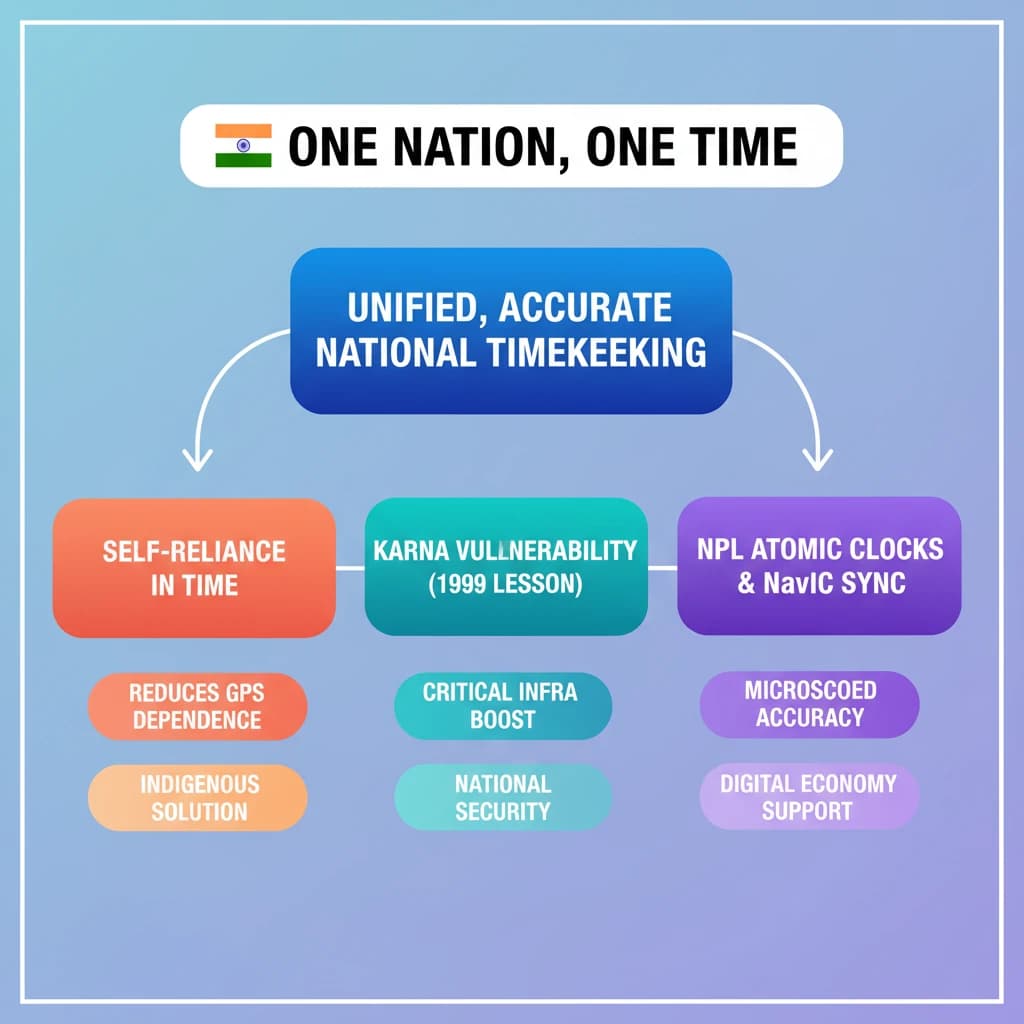
  • 'One Nation, One Time' aims for unified, microsecond-accurate national timekeeping.
  • Key objective is self-reliance, reducing dependence on foreign systems like US-controlled GPS.
  • Kargil War (1999) highlighted vulnerabilities from GPS dependence, prompting indigenous solutions.
  • NPL's atomic clocks provide the reference time, synchronized via India's NavIC system.
  • Ensures national security, boosts critical infrastructure, and supports the digital economy.
What is One Nation, One Time?

What is One Nation, One Time?

Medium⏱️ 7 min read✓ 95% Verified
science and technology

📖 Introduction

<h4>Understanding One Nation, One Time</h4><p>The <strong>'One Nation, One Time'</strong> initiative aims to establish a <strong>unified</strong> and <strong>highly precise timekeeping framework</strong> across India. This framework is crucial for various national applications.</p><p>Its scope covers all <strong>governmental</strong>, <strong>industrial</strong>, <strong>technological</strong>, and <strong>societal</strong> sectors, ensuring consistent time synchronization nationwide.</p><div class='info-box'><p><strong>Primary Objective:</strong> To achieve a <strong>microsecond-level accuracy</strong> in time dissemination throughout India. This requires advanced infrastructure and precise measurement.</p></div><h4>Government's Implementation Strategy</h4><p>To achieve this high level of accuracy, the Indian government plans to establish <strong>five Legal Metrology laboratories</strong> strategically across the country.</p><p>These laboratories will be equipped with advanced instruments to ensure the precise measurement and dissemination of time, adhering to international standards.</p><h4>The Critical Need for Self-Reliance in Timekeeping</h4><p>A primary driver for the <strong>'One Nation, One Time'</strong> initiative is the urgent need for <strong>national self-reliance</strong> in timekeeping. India currently relies significantly on external systems.</p><p>Reliance on <strong>GPS satellite time</strong>, which is controlled by the <strong>United States</strong>, poses significant <strong>national security</strong> and <strong>cybersecurity risks</strong>. This dependence can be exploited during times of conflict or crisis.</p><div class='key-point-box'><p><strong>Historical Precedent:</strong> During the <strong>Kargil War in 1999</strong>, India's dependence on foreign GPS systems compromised its ability to accurately target enemy positions, highlighting a critical vulnerability.</p></div><p>Establishing a <strong>self-reliant timekeeping system</strong> will significantly reduce this external dependence, thereby protecting India's <strong>critical infrastructure</strong> and strategic capabilities.</p><h4>Functioning Mechanism: NPL and NavIC</h4><p>The <strong>National Physical Laboratory (NPL)</strong> will be at the core of this initiative. It will utilize its highly accurate <strong>atomic clocks</strong> to provide the foundational time reference for India.</p><p>This accurate time will be synchronized and disseminated across the nation via <strong>NavIC (Navigation with Indian Constellation)</strong>, India's indigenous satellite navigation system.</p><div class='info-box'><p><strong>NPL's Atomic Clocks:</strong> These advanced clocks are incredibly precise, losing only <strong>one second over millions of years</strong>. They serve as the ultimate reference for <strong>Indian Standard Time (IST)</strong>.</p></div><div class='exam-tip-box'><p><strong>UPSC Insight:</strong> Understand the synergy between <strong>NPL's atomic clocks</strong> and <strong>NavIC</strong>. This combination forms the backbone of India's self-reliant timekeeping and navigation infrastructure, crucial for <strong>GS Paper 3 (Science & Technology, Internal Security)</strong>.</p></div>
Concept Diagram

💡 Key Takeaways

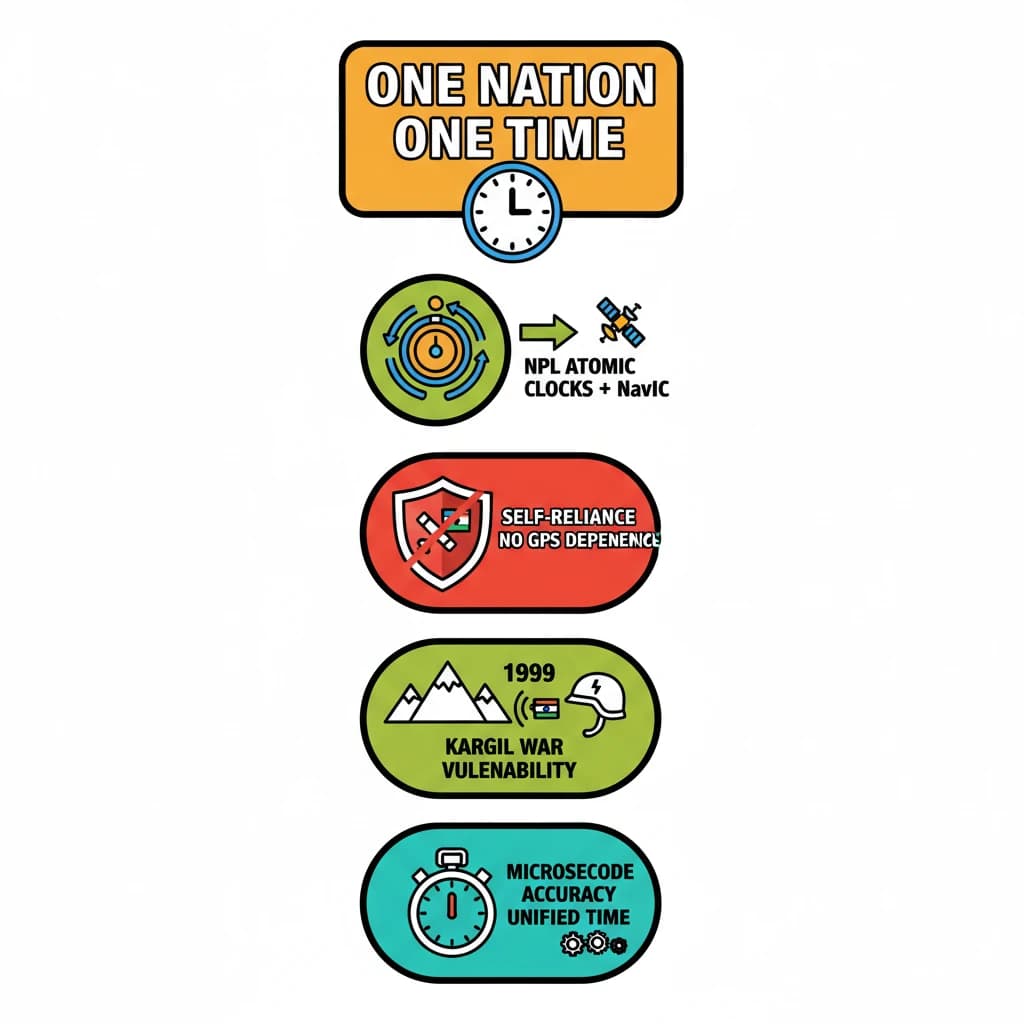
  • •'One Nation, One Time' aims for unified, microsecond-accurate national timekeeping.
  • •Key objective is self-reliance, reducing dependence on foreign systems like US-controlled GPS.
  • •Kargil War (1999) highlighted vulnerabilities from GPS dependence, prompting indigenous solutions.
  • •NPL's atomic clocks provide the reference time, synchronized via India's NavIC system.
  • •Ensures national security, boosts critical infrastructure, and supports the digital economy.

🧠 Memory Techniques
Memory Aid
95% Verified Content

📚 Reference Sources

•National Physical Laboratory (NPL) website
•Indian Space Research Organisation (ISRO) - NavIC documentation
•Ministry of Consumer Affairs, Food & Public Distribution - Legal Metrology Division

Related Topics

Loading related topics...
Explore:Science And Technology Topics·All Subjects·Daily Current Affairs·Editorial Analysis·Previous Year Questions·UPSC GPT
What is One Nation, One Time? - UPSC Science And Technology