Loading page, please wait…
Vaidra Logo
Vaidra

Top 4 items + smart groups

UPSC GPT
New
Current Affairs
Daily Solutions
Daily Puzzle
Mains Evaluator

Version 2.0.0 • Built with ❤️ for UPSC aspirants

Loading...
Loading...
Loading...
Loading...
Loading...
Loading...
Loading...
Loading...
Loading...
Loading...
Loading...
Loading...
Loading...
Back
All Subjects

Topics

0 topics • 0 completed

Loading topics...
Loading...
Loading...
Loading...
Loading...
Loading...
Overall Progress0%

Discoveries in Biology Using C. elegans - UPSC Science And Technology

What is Discoveries in Biology Using C. elegans in UPSC Science And Technology?

Discoveries in Biology Using C. elegans is a key topic under Science And Technology for UPSC Civil Services Examination. Key points include: C. elegans is a critical model organism, instrumental in multiple Nobel Prize-winning discoveries (miRNAs, GFP, RNAi, programmed cell death).. Its transparent body, fixed cell lineage, and genetic tractability make it ideal for studying fundamental biological processes.. Smart Proteins (alternative proteins) are emerging as a sustainable solution for global food security, reducing environmental impact and zoonotic disease risks.. Understanding this topic is essential for both UPSC Prelims and Mains preparation.

Why is Discoveries in Biology Using C. elegans important for UPSC exam?

Discoveries in Biology Using C. elegans is a Medium-level topic in UPSC Science And Technology. It is tested in both Prelims (factual MCQs) and Mains (analytical answer writing). Previous year UPSC questions have frequently covered aspects of Discoveries in Biology Using C. elegans, making it essential for comprehensive IAS preparation.

How to prepare Discoveries in Biology Using C. elegans for UPSC?

To prepare Discoveries in Biology Using C. elegans for UPSC: (1) Study the comprehensive notes covering all key concepts on Vaidra. (2) Practice previous year questions on this topic. (3) Connect it with current affairs using daily updates. (4) Revise using key takeaways and mind maps available for Science And Technology. (5) Write practice answers linking Discoveries in Biology Using C. elegans to related GS Paper topics.

Key takeaways of Discoveries in Biology Using C. elegans for UPSC

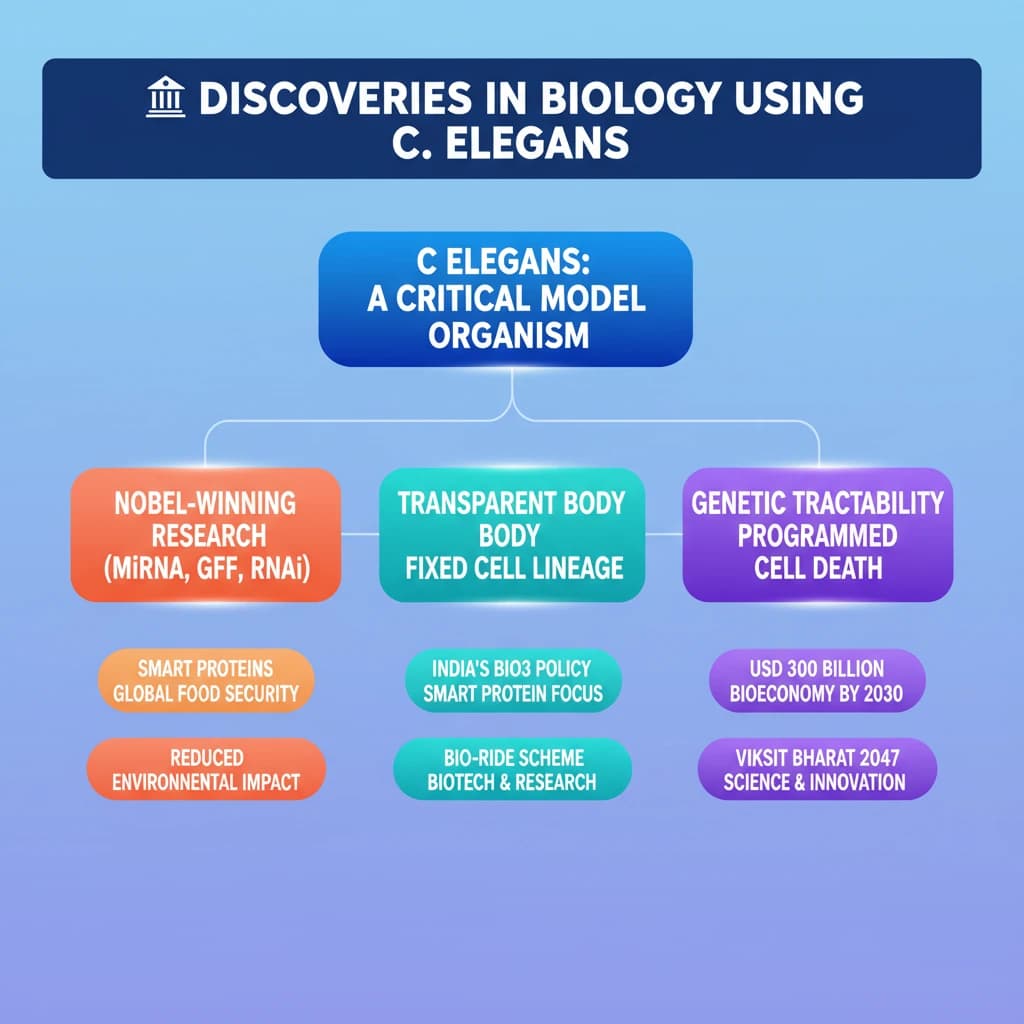
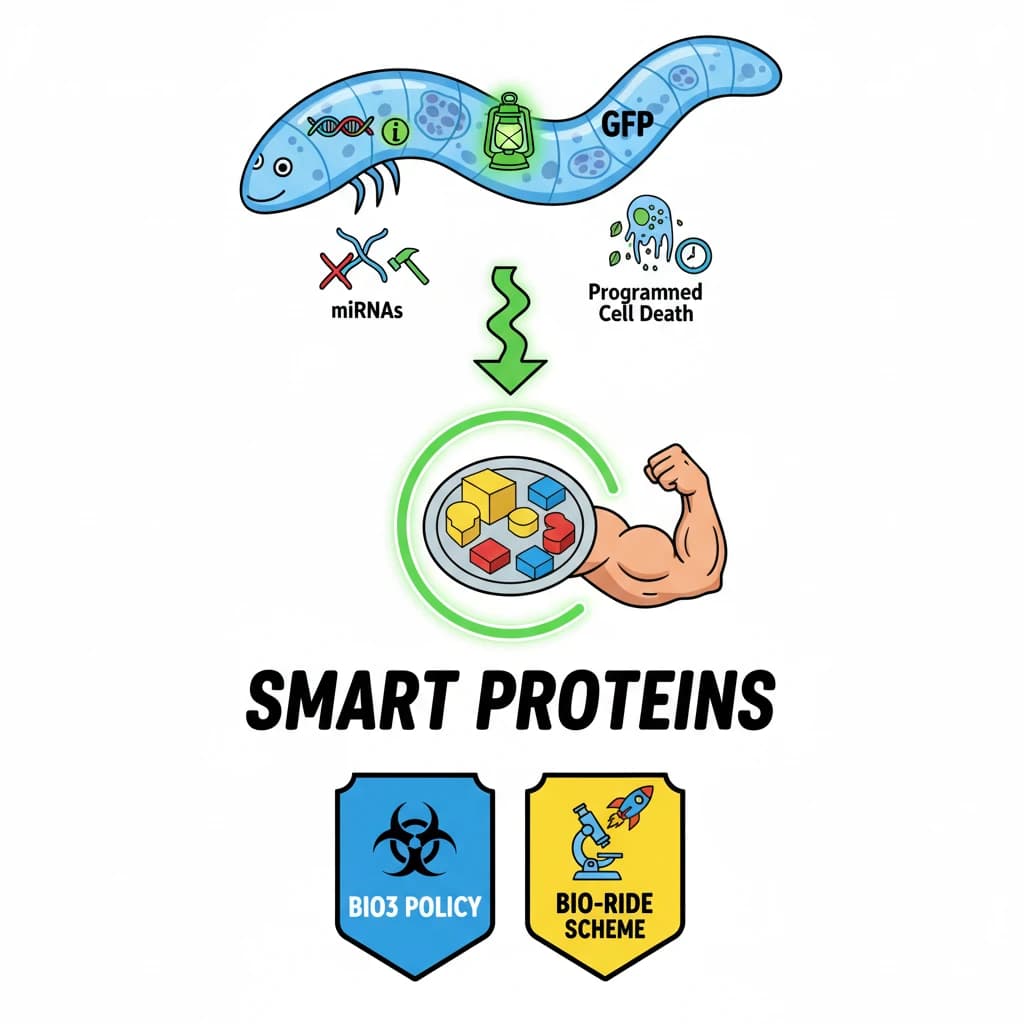
  • C. elegans is a critical model organism, instrumental in multiple Nobel Prize-winning discoveries (miRNAs, GFP, RNAi, programmed cell death).
  • Its transparent body, fixed cell lineage, and genetic tractability make it ideal for studying fundamental biological processes.
  • Smart Proteins (alternative proteins) are emerging as a sustainable solution for global food security, reducing environmental impact and zoonotic disease risks.
  • India's Bio3 Policy prioritizes smart protein production, while the Bio-RIDE scheme aims to boost biotechnology research and entrepreneurship.
  • India targets a USD 300 billion bioeconomy by 2030, aligning with the Viksit Bharat 2047 vision.
Discoveries in Biology Using C. elegans

Discoveries in Biology Using C. elegans

Medium⏱️ 7 min read✓ 95% Verified
science and technology

📖 Introduction

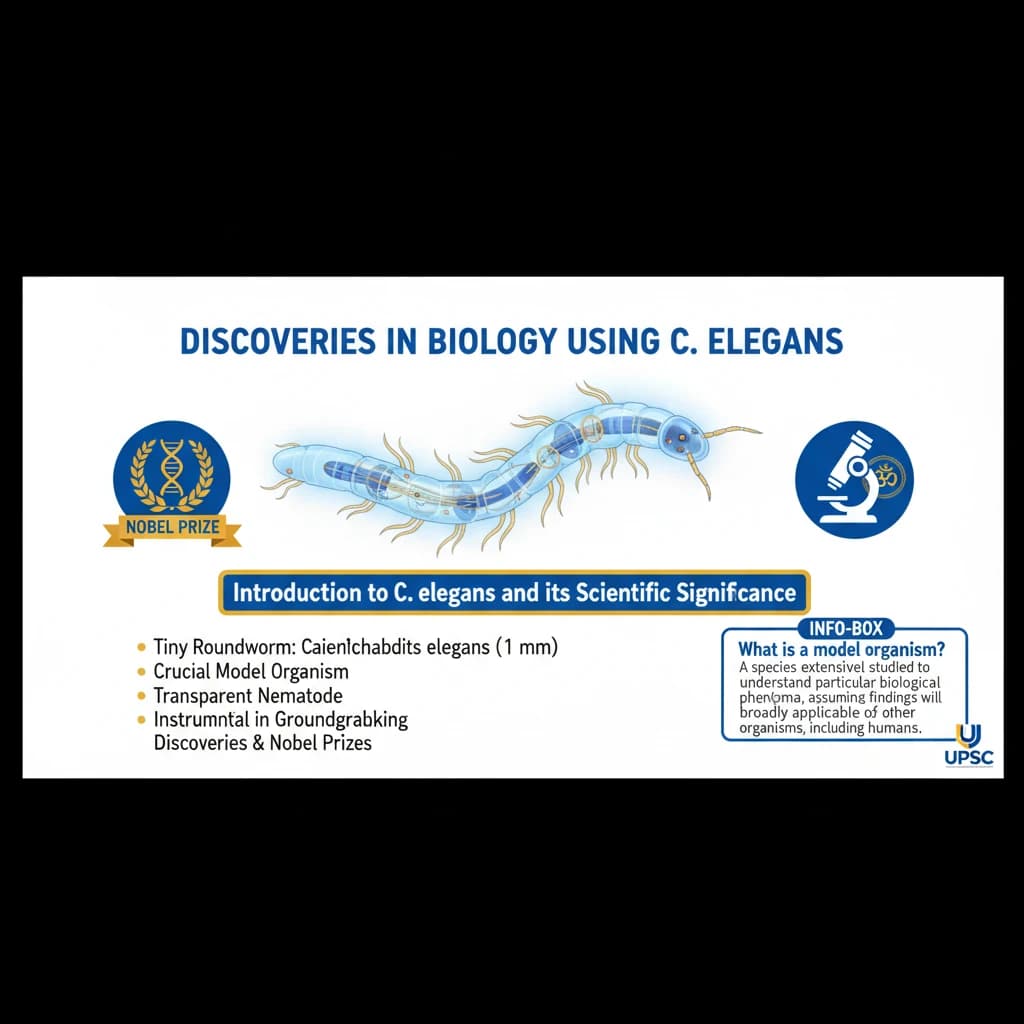
<h4>Introduction to C. elegans and its Scientific Significance</h4><p>The tiny roundworm <strong>Caenorhabditis elegans</strong>, often abbreviated as <strong>C. elegans</strong>, has emerged as a crucial model organism in biological research.</p><p>This transparent nematode, measuring only <strong>1 mm</strong> in length, has been instrumental in numerous groundbreaking discoveries, several of which have been recognized with <strong>Nobel Prizes</strong>.</p><div class='info-box'><p><strong>What is C. elegans?</strong></p><ul><li>A <strong>transparent nematode</strong> (roundworm).</li><li>Length: Approximately <strong>1 mm</strong>.</li><li>An <strong>invertebrate</strong>, commonly found in soil.</li></ul></div><h4>C. elegans: A Nobel Prize Powerhouse</h4><p>The simplicity and genetic tractability of <strong>C. elegans</strong> have made it an ideal subject for studying fundamental biological processes, leading to significant advancements across various fields.</p><p>Its contributions span genetics, developmental biology, neurobiology, and cell biology, often revealing mechanisms conserved across species, including humans.</p><div class='key-point-box'><p><strong>Why C. elegans is a Model Organism:</strong></p><ul><li><strong>Transparent body</strong>: Allows direct observation of internal processes.</li><li><strong>Simple nervous system</strong>: Exactly 302 neurons, fully mapped.</li><li><strong>Short life cycle</strong>: Rapid generation time for genetic studies.</li><li><strong>Fixed cell lineage</strong>: Every cell division and fate is known.</li><li><strong>Genetic tractability</strong>: Easy to manipulate genes.</li></ul></div><p>Several Nobel Prizes have been awarded for discoveries made using or significantly advanced by research on <strong>C. elegans</strong>:</p><table class='info-table'><tr><th>Nobel Laureates</th><th>Year</th><th>Prize Category</th><th>Discovery/Contribution</th></tr><tr><td><strong>Victor Ambros</strong> and <strong>Gary Ruvkun</strong></td><td><strong>2024</strong></td><td>Physiology or Medicine</td><td>Discovered <strong>microRNAs</strong></td></tr><tr><td><strong>Osamu Shimomura</strong>, <strong>Martin Chalfie</strong>, <strong>Roger Tsien</strong></td><td><strong>2008</strong></td><td>Chemistry</td><td>Developed <strong>Green Fluorescent Protein (GFP)</strong></td></tr><tr><td><strong>Andrew Fire</strong> and <strong>Craig Mello</strong></td><td><strong>2006</strong></td><td>Medicine</td><td>Discovered <strong>RNA interference (RNAi)</strong></td></tr><tr><td><strong>Sydney Brenner</strong></td><td><strong>2002</strong></td><td>Medicine</td><td>Research on understanding <strong>programmed cell death</strong></td></tr></table><h4>The Rise of Smart Proteins: Food of the Future</h4><p>Beyond model organisms, biotechnology is revolutionizing food production, with <strong>smart proteins</strong> emerging as a sustainable solution to global food security and environmental challenges.</p><p>The Indian government has recognized this potential through policies like the <strong>Biotechnology for Economy, Environment, and Employment (Bio3) Policy</strong>.</p><div class='info-box'><p><strong>What are Smart Proteins?</strong></p><ul><li>Also known as <strong>alternative proteins</strong>.</li><li>Derived from <strong>unconventional sources</strong>: algae, fungi, insects.</li><li>Produced using <strong>advanced methods</strong>: fermentation, lab-grown cells.</li><li>Includes <strong>plant-based proteins</strong> designed to mimic animal products in taste and nutrition.</li></ul></div><p>These proteins offer a compelling alternative to conventional animal agriculture, addressing concerns related to environmental impact, food safety, and ethical consumption.</p><h4>Environmental and Health Benefits of Smart Proteins</h4><p>The production of <strong>alternative proteins</strong> significantly reduces the environmental footprint compared to traditional meat production.</p><div class='key-point-box'><p><strong>Environmental Advantages:</strong></p><ul><li>Uses <strong>72-99% less water</strong>.</li><li>Requires <strong>47-99% less land</strong>.</li><li>Causes <strong>51-91% less water pollution</strong>.</li><li>Emits <strong>30-90% fewer greenhouse gases</strong>.</li></ul></div><p>From a public health perspective, <strong>smart proteins</strong> enhance <strong>food safety</strong> by mitigating the risk of <strong>zoonotic diseases</strong>, which are illnesses transmitted from animals to humans.</p><p>They also align with ethical consumption trends and can complement diverse dietary habits, including those prevalent in <strong>India</strong>.</p><div class='info-box'><p><strong>India's Protein Consumption:</strong></p><p>India's protein intake increased from <strong>9.7%</strong> of calories in <strong>1991</strong> to <strong>11%</strong> in <strong>2021</strong>, reflecting rising incomes and changing dietary patterns.</p></div><h4>BIO-RIDE Scheme: Boosting India's Bioeconomy</h4><p>To further bolster research and innovation in biotechnology, the <strong>Union Cabinet</strong> has approved the <strong>Biotechnology Research Innovation and Entrepreneurship Development (Bio-RIDE) scheme</strong>.</p><p>This scheme is a strategic initiative aimed at positioning <strong>India</strong> as a global leader in the biotechnology sector.</p><div class='key-point-box'><p><strong>Objectives of Bio-RIDE:</strong></p><ul><li>Foster <strong>research, innovation, and entrepreneurship</strong> in biotechnology.</li><li>Achieve a <strong>USD 300 billion bioeconomy</strong> for India by <strong>2030</strong>.</li><li>Contribute to the broader vision of <strong>Viksit Bharat 2047</strong>.</li></ul></div><div class='exam-tip-box'><p><strong>UPSC Insight:</strong> Understand how schemes like <strong>Bio-RIDE</strong> and policies like <strong>Bio3</strong> are crucial for India's economic growth, sustainable development, and global standing in the science and technology domain. Connect them to topics like <strong>food security</strong>, <strong>climate change mitigation</strong>, and <strong>public health</strong>.</p></div>
Concept Diagram

💡 Key Takeaways

  • •C. elegans is a critical model organism, instrumental in multiple Nobel Prize-winning discoveries (miRNAs, GFP, RNAi, programmed cell death).
  • •Its transparent body, fixed cell lineage, and genetic tractability make it ideal for studying fundamental biological processes.
  • •Smart Proteins (alternative proteins) are emerging as a sustainable solution for global food security, reducing environmental impact and zoonotic disease risks.
  • •India's Bio3 Policy prioritizes smart protein production, while the Bio-RIDE scheme aims to boost biotechnology research and entrepreneurship.
  • •India targets a USD 300 billion bioeconomy by 2030, aligning with the Viksit Bharat 2047 vision.

🧠 Memory Techniques
Memory Aid
95% Verified Content

📚 Reference Sources

•Nobel Prize official website (for laureates and discoveries)
•General knowledge of Indian government policies (Bio3, Bio-RIDE, Viksit Bharat)

Related Topics

Loading related topics...
Explore:Science And Technology Topics·All Subjects·Daily Current Affairs·Editorial Analysis·Previous Year Questions·UPSC GPT
Discoveries in Biology Using C. elegans - UPSC Science And Technology