Loading page, please wait…
Vaidra Logo
Vaidra

Top 4 items + smart groups

UPSC GPT
New
Current Affairs
Daily Solutions
Daily Puzzle
Mains Evaluator

Version 2.0.0 • Built with ❤️ for UPSC aspirants

Loading...
Loading...
Loading...
Loading...
Loading...
Loading...
Loading...
Loading...
Loading...
Loading...
Loading...
Loading...
Loading...
Back
All Subjects

Topics

0 topics • 0 completed

Loading topics...
Loading...
Loading...
Loading...
Loading...
Loading...
Overall Progress0%

Health and Diseases - UPSC Science And Technology

What is Health and Diseases in UPSC Science And Technology?

Health and Diseases is a key topic under Science And Technology for UPSC Civil Services Examination. Key points include: Sickle Cell Disease (SCD) is a genetic blood disorder causing abnormal, sickle-shaped red blood cells.. It leads to blocked blood flow, severe pain (sickle cell crisis), organ damage, and reduced life expectancy.. SCD disproportionately affects tribal communities in India, identified as a major health issue by MoHFW.. Understanding this topic is essential for both UPSC Prelims and Mains preparation.

Why is Health and Diseases important for UPSC exam?

Health and Diseases is a Easy-level topic in UPSC Science And Technology. It is tested in both Prelims (factual MCQs) and Mains (analytical answer writing). Previous year UPSC questions have frequently covered aspects of Health and Diseases, making it essential for comprehensive IAS preparation.

How to prepare Health and Diseases for UPSC?

To prepare Health and Diseases for UPSC: (1) Study the comprehensive notes covering all key concepts on Vaidra. (2) Practice previous year questions on this topic. (3) Connect it with current affairs using daily updates. (4) Revise using key takeaways and mind maps available for Science And Technology. (5) Write practice answers linking Health and Diseases to related GS Paper topics.

Key takeaways of Health and Diseases for UPSC

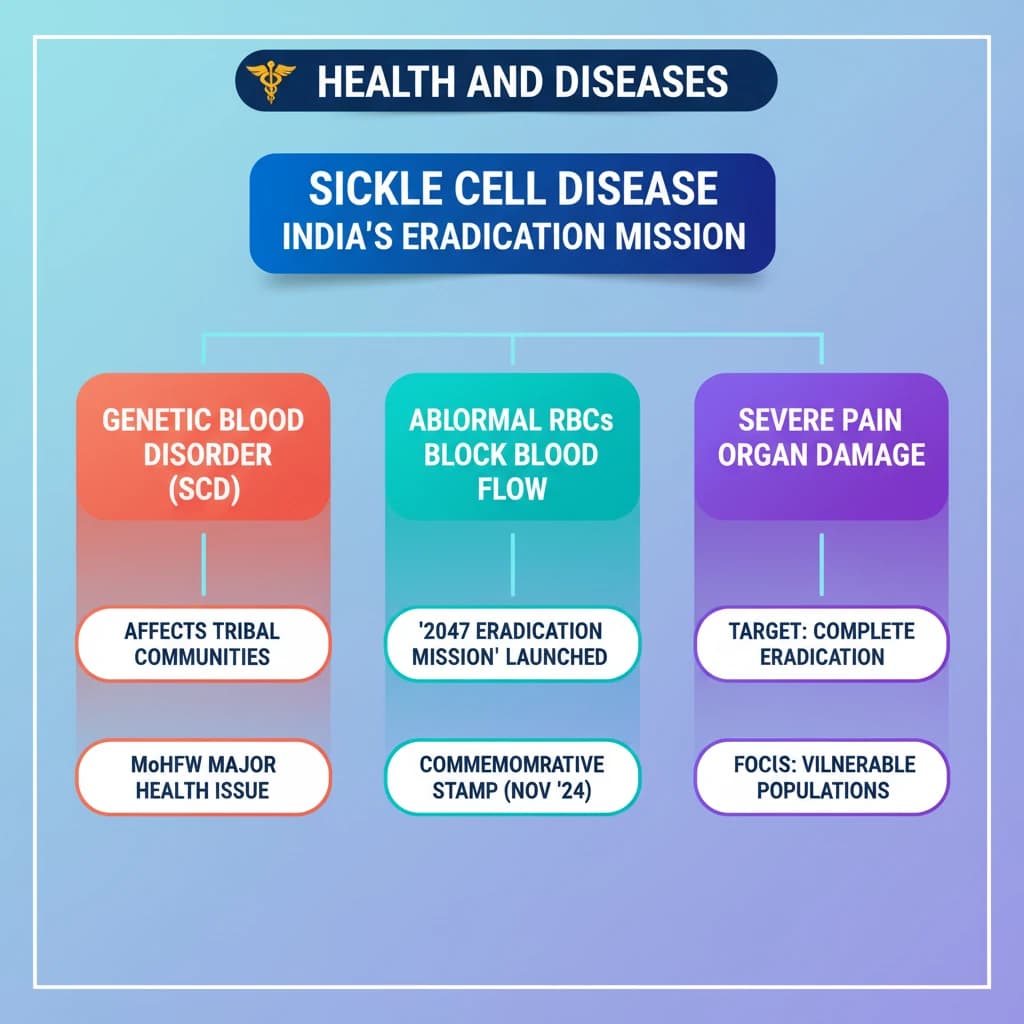
  • Sickle Cell Disease (SCD) is a genetic blood disorder causing abnormal, sickle-shaped red blood cells.
  • It leads to blocked blood flow, severe pain (sickle cell crisis), organ damage, and reduced life expectancy.
  • SCD disproportionately affects tribal communities in India, identified as a major health issue by MoHFW.
  • India has launched the 'Sickle Cell Eradication - 2047' mission, marked by a commemorative stamp on 15th Nov 2024.
  • The 2047 target aims for complete eradication of sickle cell anaemia, focusing on vulnerable populations.
Health and Diseases

Health and Diseases

Easy⏱️ 5 min read✓ 98% Verified
science and technology

📖 Introduction

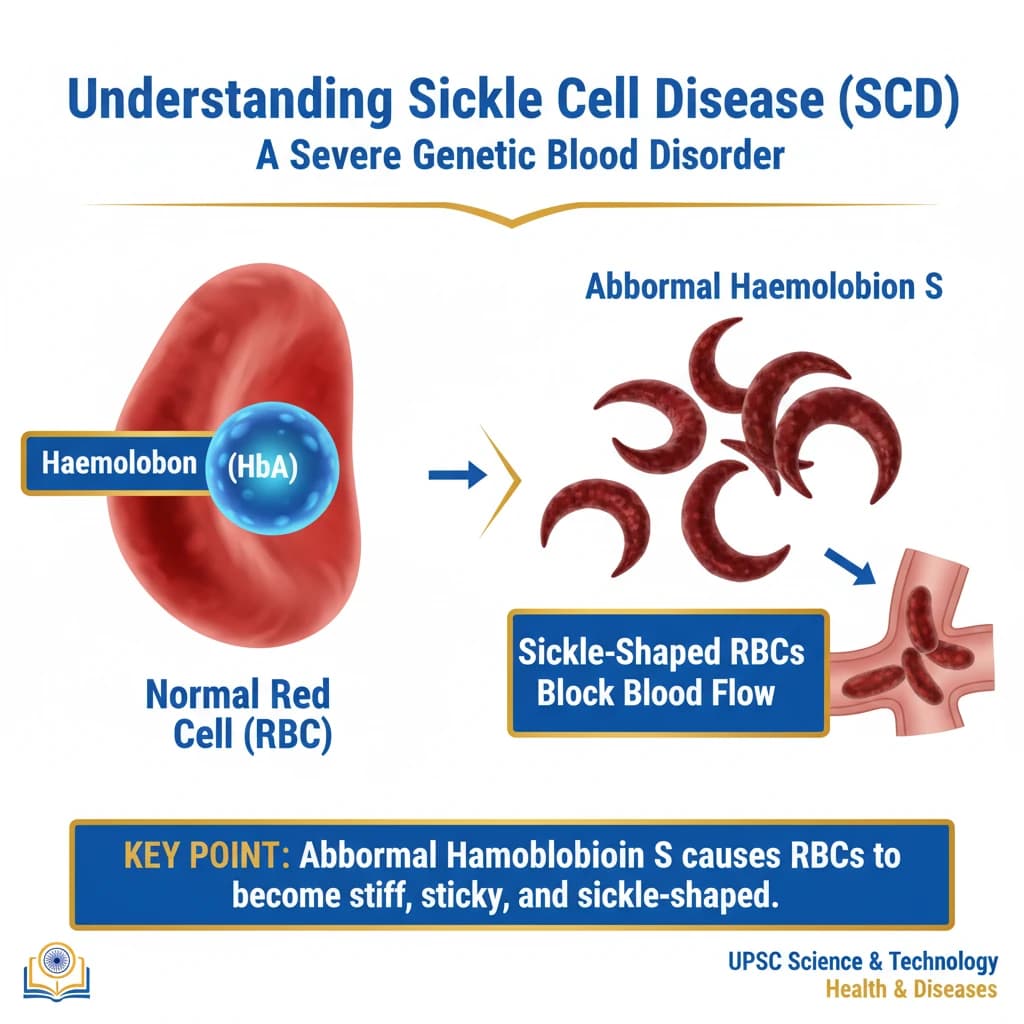
<h4>Understanding Sickle Cell Disease (SCD)</h4><p><strong>Sickle Cell Disease (SCD)</strong> is a severe <strong>genetic blood disorder</strong> that affects millions globally. It is characterized by an abnormality in <strong>haemoglobin</strong>, the vital protein responsible for carrying oxygen throughout the body.</p><div class='key-point-box'><p>The core issue in <strong>SCD</strong> is the production of abnormal <strong>haemoglobin S</strong>, which causes red blood cells (RBCs) to become rigid and take on a characteristic <strong>sickle or crescent shape</strong>, especially under low oxygen conditions.</p></div><h4>Nature of Sickle Cell Disease</h4><p>Unlike healthy, flexible red blood cells, the <strong>sickle-shaped cells</strong> are stiff and sticky. This abnormal shape prevents them from flowing smoothly through small blood vessels, leading to blockages.</p><p>These blockages impede blood flow to various organs and tissues, causing a range of severe complications and symptoms. The disease is hereditary, meaning it is passed down through families.</p><h4>Impact on the Body</h4><p>The consequences of <strong>SCD</strong> are profound and systemic. Blocked blood flow leads to a lack of oxygen in tissues, causing intense pain and organ damage over time. It significantly reduces the life expectancy of affected individuals.</p><div class='info-box'><p>The <strong>Ministry of Health and Family Welfare (MoHFW)</strong> tribal health expert committee has specifically identified <strong>Sickle Cell Disease</strong> as one of the <strong>ten major health issues</strong> predominantly affecting <strong>tribal communities</strong> in India.</p></div><h4>Key Symptoms of SCD</h4><p>Individuals suffering from <strong>Sickle Cell Disease</strong> experience a variety of debilitating symptoms, which can vary in severity and frequency. These symptoms are a direct result of the abnormal red blood cells and their impact on circulation.</p><ul><li><strong>Chronic Anaemia:</strong> A persistent lack of healthy red blood cells leads to symptoms such as extreme <strong>fatigue</strong>, general <strong>weakness</strong>, and noticeable <strong>paleness</strong> of the skin.</li><li><strong>Painful Episodes (Sickle Cell Crisis):</strong> These are sudden, severe, and intense bouts of pain. They can occur in the <strong>bones</strong>, <strong>chest</strong>, <strong>back</strong>, <strong>arms</strong>, and <strong>legs</strong>, caused by blood vessel blockages.</li><li><strong>Delayed Growth and Puberty:</strong> Children and adolescents with <strong>SCD</strong> often experience slower physical development compared to their peers due to the chronic stress on their bodies.</li></ul><div class='exam-tip-box'><p>For UPSC, understand <strong>SCD</strong> not just as a disease, but as a significant <strong>public health challenge</strong>, especially concerning <strong>vulnerable populations</strong> like tribal communities. Be ready to discuss its genetic basis and socio-economic impact.</p></div>
Concept Diagram

💡 Key Takeaways

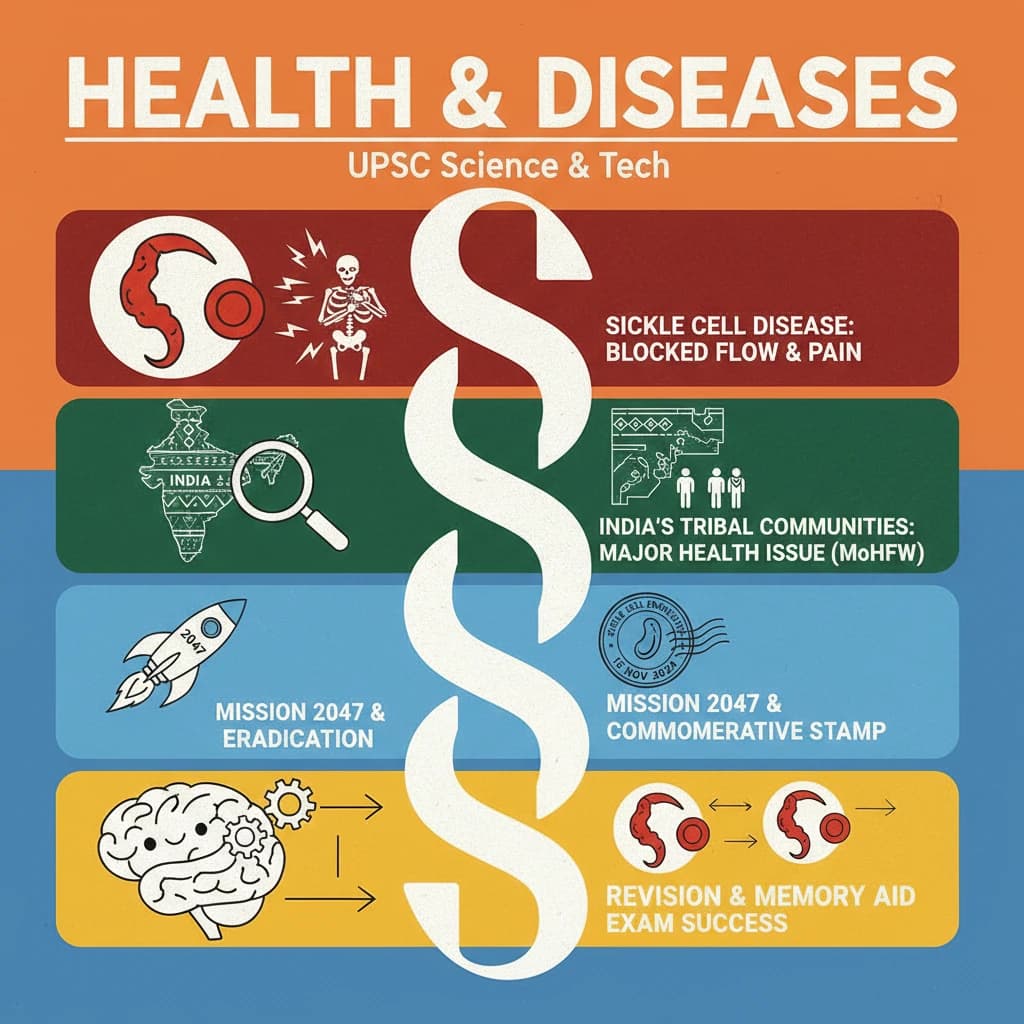
  • •Sickle Cell Disease (SCD) is a genetic blood disorder causing abnormal, sickle-shaped red blood cells.
  • •It leads to blocked blood flow, severe pain (sickle cell crisis), organ damage, and reduced life expectancy.
  • •SCD disproportionately affects tribal communities in India, identified as a major health issue by MoHFW.
  • •India has launched the 'Sickle Cell Eradication - 2047' mission, marked by a commemorative stamp on 15th Nov 2024.
  • •The 2047 target aims for complete eradication of sickle cell anaemia, focusing on vulnerable populations.

🧠 Memory Techniques
Memory Aid
98% Verified Content

Related Topics

Loading related topics...
Explore:Science And Technology Topics·All Subjects·Daily Current Affairs·Editorial Analysis·Previous Year Questions·UPSC GPT
Health and Diseases - UPSC Science And Technology