Loading page, please wait…
Vaidra Logo
Vaidra

Top 4 items + smart groups

UPSC GPT
New
Current Affairs
Daily Solutions
Daily Puzzle
Mains Evaluator

Version 2.0.0 • Built with ❤️ for UPSC aspirants

Loading...
Loading...
Loading...
Loading...
Loading...
Loading...
Loading...
Loading...
Loading...
Loading...
Loading...
Loading...
Loading...
Back
All Subjects

Topics

0 topics • 0 completed

Loading topics...
Loading...
Loading...
Loading...
Loading...
Loading...
Overall Progress0%

NASA’s Parker Solar Probe - UPSC Science And Technology

What is NASA’s Parker Solar Probe in UPSC Science And Technology?

NASA’s Parker Solar Probe is a key topic under Science And Technology for UPSC Civil Services Examination. Key points include: NASA's Parker Solar Probe is the closest human-made object to the Sun, breaking speed and proximity records.. Launched in 2018, it's named after astrophysicist Eugene Newman Parker, the first NASA mission named for a living researcher.. Its primary objectives are to study the solar corona's heating, the origin of solar winds, and energetic particle acceleration.. Understanding this topic is essential for both UPSC Prelims and Mains preparation.

Why is NASA’s Parker Solar Probe important for UPSC exam?

NASA’s Parker Solar Probe is a Medium-level topic in UPSC Science And Technology. It is tested in both Prelims (factual MCQs) and Mains (analytical answer writing). Previous year UPSC questions have frequently covered aspects of NASA’s Parker Solar Probe, making it essential for comprehensive IAS preparation.

How to prepare NASA’s Parker Solar Probe for UPSC?

To prepare NASA’s Parker Solar Probe for UPSC: (1) Study the comprehensive notes covering all key concepts on Vaidra. (2) Practice previous year questions on this topic. (3) Connect it with current affairs using daily updates. (4) Revise using key takeaways and mind maps available for Science And Technology. (5) Write practice answers linking NASA’s Parker Solar Probe to related GS Paper topics.

Key takeaways of NASA’s Parker Solar Probe for UPSC

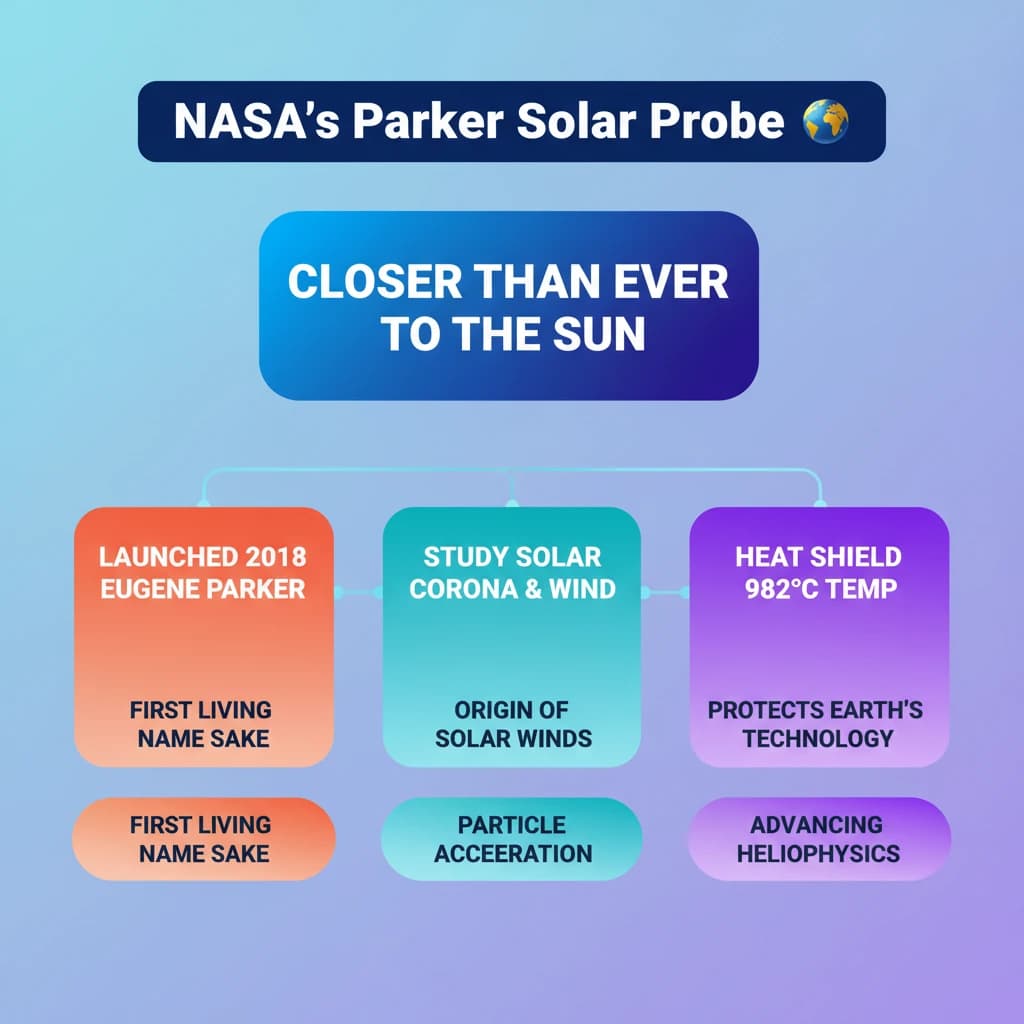
  • NASA's Parker Solar Probe is the closest human-made object to the Sun, breaking speed and proximity records.
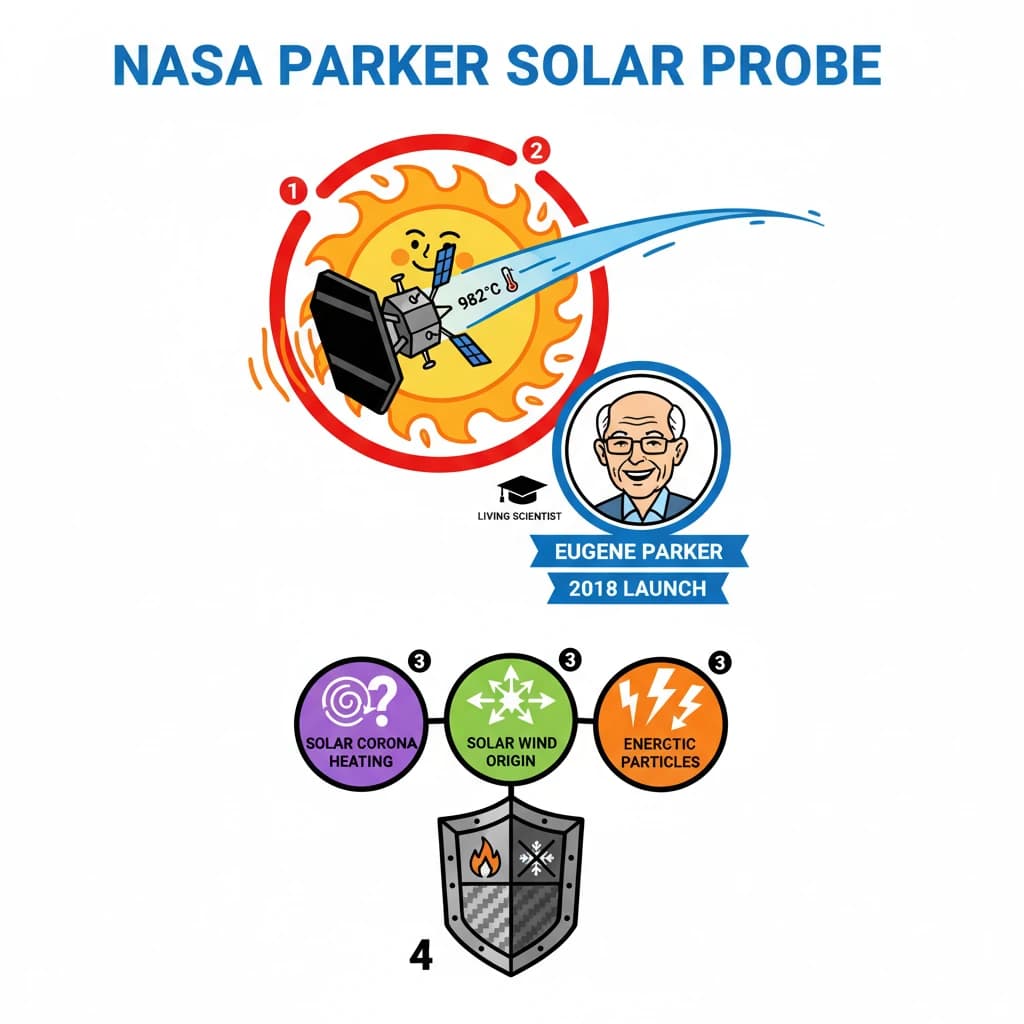
  • Launched in 2018, it's named after astrophysicist Eugene Newman Parker, the first NASA mission named for a living researcher.
  • Its primary objectives are to study the solar corona's heating, the origin of solar winds, and energetic particle acceleration.
  • Equipped with an advanced carbon-composite heat shield, it withstands extreme temperatures up to 982°C.
  • The mission provides crucial data for understanding space weather, protecting Earth's technology, and advancing heliophysics.
NASA’s Parker Solar Probe

NASA’s Parker Solar Probe

Medium⏱️ 8 min read✓ 98% Verified
science and technology

📖 Introduction

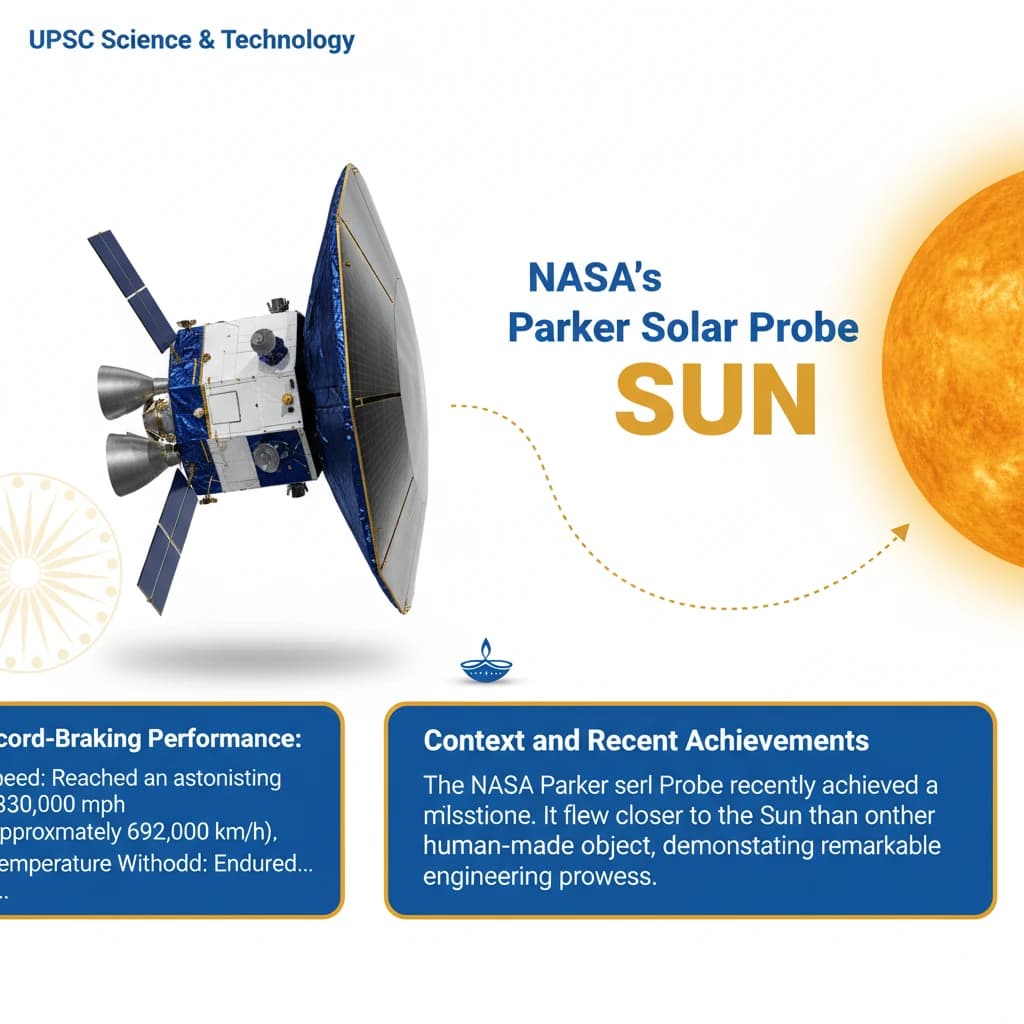
<h4>Context and Recent Achievements</h4><p>The <strong>NASA Parker Solar Probe</strong> recently achieved a historic milestone. It flew closer to the <strong>Sun</strong> than any other human-made object, demonstrating remarkable engineering prowess.</p><div class='info-box'><p><strong>Record-Breaking Performance:</strong></p><ul><li><strong>Speed:</strong> Reached an astonishing <strong>430,000 mph</strong> (approximately 692,000 km/h).</li><li><strong>Temperature Withstood:</strong> Endured extreme temperatures up to <strong>982°C</strong>.</li><li><strong>Proximity:</strong> Approached within <strong>3.8 million miles</strong> of the Sun's <strong>corona</strong>.</li></ul></div><h4>About the Parker Solar Probe Mission</h4><p>Launched in <strong>2018</strong>, the <strong>Parker Solar Probe</strong> is a robotic spacecraft, roughly the size of a car. It is a pioneering mission designed to explore the Sun's outermost atmosphere.</p><p>The probe is named after the renowned American solar astrophysicist, <strong>Eugene Newman Parker</strong>. This marks a unique distinction as it is the <strong>first NASA mission</strong> named for a living researcher.</p><div class='key-point-box'><p><strong>Unique Naming:</strong> The mission's naming after <strong>Eugene Newman Parker</strong> while he was alive highlights his foundational contributions to <strong>heliophysics</strong>, particularly his work on <strong>solar wind</strong> theory.</p></div><h4>Key Features and Technology</h4><p>To survive the extreme conditions near the Sun, the <strong>Parker Solar Probe</strong> is equipped with advanced technology. Its most critical component is its robust thermal protection system.</p><div class='info-box'><p><strong>Advanced Heat Shield:</strong></p><ul><li>The probe utilizes a sophisticated <strong>carbon-composite heat shield</strong>.</li><li>This shield is crucial for protecting the spacecraft's instruments from the intense heat and radiation.</li></ul></div><div class='exam-tip-box'><p><strong>UPSC Insight:</strong> Questions on <strong>space technology</strong> often focus on the engineering challenges and innovative solutions. The <strong>Parker Solar Probe's heat shield</strong> is an excellent example to cite for overcoming extreme environmental conditions in space.</p></div><h4>Primary Objectives of the Mission</h4><p>The mission's primary goal is to unravel long-standing mysteries about our star. It aims to gather crucial data directly from the Sun's atmosphere.</p><div class='info-box'><p><strong>Key Objectives:</strong></p><ul><li>To approach within <strong>6.5 million kilometers</strong> of the <strong>Sun</strong> to study the flow of energy and the heating of the <strong>solar corona</strong>.</li><li>To investigate the source and acceleration mechanisms of the <strong>solar winds</strong>, which are high-speed streams of charged particles.</li><li>To understand why the <strong>Sun's corona</strong> is significantly hotter than its surface, a major enigma in astrophysics.</li><li>To determine the structure and dynamics of <strong>plasma</strong> and <strong>magnetic fields</strong> at the origin points of the <strong>solar wind</strong>.</li><li>To explore the mechanisms responsible for accelerating and transporting <strong>energetic particles</strong> throughout the solar system.</li></ul></div>
Concept Diagram

💡 Key Takeaways

  • •NASA's Parker Solar Probe is the closest human-made object to the Sun, breaking speed and proximity records.
  • •Launched in 2018, it's named after astrophysicist Eugene Newman Parker, the first NASA mission named for a living researcher.
  • •Its primary objectives are to study the solar corona's heating, the origin of solar winds, and energetic particle acceleration.
  • •Equipped with an advanced carbon-composite heat shield, it withstands extreme temperatures up to 982°C.
  • •The mission provides crucial data for understanding space weather, protecting Earth's technology, and advancing heliophysics.

🧠 Memory Techniques
Memory Aid
98% Verified Content

📚 Reference Sources

•Drishti IAS (provided source summary)
•European Space Agency (ESA) resources on solar missions (for historical context verification)

Related Topics

Loading related topics...
Explore:Science And Technology Topics·All Subjects·Daily Current Affairs·Editorial Analysis·Previous Year Questions·UPSC GPT
NASA’s Parker Solar Probe - UPSC Science And Technology