Loading page, please wait…
Vaidra Logo
Vaidra

Top 4 items + smart groups

UPSC GPT
New
Current Affairs
Daily Solutions
Daily Puzzle
Mains Evaluator

Version 2.0.0 • Built with ❤️ for UPSC aspirants

Loading...
Loading...
Loading...
Loading...
Loading...
Loading...
Loading...
Loading...
Loading...
Loading...
Loading...
Loading...
Loading...
Back
All Subjects

Topics

0 topics • 0 completed

Loading topics...
Loading...
Loading...
Loading...
Loading...
Loading...
Overall Progress0%

Google DeepMind’s SIMA and AlphaGeometry - UPSC Science And Technology

What is Google DeepMind’s SIMA and AlphaGeometry in UPSC Science And Technology?

Google DeepMind’s SIMA and AlphaGeometry is a key topic under Science And Technology for UPSC Civil Services Examination. Key points include: Google DeepMind released SIMA (AI Agent) and AlphaGeometry (Specialized AI).. Predictive AI forecasts outcomes using historical data and machine learning.. SIMA is a generalist AI Agent capable of autonomous action in virtual environments, unlike passive AI models.. Understanding this topic is essential for both UPSC Prelims and Mains preparation.

Why is Google DeepMind’s SIMA and AlphaGeometry important for UPSC exam?

Google DeepMind’s SIMA and AlphaGeometry is a Medium-level topic in UPSC Science And Technology. It is tested in both Prelims (factual MCQs) and Mains (analytical answer writing). Previous year UPSC questions have frequently covered aspects of Google DeepMind’s SIMA and AlphaGeometry, making it essential for comprehensive IAS preparation.

How to prepare Google DeepMind’s SIMA and AlphaGeometry for UPSC?

To prepare Google DeepMind’s SIMA and AlphaGeometry for UPSC: (1) Study the comprehensive notes covering all key concepts on Vaidra. (2) Practice previous year questions on this topic. (3) Connect it with current affairs using daily updates. (4) Revise using key takeaways and mind maps available for Science And Technology. (5) Write practice answers linking Google DeepMind’s SIMA and AlphaGeometry to related GS Paper topics.

Key takeaways of Google DeepMind’s SIMA and AlphaGeometry for UPSC

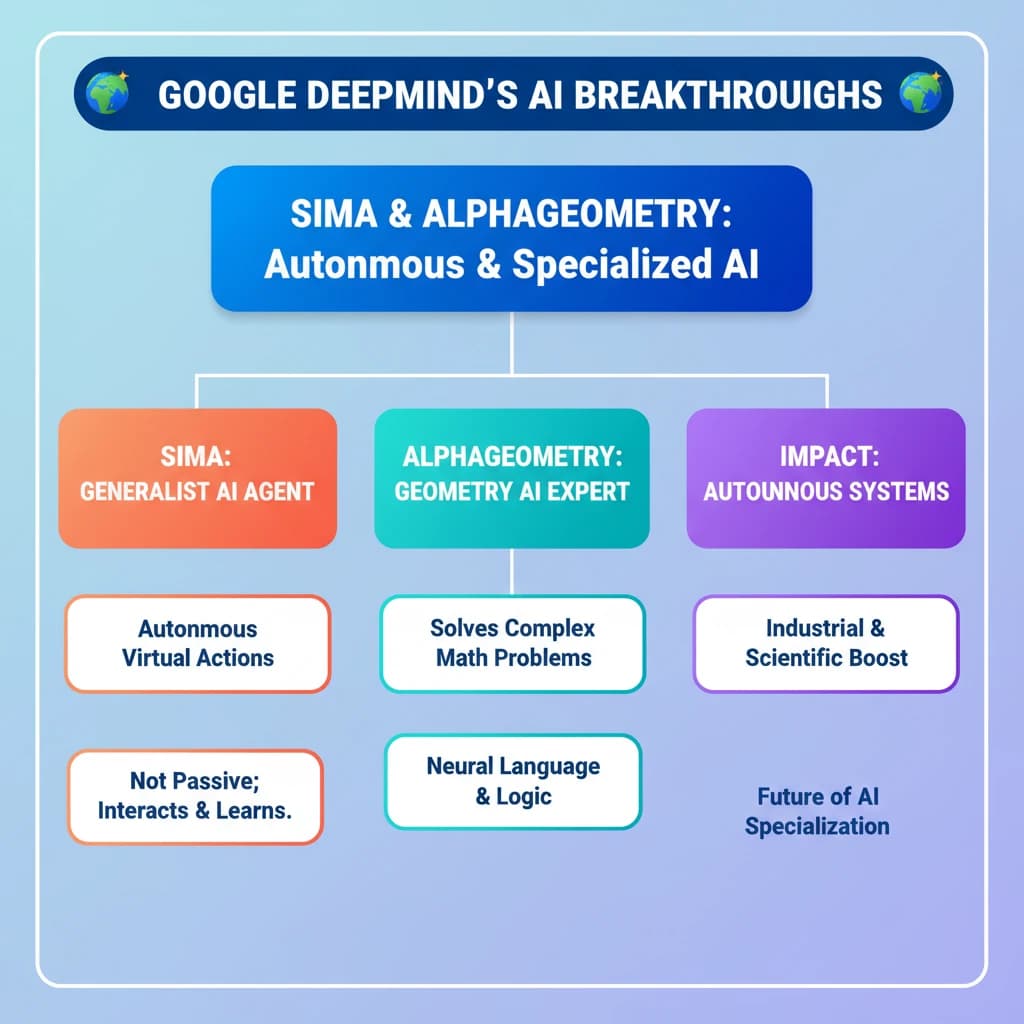
  • Google DeepMind released SIMA (AI Agent) and AlphaGeometry (Specialized AI).
  • Predictive AI forecasts outcomes using historical data and machine learning.
  • SIMA is a generalist AI Agent capable of autonomous action in virtual environments, unlike passive AI models.
  • AlphaGeometry is a specialized AI for complex geometry problems, combining neural language models and symbolic deduction.
  • These innovations highlight the shift towards more autonomous and specialized AI applications with significant industrial and scientific impact.
Google DeepMind’s SIMA and AlphaGeometry

Google DeepMind’s SIMA and AlphaGeometry

Medium⏱️ 7 min read✓ 95% Verified
science and technology

📖 Introduction

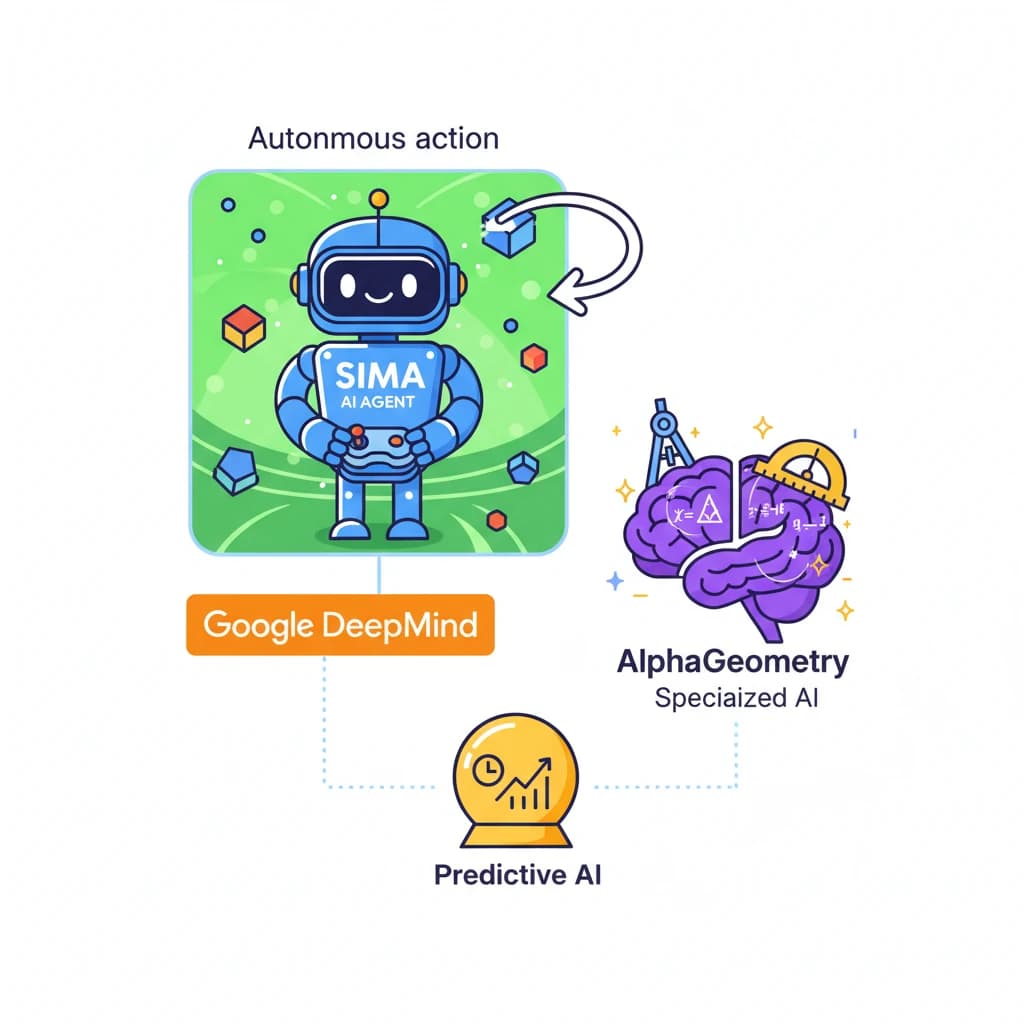
<h4>Introduction to Google DeepMind's AI Innovations</h4><p>Recently, <strong>Google DeepMind</strong> unveiled several advanced <strong>AI products</strong> based on <strong>Predictive AI Models</strong>. Among these, <strong>SIMA (Scalable Instructable Multimodal Agent)</strong> and <strong>AlphaGeometry</strong> have garnered significant attention.</p><p>These innovations build upon the widespread interest generated by other large language models like <strong>OpenAI’s ChatGPT</strong> and <strong>Google’s Gemini</strong>. Industries such as oil and gas, and pharmaceuticals, are increasingly leveraging <strong>generative AI</strong> or <strong>Predictive AI</strong> for critical applications like oil exploration and drug discovery.</p><h4>Understanding Predictive AI</h4><div class='info-box'><p><strong>Predictive AI models</strong> are a class of artificial intelligence systems designed to forecast future outcomes. They achieve this by analyzing historical data, identifying patterns, and recognizing trends.</p></div><p>These sophisticated models employ advanced algorithms, statistical techniques, and various machine learning methods. Their primary function is to process vast datasets and generate informed predictions about upcoming events or behaviors.</p><h4>What is SIMA?</h4><p><strong>SIMA</strong> stands for <strong>Scalable Instructable Multimodal Agent</strong>. It represents a distinct category of AI, differing significantly from conventional <strong>AI models</strong> such as <strong>OpenAI’s ChatGPT</strong> or <strong>Google Gemini</strong>.</p><div class='key-point-box'><p>Unlike <strong>AI models</strong>, which are primarily trained on extensive datasets and are limited in autonomous action, an <strong>AI Agent</strong> like <strong>SIMA</strong> can process data and independently take actions within its environment.</p></div><p><strong>SIMA</strong> is characterized as a <strong>generalist AI Agent</strong>, capable of performing a diverse range of tasks. It functions as a virtual assistant that can comprehend and execute instructions across various virtual settings.</p><p>This includes activities ranging from exploring complex virtual dungeons to constructing elaborate digital castles. <strong>SIMA's</strong> core capability lies in its ability to accomplish assigned tasks and solve challenges within these environments.</p><h4>How SIMA Works</h4><p><strong>SIMA</strong> is engineered to understand human commands by being trained to process natural language. This allows it to accurately interpret instructions like 'build a castle' or 'find the treasure chest'.</p><p>A crucial feature of this <strong>AI agent</strong> is its capacity for continuous learning and adaptation. <strong>SIMA</strong> refines its abilities and understanding through ongoing interactions with the user, improving its performance over time.</p><h4>Training of SIMA</h4><p><strong>Google DeepMind</strong> collaborated with eight prominent game studios to train <strong>SIMA</strong>. This extensive training involved nine different video games, including popular titles such as <strong>Teardown</strong> and <strong>No Man’s Sky</strong>.</p><p>During its training, <strong>SIMA</strong> acquired a wide array of skills essential for virtual environments. These skills encompass navigation, efficient menu utilization, resource mining, and even spaceship flying.</p><p>The development team also rigorously tested <strong>SIMA</strong> in four dedicated research environments. One notable testing ground was the <strong>Construction Lab in Unity</strong>, demonstrating its versatility.</p><h4>Introducing AlphaGeometry</h4><p><strong>DeepMind’s AlphaGeometry</strong> is a highly specialized <strong>AI system</strong> specifically engineered to solve complex geometry problems. It stands apart from general-purpose <strong>AI models</strong> like <strong>OpenAI’s ChatGPT</strong> or <strong>Google’s Gemini</strong> due to its focused application.</p><p>This system is uniquely tailored for tasks requiring geometric reasoning. It achieves its capabilities by integrating advanced <strong>neural language modelling techniques</strong> with a specialized <strong>symbolic deduction engine</strong>.</p><p>The <strong>symbolic deduction engine</strong> is particularly adept at handling algebraic and geometric reasoning tasks. This combination allows <strong>AlphaGeometry</strong> to tackle challenging mathematical proofs.</p><div class='info-box'><p><strong>Neural language models</strong> are computational models built upon <strong>neural network architecture</strong>. These architectures are inspired by the intricate structure and function of the human brain, enabling them to process and understand language.</p></div><div class='info-box'><p><strong>Symbolic deduction</strong> is a method of logical reasoning that operates on symbols and predefined logical rules. It derives conclusions from premises by manipulating symbolic representations of statements.</p></div>
Concept Diagram

💡 Key Takeaways

  • •Google DeepMind released SIMA (AI Agent) and AlphaGeometry (Specialized AI).
  • •Predictive AI forecasts outcomes using historical data and machine learning.
  • •SIMA is a generalist AI Agent capable of autonomous action in virtual environments, unlike passive AI models.
  • •AlphaGeometry is a specialized AI for complex geometry problems, combining neural language models and symbolic deduction.
  • •These innovations highlight the shift towards more autonomous and specialized AI applications with significant industrial and scientific impact.

🧠 Memory Techniques
Memory Aid
95% Verified Content

Related Topics

Loading related topics...
Explore:Science And Technology Topics·All Subjects·Daily Current Affairs·Editorial Analysis·Previous Year Questions·UPSC GPT
Google DeepMind’s SIMA and AlphaGeometry - UPSC Science And Technology