Loading page, please wait…
Vaidra Logo
Vaidra

Top 4 items + smart groups

UPSC GPT
New
Current Affairs
Daily Solutions
Daily Puzzle
Mains Evaluator

Version 2.0.0 • Built with ❤️ for UPSC aspirants

Loading...
Loading...
Loading...
Loading...
Loading...
Loading...
Loading...
Loading...
Loading...
Loading...
Loading...
Loading...
Loading...
Back
All Subjects

Topics

0 topics • 0 completed

Loading topics...
Loading...
Loading...
Loading...
Loading...
Loading...
Overall Progress0%

Why is the Carbon Footprint of Artificial Intelligence High? - UPSC Science And Technology

What is Why is the Carbon Footprint of Artificial Intelligence High? in UPSC Science And Technology?

Why is the Carbon Footprint of Artificial Intelligence High? is a key topic under Science And Technology for UPSC Civil Services Examination. Key points include: AI's carbon footprint includes all GHG emissions from its creation, training, and use.. Data centres, driven by AI demand, are major contributors to global energy consumption.. By 2025, the IT industry (fueled by AI) could consume 20% of global electricity and emit 5.5% of carbon.. Understanding this topic is essential for both UPSC Prelims and Mains preparation.

Why is Why is the Carbon Footprint of Artificial Intelligence High? important for UPSC exam?

Why is the Carbon Footprint of Artificial Intelligence High? is a Medium-level topic in UPSC Science And Technology. It is tested in both Prelims (factual MCQs) and Mains (analytical answer writing). Previous year UPSC questions have frequently covered aspects of Why is the Carbon Footprint of Artificial Intelligence High?, making it essential for comprehensive IAS preparation.

How to prepare Why is the Carbon Footprint of Artificial Intelligence High? for UPSC?

To prepare Why is the Carbon Footprint of Artificial Intelligence High? for UPSC: (1) Study the comprehensive notes covering all key concepts on Vaidra. (2) Practice previous year questions on this topic. (3) Connect it with current affairs using daily updates. (4) Revise using key takeaways and mind maps available for Science And Technology. (5) Write practice answers linking Why is the Carbon Footprint of Artificial Intelligence High? to related GS Paper topics.

Key takeaways of Why is the Carbon Footprint of Artificial Intelligence High? for UPSC

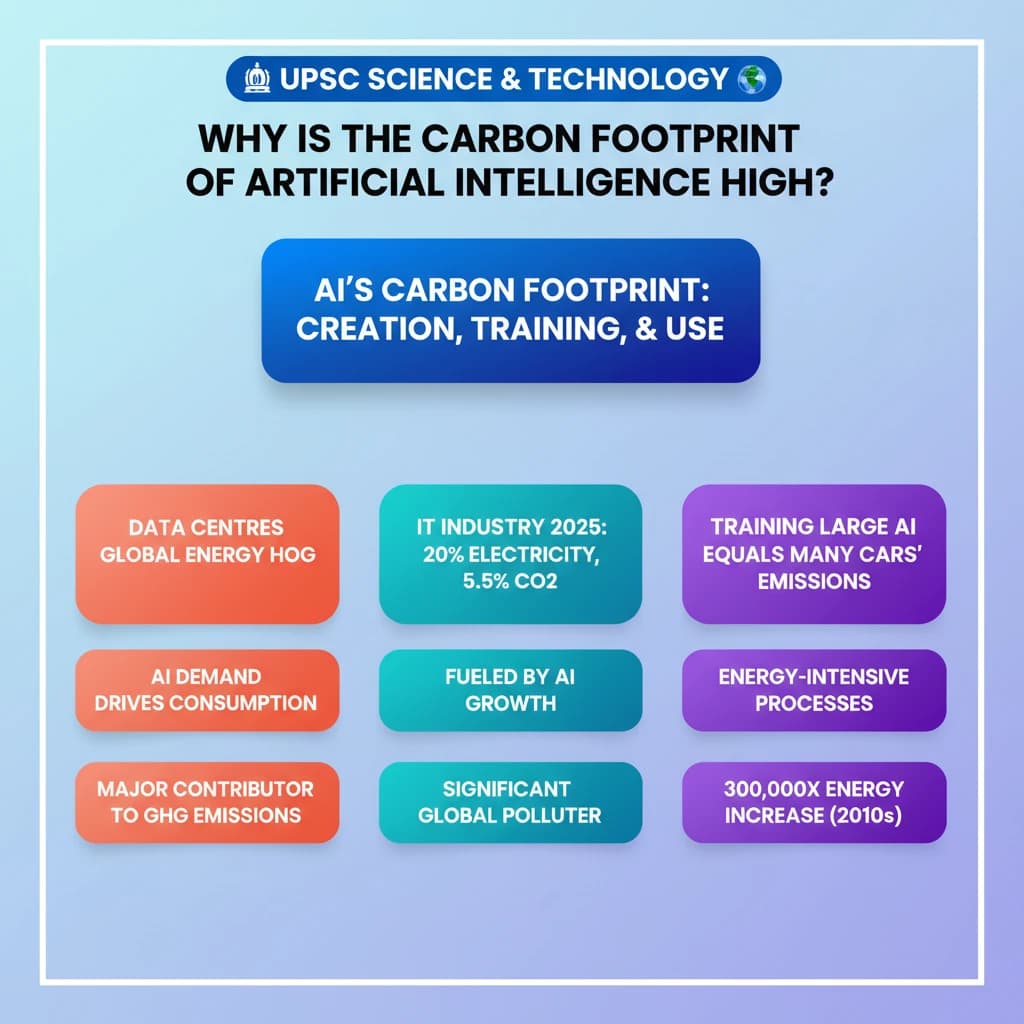
  • AI's carbon footprint includes all GHG emissions from its creation, training, and use.
  • Data centres, driven by AI demand, are major contributors to global energy consumption.
  • By 2025, the IT industry (fueled by AI) could consume 20% of global electricity and emit 5.5% of carbon.
  • Training large AI models (like GPT-3) is extremely energy-intensive, emitting CO2 equivalent to multiple cars' lifetimes.
  • AI energy requirements have increased 300,000-fold since the early 2010s AI boom.
Why is the Carbon Footprint of Artificial Intelligence High?

Why is the Carbon Footprint of Artificial Intelligence High?

Medium⏱️ 8 min read✓ 95% Verified
science and technology

📖 Introduction

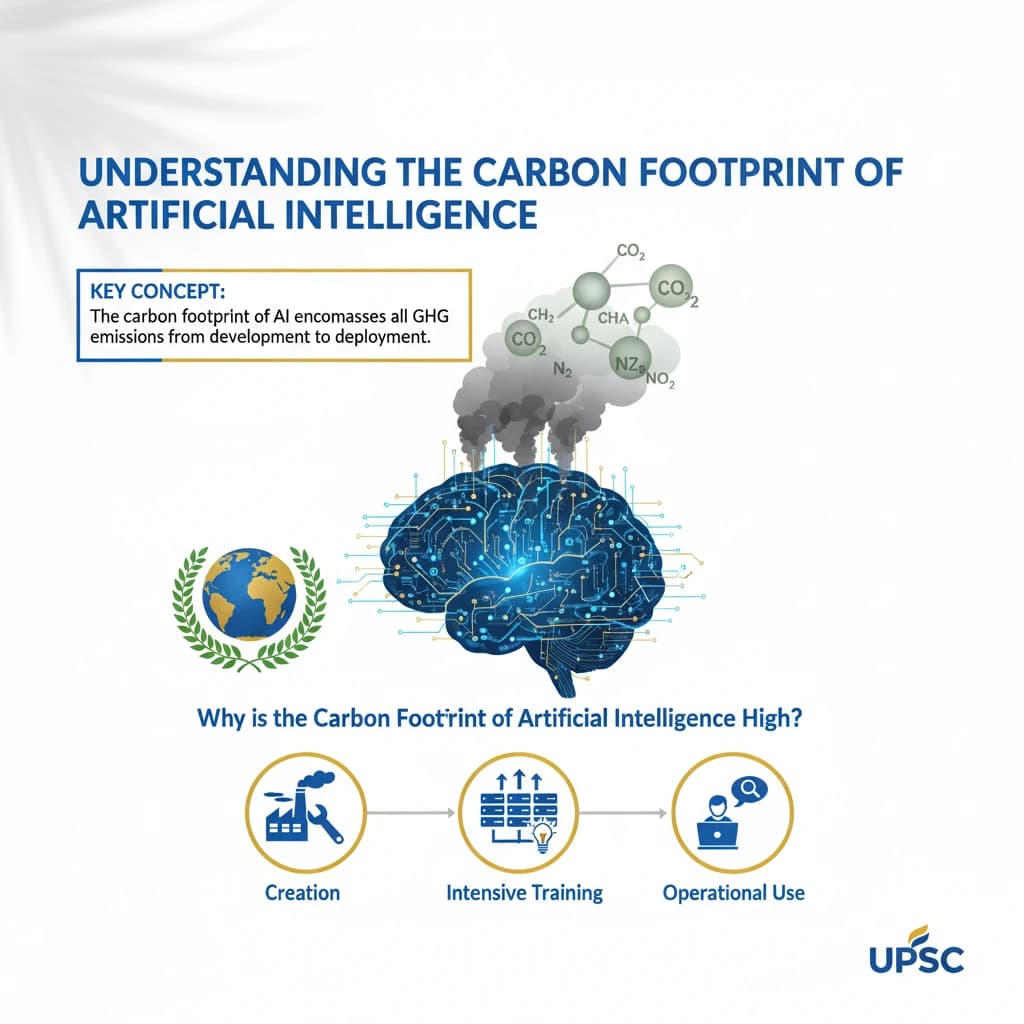
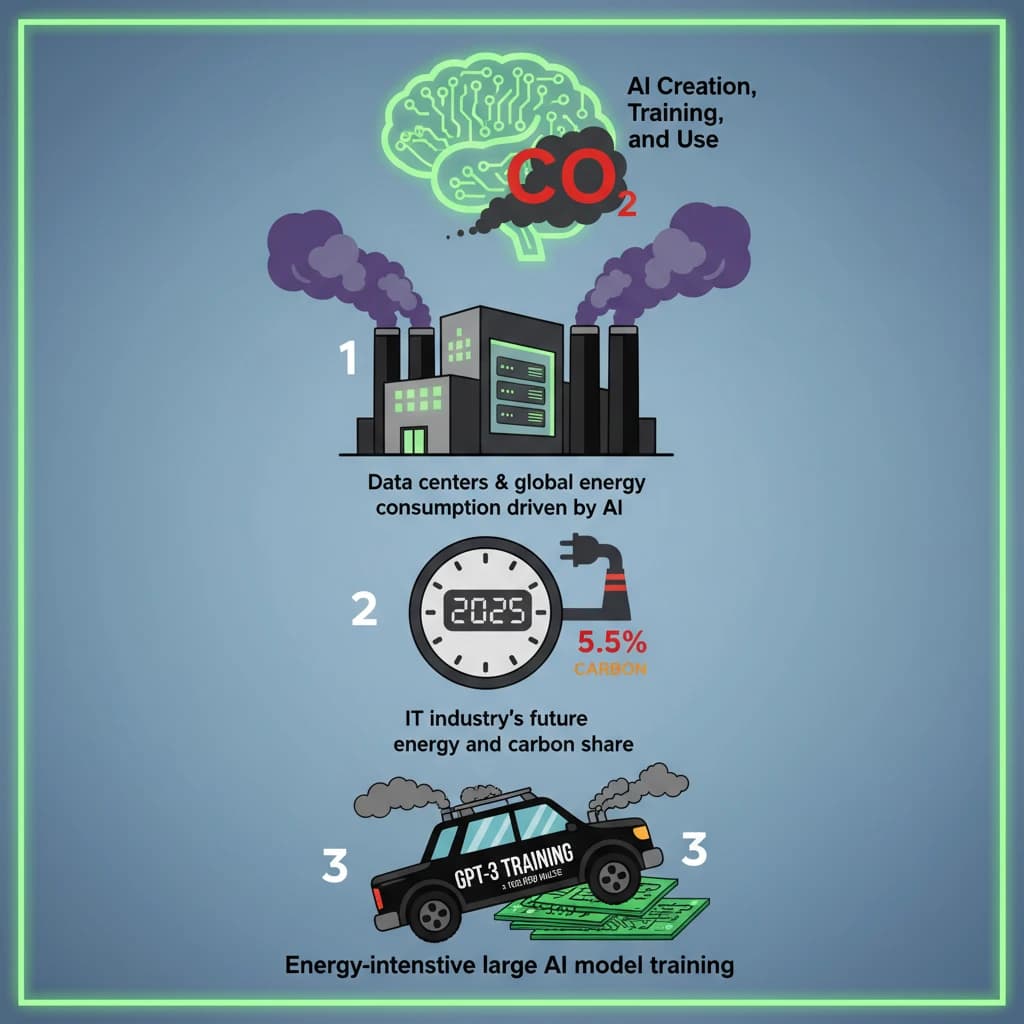
<h4>Understanding the Carbon Footprint of Artificial Intelligence</h4><p>The <strong>carbon footprint of artificial intelligence (AI)</strong> refers to the total amount of <strong>greenhouse gas (GHG) emissions</strong> generated throughout the entire lifecycle of AI systems. This includes their creation, intensive training, and subsequent operational use.</p><div class='key-point-box'><p><strong>Key Concept:</strong> The carbon footprint of AI encompasses all GHG emissions from development to deployment, highlighting its environmental impact.</p></div><h4>Growing Energy Consumption and Data Centres</h4><p>The rapid proliferation of <strong>data centres</strong> is a primary driver behind the increasing energy demands of AI. These facilities are essential for storing, processing, and powering the complex computations required by AI algorithms.</p><p>As the demand for AI technologies continues to surge, so does the energy consumption associated with these data centres globally.</p><div class='info-box'><p><strong>Projected Energy Consumption:</strong> By <strong>2025</strong>, it is estimated that the <strong>Information Technology (IT) industry</strong>, significantly propelled by AI advancements, could consume up to <strong>20% of all electricity produced globally</strong>. This could lead to approximately <strong>5.5% of the world's total carbon emissions</strong>.</p></div><h4>Significant Emissions from AI Model Training</h4><p>Training large and sophisticated <strong>AI models</strong>, such as <strong>Large Language Models (LLMs)</strong> like <strong>GPT-3</strong> and <strong>GPT-4</strong>, is an incredibly energy-intensive process. This training consumes substantial amounts of electricity, leading to considerable <strong>carbon dioxide (CO2) emissions</strong>.</p><p>Research indicates that the energy expended in training a single large AI model can result in CO2 emissions equivalent to those produced by several cars over their entire lifetimes.</p><div class='info-box'><p><strong>Example: GPT-3 Emissions:</strong> The training and operation of <strong>GPT-3</strong> alone are estimated to emit approximately <strong>8.4 tonnes of CO2 annually</strong>.</p></div><p>Since the beginning of the <strong>AI boom in the early 2010s</strong>, the energy requirements for training advanced AI systems, particularly large language models (the technology underpinning platforms like <strong>ChatGPT</strong>), have escalated dramatically.</p><div class='info-box'><p><strong>Energy Requirement Surge:</strong> The energy demand for AI systems has increased by an astonishing <strong>factor of 300,000</strong> since the early 2010s.</p></div><div class='exam-tip-box'><p><strong>UPSC Insight:</strong> Understanding the specific factors contributing to AI's carbon footprint (data centres, training intensity) is crucial for questions on <strong>sustainable technology</strong> and <strong>environmental impact</strong> in GS-III.</p></div>
Concept Diagram

💡 Key Takeaways

  • •AI's carbon footprint includes all GHG emissions from its creation, training, and use.
  • •Data centres, driven by AI demand, are major contributors to global energy consumption.
  • •By 2025, the IT industry (fueled by AI) could consume 20% of global electricity and emit 5.5% of carbon.
  • •Training large AI models (like GPT-3) is extremely energy-intensive, emitting CO2 equivalent to multiple cars' lifetimes.
  • •AI energy requirements have increased 300,000-fold since the early 2010s AI boom.

🧠 Memory Techniques
Memory Aid
95% Verified Content

📚 Reference Sources

•Academic research papers on AI energy consumption and carbon emissions (e.g., publications by Emma Strubell et al. on NLP's carbon footprint, OpenAI's GPT-3 details)
•Reports from organizations like the International Energy Agency (IEA) on data centre energy use.

Related Topics

Loading related topics...
Explore:Science And Technology Topics·All Subjects·Daily Current Affairs·Editorial Analysis·Previous Year Questions·UPSC GPT
Why is the Carbon Footprint of Artificial Intelligence High? - UPSC Science And Technology