Loading page, please wait…
Vaidra Logo
Vaidra

Top 4 items + smart groups

UPSC GPT
New
Current Affairs
Daily Solutions
Daily Puzzle
Mains Evaluator

Version 2.0.0 • Built with ❤️ for UPSC aspirants

Loading...
Loading...
Loading...
Loading...
Loading...
Loading...
Loading...
Loading...
Loading...
Loading...
Loading...
Loading...
Loading...
What are the Key Facts About DRDO? - UPSC Science And Technology
Back
All Subjects

Topics

0 topics • 0 completed

Loading topics...
Loading...
Loading...
Loading...
Loading...
Loading...
Overall Progress0%

What are the Key Facts About DRDO? - UPSC Science And Technology

What is What are the Key Facts About DRDO? in UPSC Science And Technology?

What are the Key Facts About DRDO? is a key topic under Science And Technology for UPSC Civil Services Examination. Key points include: DRDO was established in <strong>1958</strong> by merging three defence entities, serving as the <strong>R&D wing of the Ministry of Defence</strong>.. It has grown from <strong>10 to 41 laboratories</strong>, plus <strong>5 DRDO Young Scientist Laboratories (DYSLs)</strong>.. Key <strong>2024 achievements</strong> include handover of <strong>Air Defence</strong>, <strong>Missile Systems (LR-LACM, QRSAM, MRAShM)</strong>, <strong>Advanced Platforms (MMA, SCA, PRACHAND)</strong>.. Understanding this topic is essential for both UPSC Prelims and Mains preparation.

Why is What are the Key Facts About DRDO? important for UPSC exam?

What are the Key Facts About DRDO? is a Medium-level topic in UPSC Science And Technology. It is tested in both Prelims (factual MCQs) and Mains (analytical answer writing). Previous year UPSC questions have frequently covered aspects of What are the Key Facts About DRDO?, making it essential for comprehensive IAS preparation.

How to prepare What are the Key Facts About DRDO? for UPSC?

To prepare What are the Key Facts About DRDO? for UPSC: (1) Study the comprehensive notes covering all key concepts on Vaidra. (2) Practice previous year questions on this topic. (3) Connect it with current affairs using daily updates. (4) Revise using key takeaways and mind maps available for Science And Technology. (5) Write practice answers linking What are the Key Facts About DRDO? to related GS Paper topics.

Key takeaways of What are the Key Facts About DRDO? for UPSC

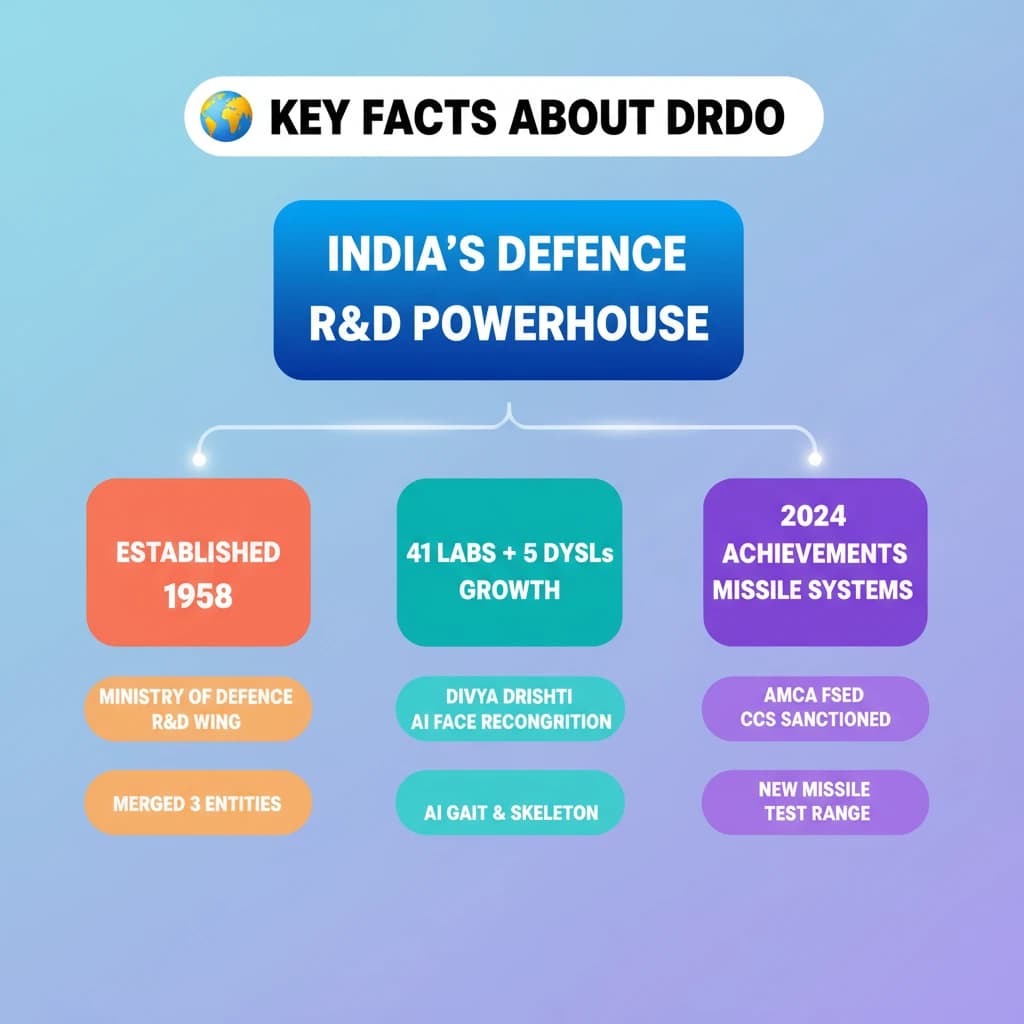
  • DRDO was established in <strong>1958</strong> by merging three defence entities, serving as the <strong>R&D wing of the Ministry of Defence</strong>.
  • It has grown from <strong>10 to 41 laboratories</strong>, plus <strong>5 DRDO Young Scientist Laboratories (DYSLs)</strong>.
  • Key <strong>2024 achievements</strong> include handover of <strong>Air Defence</strong>, <strong>Missile Systems (LR-LACM, QRSAM, MRAShM)</strong>, <strong>Advanced Platforms (MMA, SCA, PRACHAND)</strong>.
  • Developed <strong>'Divya Drishti'</strong>, an <strong>AI tool</strong> for face recognition integrated with gait and skeleton analysis.
  • <strong>CCS sanctioned flagship programs</strong>: <strong>Full Scale Engineering Development (FSED) of AMCA</strong> and a <strong>new Missile Test Range in Andhra Pradesh</strong>.
  • DRDO has developed a wide range of <strong>missile systems</strong> (Air-to-Air, Surface-to-Air, Surface-to-Surface, Cruise) and contributed to <strong>LCA Tejas</strong>.
  • Its work is crucial for <strong>'Atmanirbhar Bharat'</strong> in defence, promoting indigenous capabilities and strategic autonomy.
What are the Key Facts About DRDO?

What are the Key Facts About DRDO?

Medium⏱️ 12 min read✓ 95% Verified
science and technology

📖 Introduction

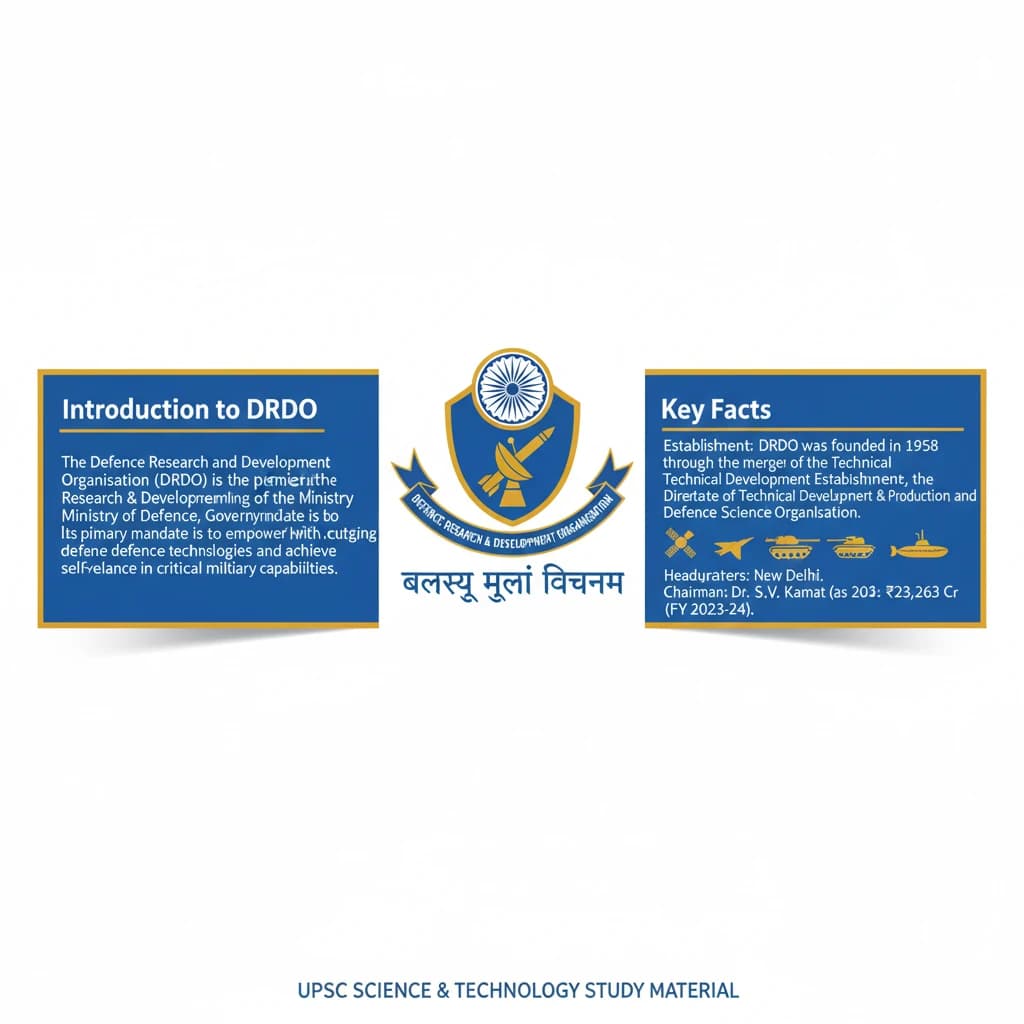
<h4>Introduction to DRDO</h4><p>The <strong>Defence Research and Development Organisation (DRDO)</strong> is the premier <strong>Research & Development (R&D) wing</strong> of the <strong>Ministry of Defence, Government of India</strong>. Its primary mandate is to empower India with cutting-edge defence technologies and achieve self-reliance in critical military capabilities.</p><div class='info-box'> <p><strong>Establishment:</strong> DRDO was founded in <strong>1958</strong> through the merger of three key defence entities:</p> <ul> <li>The <strong>Technical Development Establishment (TDEs)</strong> of the Indian Army.</li> <li>The <strong>Directorate of Technical Development and Production (DTDP)</strong>.</li> <li>The <strong>Defence Science Organisation (DSO)</strong>.</li> </ul></div><p>Starting with a modest <strong>10 laboratories</strong> at its inception, DRDO has significantly expanded its footprint. It currently operates a vast network of <strong>41 laboratories</strong> and <strong>5 DRDO Young Scientist Laboratories (DYSLs)</strong> across the nation, focusing on diverse areas of defence technology.</p><h4>Key Achievements and Contributions of DRDO</h4><p>Over the decades, DRDO has been instrumental in developing a wide array of defence systems, platforms, and technologies. These contributions have bolstered India's national security and reduced its dependence on foreign imports.</p><div class='key-point-box'> <p>DRDO's work spans various domains, including <strong>missile technology</strong>, <strong>aeronautics</strong>, <strong>electronics</strong>, <strong>armaments</strong>, <strong>combat engineering</strong>, and <strong>life sciences</strong>, among others. Its efforts are central to India's strategic autonomy.</p></div><h4>DRDO's Notable Achievements in 2024</h4><p>The year <strong>2024</strong> witnessed significant milestones for DRDO, marked by the handover of advanced systems and the sanctioning of crucial flagship programs.</p><h5>System Handover: Strengthening India's Defence Capabilities</h5><p>DRDO successfully handed over multiple advanced systems to the Indian armed forces, enhancing their operational readiness and strategic advantage. These systems represent years of indigenous research and development.</p><div class='info-box'> <p><strong>Notable Systems Handed Over:</strong></p> <ul> <li><strong>Air Defence Systems:</strong> <ul> <li><strong>Air Defence Tactical Control Radar (ADTCR)</strong></li> <li><strong>Air Defence Fire Control Radar (ADFCR)</strong></li> </ul> </li> <li><strong>Missile Systems:</strong> <ul> <li><strong>Long Range Land Attack Cruise Missile (LR-LACM)</strong></li> <li><strong>Quick Reaction Surface to Air Missile (QRSAM)</strong></li> <li><strong>Medium Range Anti-Ship Missile (MRAShM)</strong></li> </ul> </li> <li><strong>Advanced Platforms & Munitions:</strong> <ul> <li><strong>Multi-Mission Maritime Aircraft (MMA)</strong></li> <li><strong>SCA (Signal Intelligence and COMJAM Aircraft)</strong></li> <li><strong>Anti-Tank Influence Mine PRACHAND</strong></li> </ul> </li> </ul></div><h5>AI Tools Development: 'Divya Drishti'</h5><p>In a significant stride towards integrating artificial intelligence into defence, DRDO developed an innovative AI tool named <strong>'Divya Drishti'</strong>. This tool showcases advanced capabilities in surveillance and identification.</p><div class='info-box'> <p><strong>About 'Divya Drishti':</strong></p> <ul> <li>An <strong>AI tool</strong> that integrates <strong>face recognition</strong> technology.</li> <li>Combines face recognition with <strong>immutable physiological traits</strong> such as <strong>gait (pattern of walking)</strong> and <strong>skeleton analysis</strong> for enhanced accuracy and identification.</li> </ul></div><h5>Flagship Programs Sanctioned by CCS</h5><p>The <strong>Cabinet Committee on Security (CCS)</strong> sanctioned two pivotal flagship programs, underscoring India's commitment to advanced defence manufacturing and testing infrastructure.</p><div class='key-point-box'> <p><strong>Sanctioned Programs:</strong></p> <ol> <li><strong>Full Scale Engineering Development (FSED) of Advanced Medium Combat Aircraft (AMCA):</strong> This program aims to develop India's next-generation <strong>stealth fighter aircraft</strong>, a critical step in aerospace self-reliance.</li> <li><strong>New Missile Test Range in Andhra Pradesh:</strong> Establishment of a dedicated facility to further enhance India's capabilities in <strong>missile testing and evaluation</strong>.</li> </ol></div><h4>Overview of Major Missile Systems Developed by DRDO</h4><p>DRDO has been a pioneer in developing a comprehensive range of missile systems, categorized by their launch platforms and targets. These systems form the backbone of India's strategic deterrence.</p><div class='info-box'> <table class='info-table'> <tr> <th>Missile Type</th> <th>Examples</th> </tr> <tr> <td><strong>Air-to-Air Missile</strong></td> <td><strong>MICA</strong>, <strong>Astra Missile</strong></td> </tr> <tr> <td><strong>Surface-to-Air Missiles</strong></td> <td><strong>Trishul</strong>, <strong>Akash</strong>, <strong>Barak 8</strong></td> </tr> <tr> <td><strong>Surface-to-Surface Missiles</strong></td> <td><strong>Agni</strong> (series), <strong>Prithvi</strong> (series), <strong>Dhanush</strong>, <strong>Shaurya</strong></td> </tr> <tr> <td><strong>Cruise Missiles</strong></td> <td><strong>BrahMos</strong>, <strong>Nirbhay</strong></td> </tr> </table></div><h4>DRDO's Contribution to Combat Aircraft</h4><p>Beyond missile technology, DRDO has made significant strides in indigenous aircraft development, notably with the Light Combat Aircraft program.</p><div class='info-box'> <p><strong>Indigenous Fighter Jet:</strong></p> <ul> <li><strong>Light Combat Aircraft (LCA) Tejas:</strong> A multi-role light fighter developed by <strong>Aeronautical Development Agency (ADA)</strong> and produced by <strong>Hindustan Aeronautics Limited (HAL)</strong>, with DRDO playing a crucial R&D role.</li> </ul></div><div class='exam-tip-box'> <p><strong>UPSC Insight:</strong> Questions on DRDO often appear in <strong>GS-III Science & Technology</strong> and <strong>Internal Security</strong>. Focus on its role in <strong>self-reliance</strong>, specific <strong>flagship programs</strong>, and the <strong>strategic implications</strong> of its developments.</p></div>
Concept Diagram

💡 Key Takeaways

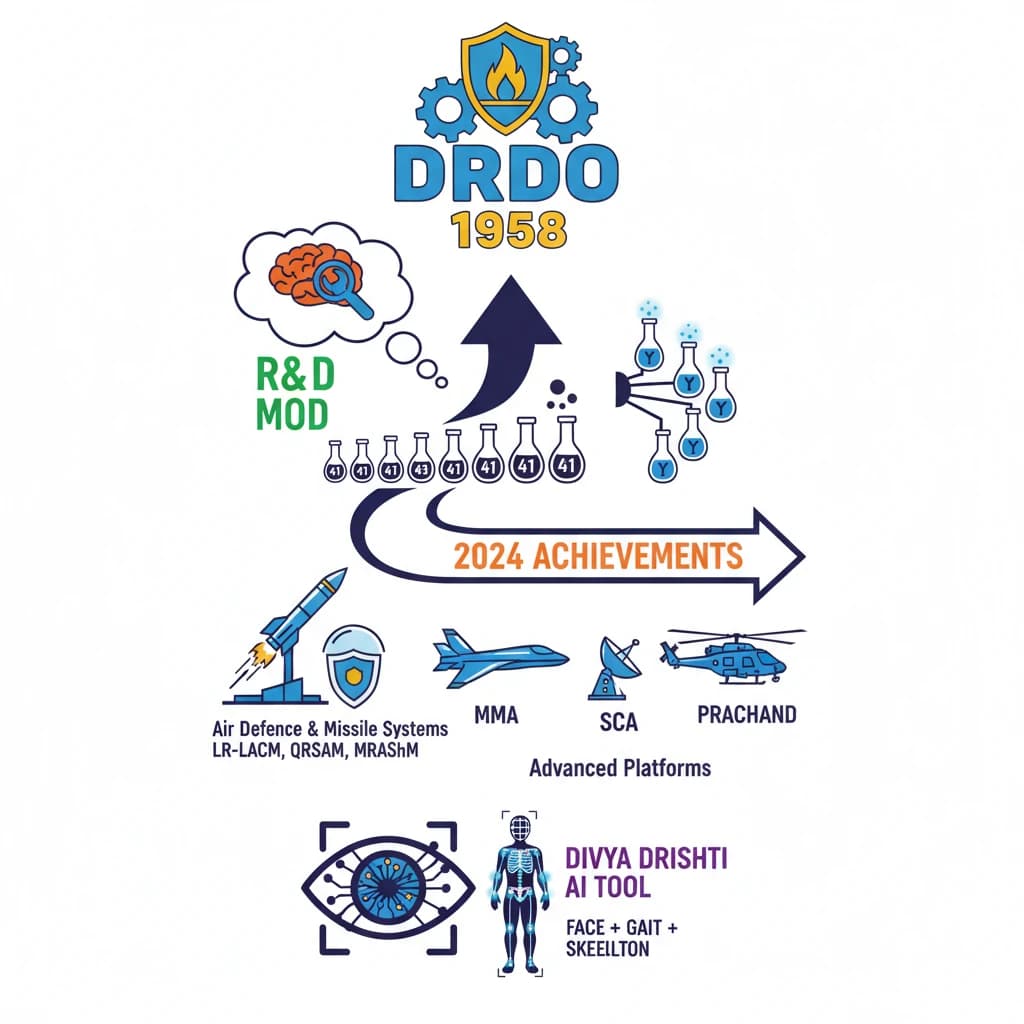
  • •DRDO was established in <strong>1958</strong> by merging three defence entities, serving as the <strong>R&D wing of the Ministry of Defence</strong>.
  • •It has grown from <strong>10 to 41 laboratories</strong>, plus <strong>5 DRDO Young Scientist Laboratories (DYSLs)</strong>.
  • •Key <strong>2024 achievements</strong> include handover of <strong>Air Defence</strong>, <strong>Missile Systems (LR-LACM, QRSAM, MRAShM)</strong>, <strong>Advanced Platforms (MMA, SCA, PRACHAND)</strong>.
  • •Developed <strong>'Divya Drishti'</strong>, an <strong>AI tool</strong> for face recognition integrated with gait and skeleton analysis.
  • •<strong>CCS sanctioned flagship programs</strong>: <strong>Full Scale Engineering Development (FSED) of AMCA</strong> and a <strong>new Missile Test Range in Andhra Pradesh</strong>.
  • •DRDO has developed a wide range of <strong>missile systems</strong> (Air-to-Air, Surface-to-Air, Surface-to-Surface, Cruise) and contributed to <strong>LCA Tejas</strong>.
  • •Its work is crucial for <strong>'Atmanirbhar Bharat'</strong> in defence, promoting indigenous capabilities and strategic autonomy.

🧠 Memory Techniques
Memory Aid
95% Verified Content

📚 Reference Sources

•Official DRDO Website (General information and mission statement)
•Ministry of Defence Press Releases (for 2024 achievements and flagship programs)

Related Topics

Loading related topics...
Explore:Science And Technology Topics·All Subjects·Daily Current Affairs·Editorial Analysis·Previous Year Questions·UPSC GPT