Loading page, please wait…
Vaidra Logo
Vaidra

Top 4 items + smart groups

UPSC GPT
New
Current Affairs
Daily Solutions
Daily Puzzle
Mains Evaluator

Version 2.0.0 • Built with ❤️ for UPSC aspirants

Loading...
Loading...
Loading...
Loading...
Loading...
Loading...
Loading...
Loading...
Loading...
Loading...
Loading...
Loading...
Loading...
What are the Key Features of MACE? - UPSC Science And Technology
Back
All Subjects

Topics

0 topics • 0 completed

Loading topics...
Loading...
Loading...
Loading...
Loading...
Loading...
Overall Progress0%

What are the Key Features of MACE? - UPSC Science And Technology

What is What are the Key Features of MACE? in UPSC Science And Technology?

What are the Key Features of MACE? is a key topic under Science And Technology for UPSC Civil Services Examination. Key points include: MACE is the highest and one of the largest Imaging Atmospheric Cherenkov Telescopes (IACTs) globally.. It indirectly detects high-energy gamma rays by capturing Cherenkov radiation produced in the atmosphere.. Key objectives include studying cosmic gamma-ray sources and searching for dark matter (WIMP annihilation).. Understanding this topic is essential for both UPSC Prelims and Mains preparation.

Why is What are the Key Features of MACE? important for UPSC exam?

What are the Key Features of MACE? is a Medium-level topic in UPSC Science And Technology. It is tested in both Prelims (factual MCQs) and Mains (analytical answer writing). Previous year UPSC questions have frequently covered aspects of What are the Key Features of MACE?, making it essential for comprehensive IAS preparation.

How to prepare What are the Key Features of MACE? for UPSC?

To prepare What are the Key Features of MACE? for UPSC: (1) Study the comprehensive notes covering all key concepts on Vaidra. (2) Practice previous year questions on this topic. (3) Connect it with current affairs using daily updates. (4) Revise using key takeaways and mind maps available for Science And Technology. (5) Write practice answers linking What are the Key Features of MACE? to related GS Paper topics.

Key takeaways of What are the Key Features of MACE? for UPSC

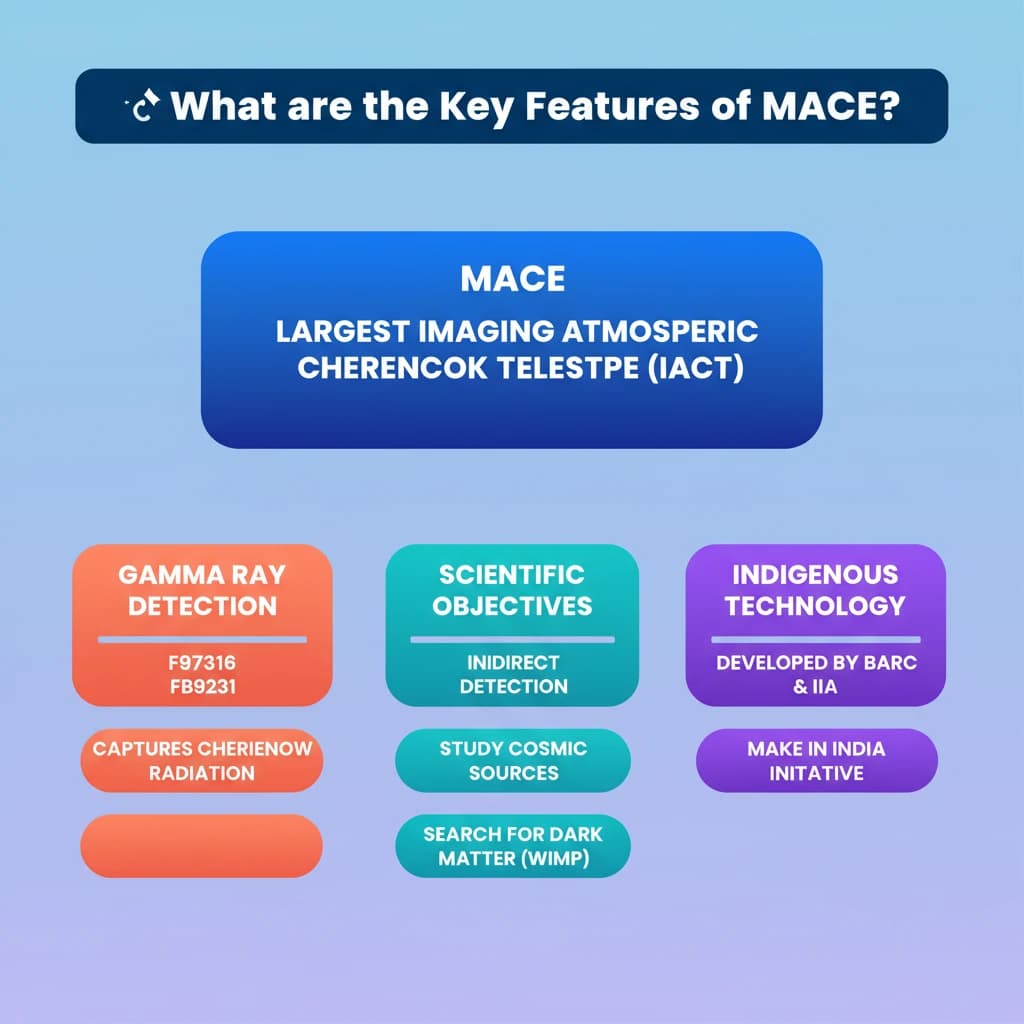
  • MACE is the highest and one of the largest Imaging Atmospheric Cherenkov Telescopes (IACTs) globally.
  • It indirectly detects high-energy gamma rays by capturing Cherenkov radiation produced in the atmosphere.
  • Key objectives include studying cosmic gamma-ray sources and searching for dark matter (WIMP annihilation).
  • Developed by BARC and IIA, it represents a significant indigenous technological achievement for India.
  • Its high-altitude location and advanced camera system are crucial for its observational capabilities.
What are the Key Features of MACE?

What are the Key Features of MACE?

Medium⏱️ 7 min read✓ 95% Verified
science and technology

📖 Introduction

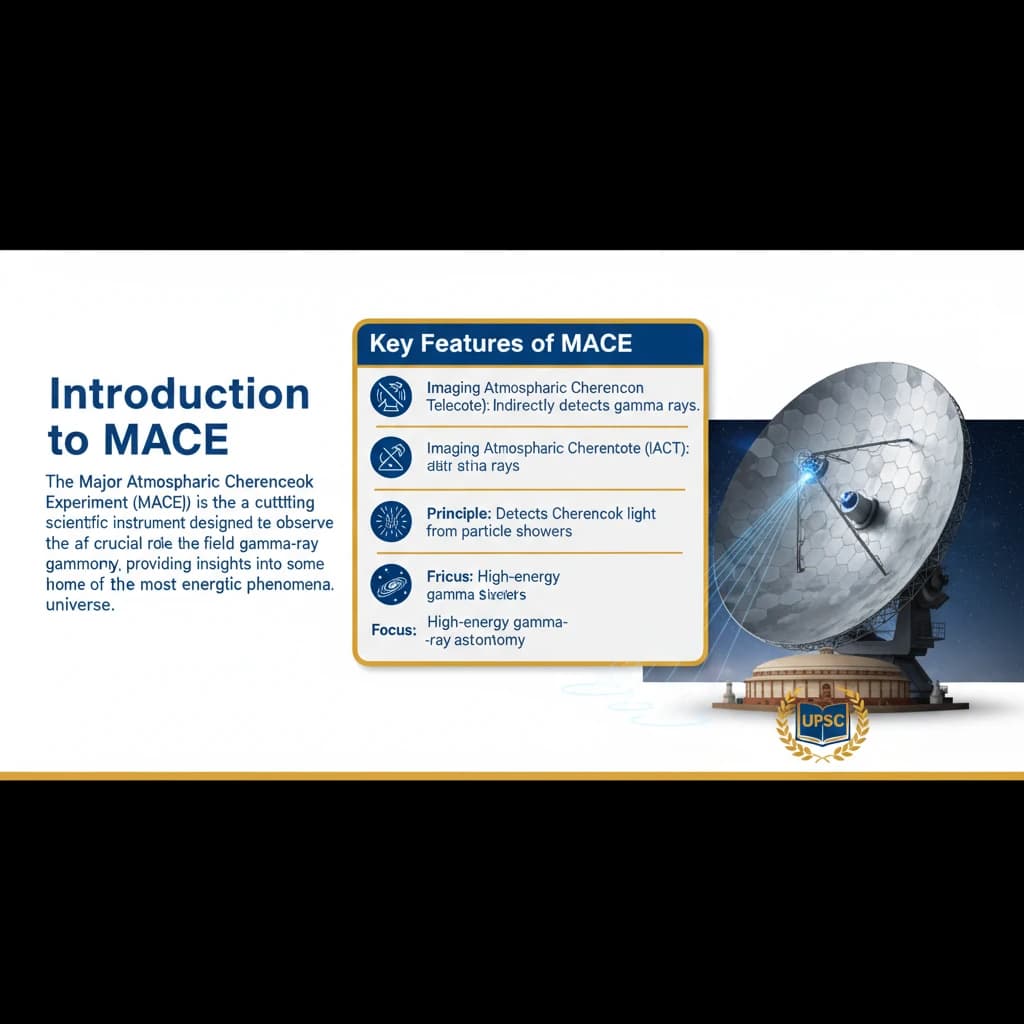
<h4>Introduction to MACE</h4><p>The <strong>Major Atmospheric Cherenkov Experiment (MACE)</strong> is a cutting-edge scientific instrument designed to observe the cosmos. It plays a crucial role in the field of <strong>gamma-ray astronomy</strong>, providing insights into some of the most energetic phenomena in the universe.</p><div class='key-point-box'><p><strong>MACE</strong> is an <strong>Imaging Atmospheric Cherenkov Telescope (IACT)</strong>. Its primary function is to indirectly detect <strong>high-energy gamma rays</strong> originating from various cosmic sources.</p></div><h4>Location and Scale</h4><p><strong>MACE</strong> is strategically located at an altitude of approximately <strong>4.3 kilometers</strong>. This elevated position provides a clearer view of the sky, minimizing atmospheric interference and enhancing observational capabilities.</p><div class='info-box'><p><strong>Global Standing:</strong></p><ul><li>Highest imaging Cherenkov telescope globally.</li><li>Largest of its kind in Asia.</li><li>Second-largest worldwide.</li></ul></div><h4>Function and Detection Mechanism</h4><p>When <strong>high-energy gamma rays</strong> from cosmic sources enter Earth’s atmosphere, they interact with atmospheric particles. This interaction leads to the creation of <strong>electron-positron pairs</strong>, initiating a particle shower.</p><p>These rapidly moving charged particles (electrons and positrons) travel faster than the speed of light in the local medium (air). This phenomenon results in the emission of faint blue light, known as <strong>Cherenkov radiation</strong>.</p><p><strong>MACE</strong> is specifically designed to capture this ephemeral <strong>Cherenkov radiation</strong> using its highly sensitive equipment. By analyzing this light, scientists can deduce the properties and origins of the incoming <strong>gamma rays</strong>.</p><h4>Key Architectural Features</h4><p>The telescope's ability to collect faint light is significantly enhanced by its sophisticated light collector. This component is crucial for gathering the weak signals of <strong>Cherenkov radiation</strong>.</p><div class='info-box'><p><strong>Light Collector Specifications:</strong></p><ul><li>Composed of <strong>356 mirror panels</strong>.</li><li>Arranged in a <strong>honeycomb structure</strong>.</li><li>Enhances both <strong>stability</strong> and the overall <strong>reflective area</strong>.</li></ul></div><h4>Research Objectives</h4><p>The fundamental goal of <strong>MACE</strong> is to conduct in-depth studies of <strong>high-energy gamma rays</strong> emitted from various cosmic sources. This research contributes significantly to our understanding of the extreme universe.</p><p>A major objective is to investigate the elusive nature of <strong>dark matter</strong>. <strong>MACE</strong> aims to detect <strong>gamma rays</strong> that might be produced from the annihilation events of <strong>Weakly Interacting Massive Particles (WIMPs)</strong>.</p><div class='key-point-box'><p>Understanding <strong>WIMPs</strong> is critical, as these hypothetical particles are believed to constitute a substantial portion of the universe's total mass, yet they do not interact with ordinary matter via electromagnetic or strong nuclear forces.</p></div><h4>Institutions Involved</h4><p>The development and operation of <strong>MACE</strong> involve significant collaboration between leading Indian scientific institutions. These collaborations are vital for advancing India's capabilities in high-energy astrophysics.</p><div class='info-box'><p><strong>Primary Institutions:</strong></p><ul><li><strong>Bhabha Atomic Research Centre (BARC)</strong></li><li><strong>Indian Institute of Astrophysics (IIA)</strong></li></ul></div><h4>Technological Innovations</h4><p><strong>MACE</strong> incorporates several advanced technological features to ensure its observational prowess. These innovations are key to its ability to detect extremely faint and short-lived signals.</p><div class='info-box'><p><strong>High-Resolution Camera:</strong></p><ul><li>Equipped with <strong>1,088 photomultiplier tubes</strong>.</li><li>Designed to detect and significantly amplify faint signals from <strong>Cherenkov radiation</strong>.</li></ul></div><p>The telescope's elevated location provides a distinct advantage. Positioned high above the majority of atmospheric disturbances, it offers a clearer and more stable view of the celestial sphere, optimizing its observational capabilities.</p><div class='exam-tip-box'><p>For <strong>UPSC GS Paper 3 (Science and Technology)</strong>, understanding instruments like <strong>MACE</strong> is crucial. Focus on its purpose (gamma-ray detection, dark matter), location, and the underlying scientific principle (Cherenkov radiation).</p></div>
Concept Diagram

💡 Key Takeaways

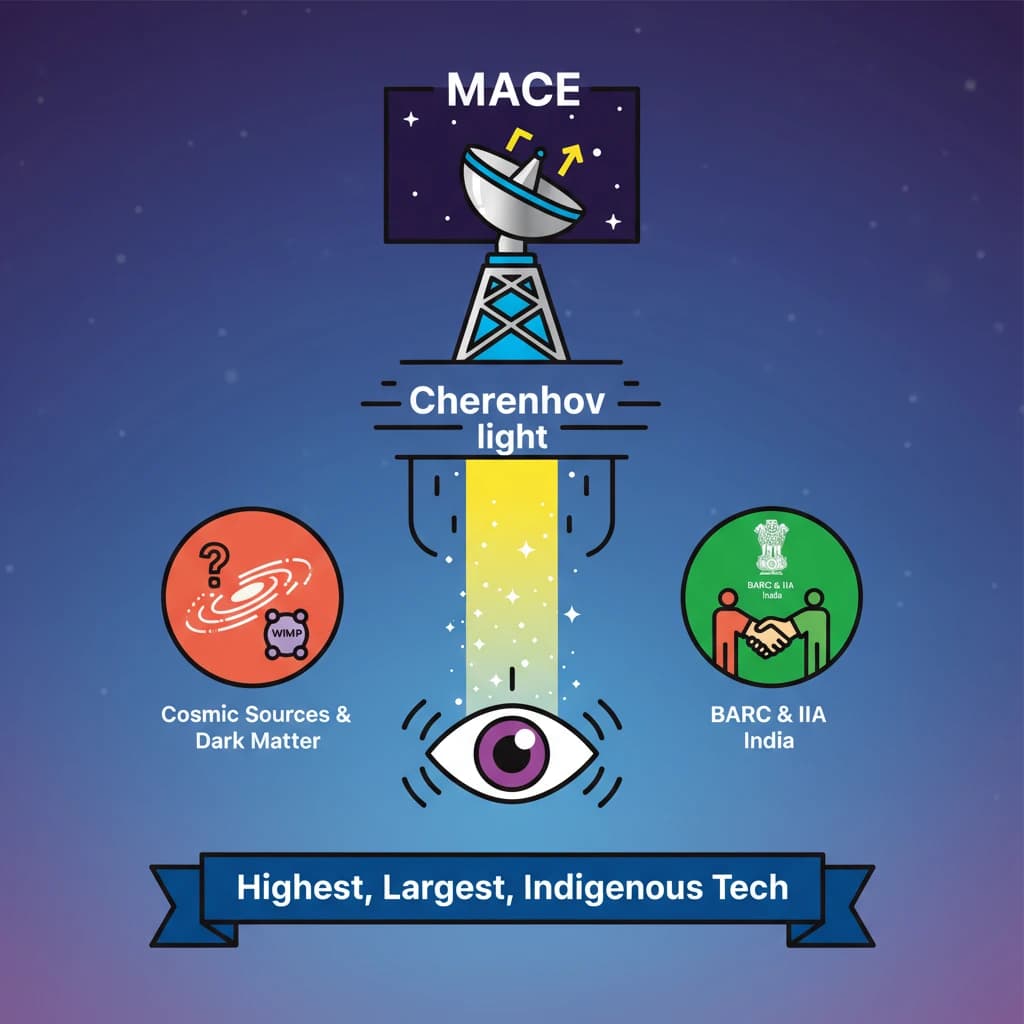
  • •MACE is the highest and one of the largest Imaging Atmospheric Cherenkov Telescopes (IACTs) globally.
  • •It indirectly detects high-energy gamma rays by capturing Cherenkov radiation produced in the atmosphere.
  • •Key objectives include studying cosmic gamma-ray sources and searching for dark matter (WIMP annihilation).
  • •Developed by BARC and IIA, it represents a significant indigenous technological achievement for India.
  • •Its high-altitude location and advanced camera system are crucial for its observational capabilities.

🧠 Memory Techniques
Memory Aid
95% Verified Content

📚 Reference Sources

•Bhabha Atomic Research Centre (BARC) official publications
•Indian Institute of Astrophysics (IIA) research outlines
•General astrophysics and particle physics literature on Cherenkov telescopes

Related Topics

Loading related topics...
Explore:Science And Technology Topics·All Subjects·Daily Current Affairs·Editorial Analysis·Previous Year Questions·UPSC GPT