Loading page, please wait…
Vaidra Logo
Vaidra

Top 4 items + smart groups

UPSC GPT
New
Current Affairs
Daily Solutions
Daily Puzzle
Mains Evaluator

Version 2.0.0 • Built with ❤️ for UPSC aspirants

Loading...
Loading...
Loading...
Loading...
Loading...
Loading...
Loading...
Loading...
Loading...
Loading...
Loading...
Loading...
Loading...
Back
All Subjects

Topics

0 topics • 0 completed

Loading topics...
Loading...
Loading...
Loading...
Loading...
Loading...
Overall Progress0%

What are the Key Features of the Legal Metrology (IST) Rules, 2025? - UPSC Science And Technology

What is What are the Key Features of the Legal Metrology (IST) Rules, 2025? in UPSC Science And Technology?

What are the Key Features of the Legal Metrology (IST) Rules, 2025? is a key topic under Science And Technology for UPSC Civil Services Examination. Key points include: The Legal Metrology (IST) Rules, 2025 mandate the adoption of Indian Standard Time (IST) as the sole legal time standard.. IST is maintained and disseminated by the CSIR-National Physical Laboratory (CSIR-NPL).. The rules reinforce the principle of 'One Nation, One Time', promoting uniformity and precision across India.. Understanding this topic is essential for both UPSC Prelims and Mains preparation.

Why is What are the Key Features of the Legal Metrology (IST) Rules, 2025? important for UPSC exam?

What are the Key Features of the Legal Metrology (IST) Rules, 2025? is a Medium-level topic in UPSC Science And Technology. It is tested in both Prelims (factual MCQs) and Mains (analytical answer writing). Previous year UPSC questions have frequently covered aspects of What are the Key Features of the Legal Metrology (IST) Rules, 2025?, making it essential for comprehensive IAS preparation.

How to prepare What are the Key Features of the Legal Metrology (IST) Rules, 2025? for UPSC?

To prepare What are the Key Features of the Legal Metrology (IST) Rules, 2025? for UPSC: (1) Study the comprehensive notes covering all key concepts on Vaidra. (2) Practice previous year questions on this topic. (3) Connect it with current affairs using daily updates. (4) Revise using key takeaways and mind maps available for Science And Technology. (5) Write practice answers linking What are the Key Features of the Legal Metrology (IST) Rules, 2025? to related GS Paper topics.

Key takeaways of What are the Key Features of the Legal Metrology (IST) Rules, 2025? for UPSC

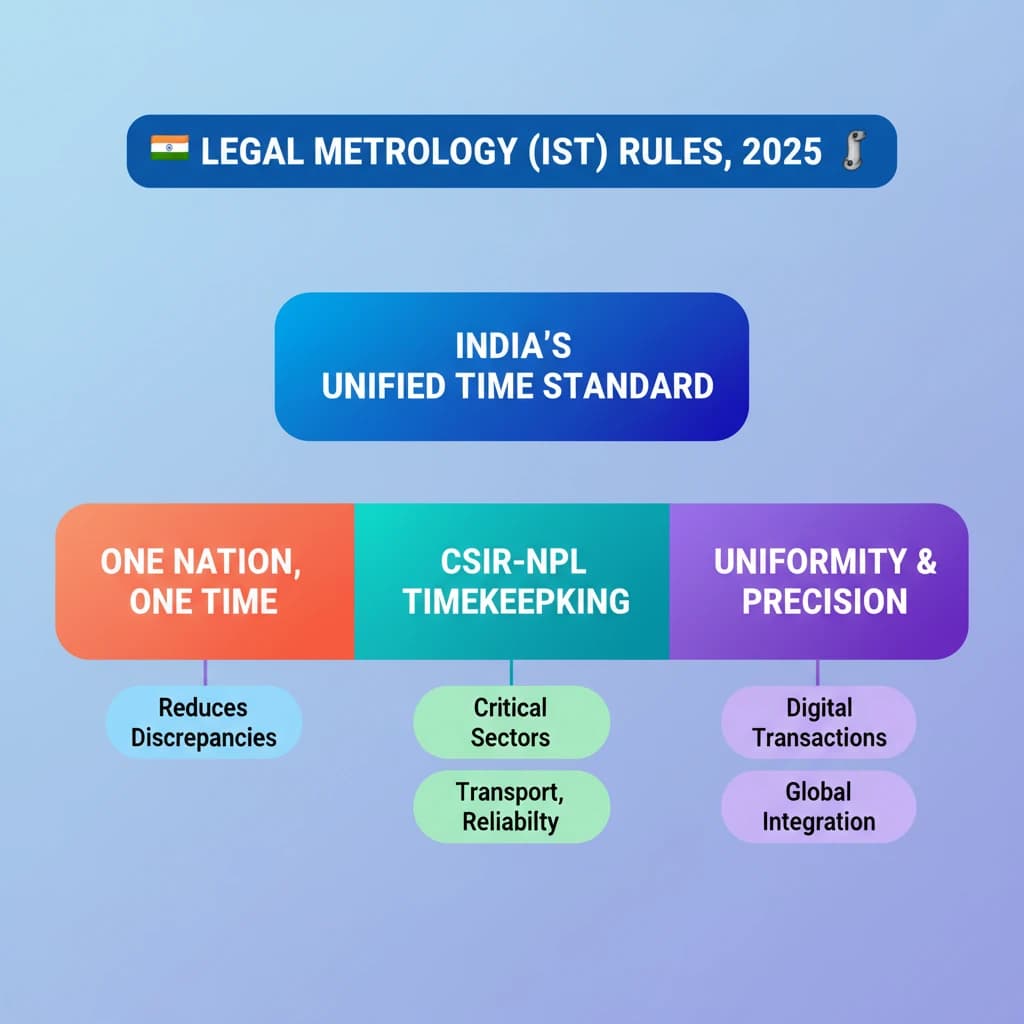
  • The Legal Metrology (IST) Rules, 2025 mandate the adoption of Indian Standard Time (IST) as the sole legal time standard.
  • IST is maintained and disseminated by the CSIR-National Physical Laboratory (CSIR-NPL).
  • The rules reinforce the principle of 'One Nation, One Time', promoting uniformity and precision across India.
  • This standardization is crucial for critical sectors like transportation, finance, digital transactions, and national security.
  • It enhances reliability, reduces discrepancies, and supports India's digital transformation and global integration efforts.
What are the Key Features of the Legal Metrology (IST) Rules, 2025?

What are the Key Features of the Legal Metrology (IST) Rules, 2025?

Medium⏱️ 8 min read✓ 95% Verified
science and technology

📖 Introduction

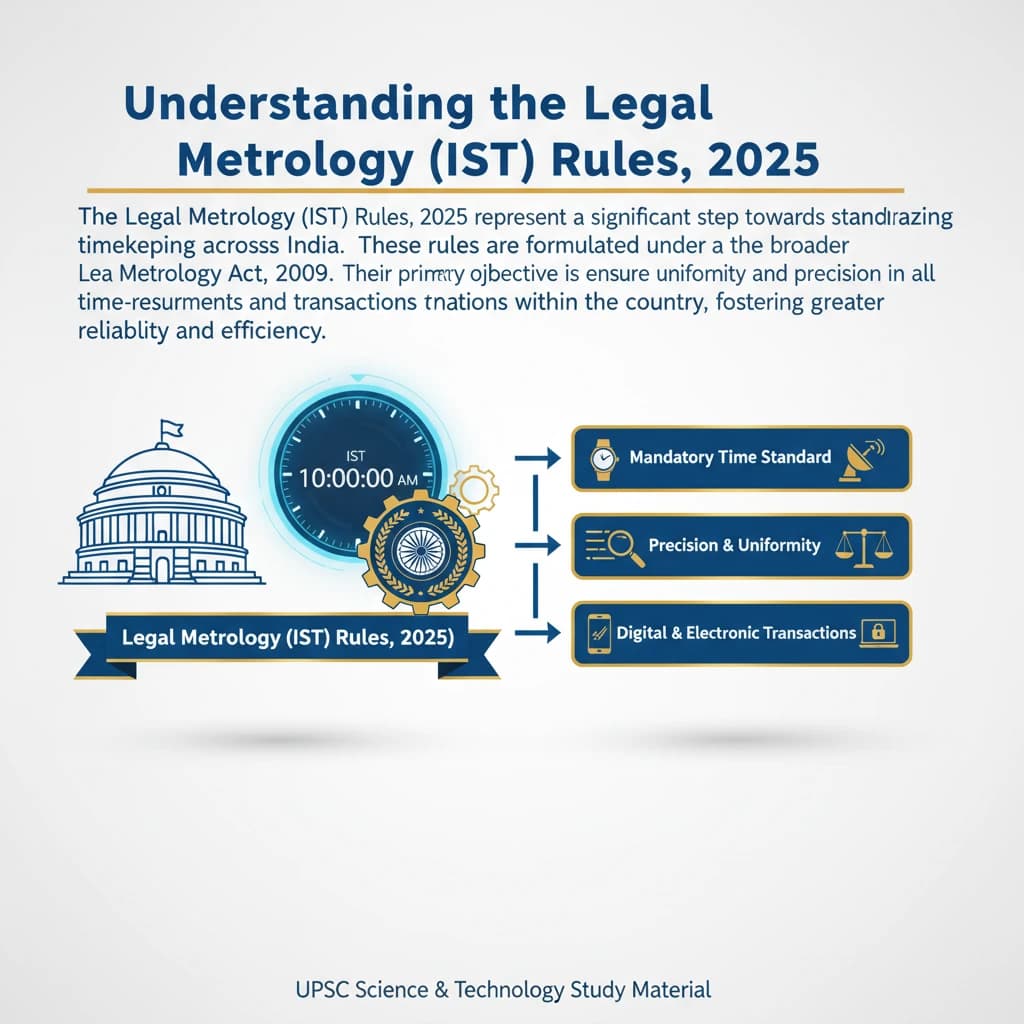
<h4>Understanding the Legal Metrology (IST) Rules, 2025</h4><p>The <strong>Legal Metrology (IST) Rules, 2025</strong> represent a significant step towards standardizing timekeeping across India. These rules are formulated under the broader framework of the <strong>Legal Metrology Act, 2009</strong>.</p><p>Their primary objective is to ensure uniformity and precision in all time-related measurements and transactions within the country, fostering greater reliability and efficiency.</p><h4>Mandatory Adoption of Indian Standard Time (IST)</h4><p>A central feature of the <strong>Legal Metrology (IST) Rules, 2025</strong> is the <strong>mandatory adoption of IST</strong>. This means that <strong>Indian Standard Time</strong> will become the sole legally recognized time standard throughout India for all official, commercial, and scientific purposes.</p><div class='info-box'><p><strong>Indian Standard Time (IST)</strong> is based on a longitude of <strong>82.5° E</strong>, passing near <strong>Mirzapur, Uttar Pradesh</strong>. It is <strong>5 hours and 30 minutes ahead of Coordinated Universal Time (UTC)</strong>.</p></div><h4>Role of CSIR-NPL</h4><p>The rules explicitly state that <strong>IST</strong>, as maintained by the <strong>Council of Scientific and Industrial Research - National Physical Laboratory (CSIR-NPL)</strong>, will be the official benchmark. <strong>CSIR-NPL</strong> is India's national metrology institute, responsible for maintaining and disseminating national standards of measurement.</p><div class='key-point-box'><p><strong>CSIR-NPL's</strong> role is crucial as it ensures the <strong>accuracy, traceability, and reliability</strong> of <strong>IST</strong> through advanced atomic clocks and precise calibration mechanisms.</p></div><h4>Reinforcing "One Nation, One Time"</h4><p>The mandatory adoption of <strong>IST</strong> strongly reinforces the principle of <strong>"One Nation, One Time."</strong> This initiative aims to eliminate any potential ambiguities or discrepancies in timekeeping that could arise from unofficial or localized time standards.</p><div class='exam-tip-box'><p>This concept is vital for national integration and efficient governance. UPSC aspirants should connect it with other 'One Nation' initiatives like <strong>'One Nation, One Ration Card'</strong> or <strong>'One Nation, One Grid'</strong> to demonstrate holistic understanding.</p></div><p>A unified time standard is essential for critical sectors such as transportation, communication, financial markets, and national defense, where synchronized operations are paramount.</p>
Concept Diagram

💡 Key Takeaways

  • •The Legal Metrology (IST) Rules, 2025 mandate the adoption of Indian Standard Time (IST) as the sole legal time standard.
  • •IST is maintained and disseminated by the CSIR-National Physical Laboratory (CSIR-NPL).
  • •The rules reinforce the principle of 'One Nation, One Time', promoting uniformity and precision across India.
  • •This standardization is crucial for critical sectors like transportation, finance, digital transactions, and national security.
  • •It enhances reliability, reduces discrepancies, and supports India's digital transformation and global integration efforts.

🧠 Memory Techniques

Memory Aid
95% Verified Content

📚 Reference Sources

•Legal Metrology Act, 2009 (India)
•CSIR-National Physical Laboratory (NPL) official website
•Ministry of Consumer Affairs, Food & Public Distribution notifications (related to Legal Metrology)

Related Topics

Loading related topics...
Explore:Science And Technology Topics·All Subjects·Daily Current Affairs·Editorial Analysis·Previous Year Questions·UPSC GPT
What are the Key Features of the Legal Metrology (IST) Rules, 2025? - UPSC Science And Technology