Loading page, please wait…
Vaidra Logo
Vaidra

Top 4 items + smart groups

UPSC GPT
New
Current Affairs
Daily Solutions
Daily Puzzle
Mains Evaluator

Version 2.0.0 • Built with ❤️ for UPSC aspirants

Loading...
Loading...
Loading...
Loading...
Loading...
Loading...
Loading...
Loading...
Loading...
Loading...
Loading...
Loading...
Loading...
Back
All Subjects

Topics

0 topics • 0 completed

Loading topics...
Loading...
Loading...
Loading...
Loading...
Loading...
Overall Progress0%
Earth's Magnetic and Geographic Poles: Location, Compass Use, and Protection - UPSC Science And Technology

Earth's Magnetic and Geographic Poles: Location, Compass Use, and Protection - UPSC Science And Technology

What is Earth's Magnetic and Geographic Poles: Location, Compass Use, and Protection in UPSC Science And Technology?

Earth's Magnetic and Geographic Poles: Location, Compass Use, and Protection is a key topic under Science And Technology for UPSC Civil Services Examination. Key points include: Earth has distinct geographic (fixed) and magnetic (dynamic) poles.. Magnetic poles are where field lines enter/exit; compasses point to magnetic north.. The magnetosphere shields Earth from harmful solar wind and CMEs.. Understanding this topic is essential for both UPSC Prelims and Mains preparation.

Why is Earth's Magnetic and Geographic Poles: Location, Compass Use, and Protection important for UPSC exam?

Earth's Magnetic and Geographic Poles: Location, Compass Use, and Protection is a Medium-level topic in UPSC Science And Technology. It is tested in both Prelims (factual MCQs) and Mains (analytical answer writing). Previous year UPSC questions have frequently covered aspects of Earth's Magnetic and Geographic Poles: Location, Compass Use, and Protection, making it essential for comprehensive IAS preparation.

How to prepare Earth's Magnetic and Geographic Poles: Location, Compass Use, and Protection for UPSC?

To prepare Earth's Magnetic and Geographic Poles: Location, Compass Use, and Protection for UPSC: (1) Study the comprehensive notes covering all key concepts on Vaidra. (2) Practice previous year questions on this topic. (3) Connect it with current affairs using daily updates. (4) Revise using key takeaways and mind maps available for Science And Technology. (5) Write practice answers linking Earth's Magnetic and Geographic Poles: Location, Compass Use, and Protection to related GS Paper topics.

Key takeaways of Earth's Magnetic and Geographic Poles: Location, Compass Use, and Protection for UPSC

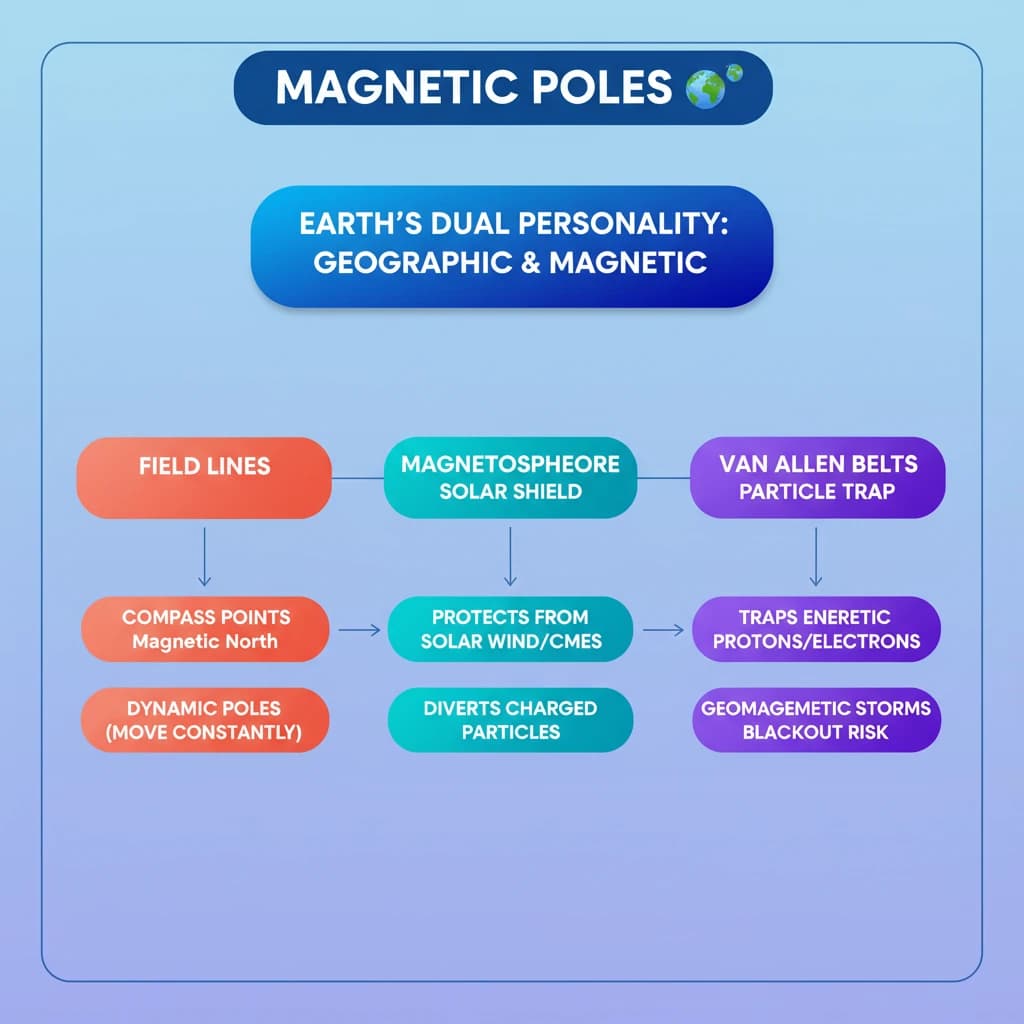
  • Earth has distinct geographic (fixed) and magnetic (dynamic) poles.
  • Magnetic poles are where field lines enter/exit; compasses point to magnetic north.
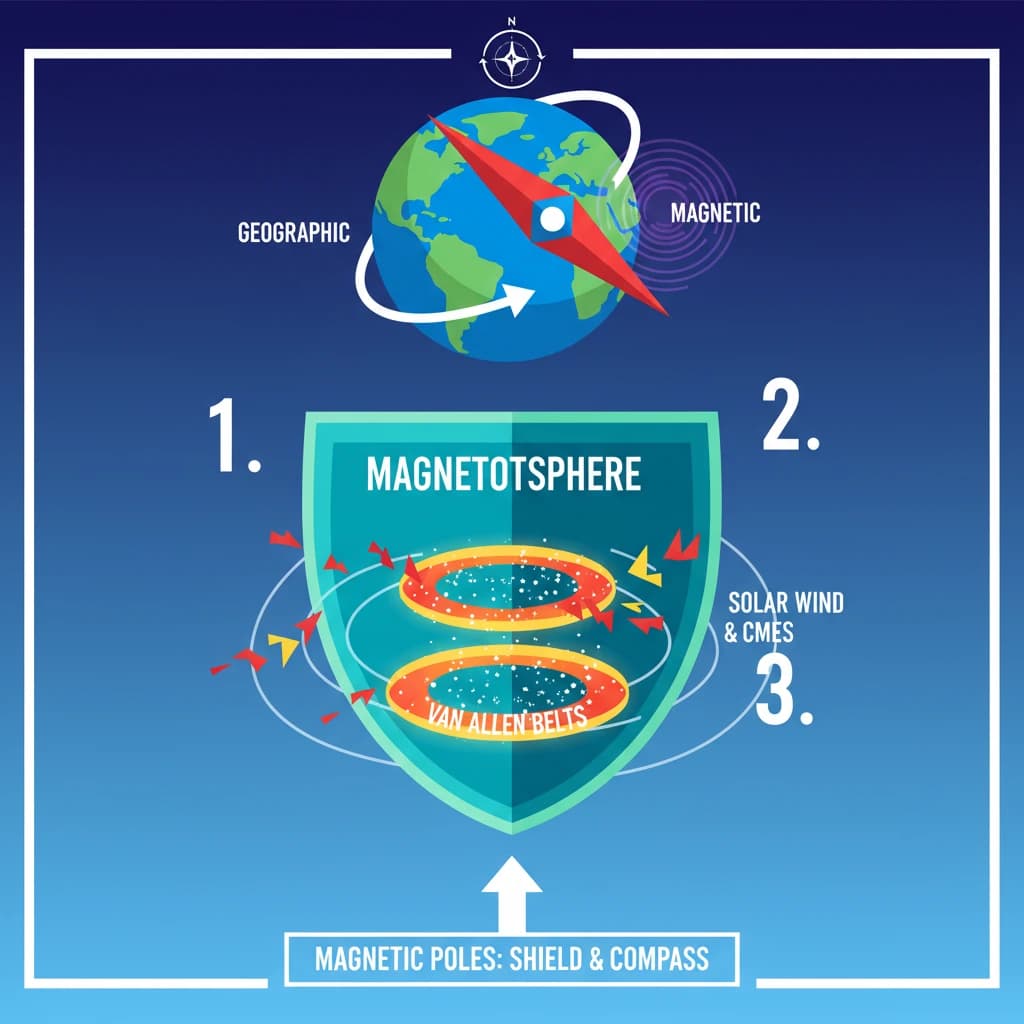
  • The magnetosphere shields Earth from harmful solar wind and CMEs.
  • Van Allen belts trap energetic particles within the magnetosphere.
  • Geomagnetic storms can cause power blackouts and communication disruptions.
  • Auroras are spectacular light shows caused by charged particles funneled to polar regions.
Earth's Magnetic and Geographic Poles: Location, Compass Use, and Protection

Earth's Magnetic and Geographic Poles: Location, Compass Use, and Protection

Medium⏱️ 6 min read✓ 95% Verified
science and technology

📖 Introduction

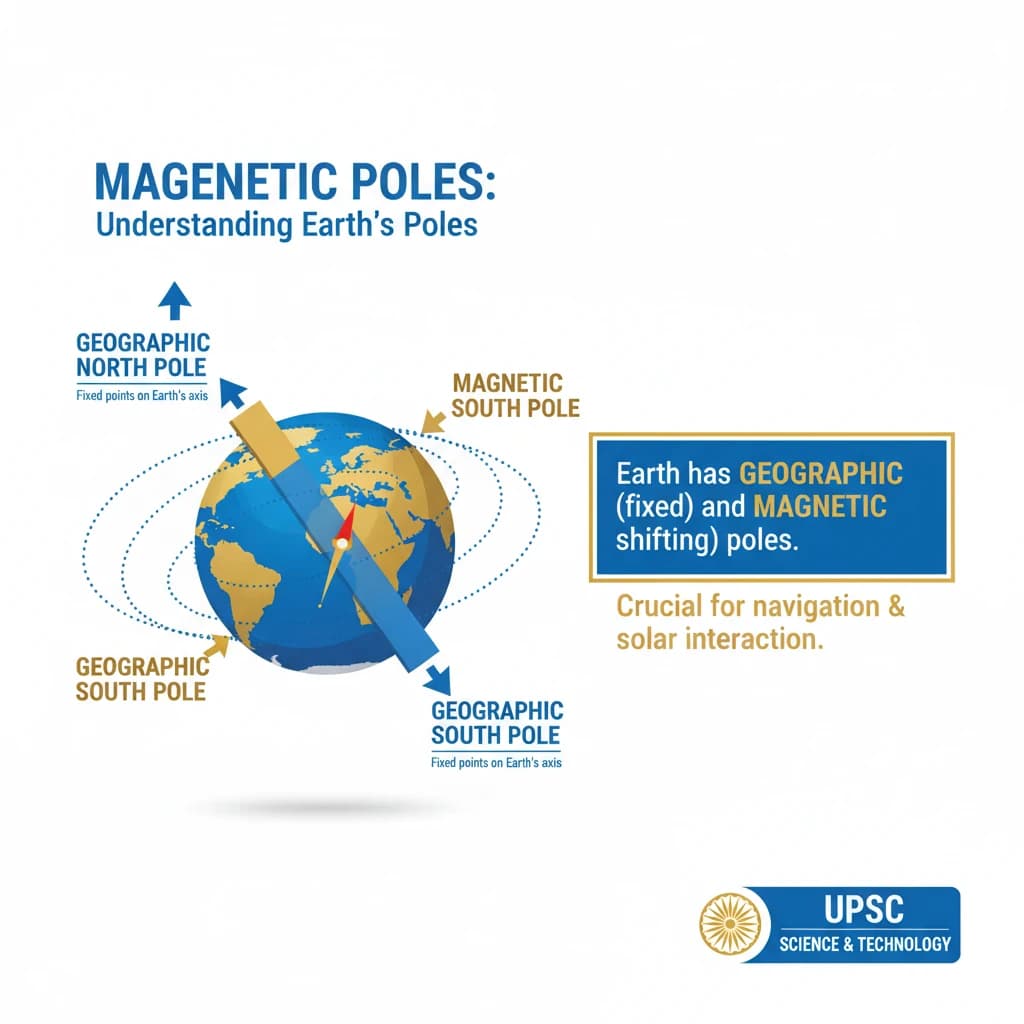
<h4>Understanding Earth's Poles</h4><p>The Earth possesses two distinct sets of poles: <strong>geographic poles</strong> and <strong>magnetic poles</strong>.</p><p>These poles are crucial for understanding Earth's orientation in space and its interaction with the solar environment.</p><h4>Geographic Poles Explained</h4><p>The <strong>geographic North</strong> and <strong>South poles</strong> are fixed points on Earth's surface.</p><div class='info-box'><p>They represent the locations where all lines of <strong>longitude converge</strong>.</p></div><ul><li>The <strong>Geographic North Pole</strong> is located in the middle of the <strong>Arctic Ocean</strong>.</li><li>The <strong>Geographic South Pole</strong> is found in <strong>Antarctica</strong>.</li></ul><h4>Magnetic Poles Explained</h4><p>In contrast, the <strong>magnetic poles</strong> are dynamic locations where the Earth's <strong>magnetic field lines</strong> interact with the surface.</p><div class='info-box'><p>The <strong>Magnetic North Pole</strong> (also known as the <strong>North Dip Pole</strong>) is where magnetic field lines <strong>enter</strong> the Earth's surface.</p></div><p>Conversely, the <strong>Magnetic South Pole</strong> is where magnetic field lines <strong>exit</strong> the Earth's surface.</p><div class='key-point-box'><p>It is important to note that the <strong>Magnetic North Pole</strong> is geographically located near the <strong>Geographic South Pole</strong>, and vice-versa, due to the Earth's internal dynamo.</p></div><h4>Current Location of Magnetic North Pole</h4><p>The <strong>Magnetic North Pole</strong> is not stationary; it constantly drifts over time.</p><div class='info-box'><p>It is currently found on <strong>Ellesmere Island</strong> in <strong>northern Canada</strong>.</p></div><h4>Compass Navigation and Magnetic Poles</h4><p>When a <strong>compass</strong> points "north," it is not aligning with the <strong>true Geographic North Pole</strong>.</p><div class='key-point-box'><p>Instead, a compass aligns itself with the Earth's <strong>magnetic field</strong> and points towards the <strong>Magnetic North Pole</strong>.</p></div><div class='exam-tip-box'><p>Understanding this distinction is crucial for navigation and for explaining phenomena like <strong>magnetic declination</strong> in UPSC Geography questions.</p></div><h4>Earth's Magnetosphere: A Protective Shield</h4><p>The Earth's <strong>magnetosphere</strong> is an invisible shield extending into space, generated by the planet's internal dynamo.</p><div class='key-point-box'><p>Its primary function is to <strong>shield the planet</strong> from harmful <strong>space weather</strong>.</p></div><p>This includes dangerous phenomena such as <strong>solar wind</strong>, <strong>coronal mass ejections (CMEs)</strong>, and high-energy <strong>cosmic rays</strong>.</p><h4>Van Allen Radiation Belts</h4><p>The magnetosphere effectively <strong>repels harmful energy</strong> away from Earth.</p><div class='info-box'><p>Some of this trapped energy is concentrated in specific regions known as the <strong>Van Allen radiation belts</strong>.</p></div><p>These belts are toroidal regions of energetic charged particles, held in place by Earth's magnetic field.</p><h4>Geomagnetic Storms and Their Impacts</h4><p>During intense <strong>space weather events</strong>, the Earth's magnetic field can be significantly disturbed.</p><p>These disturbances lead to phenomena called <strong>geomagnetic storms</strong>.</p><div class='key-point-box'><p><strong>Geomagnetic storms</strong> can have severe consequences, including widespread <strong>power blackouts</strong> and disruptions to <strong>communication systems</strong>.</p></div><h4>The Spectacle of Auroras</h4><p>Disturbances in Earth's magnetic field also play a role in creating beautiful natural light displays.</p><div class='info-box'><p>These disturbances <strong>funnel charged ions</strong> towards the <strong>polar regions</strong>.</p></div><p>When these ions collide with atmospheric gases, they create the spectacular light shows known as <strong>auroras</strong>.</p><ul><li>The <strong>Northern Lights</strong> are called <strong>Aurora Borealis</strong>.</li><li>The <strong>Southern Lights</strong> are called <strong>Aurora Australis</strong>.</li></ul>
Concept Diagram

💡 Key Takeaways

  • •Earth has distinct geographic (fixed) and magnetic (dynamic) poles.
  • •Magnetic poles are where field lines enter/exit; compasses point to magnetic north.
  • •The magnetosphere shields Earth from harmful solar wind and CMEs.
  • •Van Allen belts trap energetic particles within the magnetosphere.
  • •Geomagnetic storms can cause power blackouts and communication disruptions.
  • •Auroras are spectacular light shows caused by charged particles funneled to polar regions.

🧠 Memory Techniques
Memory Aid
95% Verified Content

Related Topics

Loading related topics...
Explore:Science And Technology Topics·All Subjects·Daily Current Affairs·Editorial Analysis·Previous Year Questions·UPSC GPT