Loading page, please wait…
Vaidra Logo
Vaidra

Top 4 items + smart groups

UPSC GPT
New
Current Affairs
Daily Solutions
Daily Puzzle
Mains Evaluator

Version 2.0.0 • Built with ❤️ for UPSC aspirants

Loading...
Loading...
Loading...
Loading...
Loading...
Loading...
Loading...
Loading...
Loading...
Loading...
Loading...
Loading...
Loading...
Back
All Subjects

Topics

0 topics • 0 completed

Loading topics...
Loading...
Loading...
Loading...
Loading...
Loading...
Overall Progress0%

What are the Challenges Associated with LEO? - UPSC Science And Technology

What is What are the Challenges Associated with LEO? in UPSC Science And Technology?

What are the Challenges Associated with LEO? is a key topic under Science And Technology for UPSC Civil Services Examination. Key points include: LEO is severely congested with over 14,000 satellites and 120 million debris fragments.. Recent incidents (Chinese rocket, Russian satellite) highlight the increasing threat of space debris and collision risk.. A 3.13% collision probability and USD 556 million in potential damages underscore the economic threat.. Understanding this topic is essential for both UPSC Prelims and Mains preparation.

Why is What are the Challenges Associated with LEO? important for UPSC exam?

What are the Challenges Associated with LEO? is a Medium-level topic in UPSC Science And Technology. It is tested in both Prelims (factual MCQs) and Mains (analytical answer writing). Previous year UPSC questions have frequently covered aspects of What are the Challenges Associated with LEO?, making it essential for comprehensive IAS preparation.

How to prepare What are the Challenges Associated with LEO? for UPSC?

To prepare What are the Challenges Associated with LEO? for UPSC: (1) Study the comprehensive notes covering all key concepts on Vaidra. (2) Practice previous year questions on this topic. (3) Connect it with current affairs using daily updates. (4) Revise using key takeaways and mind maps available for Science And Technology. (5) Write practice answers linking What are the Challenges Associated with LEO? to related GS Paper topics.

Key takeaways of What are the Challenges Associated with LEO? for UPSC

  • LEO is severely congested with over 14,000 satellites and 120 million debris fragments.
  • Recent incidents (Chinese rocket, Russian satellite) highlight the increasing threat of space debris and collision risk.
  • A 3.13% collision probability and USD 556 million in potential damages underscore the economic threat.
  • Mega-constellations like SpaceX's Starlink are rapidly saturating LEO, intensifying competition for orbital space.
  • Effective regulation, international collaboration, and new technologies are crucial for sustainable LEO management.
What are the Challenges Associated with LEO?

What are the Challenges Associated with LEO?

Medium⏱️ 8 min read✓ 95% Verified
science and technology

📖 Introduction

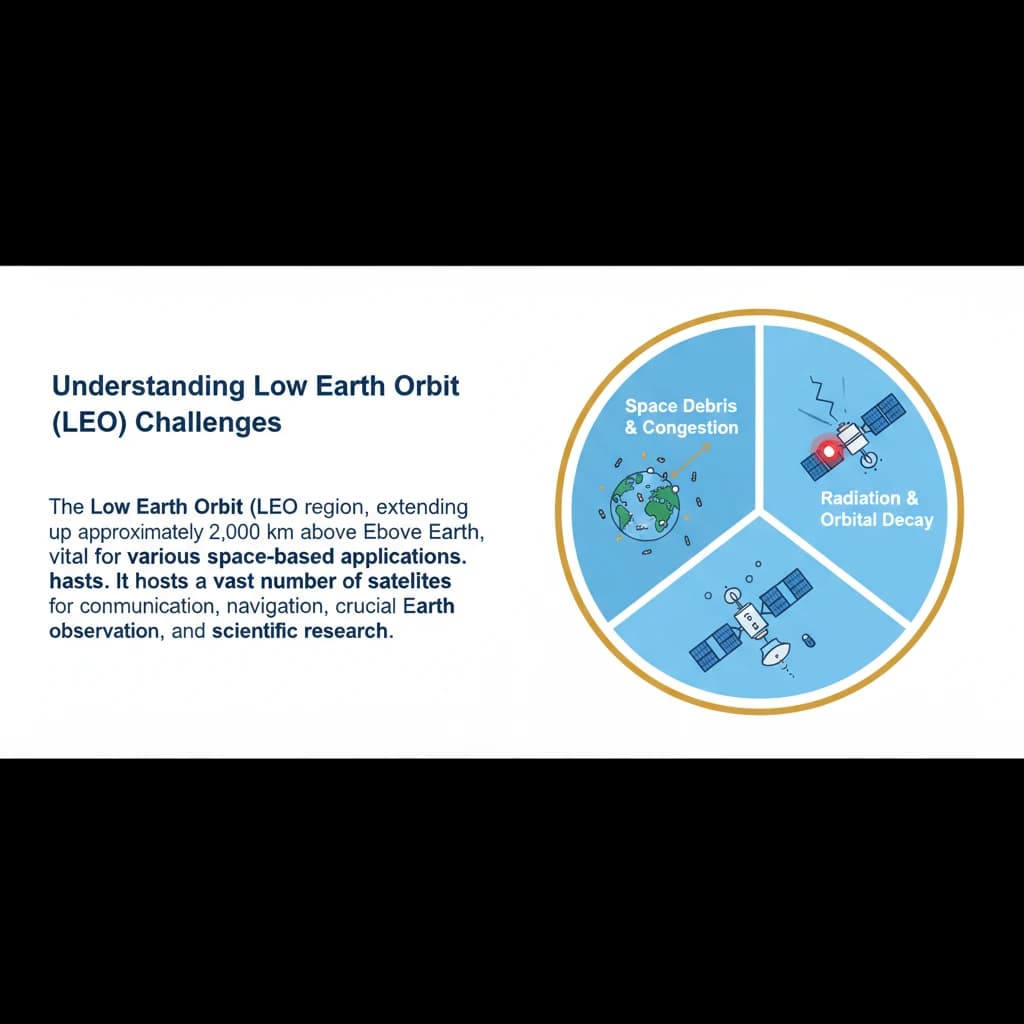
<h4>Introduction to Low Earth Orbit Challenges</h4><p>The <strong>Low Earth Orbit (LEO)</strong> region, crucial for modern satellite operations, is facing significant challenges due to increasing congestion and the proliferation of <strong>space debris</strong>. This orbital space is vital for communication, navigation, and Earth observation.</p><p>The rapid growth in satellite deployment, particularly <strong>mega-constellations</strong>, has intensified competition for orbital slots. This situation demands effective regulation and robust international collaboration to ensure sustainable use of LEO.</p><h4>Overview of LEO Congestion</h4><p>Currently, over <strong>14,000 satellites</strong> orbit in <strong>LEO</strong>. A significant portion of these, approximately <strong>3,500</strong>, are now <strong>inactive</strong>. In addition to functional and defunct satellites, LEO is cluttered with an estimated <strong>120 million debris fragments</strong>, posing a severe threat to operational spacecraft.</p><div class='info-box'><p><strong>LEO Congestion Statistics:</strong></p><ul><li>Total Satellites in LEO: <strong>&gt;14,000</strong></li><li>Inactive Satellites: <strong>~3,500</strong></li><li>Estimated Debris Fragments: <strong>~120 million</strong></li></ul></div><h4>Space Debris Threat</h4><p>Recent incidents have underscored the escalating danger posed by <strong>space debris</strong>. These events contribute to a cascade effect, where collisions generate more debris, increasing the risk of further impacts. Such incidents threaten not only satellites but also human missions, including astronauts aboard the <strong>International Space Station (ISS)</strong>.</p><div class='key-point-box'><p><strong>Key Debris Incidents:</strong></p><ul><li>Explosion of a <strong>Chinese rocket</strong> (likely <strong>Chang Zheng 4C</strong> upper stage).</li><li>Collision involving a <strong>defunct Russian satellite</strong> (e.g., <strong>Kosmos-2251</strong>).</li></ul><p>These events significantly increase the amount of unmanageable debris.</p></div><h4>Collision Risk in LEO</h4><p>The increased congestion in <strong>LEO</strong> directly translates to a heightened <strong>collision risk</strong>. This risk has substantial financial implications, with potential damages estimated to be in the hundreds of millions of dollars over the next few years.</p><div class='info-box'><p><strong>Projected Collision Impact:</strong></p><ul><li>Estimated Damages (2024-2029): <strong>USD 556 million</strong></li><li>Overall Collision Probability: <strong>3.13%</strong></li><li>Increase in Close Encounters (Past Year): <strong>17% per satellite</strong></li></ul></div><div class='exam-tip-box'><p><strong>UPSC Insight:</strong> Questions on <strong>space debris</strong> and <strong>LEO congestion</strong> often appear in <strong>Science &amp; Technology</strong> (GS Paper 3). Focus on both the technical challenges and policy implications, including international cooperation and mitigation strategies.</p></div><h4>Orbital Saturation and Mega-Constellations</h4><p>The rapid proliferation of <strong>satellite constellations</strong> is a primary driver of <strong>orbital saturation</strong>. Companies like <strong>SpaceX</strong>, with its <strong>Starlink</strong> project, are deploying thousands of satellites, drastically altering the LEO environment. This exponential growth demands urgent attention to regulatory frameworks.</p><div class='info-box'><p><strong>Starlink's Contribution to LEO:</strong></p><ul><li>Number of Starlink Satellites: <strong>&gt;6,764</strong> (as of recent data, constantly increasing)</li><li>Impact: Significant increase in active objects and potential for future debris.</li></ul></div><p>The intensification of competition for finite orbital space makes effective <strong>regulation</strong> and robust <strong>international collaboration</strong> absolutely crucial for the long-term sustainability of space activities.</p>
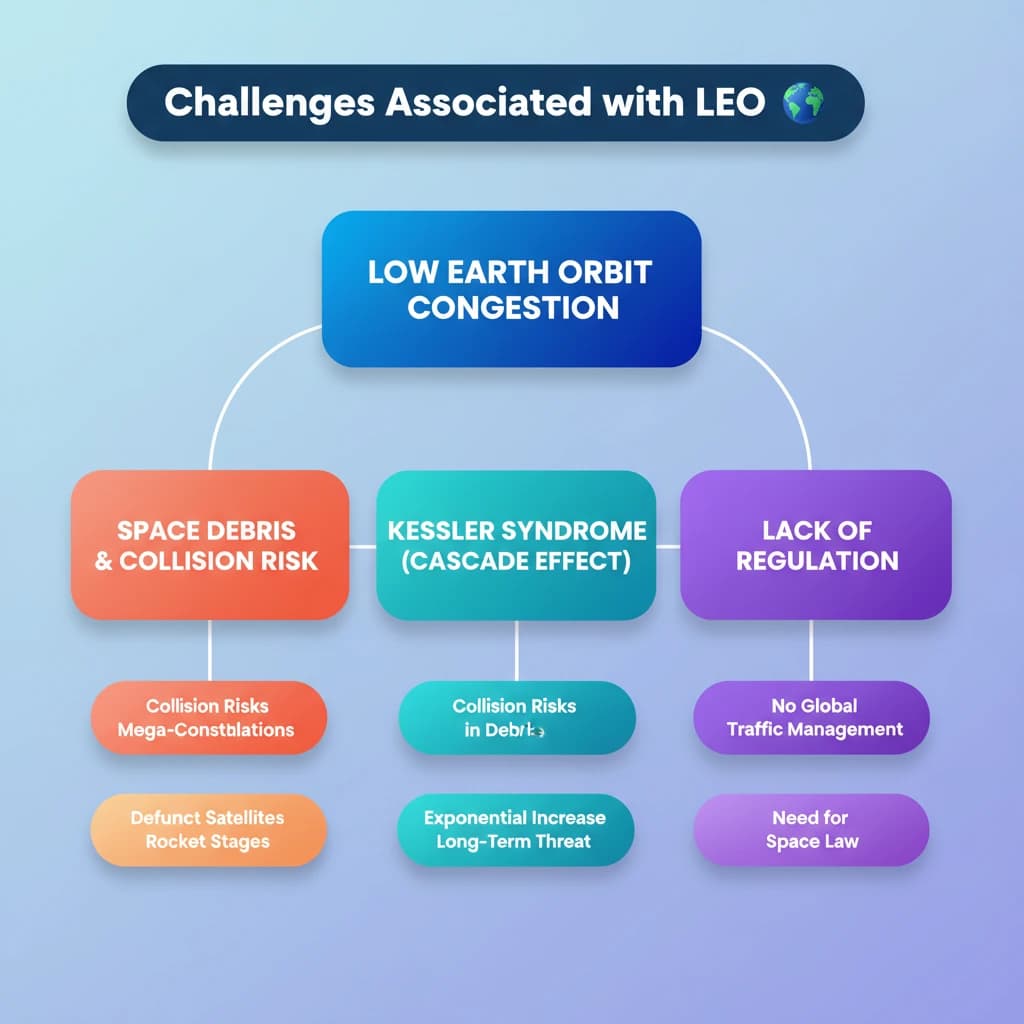
Concept Diagram

💡 Key Takeaways

  • •LEO is severely congested with over 14,000 satellites and 120 million debris fragments.
  • •Recent incidents (Chinese rocket, Russian satellite) highlight the increasing threat of space debris and collision risk.
  • •A 3.13% collision probability and USD 556 million in potential damages underscore the economic threat.
  • •Mega-constellations like SpaceX's Starlink are rapidly saturating LEO, intensifying competition for orbital space.
  • •Effective regulation, international collaboration, and new technologies are crucial for sustainable LEO management.

🧠 Memory Techniques
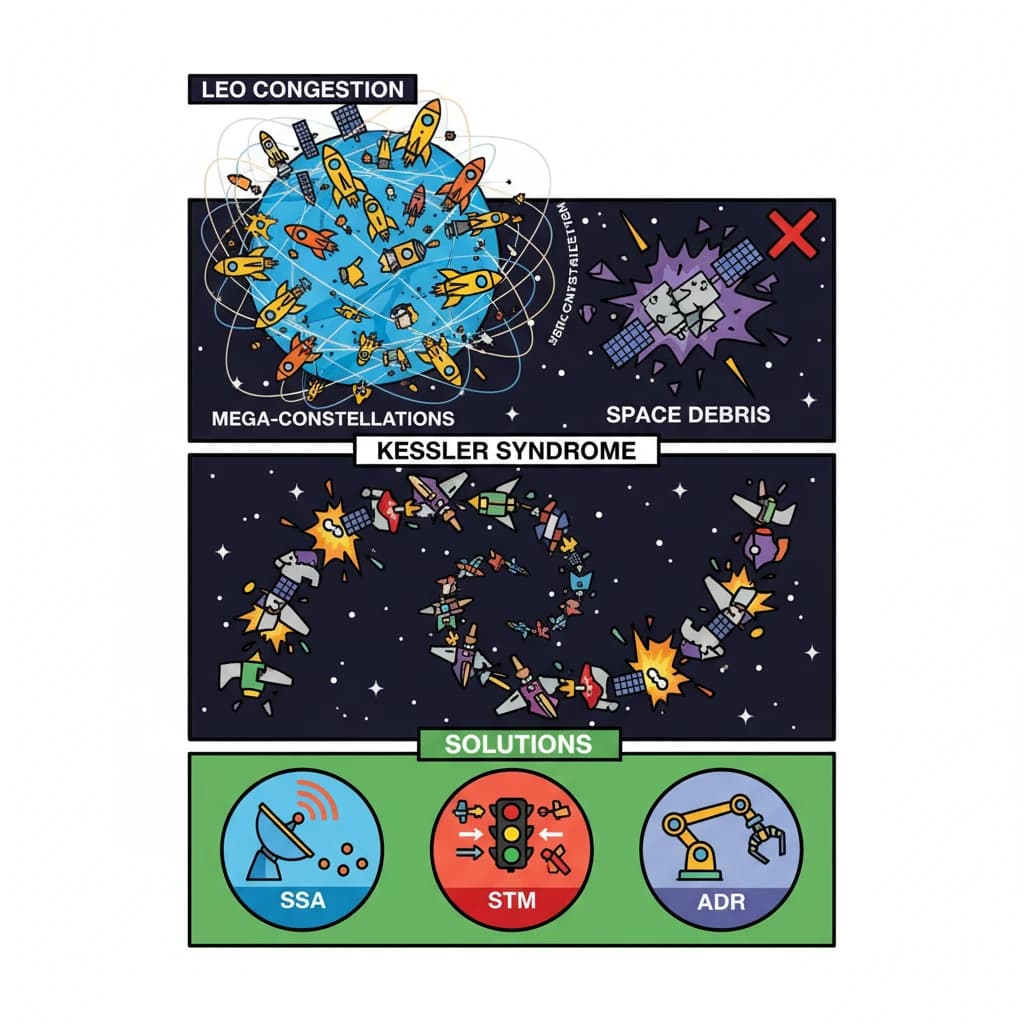
Memory Aid
95% Verified Content

Related Topics

Loading related topics...
Explore:Science And Technology Topics·All Subjects·Daily Current Affairs·Editorial Analysis·Previous Year Questions·UPSC GPT
What are the Challenges Associated with LEO? - UPSC Science And Technology