Loading page, please wait…
Vaidra Logo
Vaidra

Top 4 items + smart groups

UPSC GPT
New
Current Affairs
Daily Solutions
Daily Puzzle
Mains Evaluator

Version 2.0.0 • Built with ❤️ for UPSC aspirants

Loading...
Loading...
Loading...
Loading...
Loading...
Loading...
Loading...
Loading...
Loading...
Loading...
Loading...
Loading...
Loading...
Orbital Saturation - UPSC Science And Technology
Back
All Subjects

Topics

0 topics • 0 completed

Loading topics...
Loading...
Loading...
Loading...
Loading...
Loading...
Overall Progress0%

Orbital Saturation - UPSC Science And Technology

What is Orbital Saturation in UPSC Science And Technology?

Orbital Saturation is a key topic under Science And Technology for UPSC Civil Services Examination. Key points include: Orbital saturation is the excessive crowding of specific orbital regions, primarily Low Earth Orbit (LEO).. It is driven by the rapid growth of satellite mega-constellations, exemplified by SpaceX's Starlink (6,764 satellites).. Consequences include intensified competition for orbital space and a significantly increased risk of collisions.. Understanding this topic is essential for both UPSC Prelims and Mains preparation.

Why is Orbital Saturation important for UPSC exam?

Orbital Saturation is a Medium-level topic in UPSC Science And Technology. It is tested in both Prelims (factual MCQs) and Mains (analytical answer writing). Previous year UPSC questions have frequently covered aspects of Orbital Saturation, making it essential for comprehensive IAS preparation.

How to prepare Orbital Saturation for UPSC?

To prepare Orbital Saturation for UPSC: (1) Study the comprehensive notes covering all key concepts on Vaidra. (2) Practice previous year questions on this topic. (3) Connect it with current affairs using daily updates. (4) Revise using key takeaways and mind maps available for Science And Technology. (5) Write practice answers linking Orbital Saturation to related GS Paper topics.

Key takeaways of Orbital Saturation for UPSC

  • Orbital saturation is the excessive crowding of specific orbital regions, primarily Low Earth Orbit (LEO).
  • It is driven by the rapid growth of satellite mega-constellations, exemplified by SpaceX's Starlink (6,764 satellites).
  • Consequences include intensified competition for orbital space and a significantly increased risk of collisions.
  • Effective regulation and international collaboration are crucial to manage and mitigate orbital saturation.
  • The issue is linked to space debris, sustainable space use, and the need for updated space governance.
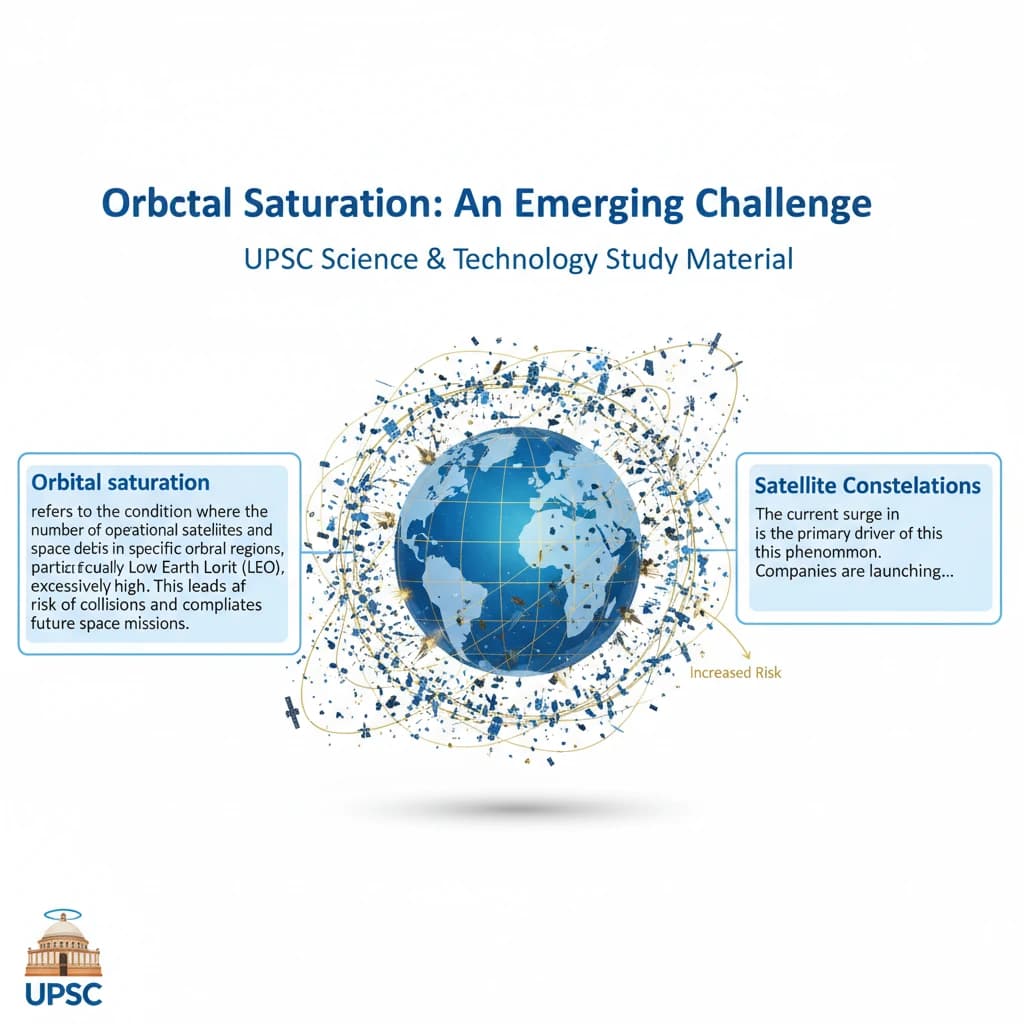
Orbital Saturation

Orbital Saturation

Medium⏱️ 6 min read✓ 95% Verified
science and technology

📖 Introduction

<h4>Orbital Saturation: An Emerging Challenge</h4><p><strong>Orbital saturation</strong> refers to the condition where the number of operational satellites and space debris in specific orbital regions, particularly <strong>Low Earth Orbit (LEO)</strong>, becomes excessively high. This leads to an increased risk of collisions and complicates future space missions.</p><p>The current surge in <strong>satellite constellations</strong> is the primary driver of this phenomenon. Companies are launching thousands of satellites to provide global services, intensifying the competition for viable orbital slots.</p><div class='info-box'><p><strong>Key Example: SpaceX's Starlink</strong></p><ul><li><strong>SpaceX's Starlink</strong> constellation currently comprises <strong>6,764 satellites</strong> (as per source content).</li><li>These satellites operate in <strong>Low Earth Orbit (LEO)</strong> to provide high-speed internet globally.</li></ul></div><p>This rapid deployment has created significant challenges. The sheer volume of objects increases the probability of accidental collisions, which in turn generates more <strong>space debris</strong>.</p><div class='key-point-box'><p><strong>Crucial Requirements: Regulation and Collaboration</strong></p><p>Addressing orbital saturation necessitates robust <strong>effective regulation</strong> and enhanced <strong>international collaboration</strong>. These measures are vital to ensure the long-term sustainability and safety of outer space activities for all nations.</p></div><div class='exam-tip-box'><p><strong>UPSC Relevance (GS Paper 3: Science & Technology)</strong></p><p><strong>Orbital saturation</strong> is a critical topic for UPSC, often linked with <strong>space debris management</strong>, <strong>space governance</strong>, and the future of <strong>sustainable space exploration</strong>. Be prepared to discuss its causes, consequences, and potential solutions.</p></div>
Concept Diagram

💡 Key Takeaways

  • •Orbital saturation is the excessive crowding of specific orbital regions, primarily Low Earth Orbit (LEO).
  • •It is driven by the rapid growth of satellite mega-constellations, exemplified by SpaceX's Starlink (6,764 satellites).
  • •Consequences include intensified competition for orbital space and a significantly increased risk of collisions.
  • •Effective regulation and international collaboration are crucial to manage and mitigate orbital saturation.
  • •The issue is linked to space debris, sustainable space use, and the need for updated space governance.

🧠 Memory Techniques
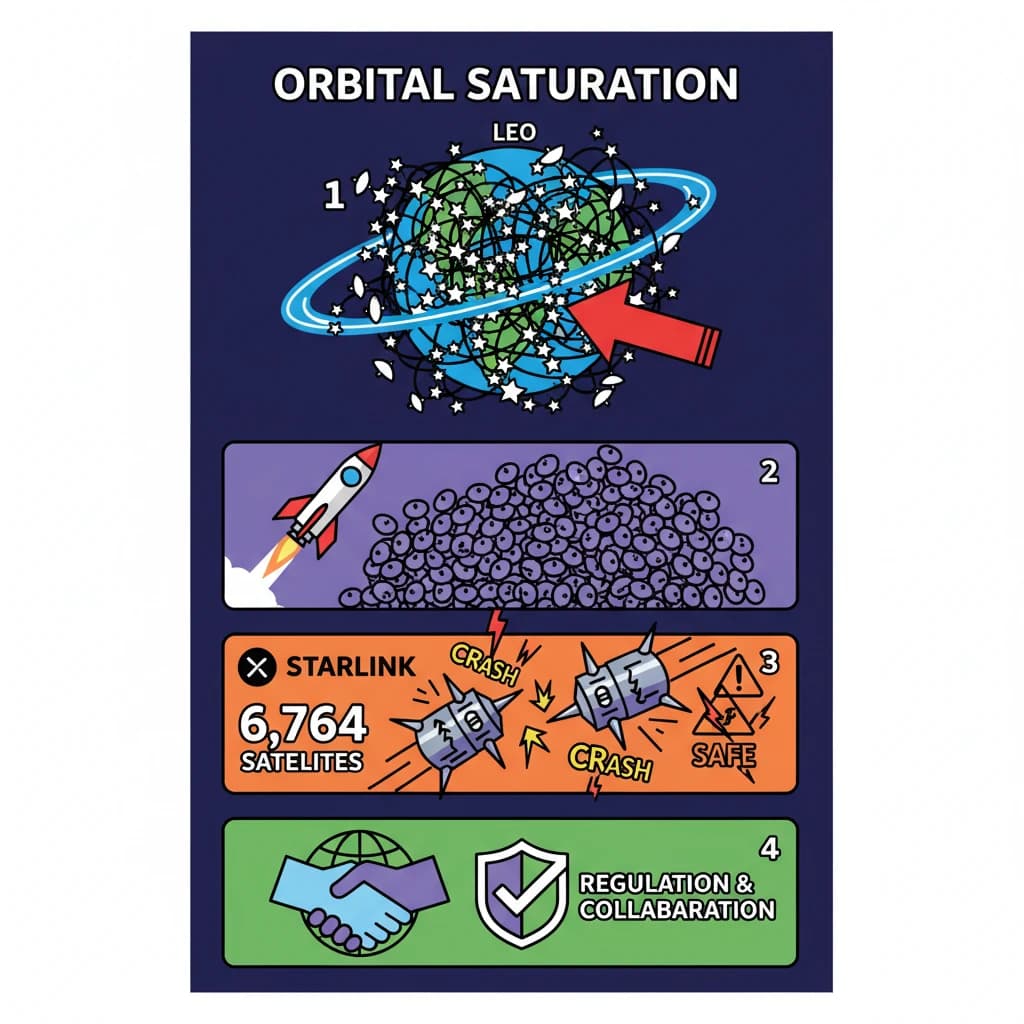
Memory Aid
95% Verified Content

📚 Reference Sources

•Publicly available data on SpaceX Starlink satellite deployments
•General knowledge on space debris and space governance

Related Topics

Loading related topics...
Explore:Science And Technology Topics·All Subjects·Daily Current Affairs·Editorial Analysis·Previous Year Questions·UPSC GPT