Loading page, please wait…
Vaidra Logo
Vaidra

Top 4 items + smart groups

UPSC GPT
New
Current Affairs
Daily Solutions
Daily Puzzle
Mains Evaluator

Version 2.0.0 • Built with ❤️ for UPSC aspirants

Loading...
Loading...
Loading...
Loading...
Loading...
Loading...
Loading...
Loading...
Loading...
Loading...
Loading...
Loading...
Loading...
Back
All Subjects

Topics

0 topics • 0 completed

Loading topics...
Loading...
Loading...
Loading...
Loading...
Loading...
Overall Progress0%

Biotechnology: Genetic Engineering, Vaccines, GM Crops - UPSC Science And Technology

What is Biotechnology: Genetic Engineering, Vaccines, GM Crops in UPSC Science And Technology?

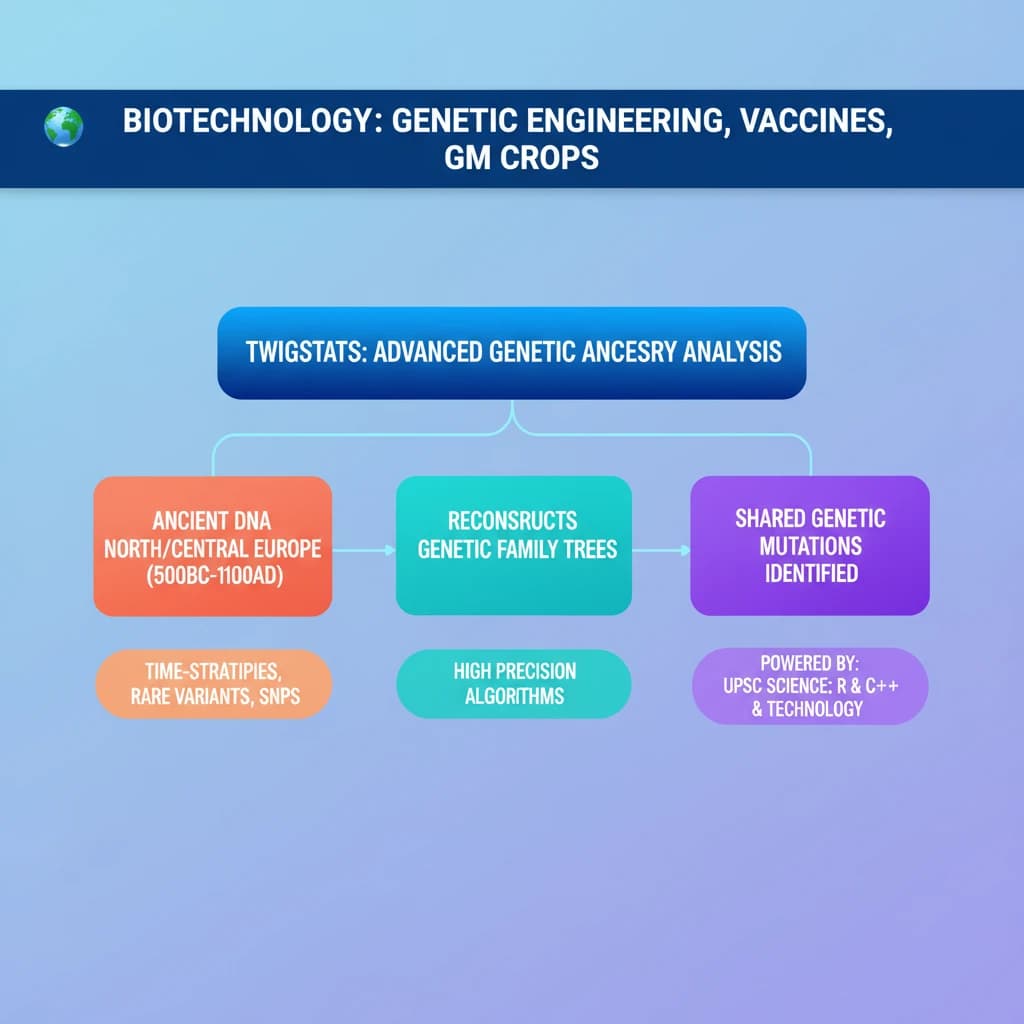
Biotechnology: Genetic Engineering, Vaccines, GM Crops is a key topic under Science And Technology for UPSC Civil Services Examination. Key points include: <strong>Twigstats</strong> is an advanced genetic analysis tool for precise individual-level ancestry tracing.. It uses ancient <strong>DNA</strong> from <strong>Northern and Central Europe (500 BC-1000 AD)</strong>.. The tool reconstructs <strong>genetic family trees</strong> by analyzing <strong>shared genetic mutations</strong>.. Understanding this topic is essential for both UPSC Prelims and Mains preparation.

Why is Biotechnology: Genetic Engineering, Vaccines, GM Crops important for UPSC exam?

Biotechnology: Genetic Engineering, Vaccines, GM Crops is a Medium-level topic in UPSC Science And Technology. It is tested in both Prelims (factual MCQs) and Mains (analytical answer writing). Previous year UPSC questions have frequently covered aspects of Biotechnology: Genetic Engineering, Vaccines, GM Crops, making it essential for comprehensive IAS preparation.

How to prepare Biotechnology: Genetic Engineering, Vaccines, GM Crops for UPSC?

To prepare Biotechnology: Genetic Engineering, Vaccines, GM Crops for UPSC: (1) Study the comprehensive notes covering all key concepts on Vaidra. (2) Practice previous year questions on this topic. (3) Connect it with current affairs using daily updates. (4) Revise using key takeaways and mind maps available for Science And Technology. (5) Write practice answers linking Biotechnology: Genetic Engineering, Vaccines, GM Crops to related GS Paper topics.

Key takeaways of Biotechnology: Genetic Engineering, Vaccines, GM Crops for UPSC

  • <strong>Twigstats</strong> is an advanced genetic analysis tool for precise individual-level ancestry tracing.
  • It uses ancient <strong>DNA</strong> from <strong>Northern and Central Europe (500 BC-1000 AD)</strong>.
  • The tool reconstructs <strong>genetic family trees</strong> by analyzing <strong>shared genetic mutations</strong>.
  • Key features include <strong>time-stratified analysis</strong> and integration of <strong>haplotypes, rare variants, and SNPs</strong>.
  • It leverages statistical languages <strong>R</strong> and <strong>C++</strong> for high precision.
  • It significantly enhances understanding of <strong>population dynamics</strong> and historical migrations.
Biotechnology: Genetic Engineering, Vaccines, GM Crops

Biotechnology: Genetic Engineering, Vaccines, GM Crops

Medium⏱️ 6 min read✓ 95% Verified
science and technology

📖 Introduction

<h4>Introduction to Twigstats</h4><p>The recent development of the <strong>Twigstats</strong> genetic analysis tool marks a significant advancement in tracing individual-level ancestry.</p><div class='info-box'><p>This tool has notably improved the precision of tracing ancestry using ancient <strong>Deoxyribonucleic acid (DNA)</strong> samples.</p><p>These samples originate from <strong>northern and Central Europe</strong>, spanning a period from <strong>500 BC to 1000 AD</strong>.</p></div><h4>What is Twigstats?</h4><p><strong>Twigstats</strong> is an advanced analytical tool specifically developed for intricate <strong>genetic studies</strong>.</p><p>Its primary focus is on high-precision <strong>ancestry analysis</strong>, offering deeper insights into population dynamics.</p><div class='info-box'><p>It integrates <strong>genetic data</strong> with <strong>archaeological findings</strong> and <strong>historical context</strong> to enhance understanding.</p></div><h4>How Twigstats Works</h4><p>The core mechanism of <strong>Twigstats</strong> involves reconstructing <strong>genetic family trees</strong>.</p><p>It achieves this by meticulously analyzing <strong>shared genetic mutations</strong> present between individuals.</p><p>The tool specifically utilizes <strong>recent mutations</strong> to accurately trace ancestry.</p><p>This allows it to establish vital connections between people from different time periods, effectively linking <strong>modern DNA</strong> with that of <strong>ancient populations</strong>.</p><h4>Key Features of Twigstats</h4><h5>Time-Stratified Ancestry Analysis</h5><p><strong>Twigstats</strong> employs a sophisticated <strong>time-stratified approach</strong> for analyzing genetic data.</p><p>This method significantly enhances accuracy by studying the evolution of <strong>ancestry and populations</strong> across various historical periods.</p><h5>Integration of Genetic Techniques</h5><p>The tool combines several advanced genetic techniques to provide a comprehensive understanding.</p><p>It integrates <strong>haplotypes</strong> (shared DNA segments), <strong>rare variants</strong>, and <strong>Single Nucleotide Polymorphisms (SNPs)</strong>.</p><div class='key-point-box'><p>This integration offers deeper insights into <strong>demographic transitions</strong> over time, thereby boosting the accuracy of <strong>genetic analysis</strong>.</p></div><h5>Compatibility with R and C++</h5><p><strong>Twigstats</strong> leverages the power of statistical languages <strong>R</strong> and <strong>C++</strong>.</p><p>This compatibility assists researchers in analyzing complex <strong>genetic data</strong> with unparalleled precision and efficiency.</p>
Concept Diagram

💡 Key Takeaways

  • •<strong>Twigstats</strong> is an advanced genetic analysis tool for precise individual-level ancestry tracing.
  • •It uses ancient <strong>DNA</strong> from <strong>Northern and Central Europe (500 BC-1000 AD)</strong>.
  • •The tool reconstructs <strong>genetic family trees</strong> by analyzing <strong>shared genetic mutations</strong>.
  • •Key features include <strong>time-stratified analysis</strong> and integration of <strong>haplotypes, rare variants, and SNPs</strong>.
  • •It leverages statistical languages <strong>R</strong> and <strong>C++</strong> for high precision.
  • •It significantly enhances understanding of <strong>population dynamics</strong> and historical migrations.

🧠 Memory Techniques
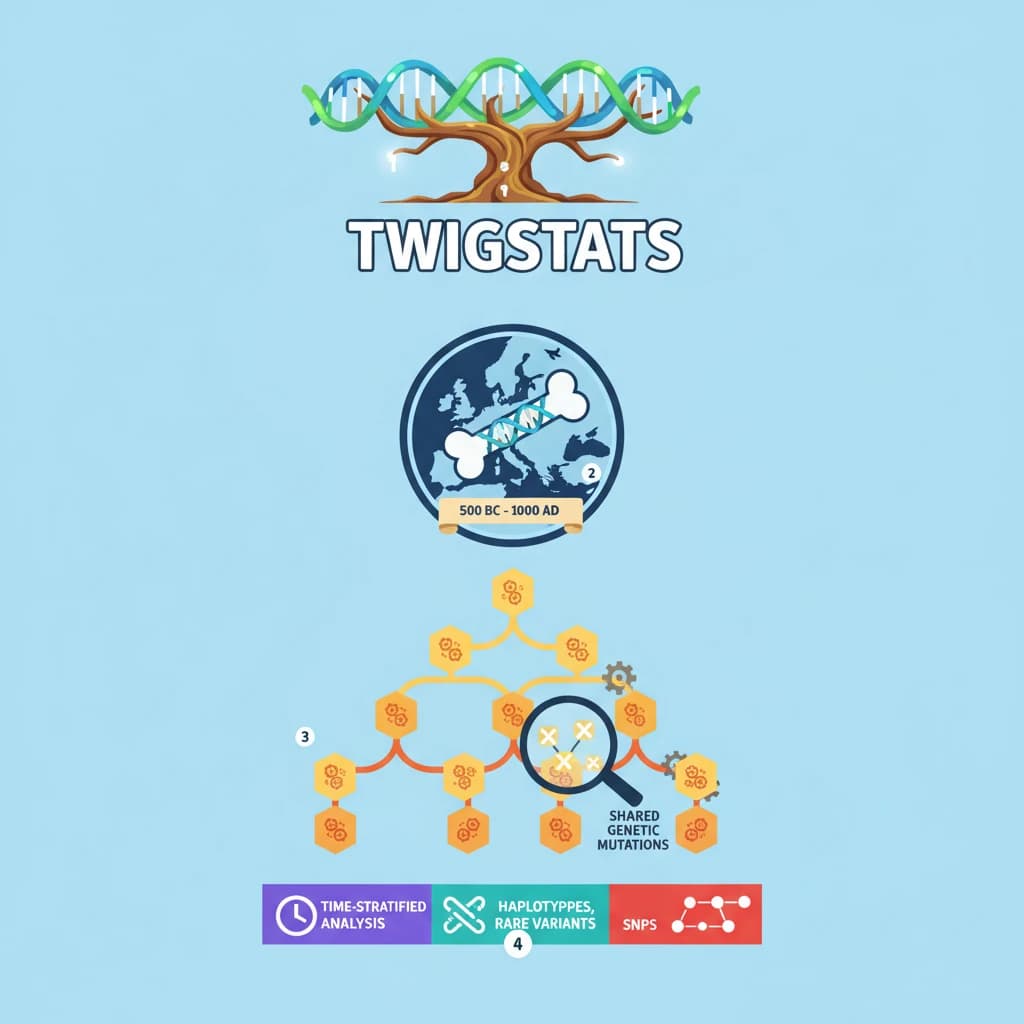
Memory Aid
95% Verified Content

Related Topics

Loading related topics...
Explore:Science And Technology Topics·All Subjects·Daily Current Affairs·Editorial Analysis·Previous Year Questions·UPSC GPT
Biotechnology: Genetic Engineering, Vaccines, GM Crops - UPSC Science And Technology