Loading page, please wait…
Vaidra Logo
Vaidra

Top 4 items + smart groups

UPSC GPT
New
Current Affairs
Daily Solutions
Daily Puzzle
Mains Evaluator

Version 2.0.0 • Built with ❤️ for UPSC aspirants

Loading...
Loading...
Loading...
Loading...
Loading...
Loading...
Loading...
Loading...
Loading...
Loading...
Loading...
Loading...
Loading...
Back
All Subjects

Topics

0 topics • 0 completed

Loading topics...
Loading...
Loading...
Loading...
Loading...
Loading...
Overall Progress0%

GSAT-20 (GSAT-N2) Aboard SpaceX’s Falcon-9 - UPSC Science And Technology

What is GSAT-20 (GSAT-N2) Aboard SpaceX’s Falcon-9 in UPSC Science And Technology?

GSAT-20 (GSAT-N2) Aboard SpaceX’s Falcon-9 is a key topic under Science And Technology for UPSC Civil Services Examination. Key points include: GSAT-20 (GSAT-N2) is a high throughput Ka-band satellite for India's broadband needs.. It will be launched by NewSpace India Limited (NSIL) aboard SpaceX's Falcon-9 rocket in 2024.. The satellite offers 64 Gbps capacity with 32 spot beams, covering all of India, including remote islands.. Understanding this topic is essential for both UPSC Prelims and Mains preparation.

Why is GSAT-20 (GSAT-N2) Aboard SpaceX’s Falcon-9 important for UPSC exam?

GSAT-20 (GSAT-N2) Aboard SpaceX’s Falcon-9 is a Medium-level topic in UPSC Science And Technology. It is tested in both Prelims (factual MCQs) and Mains (analytical answer writing). Previous year UPSC questions have frequently covered aspects of GSAT-20 (GSAT-N2) Aboard SpaceX’s Falcon-9, making it essential for comprehensive IAS preparation.

How to prepare GSAT-20 (GSAT-N2) Aboard SpaceX’s Falcon-9 for UPSC?

To prepare GSAT-20 (GSAT-N2) Aboard SpaceX’s Falcon-9 for UPSC: (1) Study the comprehensive notes covering all key concepts on Vaidra. (2) Practice previous year questions on this topic. (3) Connect it with current affairs using daily updates. (4) Revise using key takeaways and mind maps available for Science And Technology. (5) Write practice answers linking GSAT-20 (GSAT-N2) Aboard SpaceX’s Falcon-9 to related GS Paper topics.

Key takeaways of GSAT-20 (GSAT-N2) Aboard SpaceX’s Falcon-9 for UPSC

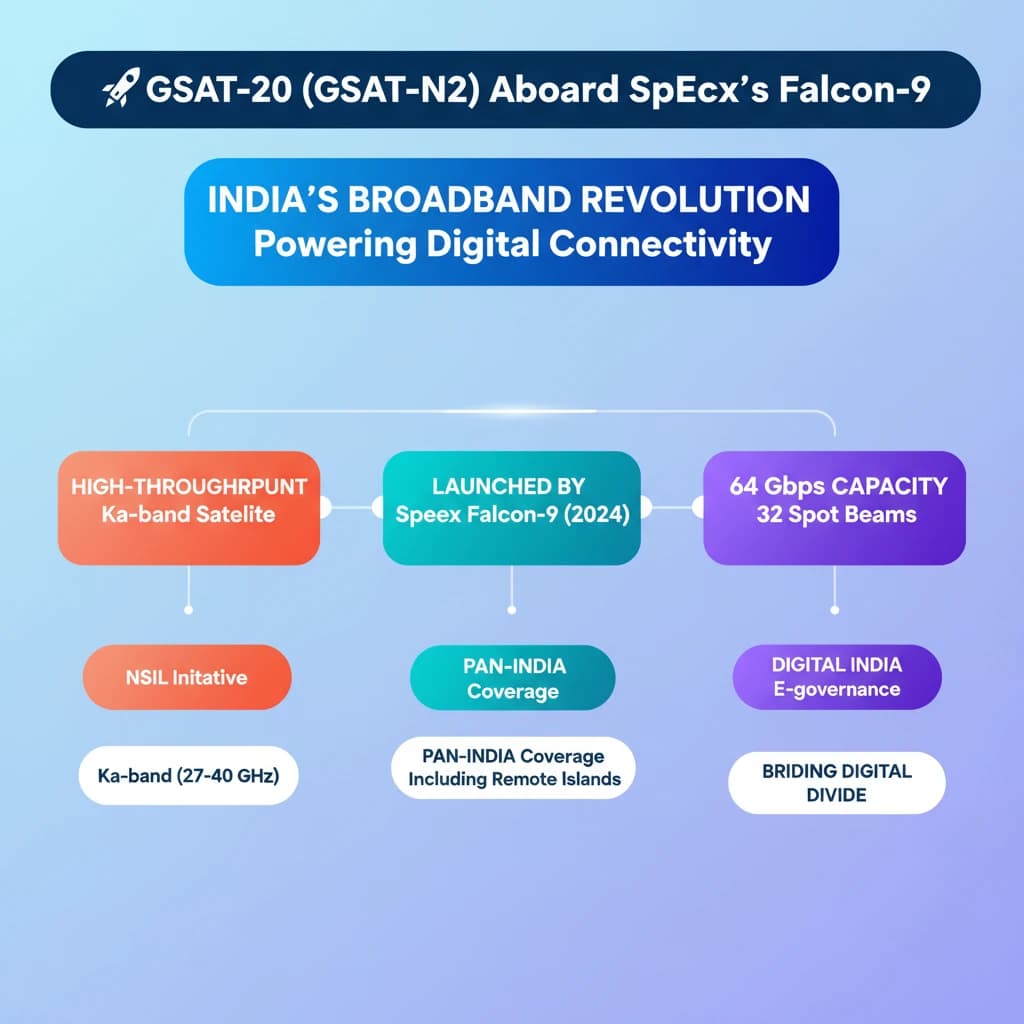
  • GSAT-20 (GSAT-N2) is a high throughput Ka-band satellite for India's broadband needs.
  • It will be launched by NewSpace India Limited (NSIL) aboard SpaceX's Falcon-9 rocket in 2024.
  • The satellite offers 64 Gbps capacity with 32 spot beams, covering all of India, including remote islands.
  • Ka-band (27-40 GHz) enables high-speed data transfer through focused spot beams.
  • This mission is crucial for Digital India, e-governance, and bridging the digital divide in remote regions.
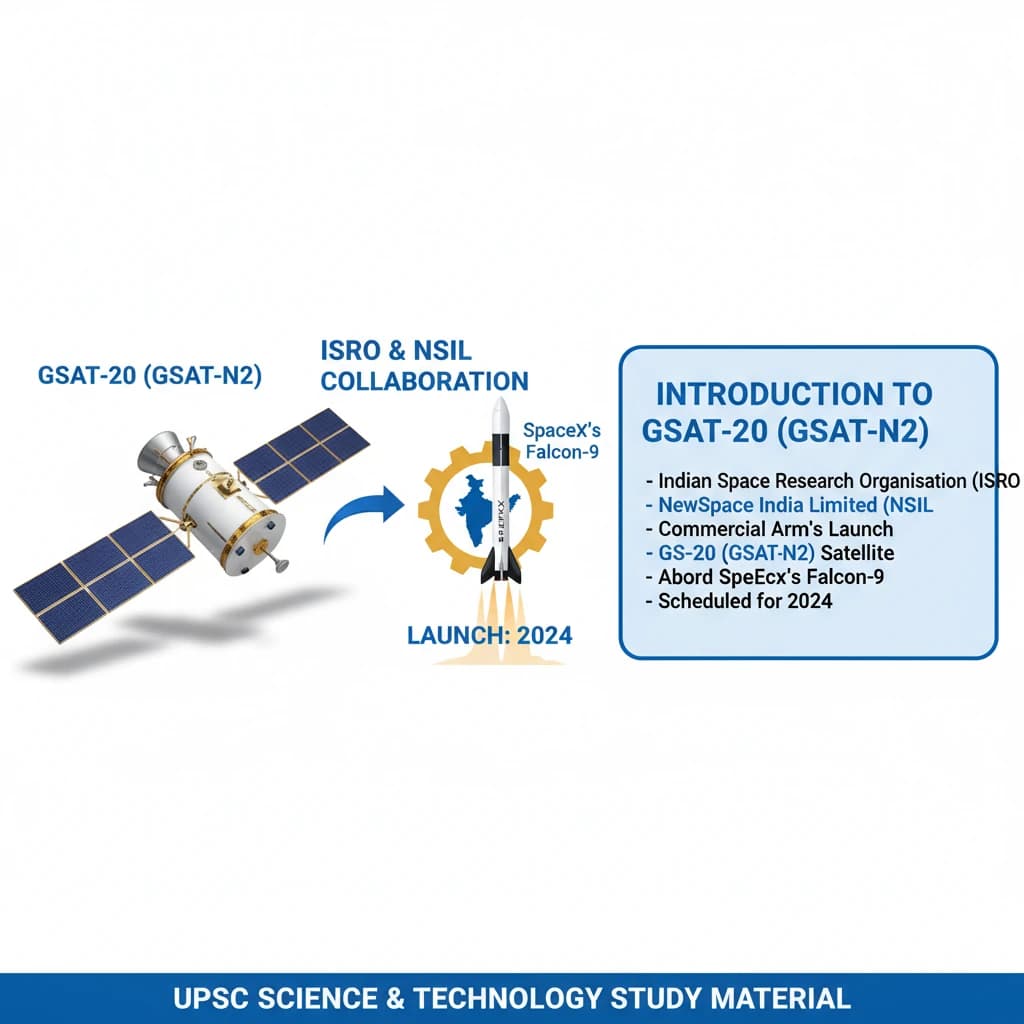
GSAT-20 (GSAT-N2) Aboard SpaceX’s Falcon-9

GSAT-20 (GSAT-N2) Aboard SpaceX’s Falcon-9

Medium⏱️ 6 min read✓ 98% Verified
science and technology

📖 Introduction

<h4>Introduction to GSAT-20 (GSAT-N2)</h4><p>The <strong>Indian Space Research Organisation's (ISRO)</strong> commercial arm, <strong>NewSpace India Limited (NSIL)</strong>, is preparing for a significant launch. They are set to deploy the <strong>GSAT-20 (GSAT-N2)</strong> satellite.</p><p>This launch is scheduled for <strong>2024</strong> and will be carried out aboard <strong>SpaceX's Falcon-9</strong> rocket.</p><h4>Why GSAT-20 (GSAT-N2) is in News</h4><p>The upcoming launch of <strong>GSAT-20 (GSAT-N2)</strong> is a major development in India's space communication efforts. It signifies a strategic collaboration with a global private space entity, <strong>SpaceX</strong>.</p><div class='key-point-box'><p>This mission aims to significantly enhance India's domestic satellite communication capabilities, particularly in providing high-speed internet access across the nation.</p></div><h4>Understanding GSAT-20 (GSAT-N2)</h4><p><strong>GSAT-20</strong>, also known as <strong>GSAT-N2</strong>, is categorized as a <strong>high throughput Ka-band satellite</strong>. Its primary objective is to provide advanced communication services across India.</p><p>The satellite is specifically designed to address the escalating demand for <strong>broadband communication</strong> within the country. It promises to deliver robust connectivity solutions.</p><div class='info-box'><p><strong>Key Services Provided by GSAT-20:</strong><ul><li><strong>High-speed broadband internet connectivity</strong></li><li><strong>Digital video transmission</strong></li><li><strong>Radio transmission</strong></li></ul></p></div><h4>Coverage and Capacity of GSAT-20</h4><p><strong>GSAT-20</strong> is engineered to offer comprehensive coverage across the entire Indian geographical area. This includes challenging and remote regions.</p><p>Crucially, its reach extends to far-flung territories such as the <strong>Andaman and Nicobar Islands</strong> and the <strong>Lakshadweep islands</strong>, ensuring inclusive connectivity.</p><div class='info-box'><p><strong>HTS Capacity:</strong> The satellite boasts an improved <strong>High Throughput Satellite (HTS) capacity</strong> of nearly <strong>64 Gbps</strong>.</p><p><strong>Beam Design:</strong> It incorporates <strong>32 beams</strong>, which are specifically designed to cater to the demanding service needs of underserved areas, aiming to bridge the digital divide.</p></div><h4>The Ka-band Technology</h4><p>The <strong>Ka-band</strong> is a critical technology utilized by <strong>GSAT-20</strong>. It refers to a specific range of radio frequencies.</p><div class='info-box'><p><strong>Ka-band Frequencies:</strong> The <strong>Ka-band</strong> operates within radio frequencies ranging from <strong>27 to 40 GHz</strong>.</p><p><strong>Benefits:</strong> This frequency band facilitates <strong>high-speed satellite data transfers</strong>. It achieves wide coverage through the use of highly focused <strong>spot beams</strong>, enhancing efficiency and data rates.</p></div><h4>SpaceX's Falcon-9 Rocket</h4><p>The launch vehicle for <strong>GSAT-20</strong> is <strong>SpaceX's Falcon-9</strong>. This rocket is renowned for its advanced capabilities in space transportation.</p><div class='info-box'><p><strong>Falcon-9 Specifications:</strong><ul><li>World’s first <strong>orbital class reusable, two-stage rocket</strong>.</li><li>Designed and manufactured by <strong>SpaceX</strong>.</li><li>Purpose: Reliable and safe transport of people and payloads into <strong>Earth orbit and beyond</strong>.</li></ul></p></div><div class='exam-tip-box'><p>For <strong>UPSC Prelims</strong>, remember key facts like <strong>GSAT-20 (GSAT-N2)</strong>, <strong>NSIL</strong>, <strong>SpaceX Falcon-9</strong>, <strong>Ka-band</strong>, and its <strong>HTS capacity</strong>. For <strong>Mains</strong>, focus on its implications for <strong>Digital India</strong>, rural connectivity, and India's space diplomacy.</p></div>
Concept Diagram

💡 Key Takeaways

  • •GSAT-20 (GSAT-N2) is a high throughput Ka-band satellite for India's broadband needs.
  • •It will be launched by NewSpace India Limited (NSIL) aboard SpaceX's Falcon-9 rocket in 2024.
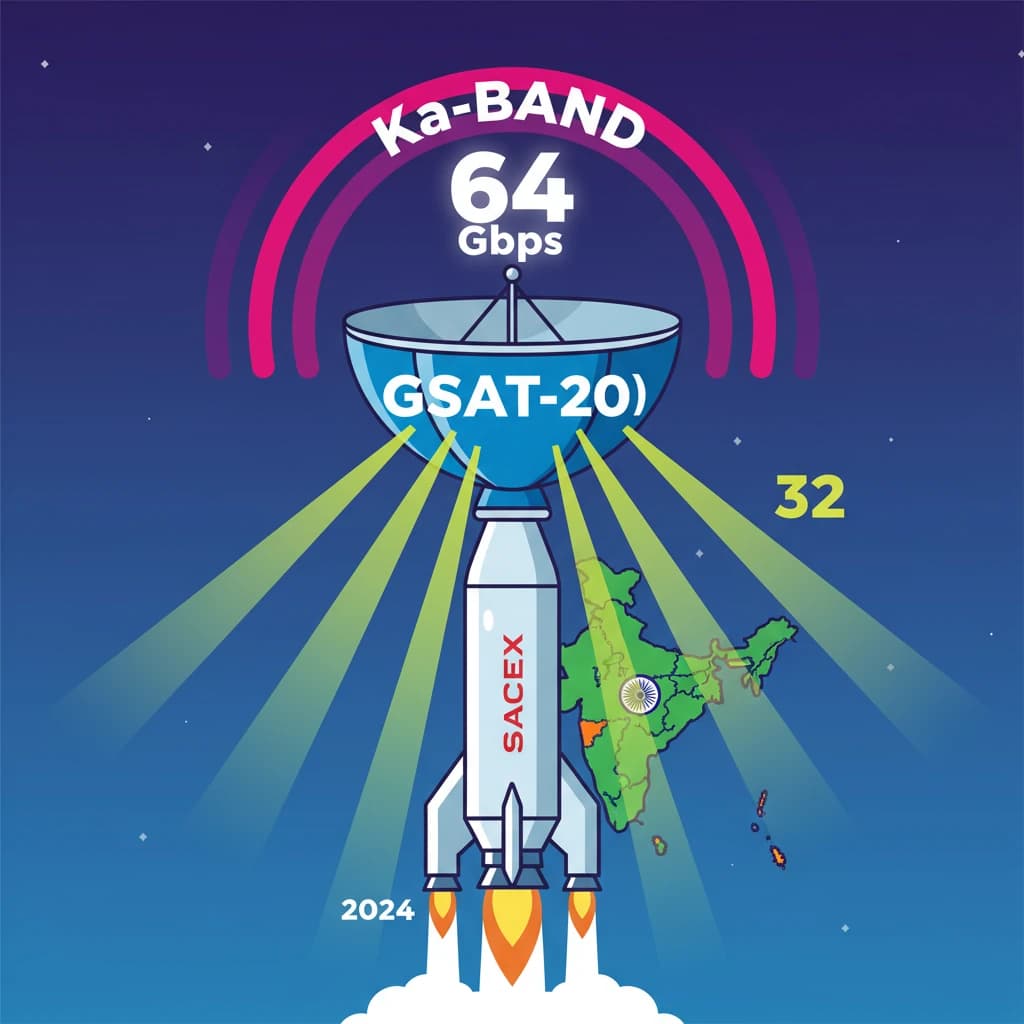
  • •The satellite offers 64 Gbps capacity with 32 spot beams, covering all of India, including remote islands.
  • •Ka-band (27-40 GHz) enables high-speed data transfer through focused spot beams.
  • •This mission is crucial for Digital India, e-governance, and bridging the digital divide in remote regions.

🧠 Memory Techniques
Memory Aid
98% Verified Content

📚 Reference Sources

•ISRO Official Website (for general satellite information and NSIL's role)
•SpaceX Official Website (for Falcon-9 details)

Related Topics

Loading related topics...
Explore:Science And Technology Topics·All Subjects·Daily Current Affairs·Editorial Analysis·Previous Year Questions·UPSC GPT
GSAT-20 (GSAT-N2) Aboard SpaceX’s Falcon-9 - UPSC Science And Technology