Loading page, please wait…
Vaidra Logo
Vaidra

Top 4 items + smart groups

UPSC GPT
New
Current Affairs
Daily Solutions
Daily Puzzle
Mains Evaluator

Version 2.0.0 • Built with ❤️ for UPSC aspirants

Loading...
Loading...
Loading...
Loading...
Loading...
Loading...
Loading...
Loading...
Loading...
Loading...
Loading...
Loading...
Loading...
Japan’s SLIM Moon Mission - UPSC Science And Technology
Back
All Subjects

Topics

0 topics • 0 completed

Loading topics...
Loading...
Loading...
Loading...
Loading...
Loading...
Overall Progress0%

Japan’s SLIM Moon Mission - UPSC Science And Technology

What is Japan’s SLIM Moon Mission in UPSC Science And Technology?

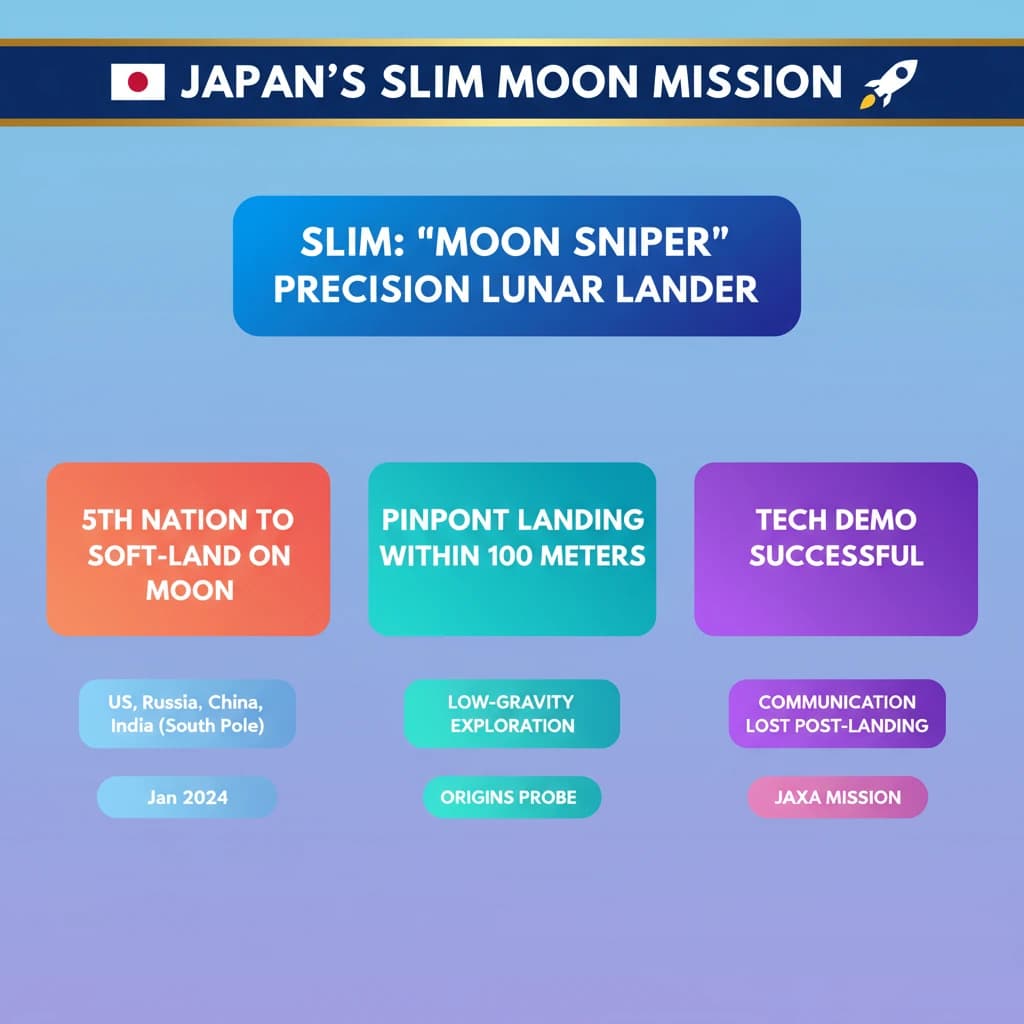
Japan’s SLIM Moon Mission is a key topic under Science And Technology for UPSC Civil Services Examination. Key points include: Japan's SLIM (Smart Lander for Investigating Moon), nicknamed "Moon Sniper," achieved a soft landing in January 2024.. SLIM made Japan the fifth nation to achieve a soft lunar landing, demonstrating precision landing technology within 100 meters.. The mission also tested low-gravity exploration technology and aimed to investigate the Moon's origins.. Understanding this topic is essential for both UPSC Prelims and Mains preparation.

Why is Japan’s SLIM Moon Mission important for UPSC exam?

Japan’s SLIM Moon Mission is a Medium-level topic in UPSC Science And Technology. It is tested in both Prelims (factual MCQs) and Mains (analytical answer writing). Previous year UPSC questions have frequently covered aspects of Japan’s SLIM Moon Mission, making it essential for comprehensive IAS preparation.

How to prepare Japan’s SLIM Moon Mission for UPSC?

To prepare Japan’s SLIM Moon Mission for UPSC: (1) Study the comprehensive notes covering all key concepts on Vaidra. (2) Practice previous year questions on this topic. (3) Connect it with current affairs using daily updates. (4) Revise using key takeaways and mind maps available for Science And Technology. (5) Write practice answers linking Japan’s SLIM Moon Mission to related GS Paper topics.

Key takeaways of Japan’s SLIM Moon Mission for UPSC

  • Japan's SLIM (Smart Lander for Investigating Moon), nicknamed "Moon Sniper," achieved a soft landing in January 2024.
  • SLIM made Japan the fifth nation to achieve a soft lunar landing, demonstrating precision landing technology within 100 meters.
  • The mission also tested low-gravity exploration technology and aimed to investigate the Moon's origins.
  • SLIM's operations concluded after JAXA lost communication, but its technological demonstration was successful.
  • Other nations with soft lunar landings are the US, Russia, China, and India (Chandrayaan-3, which landed on the South Pole).
Japan’s SLIM Moon Mission

Japan’s SLIM Moon Mission

Medium⏱️ 8 min read✓ 98% Verified
science and technology

📖 Introduction

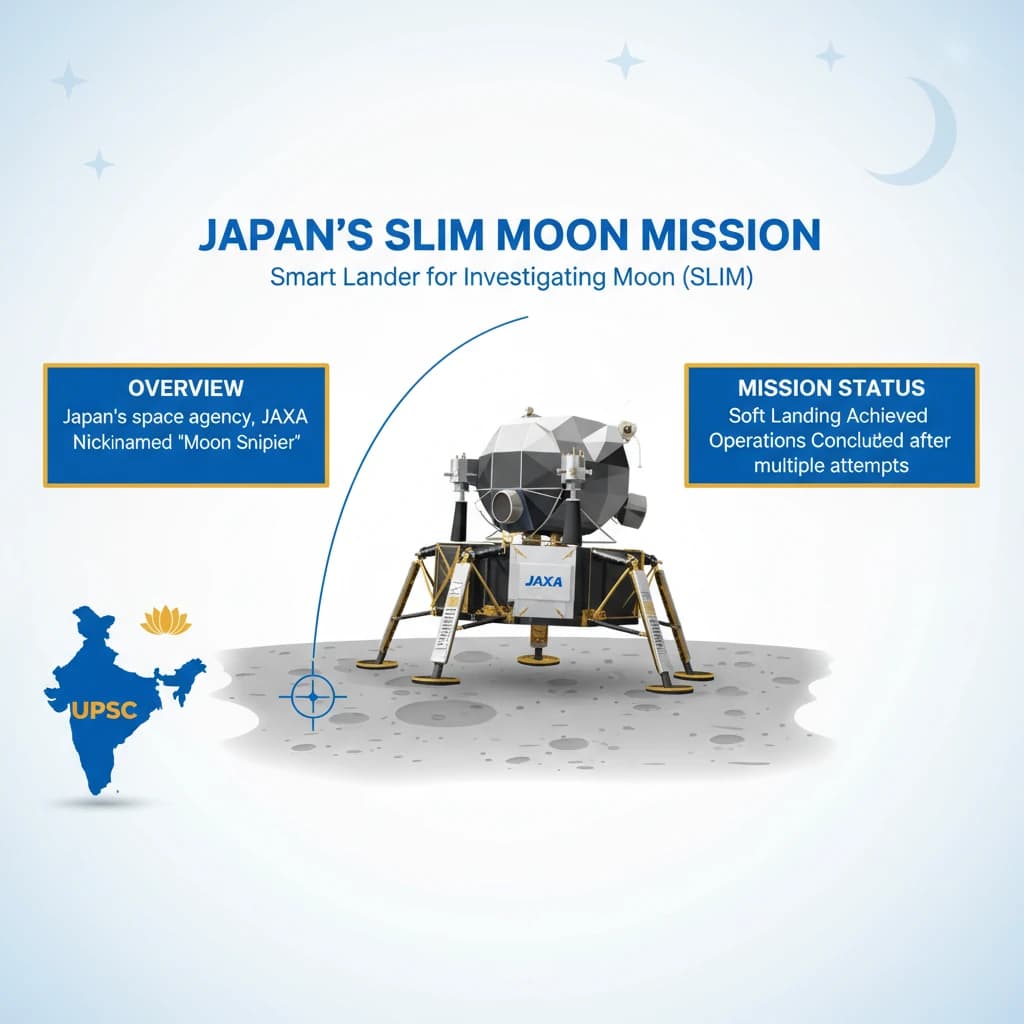
<h4>Overview of Japan's SLIM Moon Mission</h4><p>The <strong>Smart Lander for Investigating Moon (SLIM)</strong> was a significant lunar mission by <strong>Japan's space agency, JAXA</strong>. It was affectionately nicknamed the <strong>“Moon Sniper”</strong> due to its advanced capability for highly precise landings on the lunar surface.</p><p>Although the mission successfully achieved a soft landing, <strong>JAXA</strong> ultimately concluded its operations after multiple unsuccessful attempts to re-establish communication with the spacecraft. This marked the end of its operational phase.</p><div class='info-box'><p><strong>Mission Name:</strong> Smart Lander for Investigating Moon (SLIM)</p><p><strong>Agency:</strong> JAXA (Japan Aerospace Exploration Agency)</p><p><strong>Nickname:</strong> "Moon Sniper"</p></div><h4>Key Objectives and Features of SLIM</h4><p><strong>SLIM</strong> was designed as a small-scale, uncrewed lunar lander with several innovative objectives. Its primary goal was to demonstrate <strong>precise landing technology</strong>, which is crucial for future lunar and planetary explorations.</p><p>Beyond precision, the mission also aimed to test technologies for <strong>reduced equipment size and weight</strong>. This approach is vital for making space missions more cost-effective and efficient, allowing for more scientific payload capacity.</p><div class='key-point-box'><p><strong>Core Objectives:</strong></p><ul><li>Achieve <strong>precise lunar landing</strong> within 100 meters of target.</li><li>Test <strong>low-gravity exploration technology</strong>.</li><li>Investigate the <strong>Moon’s origins</strong> by analyzing landing site data.</li><li>Demonstrate <strong>reduced equipment size and weight</strong> for future missions.</li></ul></div><h4>Historic Achievement: Japan Joins Elite Lunar Club</h4><p>In <strong>January 2024</strong>, <strong>SLIM</strong> successfully performed a <strong>soft landing</strong> on the Moon. This monumental achievement made <strong>Japan the fifth nation</strong> in history to accomplish this complex feat, showcasing its advanced space capabilities.</p><p>The ability to execute a soft landing is a critical milestone in space exploration, signifying a nation's proficiency in complex orbital maneuvers, precise navigation, and controlled descent technologies.</p><div class='exam-tip-box'><p><strong>UPSC Insight:</strong> Remember the chronological order and the nations involved in achieving soft lunar landings. This is a common factual question in <strong>Prelims (GS Paper 1)</strong>.</p></div><h4>Nations with Successful Soft Lunar Landings</h4><p>Prior to <strong>Japan's SLIM mission</strong>, only four other countries had successfully achieved a <strong>soft lunar landing</strong>. These nations represent the forefront of global space exploration capabilities.</p><ul><li><strong>United States</strong></li><li><strong>Russia</strong> (then Soviet Union)</li><li><strong>China</strong></li><li><strong>India</strong></li></ul><p>Notably, <strong>ISRO’s Chandrayaan-3 Mission</strong> successfully soft-landed a lander on the <strong>Moon’s south pole region</strong>, highlighting India's growing prowess in space technology and its focus on scientifically significant regions.</p>
Concept Diagram

💡 Key Takeaways

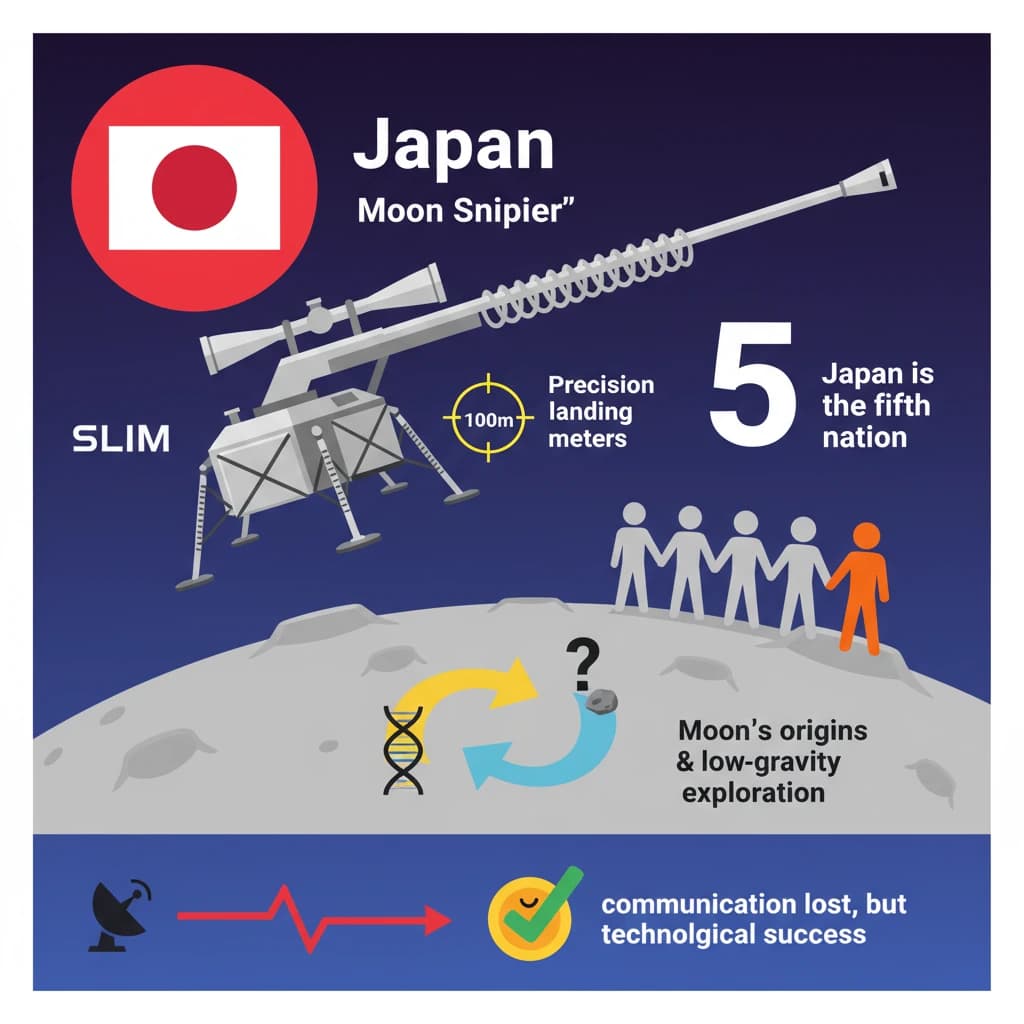
  • •Japan's SLIM (Smart Lander for Investigating Moon), nicknamed "Moon Sniper," achieved a soft landing in January 2024.
  • •SLIM made Japan the fifth nation to achieve a soft lunar landing, demonstrating precision landing technology within 100 meters.
  • •The mission also tested low-gravity exploration technology and aimed to investigate the Moon's origins.
  • •SLIM's operations concluded after JAXA lost communication, but its technological demonstration was successful.
  • •Other nations with soft lunar landings are the US, Russia, China, and India (Chandrayaan-3, which landed on the South Pole).

🧠 Memory Techniques
Memory Aid
98% Verified Content

📚 Reference Sources

•JAXA official website (for SLIM mission details)
•ISRO official website (for Chandrayaan-3 details)

Related Topics

Loading related topics...
Explore:Science And Technology Topics·All Subjects·Daily Current Affairs·Editorial Analysis·Previous Year Questions·UPSC GPT