Loading page, please wait…
Vaidra Logo
Vaidra

Top 4 items + smart groups

UPSC GPT
New
Current Affairs
Daily Solutions
Daily Puzzle
Mains Evaluator

Version 2.0.0 • Built with ❤️ for UPSC aspirants

Loading...
Loading...
Loading...
Loading...
Loading...
Loading...
Loading...
Loading...
Loading...
Loading...
Loading...
Loading...
Loading...
Back
All Subjects

Topics

0 topics • 0 completed

Loading topics...
Loading...
Loading...
Loading...
Loading...
Loading...
Overall Progress0%

Black Holes: Formation, Types, and Significance for UPSC - UPSC Science And Technology

What is Black Holes: Formation, Types, and Significance for UPSC in UPSC Science And Technology?

Black Holes: Formation, Types, and Significance for UPSC is a key topic under Science And Technology for UPSC Civil Services Examination. Key points include: Black holes are regions of spacetime with immense gravity, preventing anything, including light, from escaping.. They form primarily from the collapse of massive stars in supernovae.. Three main types exist: Stellar (from single stars), Intermediate (100-100,000 solar masses), and Supermassive (millions to billions of solar masses at galaxy centers).. Understanding this topic is essential for both UPSC Prelims and Mains preparation.

Why is Black Holes: Formation, Types, and Significance for UPSC important for UPSC exam?

Black Holes: Formation, Types, and Significance for UPSC is a Medium-level topic in UPSC Science And Technology. It is tested in both Prelims (factual MCQs) and Mains (analytical answer writing). Previous year UPSC questions have frequently covered aspects of Black Holes: Formation, Types, and Significance for UPSC, making it essential for comprehensive IAS preparation.

How to prepare Black Holes: Formation, Types, and Significance for UPSC for UPSC?

To prepare Black Holes: Formation, Types, and Significance for UPSC for UPSC: (1) Study the comprehensive notes covering all key concepts on Vaidra. (2) Practice previous year questions on this topic. (3) Connect it with current affairs using daily updates. (4) Revise using key takeaways and mind maps available for Science And Technology. (5) Write practice answers linking Black Holes: Formation, Types, and Significance for UPSC to related GS Paper topics.

Key takeaways of Black Holes: Formation, Types, and Significance for UPSC for UPSC

  • Black holes are regions of spacetime with immense gravity, preventing anything, including light, from escaping.
  • They form primarily from the collapse of massive stars in supernovae.
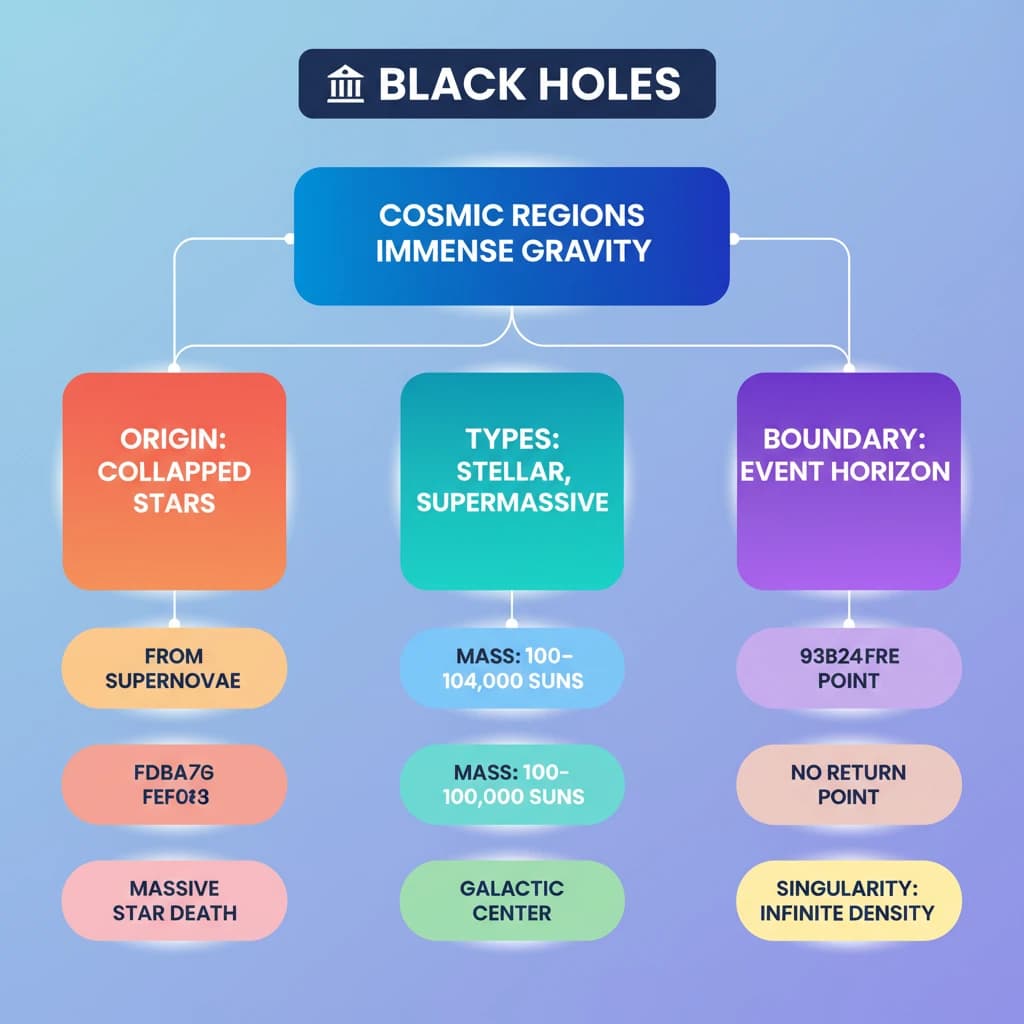
  • Three main types exist: Stellar (from single stars), Intermediate (100-100,000 solar masses), and Supermassive (millions to billions of solar masses at galaxy centers).
  • The Event Horizon is the boundary of no return, and the Singularity is the point of infinite density.
  • Research on black holes, including gravitational waves and direct imaging, is crucial for understanding gravity, spacetime, and galaxy evolution.
Black Holes: Formation, Types, and Significance for UPSC

Black Holes: Formation, Types, and Significance for UPSC

Medium⏱️ 8 min read✓ 95% Verified
science and technology

📖 Introduction

<h4>Introduction to Black Holes</h4><p>A <strong>Black Hole</strong> is a region in <strong>spacetime</strong> where <strong>gravity</strong> is so intense that nothing, not even <strong>light</strong> or any form of <strong>electromagnetic radiation</strong>, can escape from it.</p><p>This extreme gravitational pull is a direct consequence of a massive amount of matter being compressed into an incredibly small space.</p><div class='info-box'><p>The boundary beyond which escape is impossible is known as the <strong>Event Horizon</strong>.</p></div><h4>Formation of Black Holes</h4><p>Black holes typically form from the catastrophic collapse of a <strong>massive star</strong> at the end of its life cycle.</p><p>This process often culminates in a violent stellar explosion known as a <strong>supernova</strong>.</p><div class='key-point-box'><p>If the remaining core of the collapsed star is sufficiently massive (generally more than three times the mass of our Sun), it continues to contract indefinitely under its own gravity, forming a black hole.</p></div><h4>Types of Black Holes</h4><p>Black holes are categorized primarily by their <strong>mass</strong>. The universe hosts different types, each with distinct formation mechanisms and characteristics.</p><ul><li><strong>Stellar Black Hole</strong>: These are formed by the <strong>gravitational collapse</strong> of a <strong>single massive star</strong>. They are typically 3 to 100 times the mass of our <strong>Sun</strong>.</li><li><strong>Intermediate Black Hole (IMBH)</strong>: Their masses fall between <strong>100 and 100,000 times that of the Sun</strong>. Their formation mechanisms are still a subject of active research, possibly through mergers of smaller black holes or collapse of dense star clusters.</li><li><strong>Supermassive Black Hole (SMBH)</strong>: These are the largest type, with masses ranging from <strong>millions to billions of times that of the Sun</strong>. They are found at the <strong>centres of most galaxies</strong>, including our own <strong>Milky Way galaxy</strong>, where <strong>Sagittarius A*</strong> resides.</li></ul><div class='exam-tip-box'><p>Understanding the different types of black holes and their formation is crucial for questions related to <strong>astronomy</strong> and <strong>space science</strong> in <strong>UPSC Prelims</strong>.</p></div>
Concept Diagram

💡 Key Takeaways

  • •Black holes are regions of spacetime with immense gravity, preventing anything, including light, from escaping.
  • •They form primarily from the collapse of massive stars in supernovae.
  • •Three main types exist: Stellar (from single stars), Intermediate (100-100,000 solar masses), and Supermassive (millions to billions of solar masses at galaxy centers).
  • •The Event Horizon is the boundary of no return, and the Singularity is the point of infinite density.
  • •Research on black holes, including gravitational waves and direct imaging, is crucial for understanding gravity, spacetime, and galaxy evolution.

🧠 Memory Techniques

Memory Aid
95% Verified Content

📚 Reference Sources

•NASA Science: Black Holes
•ESA (European Space Agency) resources on Black Holes
•Event Horizon Telescope (EHT) Collaboration publications
•LIGO Scientific Collaboration publications

Related Topics

Loading related topics...
Explore:Science And Technology Topics·All Subjects·Daily Current Affairs·Editorial Analysis·Previous Year Questions·UPSC GPT
Black Holes: Formation, Types, and Significance for UPSC - UPSC Science And Technology