Loading page, please wait…
Vaidra Logo
Vaidra

Top 4 items + smart groups

UPSC GPT
New
Current Affairs
Daily Solutions
Daily Puzzle
Mains Evaluator

Version 2.0.0 • Built with ❤️ for UPSC aspirants

Loading...
Loading...
Loading...
Loading...
Loading...
Loading...
Loading...
Loading...
Loading...
Loading...
Loading...
Loading...
Loading...
Back
All Subjects

Topics

0 topics • 0 completed

Loading topics...
Loading...
Loading...
Loading...
Loading...
Loading...
Overall Progress0%

What are microRNAs? - UPSC Science And Technology

What is What are microRNAs? in UPSC Science And Technology?

What are microRNAs? is a key topic under Science And Technology for UPSC Civil Services Examination. Key points include: microRNAs (miRNAs) are small, non-coding RNA molecules that regulate gene expression.. They function by binding to specific messenger RNA (mRNA) molecules, leading to mRNA degradation or translational repression.. miRNAs play critical roles in various biological processes, including development, cell growth, and immune response.. Understanding this topic is essential for both UPSC Prelims and Mains preparation.

Why is What are microRNAs? important for UPSC exam?

What are microRNAs? is a Medium-level topic in UPSC Science And Technology. It is tested in both Prelims (factual MCQs) and Mains (analytical answer writing). Previous year UPSC questions have frequently covered aspects of What are microRNAs?, making it essential for comprehensive IAS preparation.

How to prepare What are microRNAs? for UPSC?

To prepare What are microRNAs? for UPSC: (1) Study the comprehensive notes covering all key concepts on Vaidra. (2) Practice previous year questions on this topic. (3) Connect it with current affairs using daily updates. (4) Revise using key takeaways and mind maps available for Science And Technology. (5) Write practice answers linking What are microRNAs? to related GS Paper topics.

Key takeaways of What are microRNAs? for UPSC

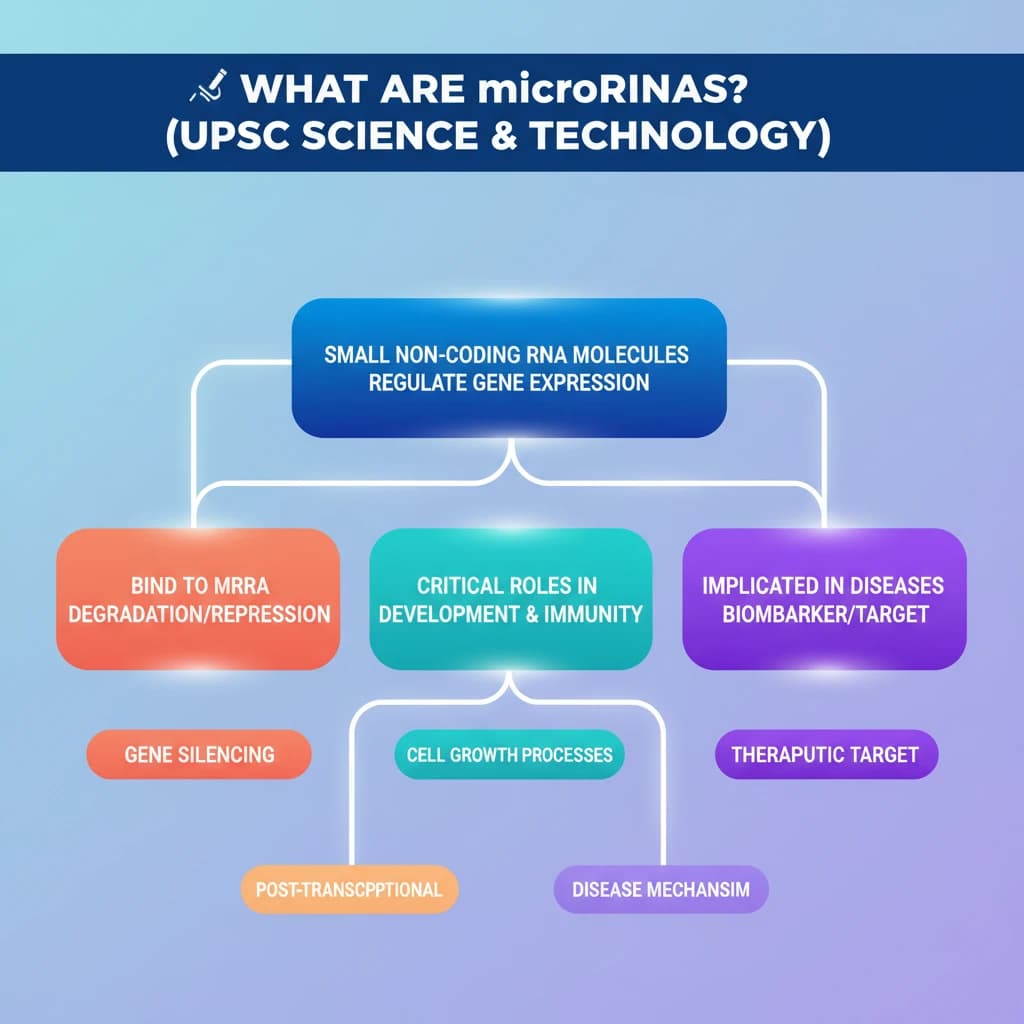
  • microRNAs (miRNAs) are small, non-coding RNA molecules that regulate gene expression.
  • They function by binding to specific messenger RNA (mRNA) molecules, leading to mRNA degradation or translational repression.
  • miRNAs play critical roles in various biological processes, including development, cell growth, and immune response.
  • Dysregulation of miRNAs is implicated in numerous diseases, making them potential biomarkers and therapeutic targets.
  • The discovery of miRNAs expanded the understanding of gene regulation beyond protein-coding genes.
What are microRNAs?

What are microRNAs?

Medium⏱️ 10 min read✓ 95% Verified
science and technology

📖 Introduction

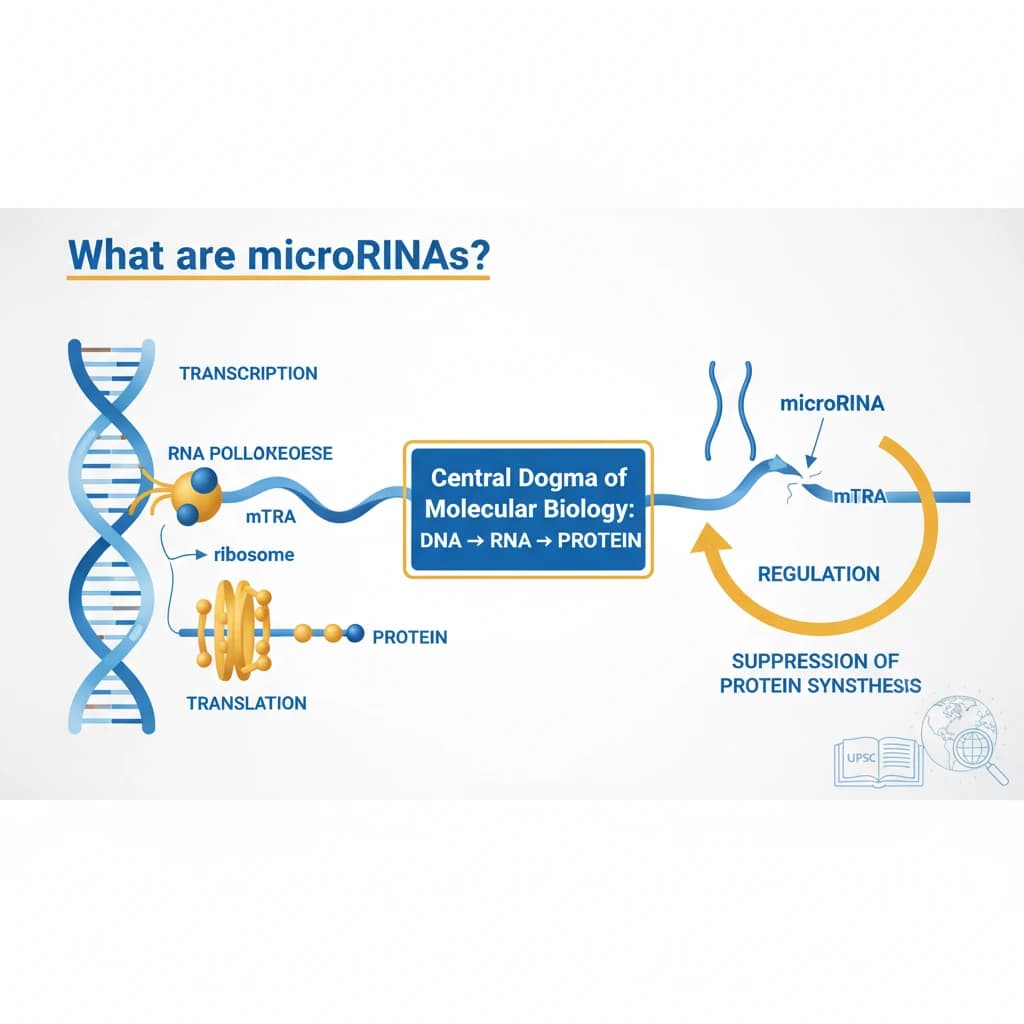
<h4>Understanding Protein Synthesis: The Central Dogma</h4><p>The human body constantly synthesizes <strong>proteins</strong>, which are essential for virtually all cellular functions. This complex biological process involves two primary steps: <strong>transcription</strong> and <strong>translation</strong>.</p><div class='info-box'><p><strong>Central Dogma of Molecular Biology:</strong> This fundamental principle describes the flow of genetic information within a biological system. It states that information flows from <strong>DNA</strong> to <strong>RNA</strong>, and then from <strong>RNA</strong> to <strong>protein</strong>.</p></div><h4>Transcription: From DNA to mRNA</h4><p>The first step, <strong>transcription</strong>, occurs within the <strong>cell nucleus</strong>. Here, a specific sequence of <strong>Deoxyribonucleic acid (DNA)</strong> is copied into a molecule called <strong>messenger Ribonucleic acid (mRNA)</strong>. This process ensures that the genetic instructions are accurately transferred.</p><p>The <strong>DNA</strong> serves as a template, and an enzyme called <strong>RNA polymerase</strong> facilitates the synthesis of a complementary <strong>mRNA</strong> strand. This newly formed <strong>mRNA</strong> molecule carries the genetic code out of the nucleus.</p><h4>Translation: From mRNA to Protein</h4><p>Following transcription, the <strong>mRNA</strong> exits the <strong>nucleus</strong> and moves into the <strong>cytoplasm</strong>, the fluid within the cell. It then attaches to a cellular machinery called a <strong>ribosome</strong>. This marks the beginning of the second main step: <strong>translation</strong>.</p><p>At the <strong>ribosome</strong>, the genetic code carried by the <strong>mRNA</strong> is 'read' and used to assemble a chain of <strong>amino acids</strong>, which folds into a functional <strong>protein</strong>. This process involves other types of RNA, such as <strong>transfer RNA (tRNA)</strong>.</p><h4>What are microRNAs (miRNAs)?</h4><p>While the above describes how proteins are made, not all <strong>RNA</strong> molecules are translated into proteins. <strong>microRNAs (miRNAs)</strong> are a class of small, non-coding <strong>RNA</strong> molecules, typically 19-25 nucleotides in length. They do not carry instructions for protein synthesis themselves.</p><div class='key-point-box'><p><strong>Key Concept: Non-coding RNA</strong> <strong>miRNAs</strong> are a crucial example of <strong>non-coding RNA (ncRNA)</strong>. Unlike <strong>mRNA</strong>, which codes for proteins, <strong>ncRNAs</strong> perform various regulatory and structural functions directly without being translated.</p></div><h4>Function and Mechanism of miRNAs</h4><p>The primary function of <strong>miRNAs</strong> is to regulate <strong>gene expression</strong>. They achieve this by binding to specific <strong>mRNA</strong> molecules, usually in the 3' untranslated region (UTR). This binding can lead to two main outcomes:</p><ul><li><strong>mRNA degradation:</strong> The <strong>miRNA</strong>-bound <strong>mRNA</strong> is marked for destruction, preventing its translation into protein.</li><li><strong>Translational repression:</strong> The <strong>miRNA</strong> inhibits the ribosome from translating the <strong>mRNA</strong> into protein, even if the <strong>mRNA</strong> is not immediately degraded.</li></ul><p>Through these mechanisms, <strong>miRNAs</strong> effectively 'silence' or reduce the production of specific proteins, playing a critical role in fine-tuning cellular processes.</p><h4>Biological Significance of miRNAs</h4><p><strong>miRNAs</strong> are involved in a vast array of biological processes. Their regulatory power makes them essential for proper cellular function and development.</p><ul><li><strong>Cell Development:</strong> They guide cell differentiation and tissue formation.</li><li><strong>Cell Proliferation and Apoptosis:</strong> They control cell growth and programmed cell death.</li><li><strong>Immune Response:</strong> They modulate the body's defense mechanisms.</li><li><strong>Disease Pathogenesis:</strong> Dysregulation of <strong>miRNAs</strong> is implicated in many diseases, including various types of <strong>cancer</strong>, <strong>neurodegenerative disorders</strong>, and <strong>cardiovascular diseases</strong>.</li></ul><div class='exam-tip-box'><p><strong>UPSC Insight:</strong> Understanding the distinction between <strong>coding RNA (mRNA)</strong> and <strong>non-coding RNA (miRNA, tRNA, rRNA)</strong> is fundamental. Questions often test the regulatory roles of these molecules in health and disease, especially in the context of biotechnology and medicine.</p></div>
Concept Diagram

💡 Key Takeaways

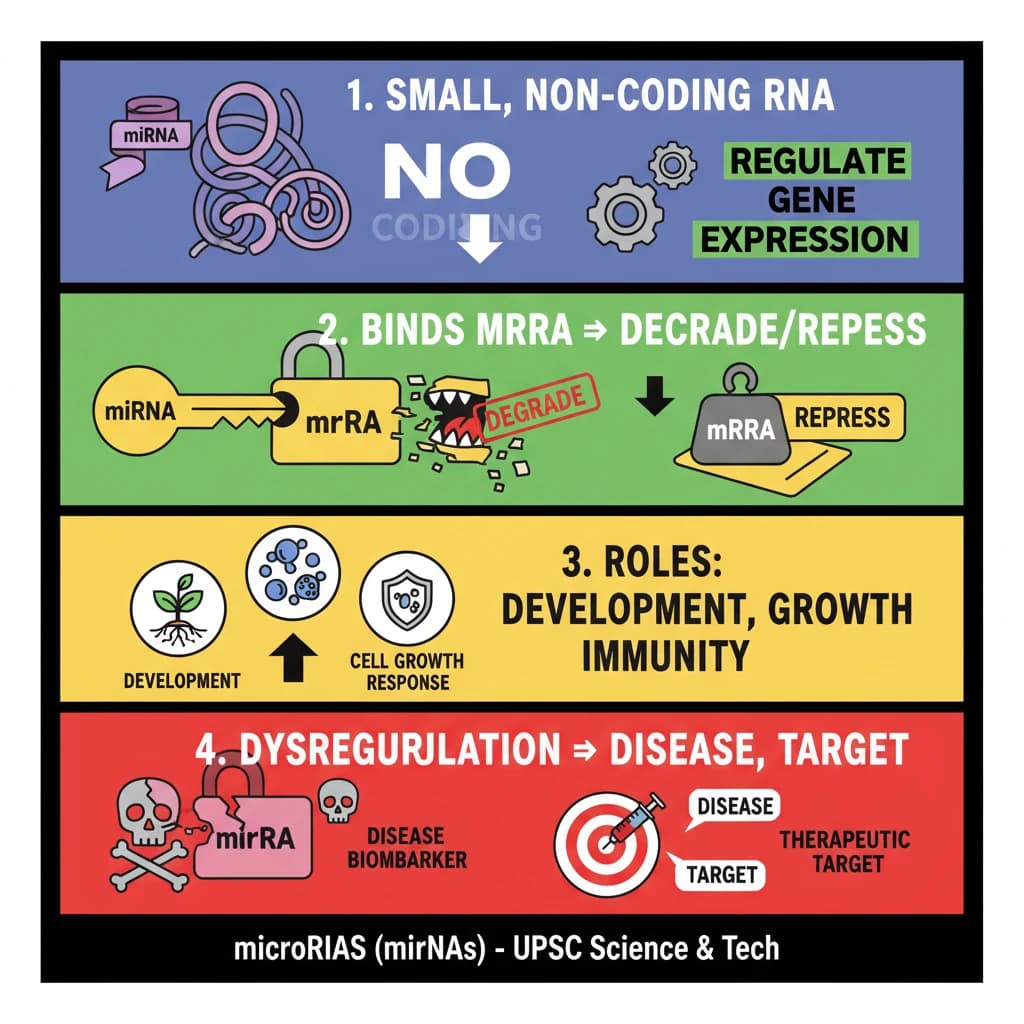
  • •microRNAs (miRNAs) are small, non-coding RNA molecules that regulate gene expression.
  • •They function by binding to specific messenger RNA (mRNA) molecules, leading to mRNA degradation or translational repression.
  • •miRNAs play critical roles in various biological processes, including development, cell growth, and immune response.
  • •Dysregulation of miRNAs is implicated in numerous diseases, making them potential biomarkers and therapeutic targets.
  • •The discovery of miRNAs expanded the understanding of gene regulation beyond protein-coding genes.

🧠 Memory Techniques
Memory Aid
95% Verified Content

📚 Reference Sources

•National Center for Biotechnology Information (NCBI) - PubMed articles on microRNAs
•Nature Education - Scitable articles on gene regulation and microRNAs
•Alberts B, Johnson A, Lewis J, et al. Molecular Biology of the Cell. 4th edition. New York: Garland Science; 2002.

Related Topics

Loading related topics...
Explore:Science And Technology Topics·All Subjects·Daily Current Affairs·Editorial Analysis·Previous Year Questions·UPSC GPT
What are microRNAs? - UPSC Science And Technology