Loading page, please wait…
Vaidra Logo
Vaidra

Top 4 items + smart groups

UPSC GPT
New
Current Affairs
Daily Solutions
Daily Puzzle
Mains Evaluator

Version 2.0.0 • Built with ❤️ for UPSC aspirants

Loading...
Loading...
Loading...
Loading...
Loading...
Loading...
Loading...
Loading...
Loading...
Loading...
Loading...
Loading...
Loading...

What are Key Facts About Proteins? - UPSC Science And Technology

What is What are Key Facts About Proteins? in UPSC Science And Technology?

What are Key Facts About Proteins? is a key topic under Science And Technology for UPSC Civil Services Examination. Key points include: Proteins are fundamental macromolecules, essential for nearly all biological processes.. They are long chains of 20 different types of amino acids, their basic building blocks.. A protein's unique three-dimensional structure is determined by its amino acid sequence and dictates its specific function.. Understanding this topic is essential for both UPSC Prelims and Mains preparation.

Why is What are Key Facts About Proteins? important for UPSC exam?

What are Key Facts About Proteins? is a Easy-level topic in UPSC Science And Technology. It is tested in both Prelims (factual MCQs) and Mains (analytical answer writing). Previous year UPSC questions have frequently covered aspects of What are Key Facts About Proteins?, making it essential for comprehensive IAS preparation.

How to prepare What are Key Facts About Proteins? for UPSC?

To prepare What are Key Facts About Proteins? for UPSC: (1) Study the comprehensive notes covering all key concepts on Vaidra. (2) Practice previous year questions on this topic. (3) Connect it with current affairs using daily updates. (4) Revise using key takeaways and mind maps available for Science And Technology. (5) Write practice answers linking What are Key Facts About Proteins? to related GS Paper topics.

Key takeaways of What are Key Facts About Proteins? for UPSC

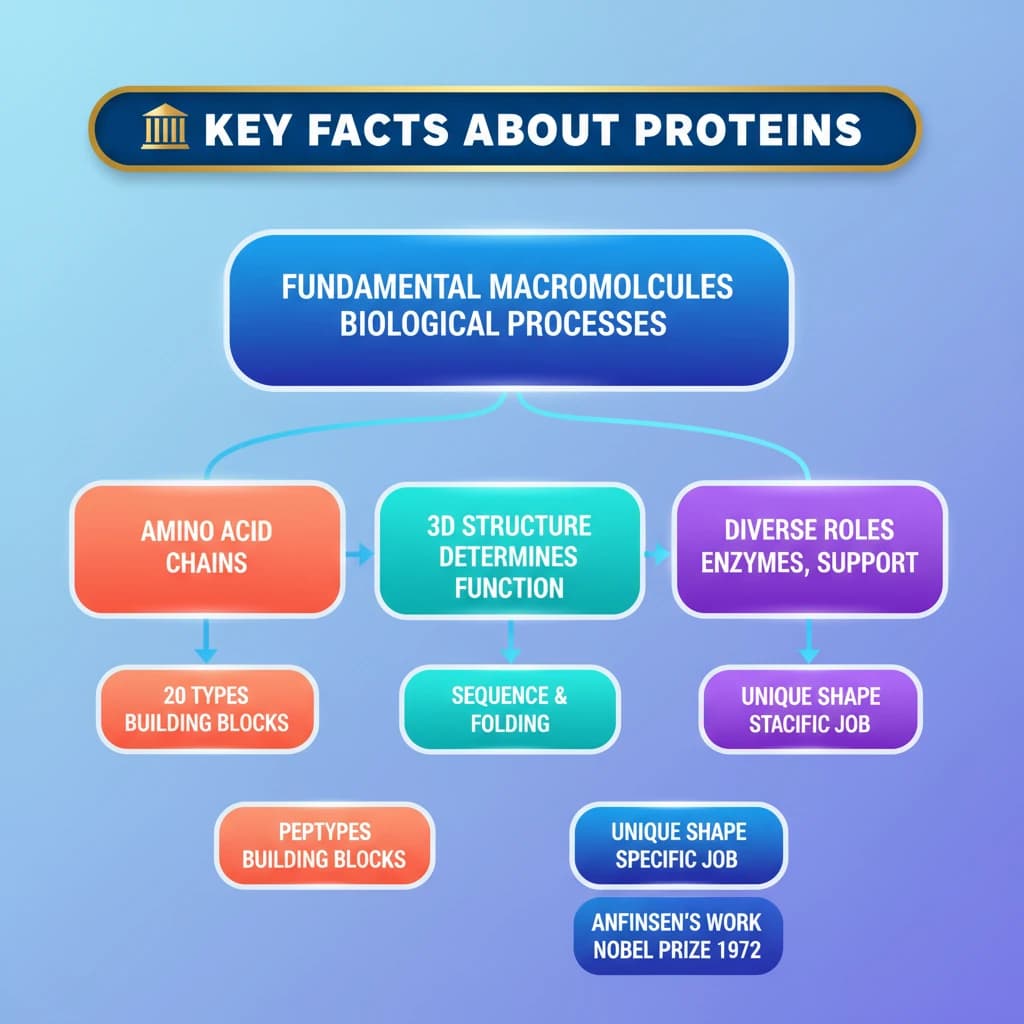
  • Proteins are fundamental macromolecules, essential for nearly all biological processes.
  • They are long chains of 20 different types of amino acids, their basic building blocks.
  • A protein's unique three-dimensional structure is determined by its amino acid sequence and dictates its specific function.
  • Proteins perform diverse roles: enzymes (catalysis), structural support (collagen), immune response (antibodies), and nutrient storage/transport.
  • Christian Anfinsen's 1972 Nobel Prize-winning work established the crucial link between amino acid sequence and protein folding/function.
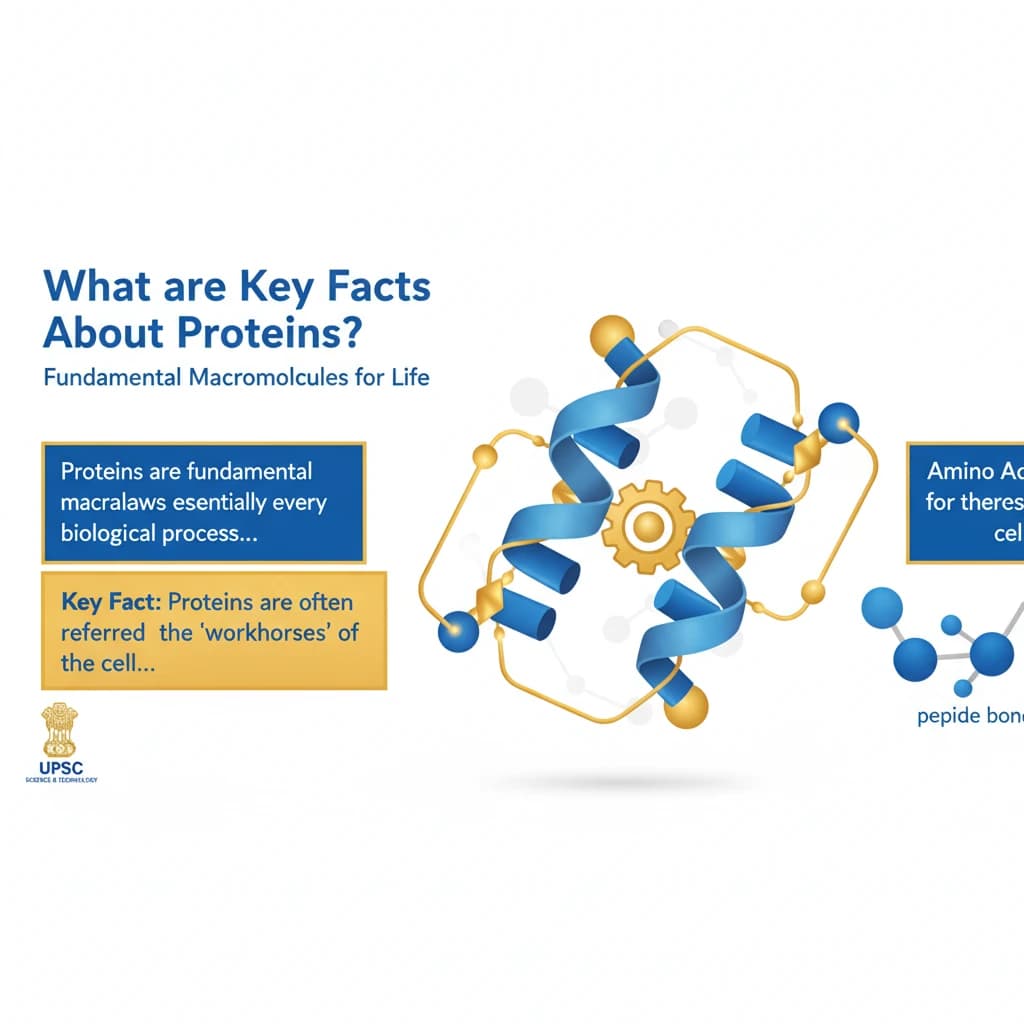
What are Key Facts About Proteins?

What are Key Facts About Proteins?

Easy⏱️ 8 min read✓ 98% Verified
science and technology

📖 Introduction

<h4>What are Proteins?</h4><p><strong>Proteins</strong> are fundamental <strong>macromolecules</strong> essential for virtually every biological process in living organisms. They are complex organic compounds that play a crucial role in the structure, function, and regulation of the body's tissues and organs.</p><div class='info-box'><p><strong>Key Fact:</strong> Proteins are often referred to as the 'workhorses' of the cell due to their diverse and indispensable functions.</p></div><h4>Amino Acids: The Building Blocks of Proteins</h4><p><strong>Proteins</strong> are constructed from smaller units called <strong>amino acids</strong>. These are <strong>organic molecules</strong> containing specific elements: <strong>carbon</strong>, <strong>hydrogen</strong>, <strong>nitrogen</strong>, <strong>oxygen</strong>, and sometimes <strong>sulphur</strong>.</p><p>There are <strong>20 different types of amino acids</strong> that serve as the basic building blocks. The unique sequence and combination of these amino acids determine the specific protein formed.</p><h4>Protein Structure and Function</h4><p>The sequence of <strong>amino acids</strong> in a protein dictates how it folds into a precise <strong>three-dimensional structure</strong>. This intricate 3D shape is absolutely critical, as it directly determines the protein's specific <strong>function</strong>.</p><div class='key-point-box'><p><strong>Important Concept:</strong> A change in a protein's <strong>amino acid sequence</strong> or its <strong>three-dimensional structure</strong> can lead to a loss of function, often with significant biological consequences.</p></div><h4>Nobel Prize in Protein Research</h4><p>The profound connection between a protein's <strong>amino acid sequence</strong> and its <strong>three-dimensional structure</strong> was a groundbreaking discovery. In <strong>1972</strong>, the <strong>Nobel Prize in Chemistry</strong> was awarded to <strong>Christian Anfinsen</strong> for his pioneering work.</p><div class='info-box'><p><strong>Christian Anfinsen's</strong> research, particularly on the enzyme <strong>ribonuclease</strong>, demonstrated that the information required for a protein to fold into its correct 3D structure is inherent in its <strong>amino acid sequence</strong>.</p></div><h4>Diverse Roles of Proteins in Biology</h4><p><strong>Proteins</strong> perform a wide array of vital functions necessary for life. Their versatility enables them to participate in almost every cellular process.</p><ul><li><strong>Speeding up Biochemical Reactions:</strong> Many proteins act as <strong>enzymes</strong>, catalyzing (speeding up) essential biochemical reactions in the body, such as digestion and metabolism.</li><li><strong>Providing Structural Support:</strong> Proteins like <strong>collagen</strong> and <strong>keratin</strong> provide structural integrity to cells, tissues, and organs, forming components of skin, hair, and connective tissues.</li><li><strong>Aiding in Immune Responses:</strong> <strong>Antibodies</strong>, which are proteins, play a crucial role in the body's immune system, identifying and neutralizing foreign invaders like bacteria and viruses.</li><li><strong>Storing Nutrients:</strong> Some proteins are involved in the storage and transport of essential nutrients. For example, <strong>ferritin</strong> stores iron in the body.</li><li><strong>Transporting Molecules:</strong> Proteins like <strong>hemoglobin</strong> transport oxygen in the blood, while others facilitate the movement of substances across cell membranes.</li></ul><div class='exam-tip-box'><p><strong>UPSC Insight:</strong> Understanding the diverse functions of <strong>proteins</strong> is crucial for topics related to human physiology, nutrition, biotechnology, and disease mechanisms in <strong>GS Paper III (Science and Technology)</strong> and <strong>GS Paper II (Health)</strong>.</p></div>
Concept Diagram

💡 Key Takeaways

  • •Proteins are fundamental macromolecules, essential for nearly all biological processes.
  • •They are long chains of 20 different types of amino acids, their basic building blocks.
  • •A protein's unique three-dimensional structure is determined by its amino acid sequence and dictates its specific function.
  • •Proteins perform diverse roles: enzymes (catalysis), structural support (collagen), immune response (antibodies), and nutrient storage/transport.
  • •Christian Anfinsen's 1972 Nobel Prize-winning work established the crucial link between amino acid sequence and protein folding/function.

🧠 Memory Techniques
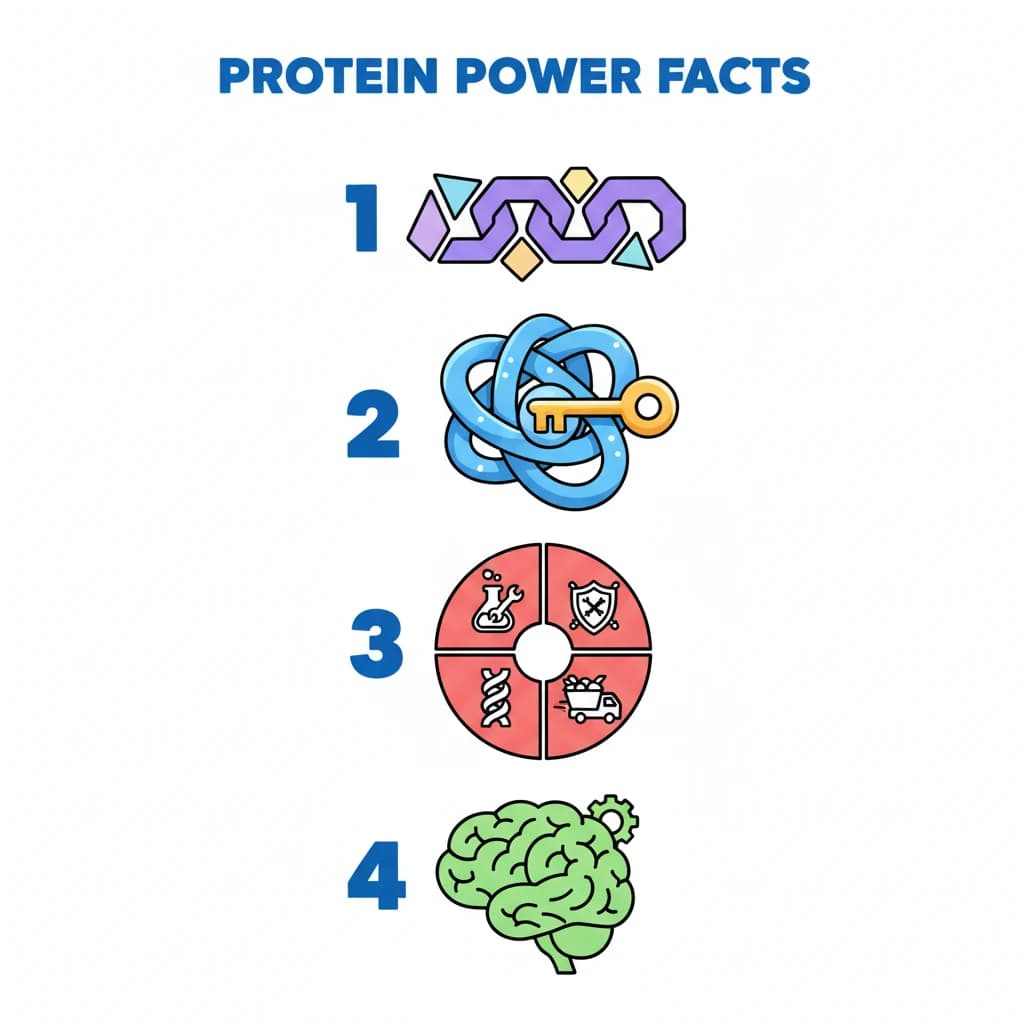
Memory Aid
98% Verified Content

📚 Reference Sources

•NCERT Biology Textbooks (Class XI & XII)
•Lehninger Principles of Biochemistry
•National Institutes of Health (NIH) - General information on proteins

Related Topics

Loading related topics...
Explore:Science And Technology Topics·All Subjects·Daily Current Affairs·Editorial Analysis·Previous Year Questions·UPSC GPT
Back
All Subjects

Topics

0 topics • 0 completed

Loading topics...
Loading...
Loading...
Loading...
Loading...
Loading...
Overall Progress0%
What are Key Facts About Proteins? - UPSC Science And Technology