Loading page, please wait…
Vaidra Logo
Vaidra

Top 4 items + smart groups

UPSC GPT
New
Current Affairs
Daily Solutions
Daily Puzzle
Mains Evaluator

Version 2.0.0 • Built with ❤️ for UPSC aspirants

Loading...
Loading...
Loading...
Loading...
Loading...
Loading...
Loading...
Loading...
Loading...
Loading...
Loading...
Loading...
Loading...
Back
All Subjects

Topics

0 topics • 0 completed

Loading topics...
Loading...
Loading...
Loading...
Loading...
Loading...
Overall Progress0%

Bose-Einstein Condensate (BEC) & Quantum Statistics - UPSC Science And Technology

What is Bose-Einstein Condensate (BEC) & Quantum Statistics in UPSC Science And Technology?

Bose-Einstein Condensate (BEC) & Quantum Statistics is a key topic under Science And Technology for UPSC Civil Services Examination. Key points include: Particles are classified as <strong>Bosons</strong> (integer spin, obey Bose-Einstein statistics) or <strong>Fermions</strong> (half-integer spin, obey Fermi-Dirac statistics and Pauli Exclusion Principle).. The <strong>Pauli Exclusion Principle</strong> states no two identical fermions can occupy the same quantum state, governing the structure of matter.. A <strong>Bose-Einstein Condensate (BEC)</strong> is an exotic state where bosonic atoms cooled near absolute zero merge into a single quantum entity with wave-like properties.. Understanding this topic is essential for both UPSC Prelims and Mains preparation.

Why is Bose-Einstein Condensate (BEC) & Quantum Statistics important for UPSC exam?

Bose-Einstein Condensate (BEC) & Quantum Statistics is a Medium-level topic in UPSC Science And Technology. It is tested in both Prelims (factual MCQs) and Mains (analytical answer writing). Previous year UPSC questions have frequently covered aspects of Bose-Einstein Condensate (BEC) & Quantum Statistics, making it essential for comprehensive IAS preparation.

How to prepare Bose-Einstein Condensate (BEC) & Quantum Statistics for UPSC?

To prepare Bose-Einstein Condensate (BEC) & Quantum Statistics for UPSC: (1) Study the comprehensive notes covering all key concepts on Vaidra. (2) Practice previous year questions on this topic. (3) Connect it with current affairs using daily updates. (4) Revise using key takeaways and mind maps available for Science And Technology. (5) Write practice answers linking Bose-Einstein Condensate (BEC) & Quantum Statistics to related GS Paper topics.

Key takeaways of Bose-Einstein Condensate (BEC) & Quantum Statistics for UPSC

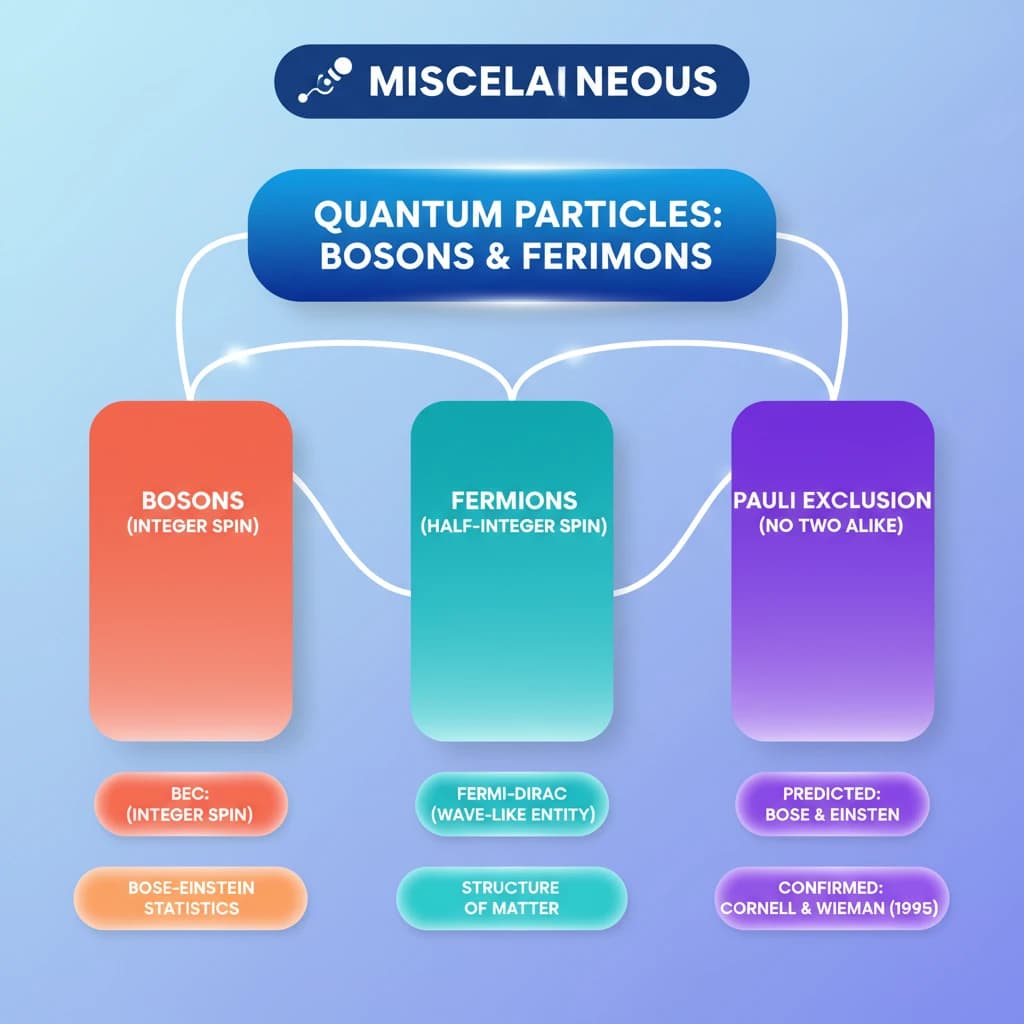
  • Particles are classified as <strong>Bosons</strong> (integer spin, obey Bose-Einstein statistics) or <strong>Fermions</strong> (half-integer spin, obey Fermi-Dirac statistics and Pauli Exclusion Principle).
  • The <strong>Pauli Exclusion Principle</strong> states no two identical fermions can occupy the same quantum state, governing the structure of matter.
  • A <strong>Bose-Einstein Condensate (BEC)</strong> is an exotic state where bosonic atoms cooled near absolute zero merge into a single quantum entity with wave-like properties.
  • BEC was predicted by <strong>Bose</strong> and <strong>Einstein</strong> and experimentally confirmed in <strong>1995</strong> by <strong>Cornell</strong> and <strong>Wieman</strong>, earning them the <strong>Nobel Prize in 2001</strong>.
  • Bose's principles are crucial for understanding the <strong>Higgs boson</strong>, <strong>quantum computing</strong>, <strong>cosmology</strong>, and <strong>condensed matter science</strong>.
Bose-Einstein Condensate (BEC) & Quantum Statistics

Bose-Einstein Condensate (BEC) & Quantum Statistics

Medium⏱️ 9 min read✓ 95% Verified
science and technology

📖 Introduction

<h4>Introduction to Quantum Particles: Bosons and Fermions</h4><p>In the realm of <strong>quantum mechanics</strong>, particles are broadly classified into two fundamental categories: <strong>Bosons</strong> and <strong>Fermions</strong>. This classification dictates their collective behavior and the phenomena they exhibit.</p><h4>Understanding Bosons and Their Properties</h4><p><strong>Bosons</strong> are particles that do not obey the <strong>Pauli Exclusion Principle</strong>. This means multiple bosons can occupy the exact same quantum state simultaneously.</p><div class='key-point-box'><p>This unique property of <strong>bosons</strong> enables macroscopic quantum phenomena such as <strong>superconductivity</strong> and <strong>superfluidity</strong>, where particles act as a single, coherent quantum entity.</p></div><p>Examples of bosons include <strong>photons</strong> (light particles), <strong>gluons</strong> (strong force carriers), and the <strong>Higgs boson</strong>.</p><h4>Fermions and the Pauli Exclusion Principle</h4><p>In contrast to bosons, <strong>Fermions</strong> strictly adhere to the <strong>Pauli Exclusion Principle</strong>. This fundamental principle states that no two identical fermions can occupy the same quantum state simultaneously within an atom.</p><div class='info-box'><p><strong>Pauli Exclusion Principle:</strong> This principle asserts that no two electrons in an atom can have the same four electronic <strong>quantum numbers</strong> (principal, azimuthal, magnetic, and spin quantum numbers). This governs the fundamental <strong>structure of matter</strong>.</p></div><p>Examples of fermions include <strong>electrons</strong>, <strong>protons</strong>, and <strong>neutrons</strong>, which are the building blocks of ordinary matter.</p><h4>Bose-Einstein Condensate (BEC): The Fifth State of Matter</h4><p>The concept of the <strong>Bose-Einstein Condensate (BEC)</strong> emerged from the pioneering work of <strong>Satyendra Nath Bose</strong>, which was later expanded upon by <strong>Albert Einstein</strong>. It represents a unique and exotic state of matter.</p><div class='info-box'><p><strong>Bose-Einstein Condensate (BEC):</strong> This state is formed when a gas of <strong>bosonic atoms</strong> is cooled to temperatures extremely close to <strong>absolute zero (-273.15° C)</strong>. At this point, the individual atoms lose their separate identities and merge into a single <strong>quantum entity</strong>, exhibiting pronounced <strong>wave-like properties</strong>.</p></div><p>In a BEC, a significant fraction of the bosons occupy the lowest possible quantum state, behaving as one "superatom."</p><h4>Experimental Confirmation and Nobel Recognition</h4><p>For many decades, the <strong>Bose-Einstein Condensate</strong> remained a theoretical prediction. However, it was triumphantly confirmed experimentally in <strong>1995</strong>.</p><p>Physicists <strong>Eric Cornell</strong> and <strong>Carl Wieman</strong> successfully created the first BEC in their laboratory. Their groundbreaking work earned them the <strong>Nobel Prize in Physics</strong> in <strong>2001</strong>, shared with Wolfgang Ketterle.</p><div class='exam-tip-box'><p>Remember the year of experimental confirmation (<strong>1995</strong>) and the Nobel Prize year (<strong>2001</strong>) along with the key scientists <strong>Eric Cornell</strong> and <strong>Carl Wieman</strong> for Prelims factual questions.</p></div><h4>Enduring Relevance in Modern Physics</h4><p>The principles laid down by <strong>Satyendra Nath Bose</strong>, particularly <strong>Bose-Einstein statistics</strong>, continue to hold profound relevance in contemporary physics and beyond.</p><p>Discoveries such as the elusive <strong>Higgs boson</strong>, often dubbed the '<strong>God Particle</strong>', directly align with bosonic principles. The <strong>Higgs boson</strong> is a fundamental elementary particle in the <strong>Standard Model of particle physics</strong>.</p><p>Furthermore, advancements in cutting-edge fields like <strong>quantum computing</strong> heavily rely on understanding and manipulating quantum states, including those involving bosonic systems and BECs.</p><p>The impact of <strong>Bose-Einstein statistics</strong> extends beyond pure physics, influencing areas such as <strong>cosmology</strong> (study of the universe) and <strong>condensed matter science</strong> (study of materials' macroscopic properties).</p><h4>Satyendra Nath Bose: Awards and Honours</h4><p><strong>Satyendra Nath Bose</strong> is revered as a towering figure in Indian science and is widely known as the '<strong>Father of the God Particle</strong>' for his foundational work.</p><div class='info-box'><p><strong>Key Honours for S.N. Bose:</strong><ul><li><strong>Padma Vibhushan:</strong> Awarded in <strong>1954</strong>, one of India's highest civilian honours.</li><li><strong>National Professor:</strong> Appointed in <strong>1959</strong>, this was the highest honour for a scholar in India, a position he held for <strong>15 years</strong>.</li></ul></p></div><p>His legacy continues to inspire generations of scientists globally.</p>
Concept Diagram

💡 Key Takeaways

  • •Particles are classified as <strong>Bosons</strong> (integer spin, obey Bose-Einstein statistics) or <strong>Fermions</strong> (half-integer spin, obey Fermi-Dirac statistics and Pauli Exclusion Principle).
  • •The <strong>Pauli Exclusion Principle</strong> states no two identical fermions can occupy the same quantum state, governing the structure of matter.
  • •A <strong>Bose-Einstein Condensate (BEC)</strong> is an exotic state where bosonic atoms cooled near absolute zero merge into a single quantum entity with wave-like properties.
  • •BEC was predicted by <strong>Bose</strong> and <strong>Einstein</strong> and experimentally confirmed in <strong>1995</strong> by <strong>Cornell</strong> and <strong>Wieman</strong>, earning them the <strong>Nobel Prize in 2001</strong>.
  • •Bose's principles are crucial for understanding the <strong>Higgs boson</strong>, <strong>quantum computing</strong>, <strong>cosmology</strong>, and <strong>condensed matter science</strong>.
  • •<strong>Satyendra Nath Bose</strong>, known as the '<strong>Father of the God Particle</strong>', received the <strong>Padma Vibhushan (1954)</strong> and was named <strong>India's National Professor (1959)</strong>.

🧠 Memory Techniques
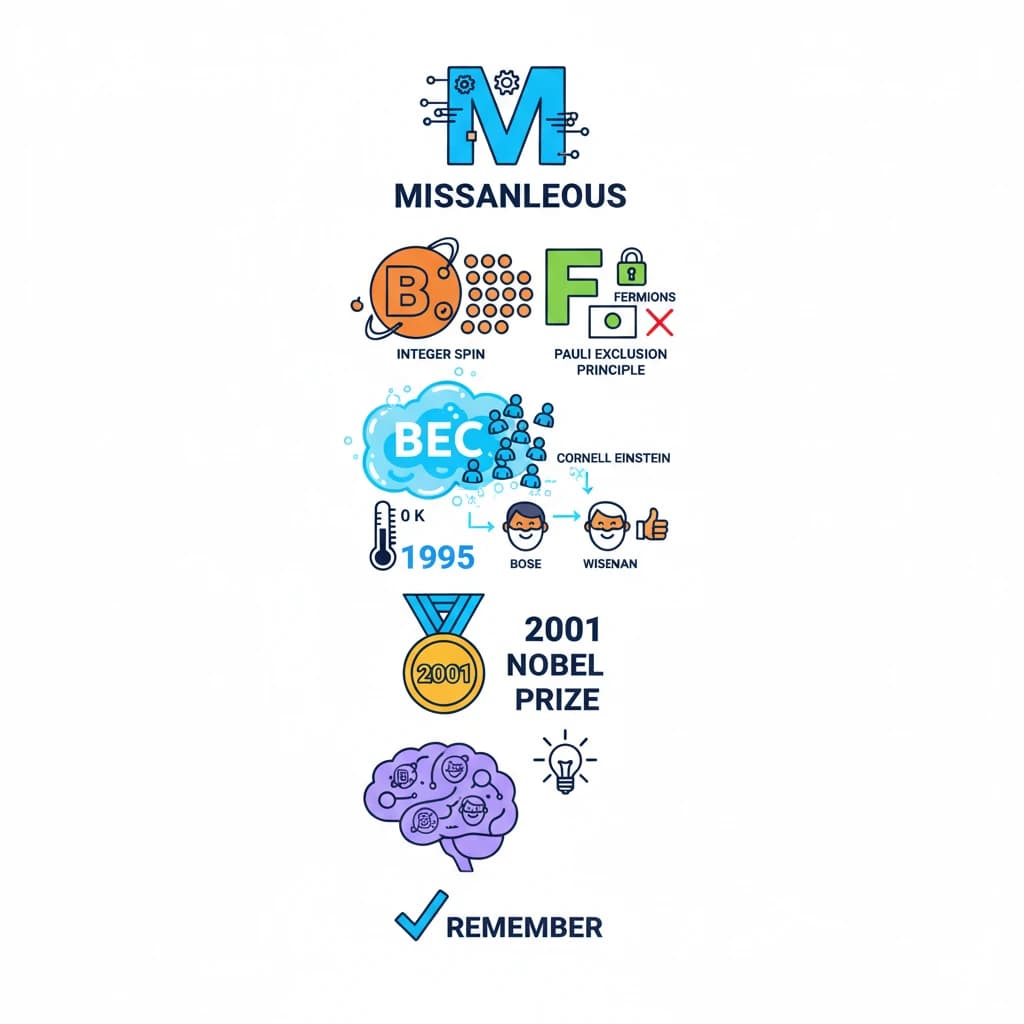
Memory Aid
95% Verified Content

📚 Reference Sources

•NCERT Physics Textbooks (Class XI, XII)
•Standard Quantum Mechanics Textbooks
•Nobel Prize Official Website (Physics Laureates 2001)
•Encyclopaedia Britannica (for definitions and historical context)

Related Topics

Loading related topics...
Explore:Science And Technology Topics·All Subjects·Daily Current Affairs·Editorial Analysis·Previous Year Questions·UPSC GPT
  • <strong>Satyendra Nath Bose</strong>, known as the '<strong>Father of the God Particle</strong>', received the <strong>Padma Vibhushan (1954)</strong> and was named <strong>India's National Professor (1959)</strong>.
  • Bose-Einstein Condensate (BEC) & Quantum Statistics - UPSC Science And Technology