Loading page, please wait…
Vaidra Logo
Vaidra

Top 4 items + smart groups

UPSC GPT
New
Current Affairs
Daily Solutions
Daily Puzzle
Mains Evaluator

Version 2.0.0 • Built with ❤️ for UPSC aspirants

Loading...
Loading...
Loading...
Loading...
Loading...
Loading...
Loading...
Loading...
Loading...
Loading...
Loading...
Loading...
Loading...

Hafnium: Properties, Uses in Nuclear Reactors & Alloys - UPSC Science And Technology

What is Hafnium: Properties, Uses in Nuclear Reactors & Alloys in UPSC Science And Technology?

Hafnium: Properties, Uses in Nuclear Reactors & Alloys is a key topic under Science And Technology for UPSC Civil Services Examination. Key points include: Hafnium is a transition metal, chemically similar to zirconium.. Its primary uses are in nuclear reactor control rods due to high neutron absorption.. It acts as a 'getter' in vacuum tubes, removing trace gases.. Understanding this topic is essential for both UPSC Prelims and Mains preparation.

Why is Hafnium: Properties, Uses in Nuclear Reactors & Alloys important for UPSC exam?

Hafnium: Properties, Uses in Nuclear Reactors & Alloys is a Easy-level topic in UPSC Science And Technology. It is tested in both Prelims (factual MCQs) and Mains (analytical answer writing). Previous year UPSC questions have frequently covered aspects of Hafnium: Properties, Uses in Nuclear Reactors & Alloys, making it essential for comprehensive IAS preparation.

How to prepare Hafnium: Properties, Uses in Nuclear Reactors & Alloys for UPSC?

To prepare Hafnium: Properties, Uses in Nuclear Reactors & Alloys for UPSC: (1) Study the comprehensive notes covering all key concepts on Vaidra. (2) Practice previous year questions on this topic. (3) Connect it with current affairs using daily updates. (4) Revise using key takeaways and mind maps available for Science And Technology. (5) Write practice answers linking Hafnium: Properties, Uses in Nuclear Reactors & Alloys to related GS Paper topics.

Key takeaways of Hafnium: Properties, Uses in Nuclear Reactors & Alloys for UPSC

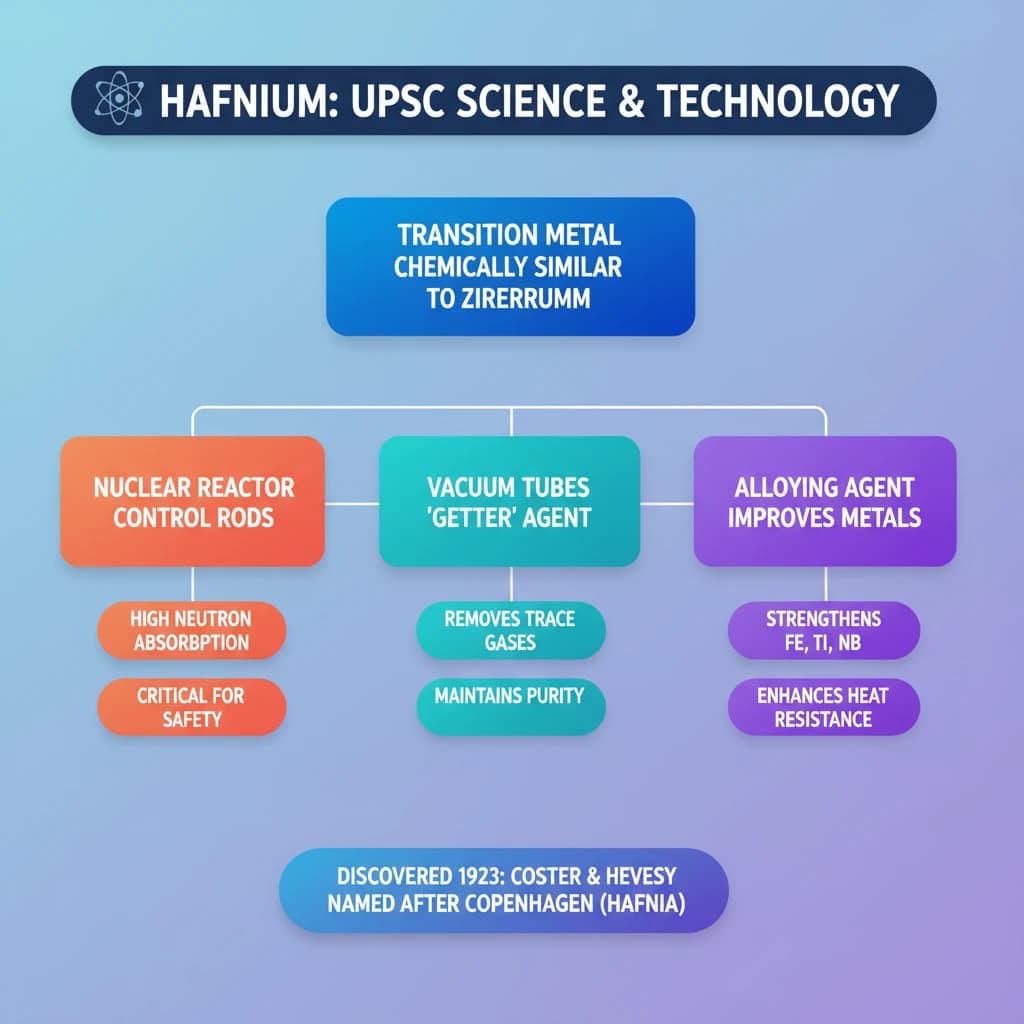
  • Hafnium is a transition metal, chemically similar to zirconium.
  • Its primary uses are in nuclear reactor control rods due to high neutron absorption.
  • It acts as a 'getter' in vacuum tubes, removing trace gases.
  • Hafnium is an alloying agent, improving properties of metals like iron, titanium, and niobium.
  • Discovered in 1923 by Coster and Hevesy, named after Copenhagen (Hafnia).
Hafnium: Properties, Uses in Nuclear Reactors & Alloys

Hafnium: Properties, Uses in Nuclear Reactors & Alloys

Easy⏱️ 5 min read✓ 98% Verified
science and technology

📖 Introduction

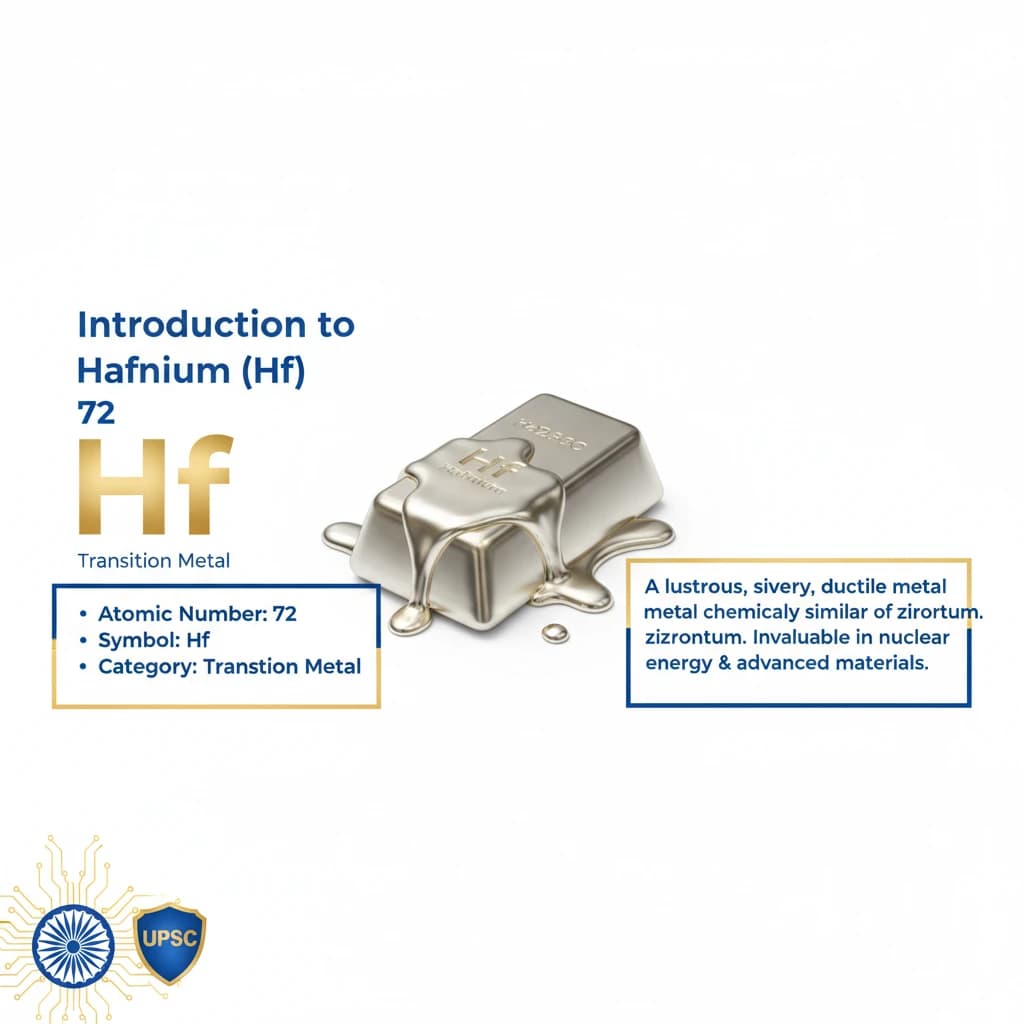
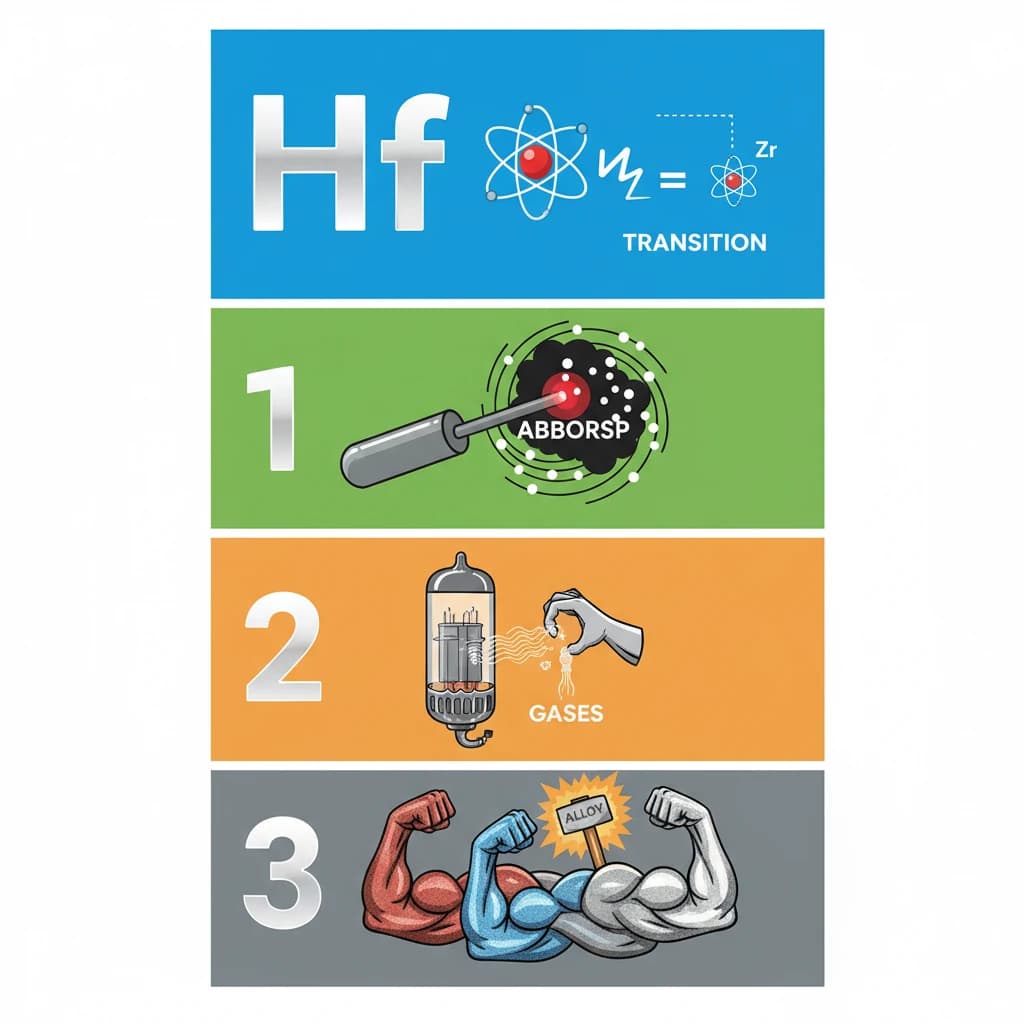
<h4>Introduction to Hafnium</h4><p><strong>Hafnium</strong> (Hf) is a lustrous, silvery, ductile metal that is chemically similar to zirconium. It is a transition metal found in Group 4 of the periodic table.</p><p>Its unique properties make it invaluable in several high-technology applications, particularly in nuclear energy and advanced materials.</p><div class='info-box'><p><strong>Atomic Number:</strong> 72</p><p><strong>Symbol:</strong> Hf</p><p><strong>Category:</strong> Transition Metal</p></div><h4>Key Applications of Hafnium</h4><p><strong>Hafnium</strong> possesses several distinct characteristics that dictate its primary industrial uses. Its high neutron absorption cross-section is particularly significant.</p><div class='key-point-box'><p><strong>Primary Uses:</strong></p><ul><li><strong>Nuclear Reactor Control Rods:</strong> Excellent neutron absorber.</li><li><strong>Vacuum Tube Getters:</strong> Removes trace gases.</li><li><strong>Alloying Agent:</strong> Enhances properties of other metals.</li></ul></div><h4>Hafnium in Nuclear Reactors</h4><p>One of the most critical applications of <strong>Hafnium</strong> is in <strong>nuclear reactors</strong>. It is a highly effective absorber of <strong>neutrons</strong>.</p><p>This property makes it ideal for manufacturing <strong>control rods</strong>, which are used to regulate the rate of fission in a nuclear reactor. By inserting or withdrawing these rods, the chain reaction can be controlled, ensuring safe and efficient operation.</p><div class='exam-tip-box'><p><strong>UPSC Insight:</strong> Understanding the role of materials like <strong>Hafnium</strong> in nuclear technology is crucial for <strong>Science & Technology (GS Paper III)</strong>. Questions often focus on the principles and applications of nuclear energy.</p></div><h4>Hafnium as a Getter in Vacuum Tubes</h4><p><strong>Hafnium</strong> is also employed in <strong>vacuum tubes</strong> as a <strong>getter</strong>. A getter is a material designed to combine with and remove trace gases from a vacuum system.</p><p>In vacuum tubes, even minute amounts of residual gases can impair performance. <strong>Hafnium's</strong> reactivity allows it to scavenge these unwanted gas molecules, thereby maintaining a high vacuum.</p><h4>Hafnium as an Alloying Agent</h4><p>Beyond its specialized roles, <strong>Hafnium</strong> serves as an <strong>alloying agent</strong> in various metals. When added to other metals, it can significantly improve their mechanical and thermal properties.</p><p>It is commonly used as an alloying element with metals such as <strong>iron</strong>, <strong>titanium</strong>, and <strong>niobium</strong>. These alloys find applications in aerospace, gas turbines, and other high-performance components where strength and heat resistance are critical.</p>
Concept Diagram

💡 Key Takeaways

  • •Hafnium is a transition metal, chemically similar to zirconium.
  • •Its primary uses are in nuclear reactor control rods due to high neutron absorption.
  • •It acts as a 'getter' in vacuum tubes, removing trace gases.
  • •Hafnium is an alloying agent, improving properties of metals like iron, titanium, and niobium.
  • •Discovered in 1923 by Coster and Hevesy, named after Copenhagen (Hafnia).

🧠 Memory Techniques
Memory Aid
98% Verified Content

📚 Reference Sources

•General scientific knowledge bases (e.g., IUPAC, Encyclopaedia Britannica for discovery details)

Related Topics

Loading related topics...
Explore:Science And Technology Topics·All Subjects·Daily Current Affairs·Editorial Analysis·Previous Year Questions·UPSC GPT
Back
All Subjects

Topics

0 topics • 0 completed

Loading topics...
Loading...
Loading...
Loading...
Loading...
Loading...
Overall Progress0%