Loading page, please wait…
Vaidra Logo
Vaidra

Top 4 items + smart groups

UPSC GPT
New
Current Affairs
Daily Solutions
Daily Puzzle
Mains Evaluator

Version 2.0.0 • Built with ❤️ for UPSC aspirants

Loading...
Loading...
Loading...
Loading...
Loading...
Loading...
Loading...
Loading...
Loading...
Loading...
Loading...
Loading...
Loading...
NASA’s Mars Sample Return Program - UPSC Science And Technology
Back
All Subjects

Topics

0 topics • 0 completed

Loading topics...
Loading...
Loading...
Loading...
Loading...
Loading...
Overall Progress0%

NASA’s Mars Sample Return Program - UPSC Science And Technology

What is NASA’s Mars Sample Return Program in UPSC Science And Technology?

NASA’s Mars Sample Return Program is a key topic under Science And Technology for UPSC Civil Services Examination. Key points include: NASA's Perseverance Rover created the first 'sample depot' on Mars in April 2024, depositing 10 rock sample tubes.. These samples are part of the Mars Sample Return (MSR) Campaign, aiming to bring Martian samples to Earth by 2040.. The MSR program is highly expensive, estimated at $11 billion, reflecting its complexity and long timeline.. Understanding this topic is essential for both UPSC Prelims and Mains preparation.

Why is NASA’s Mars Sample Return Program important for UPSC exam?

NASA’s Mars Sample Return Program is a Medium-level topic in UPSC Science And Technology. It is tested in both Prelims (factual MCQs) and Mains (analytical answer writing). Previous year UPSC questions have frequently covered aspects of NASA’s Mars Sample Return Program, making it essential for comprehensive IAS preparation.

How to prepare NASA’s Mars Sample Return Program for UPSC?

To prepare NASA’s Mars Sample Return Program for UPSC: (1) Study the comprehensive notes covering all key concepts on Vaidra. (2) Practice previous year questions on this topic. (3) Connect it with current affairs using daily updates. (4) Revise using key takeaways and mind maps available for Science And Technology. (5) Write practice answers linking NASA’s Mars Sample Return Program to related GS Paper topics.

Key takeaways of NASA’s Mars Sample Return Program for UPSC

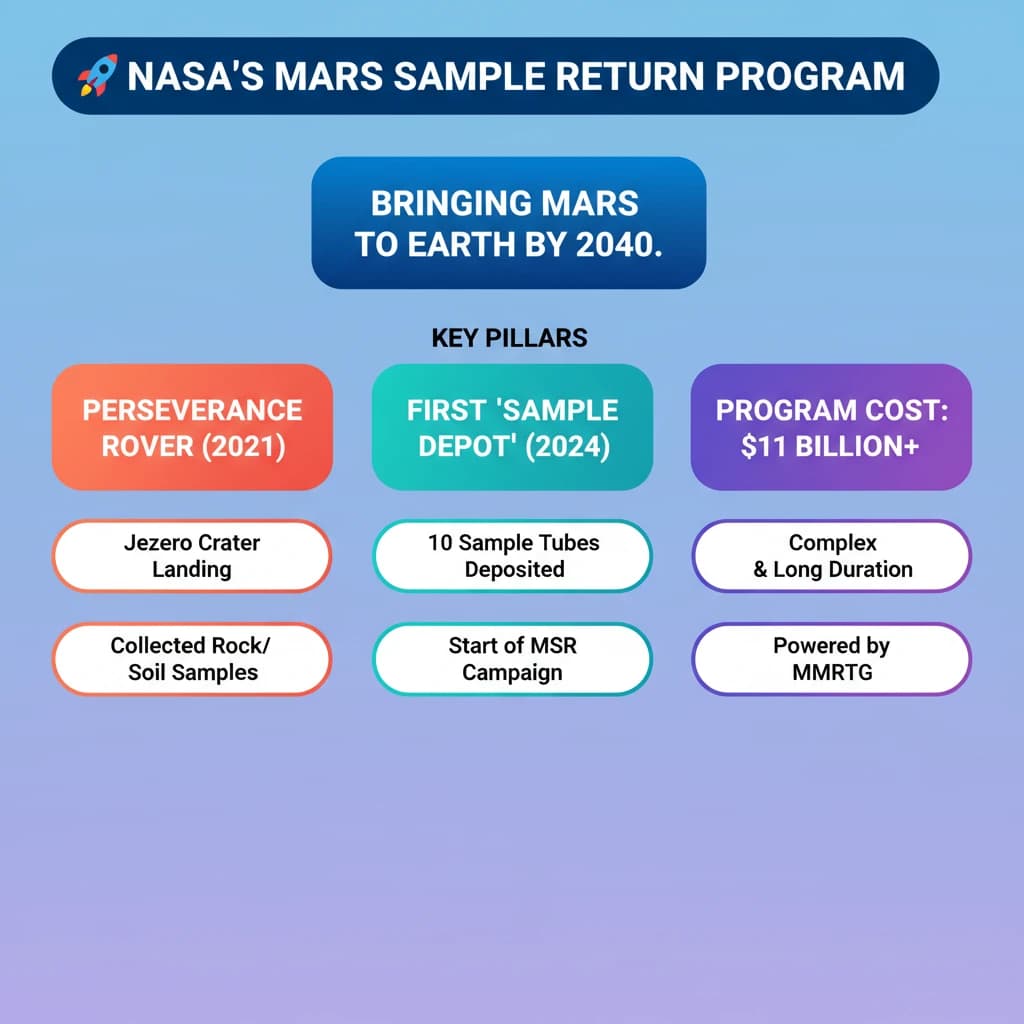
  • NASA's Perseverance Rover created the first 'sample depot' on Mars in April 2024, depositing 10 rock sample tubes.
  • These samples are part of the Mars Sample Return (MSR) Campaign, aiming to bring Martian samples to Earth by 2040.
  • The MSR program is highly expensive, estimated at $11 billion, reflecting its complexity and long timeline.
  • Perseverance Rover (part of Mars 2020 mission) landed in Jezero Crater in Feb 2021, collecting rock/soil samples.
  • The rover is powered by a Multi-Mission Radioisotope Thermoelectric Generator (MMRTG) using plutonium decay for electricity.
NASA’s Mars Sample Return Program

NASA’s Mars Sample Return Program

Medium⏱️ 6 min read✓ 98% Verified
science and technology

📖 Introduction

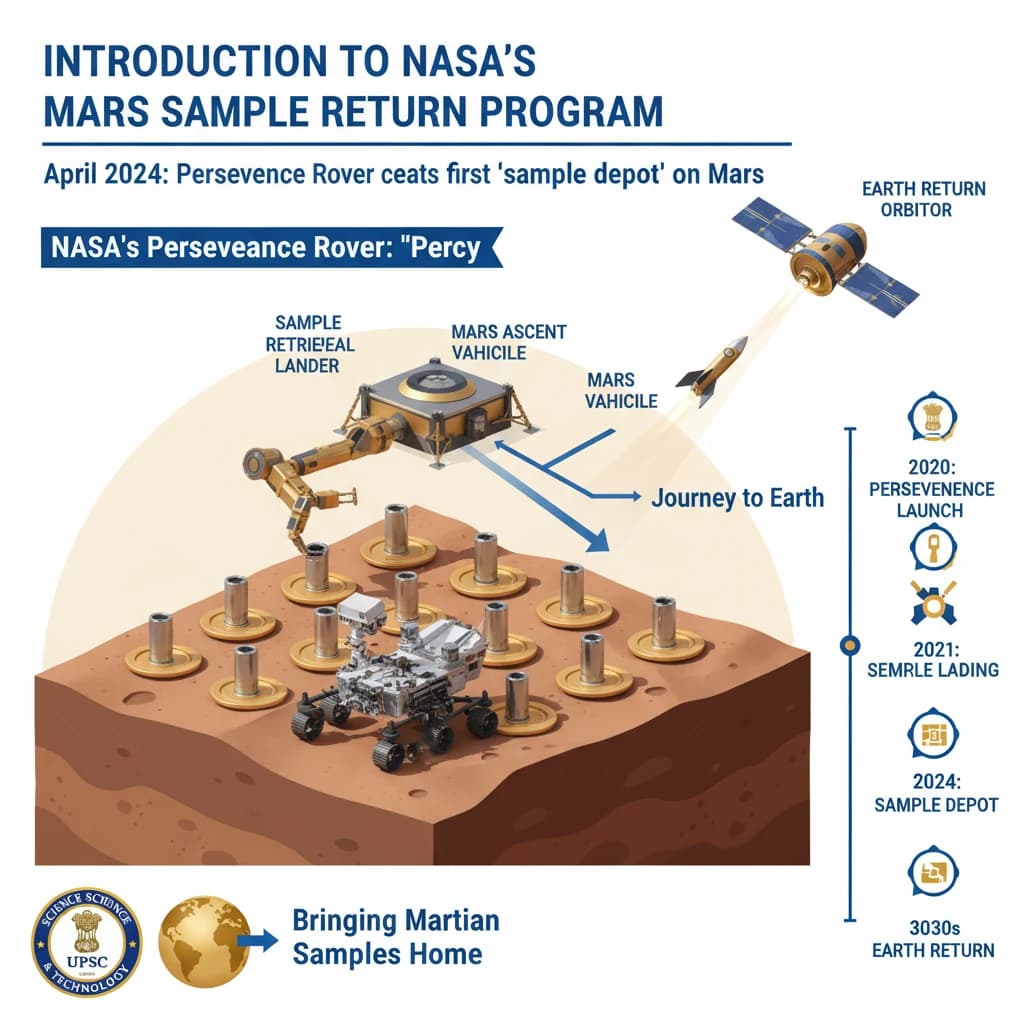
<h4>Introduction to NASA's Mars Sample Return Program</h4><p>In <strong>April 2024</strong>, <strong>NASA's Perseverance Rover</strong>, affectionately known as <strong>Percy</strong>, achieved a significant milestone by establishing the first-ever <strong>'sample depot on another world'</strong>. This involved carefully depositing ten rock sample tubes on the Martian surface.</p><p>These collected samples are intended to be retrieved and brought back to Earth as a crucial part of the ambitious <strong>Mars Sample Return (MSR) Campaign</strong>. The program aims to bring pristine Martian samples for detailed scientific analysis.</p><h4>Challenges and Timeline of the MSR Program</h4><p>The <strong>Mars Sample Return Program</strong> is a highly complex and resource-intensive endeavor. It is projected to be very expensive, with an estimated cost of <strong>$11 billion</strong>.</p><p>Furthermore, the mission has a long timeline. The full execution and return of samples to Earth are not anticipated until the year <strong>2040</strong>, highlighting the significant logistical and technological hurdles involved.</p><div class='exam-tip-box'><p><strong>UPSC Relevance:</strong> Understand the dual nature of space missions – scientific advancement alongside financial and temporal challenges. This program exemplifies long-term international scientific collaboration.</p></div><h4>Understanding the Perseverance Rover</h4><p>The <strong>Perseverance Rover</strong> is a sophisticated robotic explorer that is an integral component of <strong>NASA's Mars 2020 mission</strong>. It represents the cutting edge of planetary exploration technology.</p><p>The rover was successfully launched in <strong>July 2020</strong>. After a journey through space, it made a precise landing on Mars's <strong>Jezero Crater</strong> in <strong>February 2021</strong>, a site believed to have once harbored ancient microbial life.</p><div class='info-box'><p><strong>Perseverance Rover Specifications:</strong></p><ul><li><strong>Size:</strong> Approximately the size of a car.</li><li><strong>Weight:</strong> About <strong>1,025 kilograms</strong>, including all its scientific instruments.</li><li><strong>Primary Function:</strong> To collect and cache rock and soil samples from the Martian surface.</li><li><strong>Sample Collection:</strong> Encasing collected samples in sealed tubes for future return to Earth.</li></ul></div><h4>Perseverance Rover's Power Source</h4><p>The <strong>Perseverance Rover</strong> is powered by a robust and reliable system known as a <strong>Multi-Mission Radioisotope Thermoelectric Generator (MMRTG)</strong>. This technology is vital for long-duration missions in harsh environments.</p><p>The <strong>MMRTG</strong> generates electricity by converting heat. This heat is produced from the natural radioactive decay of <strong>plutonium-238</strong>, ensuring a consistent power supply for the rover's operations and scientific instruments.</p><div class='key-point-box'><p><strong>Key Concept:</strong> <strong>Radioisotope Thermoelectric Generators (RTGs)</strong> are crucial for deep space and long-duration planetary missions where solar power is insufficient or unavailable. They provide continuous power irrespective of sunlight.</p></div>
Concept Diagram

💡 Key Takeaways

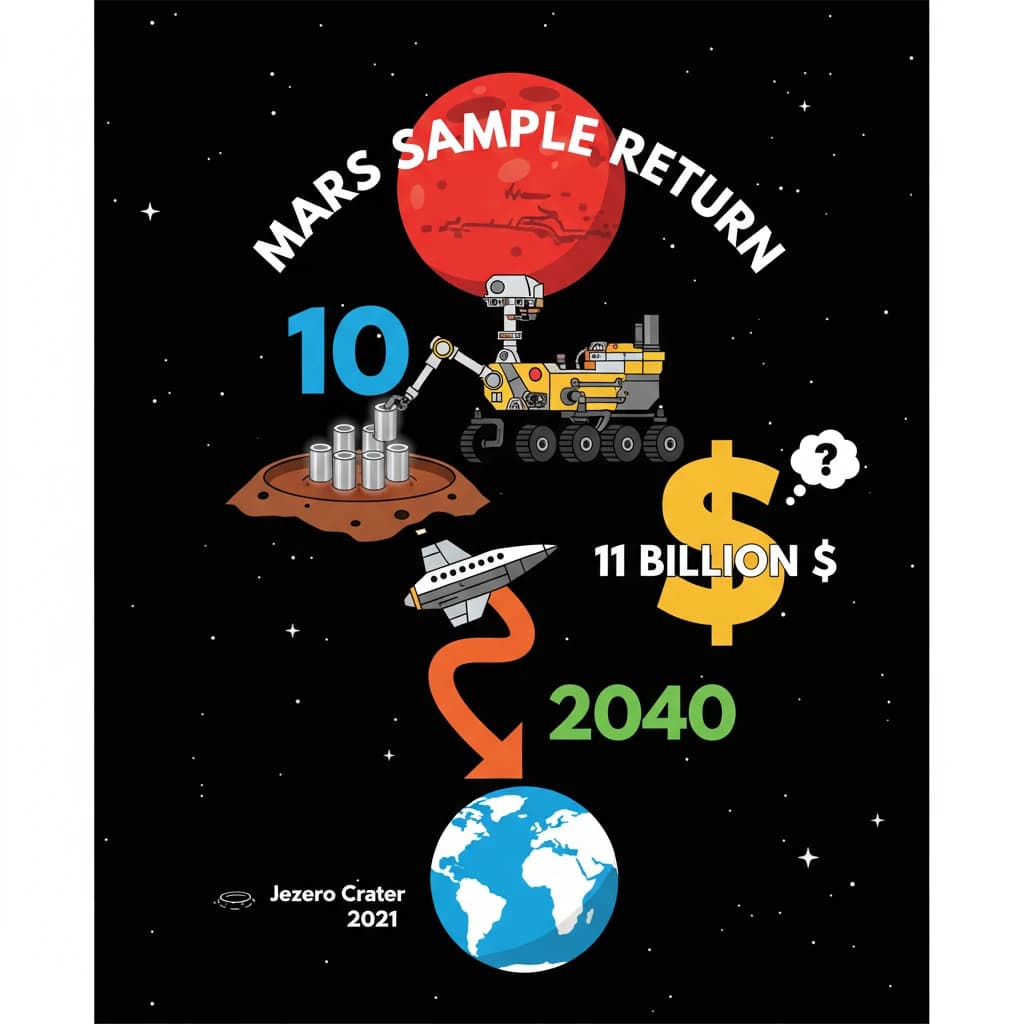
  • •NASA's Perseverance Rover created the first 'sample depot' on Mars in April 2024, depositing 10 rock sample tubes.
  • •These samples are part of the Mars Sample Return (MSR) Campaign, aiming to bring Martian samples to Earth by 2040.
  • •The MSR program is highly expensive, estimated at $11 billion, reflecting its complexity and long timeline.
  • •Perseverance Rover (part of Mars 2020 mission) landed in Jezero Crater in Feb 2021, collecting rock/soil samples.
  • •The rover is powered by a Multi-Mission Radioisotope Thermoelectric Generator (MMRTG) using plutonium decay for electricity.

🧠 Memory Techniques
Memory Aid
98% Verified Content

📚 Reference Sources

•NASA Official Website (for program details and rover specifications)
•European Space Agency (ESA) Official Website (for MSR collaboration details)

Related Topics

Loading related topics...
Explore:Science And Technology Topics·All Subjects·Daily Current Affairs·Editorial Analysis·Previous Year Questions·UPSC GPT