Loading page, please wait…
Vaidra Logo
Vaidra

Top 4 items + smart groups

UPSC GPT
New
Current Affairs
Daily Solutions
Daily Puzzle
Mains Evaluator

Version 2.0.0 • Built with ❤️ for UPSC aspirants

Loading...
Loading...
Loading...
Loading...
Loading...
Loading...
Loading...
Loading...
Loading...
Loading...
Loading...
Loading...
Loading...
Electroencephalography (EEG) - UPSC Science And Technology
Back
All Subjects

Topics

0 topics • 0 completed

Loading topics...
Loading...
Loading...
Loading...
Loading...
Loading...
Overall Progress0%

Electroencephalography (EEG) - UPSC Science And Technology

What is Electroencephalography (EEG) in UPSC Science And Technology?

Electroencephalography (EEG) is a key topic under Science And Technology for UPSC Civil Services Examination. Key points include: EEG measures brain's electrical activity via scalp electrodes.. Pioneered by Hans Berger in 1924 (first human EEG).. It is a non-invasive, cost-effective, and portable diagnostic tool.. Understanding this topic is essential for both UPSC Prelims and Mains preparation.

Why is Electroencephalography (EEG) important for UPSC exam?

Electroencephalography (EEG) is a Medium-level topic in UPSC Science And Technology. It is tested in both Prelims (factual MCQs) and Mains (analytical answer writing). Previous year UPSC questions have frequently covered aspects of Electroencephalography (EEG), making it essential for comprehensive IAS preparation.

How to prepare Electroencephalography (EEG) for UPSC?

To prepare Electroencephalography (EEG) for UPSC: (1) Study the comprehensive notes covering all key concepts on Vaidra. (2) Practice previous year questions on this topic. (3) Connect it with current affairs using daily updates. (4) Revise using key takeaways and mind maps available for Science And Technology. (5) Write practice answers linking Electroencephalography (EEG) to related GS Paper topics.

Key takeaways of Electroencephalography (EEG) for UPSC

  • EEG measures brain's electrical activity via scalp electrodes.
  • Pioneered by Hans Berger in 1924 (first human EEG).
  • It is a non-invasive, cost-effective, and portable diagnostic tool.
  • Primary application is the diagnosis of epilepsy.
  • Works on the principle of volume conduction, detecting neuronal ion exchange.
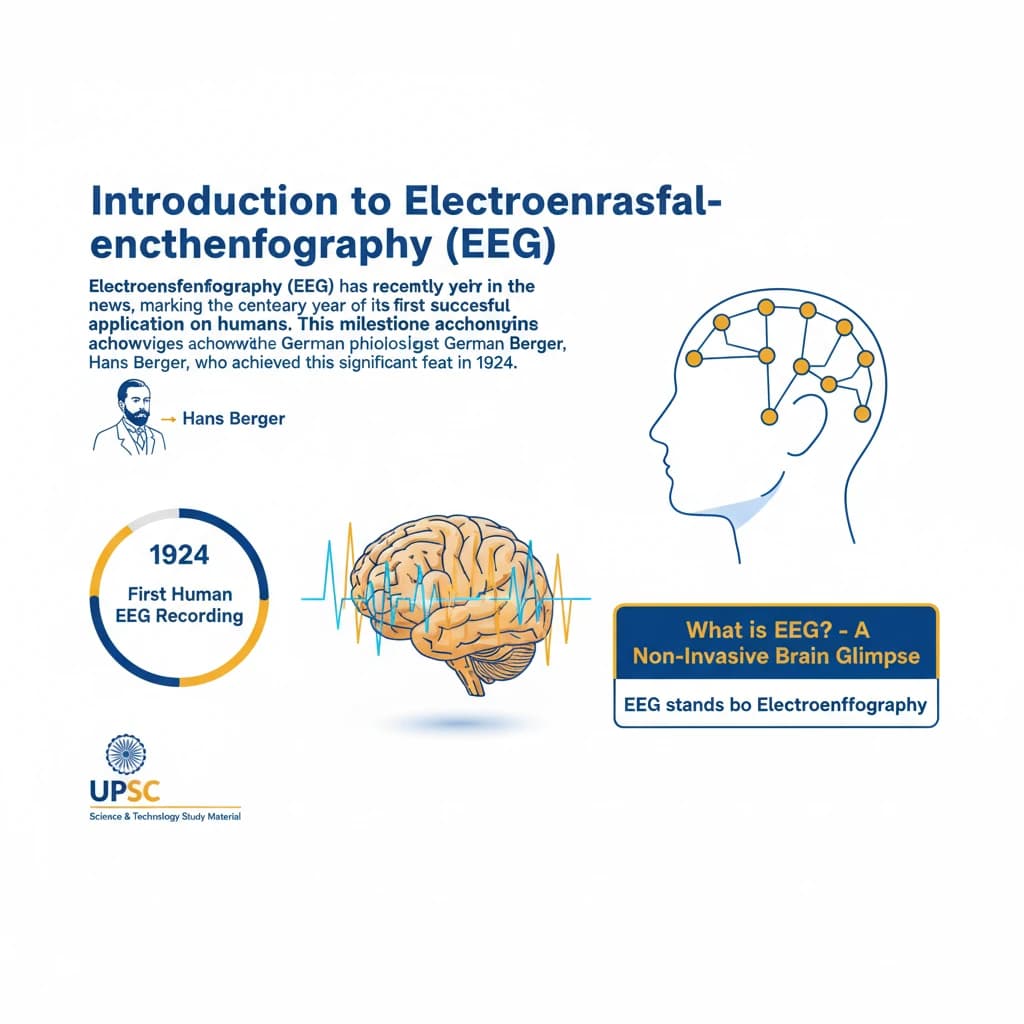
Electroencephalography (EEG)

Electroencephalography (EEG)

Medium⏱️ 8 min read✓ 95% Verified
science and technology

📖 Introduction

<h4>Introduction to Electroencephalography (EEG)</h4><p><strong>Electroencephalography (EEG)</strong> has recently been in the news, marking the <strong>centenary year</strong> of its first successful application on humans.</p><p>This milestone acknowledges the pioneering work of German physiologist <strong>Hans Berger</strong>, who achieved this significant feat in <strong>1924</strong>.</p><h4>What is EEG? - A Non-Invasive Brain Glimpse</h4><div class='info-box'><p><strong>EEG</strong> stands for <strong>Electroencephalography</strong>. The term breaks down as:<ul><li><strong>'Electro-'</strong>: Pertaining to electricity.</li><li><strong>'-encephalo-'</strong>: Referring to the brain.</li><li><strong>'-graphy'</strong>: A suffix meaning to show or to represent.</li></ul></p></div><p>It is a remarkable tool in <strong>physics</strong> and <strong>neurobiology</strong>, providing a straightforward and <strong>non-invasive</strong> method to observe the human brain's activity.</p><div class='key-point-box'><p>Key characteristics of an <strong>EEG setup</strong> include its <strong>simplicity</strong>, <strong>cost-effectiveness</strong>, and <strong>portability</strong>. It is also <strong>space-efficient</strong> and does not emit high-energy radiation or sounds, unlike technologies such as <strong>MRI</strong>.</p></div><h4>How EEG Works: Detecting Brain's Electrical Waves</h4><p>The fundamental principle behind <strong>EEG</strong> involves detecting electrical activity generated by the brain through the scalp. This process relies on a concept known as <strong>volume conduction</strong>.</p><div class='info-box'><p><strong>Volume conduction</strong> refers to the interference that occurs between the source of an electrical potential and the electrode measuring that potential. It essentially describes how electrical signals spread through biological tissues.</p></div><p>Brain cells, called <strong>neurons</strong>, continuously exchange ions with their surroundings. This exchange generates tiny electrical impulses that collectively form waves of electrical activity.</p><p><strong>EEG electrodes</strong>, placed on the scalp, track these electrical waves. These signals are then amplified and recorded to produce an <strong>electroencephalogram</strong>, which is the graphical representation of brain activity.</p><h4>Primary Application: Diagnosing Epilepsy</h4><p>One of the most crucial and well-established applications of <strong>EEG</strong> is in the diagnosis of <strong>epilepsy</strong>. It is considered the best available test for this condition.</p><div class='info-box'><p><strong>Epilepsy</strong> is a neurological condition affecting the brain, making individuals susceptible to recurrent, unprovoked seizures. <strong>EEG</strong> helps identify abnormal electrical patterns associated with seizures.</p></div><div class='exam-tip-box'><p>For <strong>UPSC Mains (GS Paper 3)</strong>, understanding diagnostic tools like <strong>EEG</strong> is important for questions on medical technology and advancements in healthcare. Focus on its non-invasive nature and primary applications.</p></div>
Concept Diagram

💡 Key Takeaways

  • •EEG measures brain's electrical activity via scalp electrodes.
  • •Pioneered by Hans Berger in 1924 (first human EEG).
  • •It is a non-invasive, cost-effective, and portable diagnostic tool.
  • •Primary application is the diagnosis of epilepsy.
  • •Works on the principle of volume conduction, detecting neuronal ion exchange.

🧠 Memory Techniques
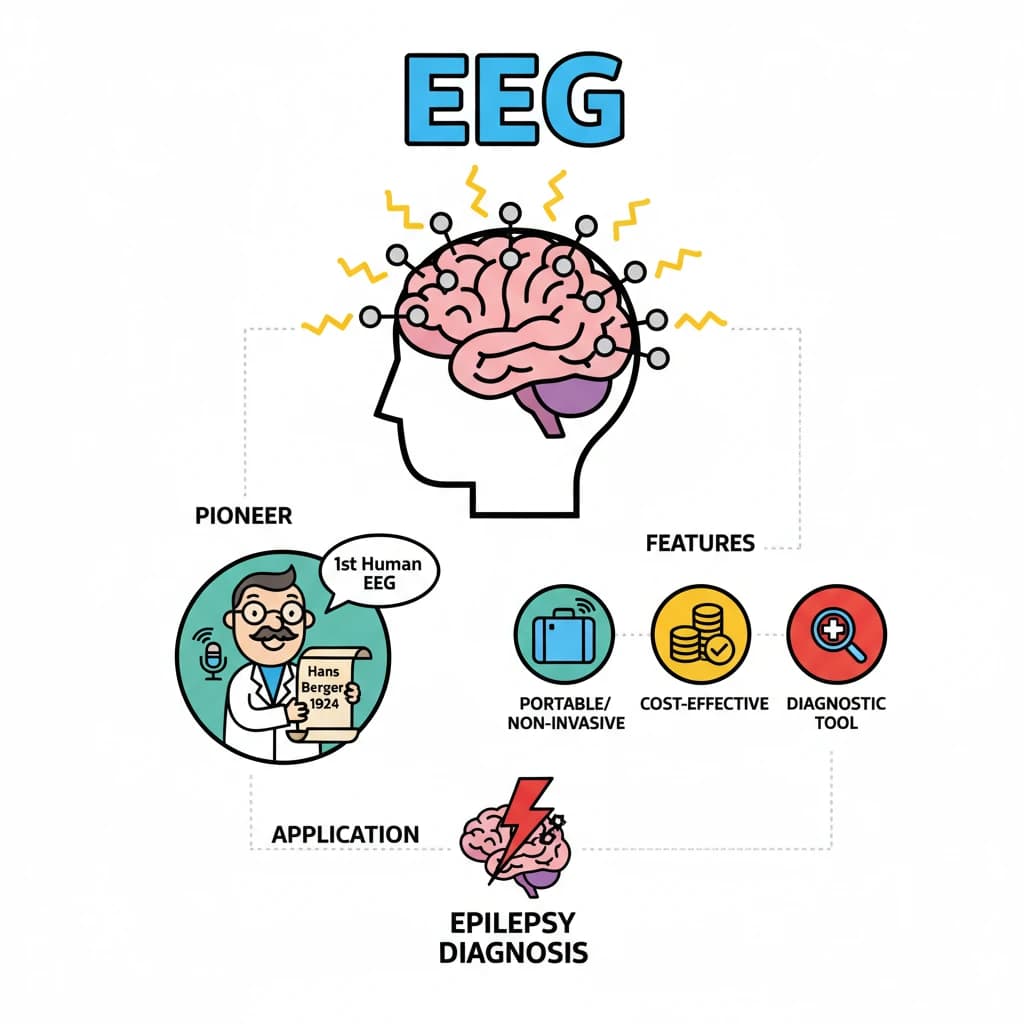
Memory Aid
95% Verified Content

📚 Reference Sources

•Standard neuroscience textbooks (general knowledge)
•Historical records of scientific discoveries

Related Topics

Loading related topics...
Explore:Science And Technology Topics·All Subjects·Daily Current Affairs·Editorial Analysis·Previous Year Questions·UPSC GPT