Loading page, please wait…
Vaidra Logo
Vaidra

Top 4 items + smart groups

UPSC GPT
New
Current Affairs
Daily Solutions
Daily Puzzle
Mains Evaluator

Version 2.0.0 • Built with ❤️ for UPSC aspirants

Loading...
Loading...
Loading...
Loading...
Loading...
Loading...
Loading...
Loading...
Loading...
Loading...
Loading...
Loading...
Loading...
Lagrange Points - UPSC Science And Technology
Back
All Subjects

Topics

0 topics • 0 completed

Loading topics...
Loading...
Loading...
Loading...
Loading...
Loading...
Overall Progress0%

Lagrange Points - UPSC Science And Technology

What is Lagrange Points in UPSC Science And Technology?

Lagrange Points is a key topic under Science And Technology for UPSC Civil Services Examination. Key points include: Lagrange Points are stable positions in a two-body gravitational system where a small object can remain in sync.. They balance gravitational forces with centripetal force, enabling minimal fuel use for spacecraft.. There are five points: L1, L2, L3 (unstable), and L4, L5 (stable, Trojan points).. Understanding this topic is essential for both UPSC Prelims and Mains preparation.

Why is Lagrange Points important for UPSC exam?

Lagrange Points is a Medium-level topic in UPSC Science And Technology. It is tested in both Prelims (factual MCQs) and Mains (analytical answer writing). Previous year UPSC questions have frequently covered aspects of Lagrange Points, making it essential for comprehensive IAS preparation.

How to prepare Lagrange Points for UPSC?

To prepare Lagrange Points for UPSC: (1) Study the comprehensive notes covering all key concepts on Vaidra. (2) Practice previous year questions on this topic. (3) Connect it with current affairs using daily updates. (4) Revise using key takeaways and mind maps available for Science And Technology. (5) Write practice answers linking Lagrange Points to related GS Paper topics.

Key takeaways of Lagrange Points for UPSC

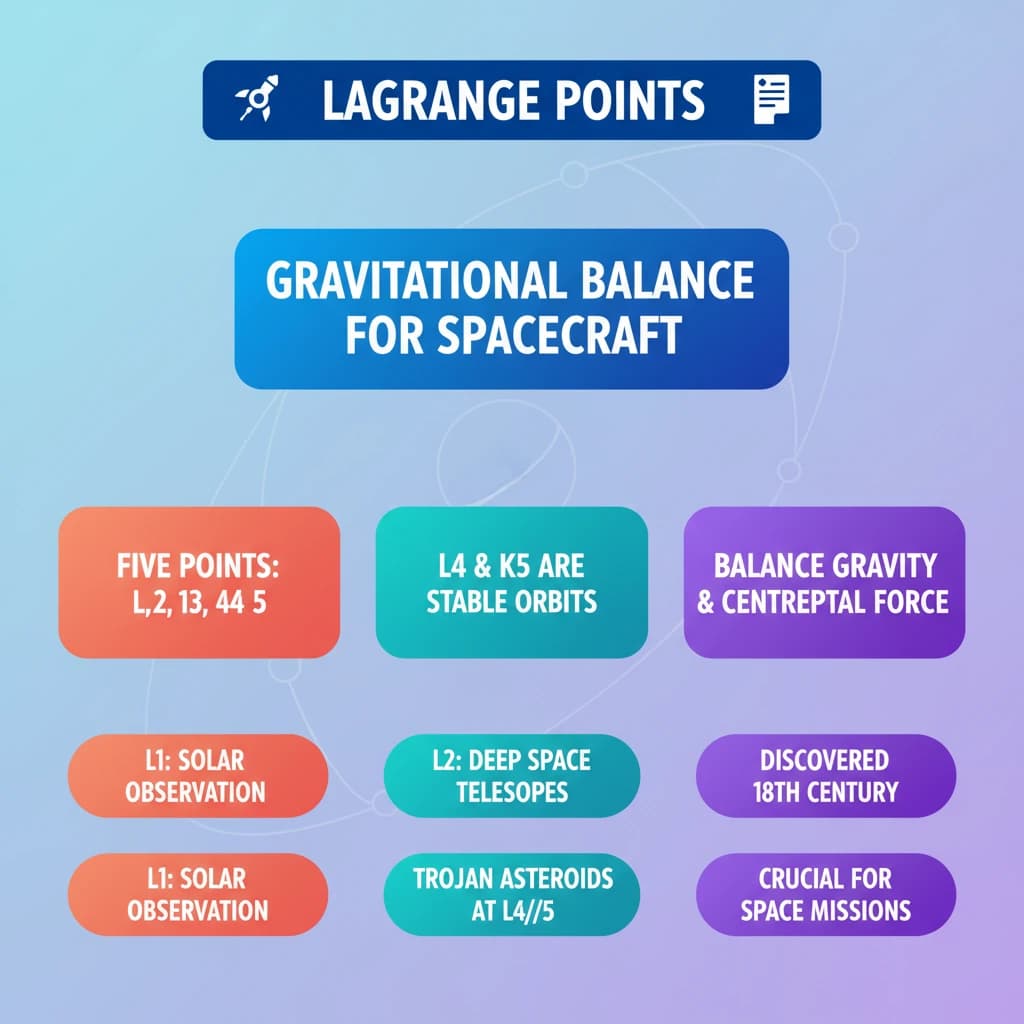
  • Lagrange Points are stable positions in a two-body gravitational system where a small object can remain in sync.
  • They balance gravitational forces with centripetal force, enabling minimal fuel use for spacecraft.
  • There are five points: L1, L2, L3 (unstable), and L4, L5 (stable, Trojan points).
  • L1 is ideal for solar observation (e.g., Aditya-L1), L2 for deep-space observatories (e.g., JWST).
  • Discovered by Joseph-Louis Lagrange in the 18th century, their practical use is crucial for modern space missions.
Lagrange Points

Lagrange Points

Medium⏱️ 8 min read✓ 98% Verified
science and technology

📖 Introduction

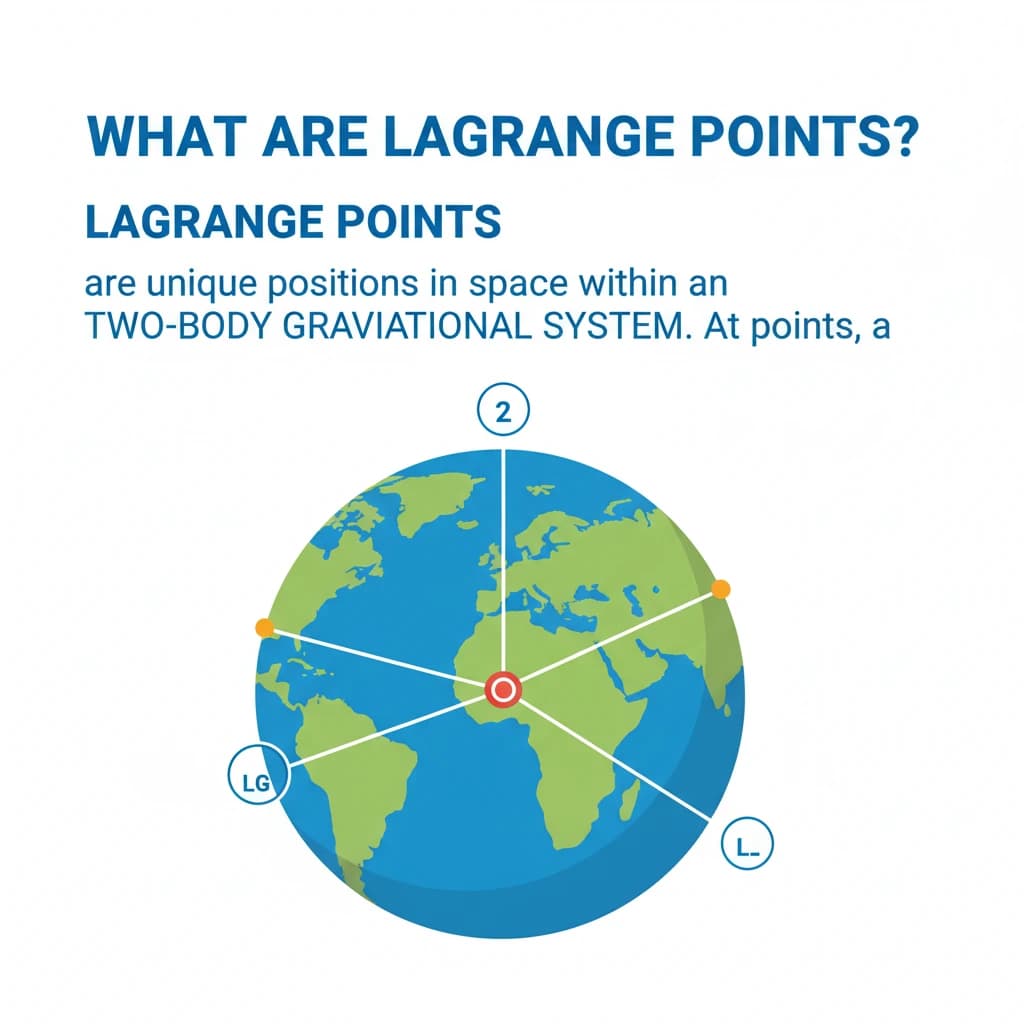
<h4>What are Lagrange Points?</h4><p><strong>Lagrange Points</strong> are unique positions in space within a <strong>two-body gravitational system</strong>. At these points, a smaller object can maintain a stable position relative to the two larger bodies.</p><p>These points are crucial for space missions as they allow spacecraft to remain in a desired location with <strong>minimal fuel consumption</strong>. This stability is achieved by balancing the <strong>gravitational forces</strong> of the two large bodies with the <strong>centripetal force</strong> required for the smaller object to move in sync with them.</p><div class='key-point-box'><p>The concept of <strong>Lagrange Points</strong> is derived from the solution to the <strong>restricted three-body problem</strong> in celestial mechanics, where a third body of negligible mass orbits two larger bodies.</p></div><h4>Types of Lagrange Points</h4><p>There are five distinct <strong>Lagrange Points</strong> (L1, L2, L3, L4, L5) associated with any two-body system, such as the <strong>Sun-Earth system</strong>.</p><ul><li><strong>L1 (Inner Lagrange Point):</strong> This point lies on the line connecting the two large bodies, *between* them.</li><li><strong>L2 (Outer Lagrange Point):</strong> This point also lies on the line connecting the two large bodies, but *outside* the smaller of the two.</li><li><strong>L3 (Transverse Lagrange Point):</strong> Located on the line connecting the two large bodies, *behind* the larger body from the perspective of the smaller body.</li><li><strong>L4 and L5 (Trojan Points):</strong> These points form an <strong>equilateral triangle</strong> with the two large bodies. They are known for their inherent stability.</li></ul><h4>Specific Characteristics of Sun-Earth Lagrange Points</h4><p>Each <strong>Lagrange Point</strong> offers unique advantages for scientific missions due to its specific location and stability properties:</p><div class='info-box'><p>The distance of <strong>L1</strong> from Earth is approximately <strong>1%</strong> of the total <strong>Earth-Sun distance</strong>. This position allows for continuous observation of the Sun.</p></div><p><strong>L2</strong>, situated behind Earth from the Sun, provides ideal conditions for observing the distant universe. Its location minimizes interference from Earth's shadow and thermal radiation, making it suitable for deep-space observatories.</p><p><strong>L3</strong> is located behind the Sun, opposite Earth. While less utilized due to communication challenges, it offers potential for observing the Sun's far side, providing insights into solar activity not visible from Earth.</p><p>Objects at <strong>L4</strong> and <strong>L5</strong> maintain exceptionally stable positions. They form an <strong>equilateral triangle</strong> with the Sun and Earth, making them potential sites for future space infrastructure or asteroid studies (e.g., <strong>Trojan asteroids</strong> near Jupiter's L4/L5 points).</p><div class='exam-tip-box'><p>Understanding the location and purpose of each <strong>Lagrange Point</strong> is crucial for <strong>UPSC Prelims</strong>, especially for questions related to <strong>space missions</strong> and <strong>observatories</strong> like <strong>Aditya-L1</strong> or <strong>JWST</strong>.</p></div>
Concept Diagram

💡 Key Takeaways

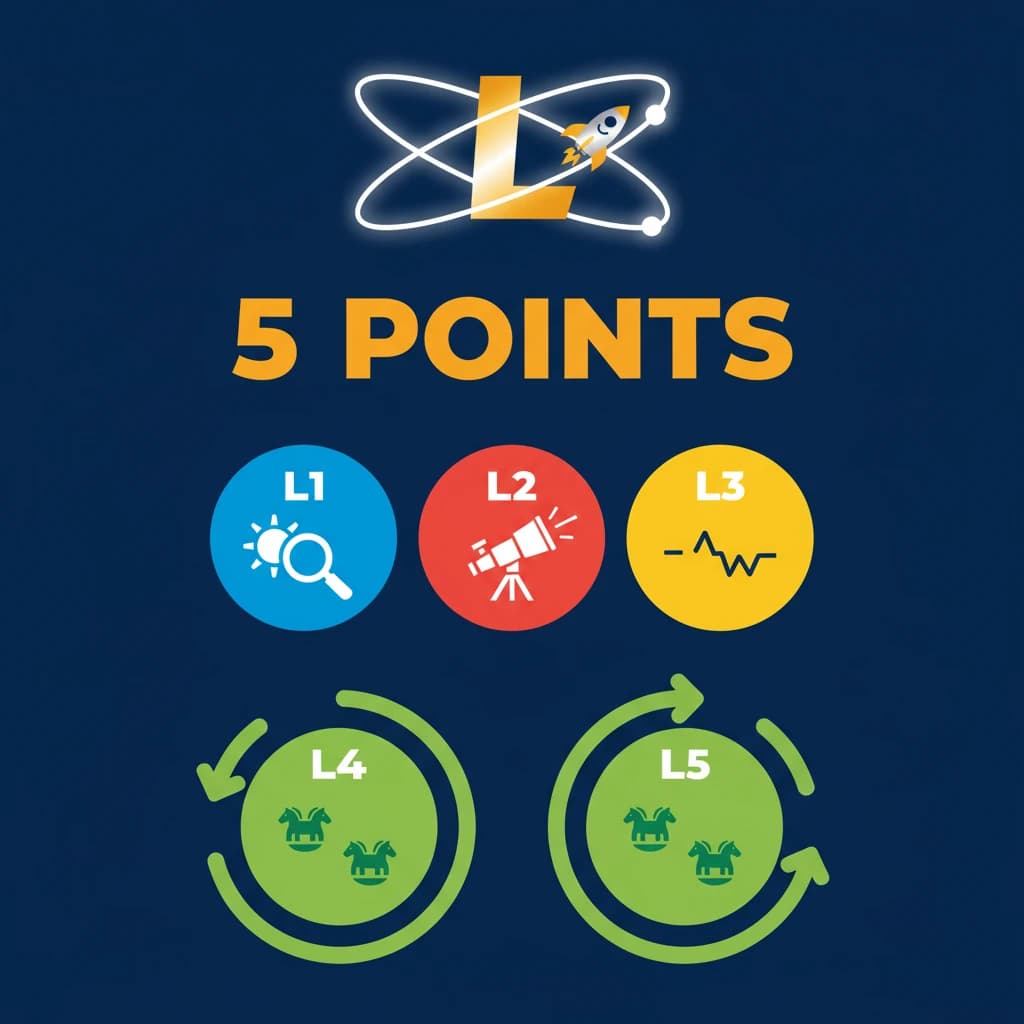
  • •Lagrange Points are stable positions in a two-body gravitational system where a small object can remain in sync.
  • •They balance gravitational forces with centripetal force, enabling minimal fuel use for spacecraft.
  • •There are five points: L1, L2, L3 (unstable), and L4, L5 (stable, Trojan points).
  • •L1 is ideal for solar observation (e.g., Aditya-L1), L2 for deep-space observatories (e.g., JWST).
  • •Discovered by Joseph-Louis Lagrange in the 18th century, their practical use is crucial for modern space missions.

🧠 Memory Techniques
Memory Aid
98% Verified Content

📚 Reference Sources

•ESA (European Space Agency) - What are Lagrange points?
•ISRO (Indian Space Research Organisation) - Aditya-L1 Mission details
•Drishti IAS - Science & Technology summaries
•General Physics and Astronomy Textbooks (e.g., 'An Introduction to Modern Astrophysics' by Carroll & Ostlie)

Related Topics

Loading related topics...
Explore:Science And Technology Topics·All Subjects·Daily Current Affairs·Editorial Analysis·Previous Year Questions·UPSC GPT