Loading page, please wait…
Vaidra Logo
Vaidra

Top 4 items + smart groups

UPSC GPT
New
Current Affairs
Daily Solutions
Daily Puzzle
Mains Evaluator

Version 2.0.0 • Built with ❤️ for UPSC aspirants

Loading...
Loading...
Loading...
Loading...
Loading...
Loading...
Loading...
Loading...
Loading...
Loading...
Loading...
Loading...
Loading...
Back
All Subjects

Topics

0 topics • 0 completed

Loading topics...
Loading...
Loading...
Loading...
Loading...
Loading...
Overall Progress0%
India’s First 3D-Printed Rocket Launched - UPSC Science And Technology

India’s First 3D-Printed Rocket Launched - UPSC Science And Technology

What is India’s First 3D-Printed Rocket Launched in UPSC Science And Technology?

India’s First 3D-Printed Rocket Launched is a key topic under Science And Technology for UPSC Civil Services Examination. Key points include: Agnikul Cosmos launched Agnibaan SOrTeD, India's first rocket with a fully 3D-printed engine.. This was the world's first rocket with a single-piece 3D-printed engine and launched from India's first private pad (Dhanush).. The engine uses liquid oxygen and kerosene as propellants.. Understanding this topic is essential for both UPSC Prelims and Mains preparation.

Why is India’s First 3D-Printed Rocket Launched important for UPSC exam?

India’s First 3D-Printed Rocket Launched is a Medium-level topic in UPSC Science And Technology. It is tested in both Prelims (factual MCQs) and Mains (analytical answer writing). Previous year UPSC questions have frequently covered aspects of India’s First 3D-Printed Rocket Launched, making it essential for comprehensive IAS preparation.

How to prepare India’s First 3D-Printed Rocket Launched for UPSC?

To prepare India’s First 3D-Printed Rocket Launched for UPSC: (1) Study the comprehensive notes covering all key concepts on Vaidra. (2) Practice previous year questions on this topic. (3) Connect it with current affairs using daily updates. (4) Revise using key takeaways and mind maps available for Science And Technology. (5) Write practice answers linking India’s First 3D-Printed Rocket Launched to related GS Paper topics.

Key takeaways of India’s First 3D-Printed Rocket Launched for UPSC

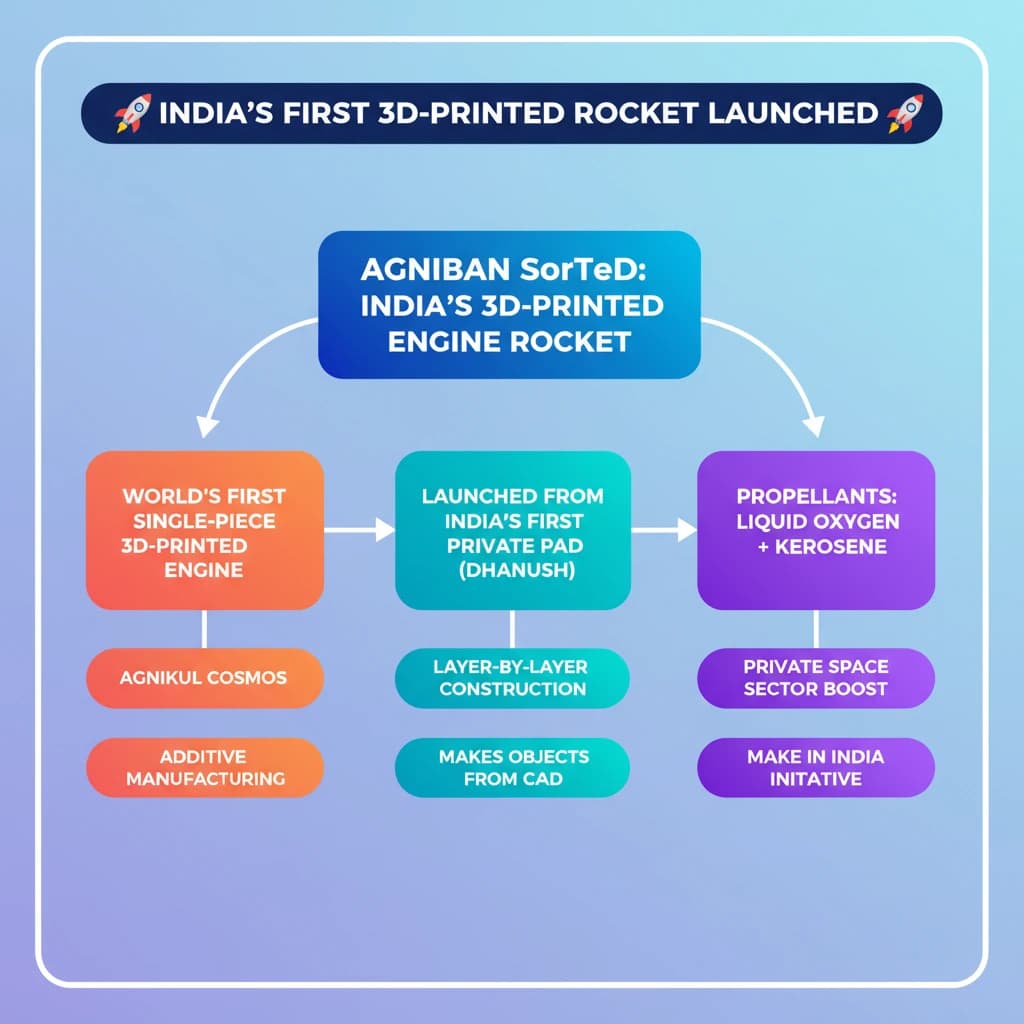
  • Agnikul Cosmos launched Agnibaan SOrTeD, India's first rocket with a fully 3D-printed engine.
  • This was the world's first rocket with a single-piece 3D-printed engine and launched from India's first private pad (Dhanush).
  • The engine uses liquid oxygen and kerosene as propellants.
  • 3D printing (additive manufacturing) builds objects layer by layer from CAD, opposite to subtractive manufacturing.
  • The launch signifies India's growing private space sector, 'Make in India' success, and technological advancement supported by ISRO and IN-SPACe.
India’s First 3D-Printed Rocket Launched

India’s First 3D-Printed Rocket Launched

Medium⏱️ 8 min read✓ 98% Verified
science and technology

📖 Introduction

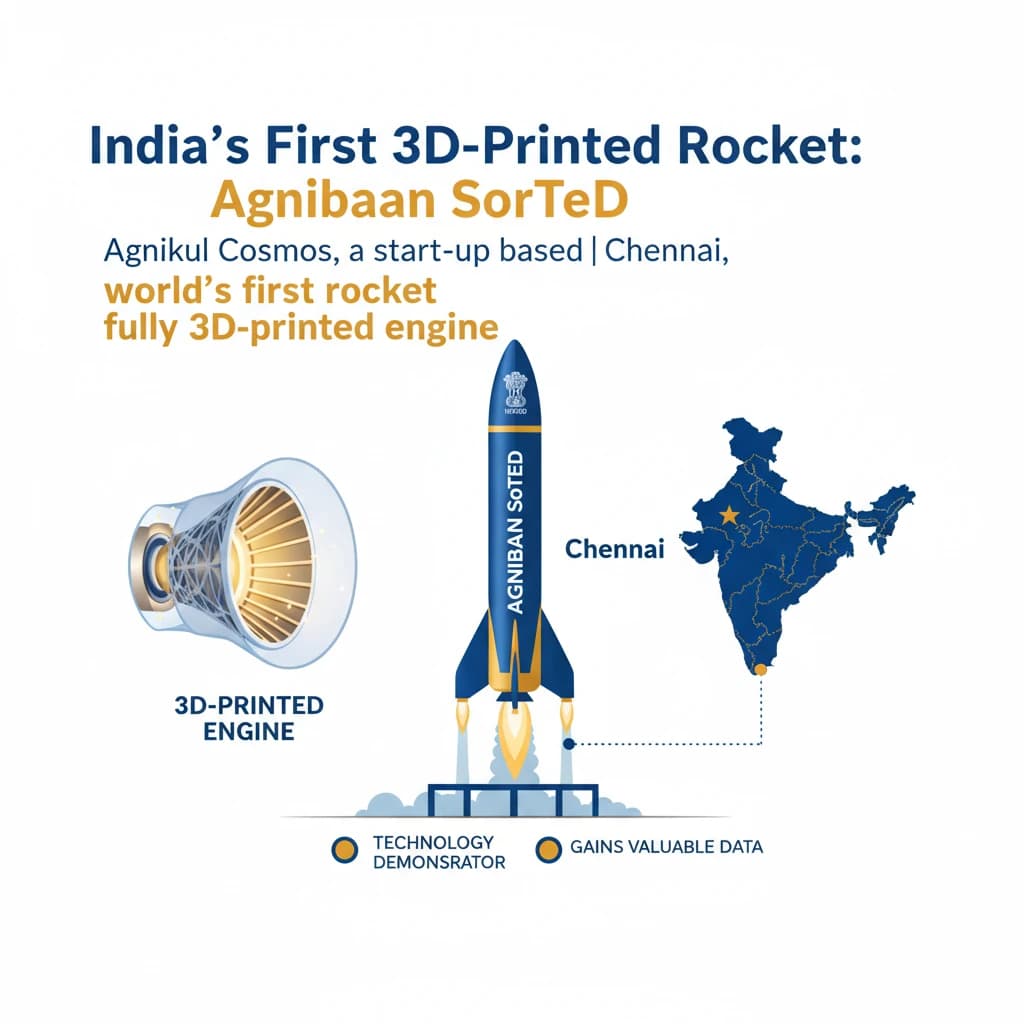
<h4>India's First 3D-Printed Rocket: Agnibaan SOrTeD</h4><p><strong>Agnikul Cosmos</strong>, a start-up based in <strong>Chennai</strong>, has achieved a significant milestone by launching <strong>Agnibaan SubOrbital Technology Demonstrator (SOrTeD)</strong>. This marks the <strong>world’s first rocket</strong> powered by a fully <strong>3D-printed engine</strong>.</p><p>The primary objective of this test flight was to showcase the company’s internally developed technologies. It also aimed to gather crucial flight data for future advancements in space technology.</p><div class='key-point-box'><p>The <strong>Agnibaan SOrTeD</strong> launch represents several 'firsts' for the Indian space ecosystem, highlighting indigenous capabilities and private sector innovation.</p></div><h4>Key Milestones Achieved</h4><ul><li><strong>Launch from a Private Pad:</strong> It was launched from <strong>Dhanush</strong>, India's first private launchpad located at <strong>Sriharikota</strong>.</li><li><strong>Homegrown Semi-Cryo Engine:</strong> The rocket is powered by an indigenously developed <strong>semi-cryogenic engine</strong>.</li><li><strong>World's 1st Single-Piece 3D-Printed Engine:</strong> Its engine is the first fully <strong>3D-printed</strong>, single-piece design globally.</li></ul><h4>Propulsion System Details</h4><p>The <strong>Agnibaan SOrTeD</strong> rocket utilizes a specific combination of propellants for its engine. It is powered by <strong>liquid oxygen</strong> and <strong>kerosene</strong>.</p><div class='info-box'><p><strong>Propellant Type:</strong> The rocket uses a combination of <strong>liquid oxygen (LOX)</strong> as the oxidizer and <strong>kerosene</strong> as the fuel. This is a common and efficient propellant choice for many rocket engines.</p></div><h4>Support and Collaboration</h4><p>The successful launch was a collaborative effort, receiving vital support from key national space organizations. Both the <strong>Indian Space Research Organisation (ISRO)</strong> and the <strong>Indian National Space Promotion and Authorisation Centre (IN-SPACe)</strong> played crucial roles in facilitating this mission.</p><div class='exam-tip-box'><p>This event is highly relevant for <strong>UPSC GS Paper 3 (Science & Technology)</strong>, particularly for topics on <strong>Space Technology</strong>, <strong>Indigenous Technology Development</strong>, and the <strong>Role of Private Sector in Space</strong>. Emphasize the 'firsts' achieved.</p></div>
Concept Diagram

💡 Key Takeaways

  • •Agnikul Cosmos launched Agnibaan SOrTeD, India's first rocket with a fully 3D-printed engine.
  • •This was the world's first rocket with a single-piece 3D-printed engine and launched from India's first private pad (Dhanush).
  • •The engine uses liquid oxygen and kerosene as propellants.
  • •3D printing (additive manufacturing) builds objects layer by layer from CAD, opposite to subtractive manufacturing.
  • •The launch signifies India's growing private space sector, 'Make in India' success, and technological advancement supported by ISRO and IN-SPACe.

🧠 Memory Techniques

Memory Aid
98% Verified Content

📚 Reference Sources

•Agnikul Cosmos Official Website
•ISRO (Indian Space Research Organisation) Press Releases
•IN-SPACe (Indian National Space Promotion and Authorisation Centre) Publications

Related Topics

Loading related topics...
Explore:Science And Technology Topics·All Subjects·Daily Current Affairs·Editorial Analysis·Previous Year Questions·UPSC GPT