Loading page, please wait…
Vaidra Logo
Vaidra

Top 4 items + smart groups

UPSC GPT
New
Current Affairs
Daily Solutions
Daily Puzzle
Mains Evaluator

Version 2.0.0 • Built with ❤️ for UPSC aspirants

Loading...
Loading...
Loading...
Loading...
Loading...
Loading...
Loading...
Loading...
Loading...
Loading...
Loading...
Loading...
Loading...
Back
All Subjects

Topics

0 topics • 0 completed

Loading topics...
Loading...
Loading...
Loading...
Loading...
Loading...
Overall Progress0%

Global Examples for Wolbachia Implementation - UPSC Science And Technology

What is Global Examples for Wolbachia Implementation in UPSC Science And Technology?

Global Examples for Wolbachia Implementation is a key topic under Science And Technology for UPSC Civil Services Examination. Key points include: Wolbachia is a natural bacterium used to control mosquito-borne diseases like dengue.. Two main strategies: Population Suppression (releasing infected males) and Population Replacement (releasing both sexes to spread Wolbachia).. Global examples (Singapore, Australia, Indonesia) show high efficacy in reducing dengue cases and hospitalizations.. Understanding this topic is essential for both UPSC Prelims and Mains preparation.

Why is Global Examples for Wolbachia Implementation important for UPSC exam?

Global Examples for Wolbachia Implementation is a Medium-level topic in UPSC Science And Technology. It is tested in both Prelims (factual MCQs) and Mains (analytical answer writing). Previous year UPSC questions have frequently covered aspects of Global Examples for Wolbachia Implementation, making it essential for comprehensive IAS preparation.

How to prepare Global Examples for Wolbachia Implementation for UPSC?

To prepare Global Examples for Wolbachia Implementation for UPSC: (1) Study the comprehensive notes covering all key concepts on Vaidra. (2) Practice previous year questions on this topic. (3) Connect it with current affairs using daily updates. (4) Revise using key takeaways and mind maps available for Science And Technology. (5) Write practice answers linking Global Examples for Wolbachia Implementation to related GS Paper topics.

Key takeaways of Global Examples for Wolbachia Implementation for UPSC

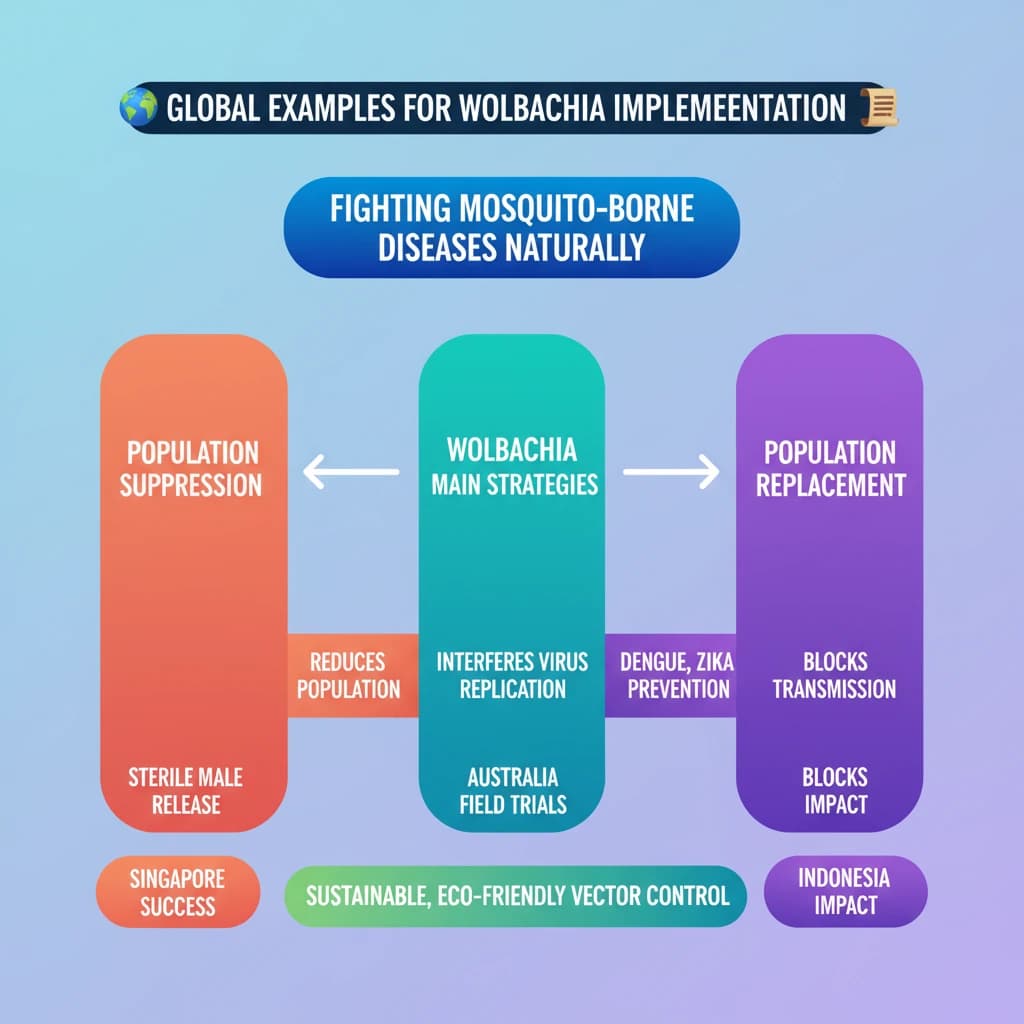
  • Wolbachia is a natural bacterium used to control mosquito-borne diseases like dengue.
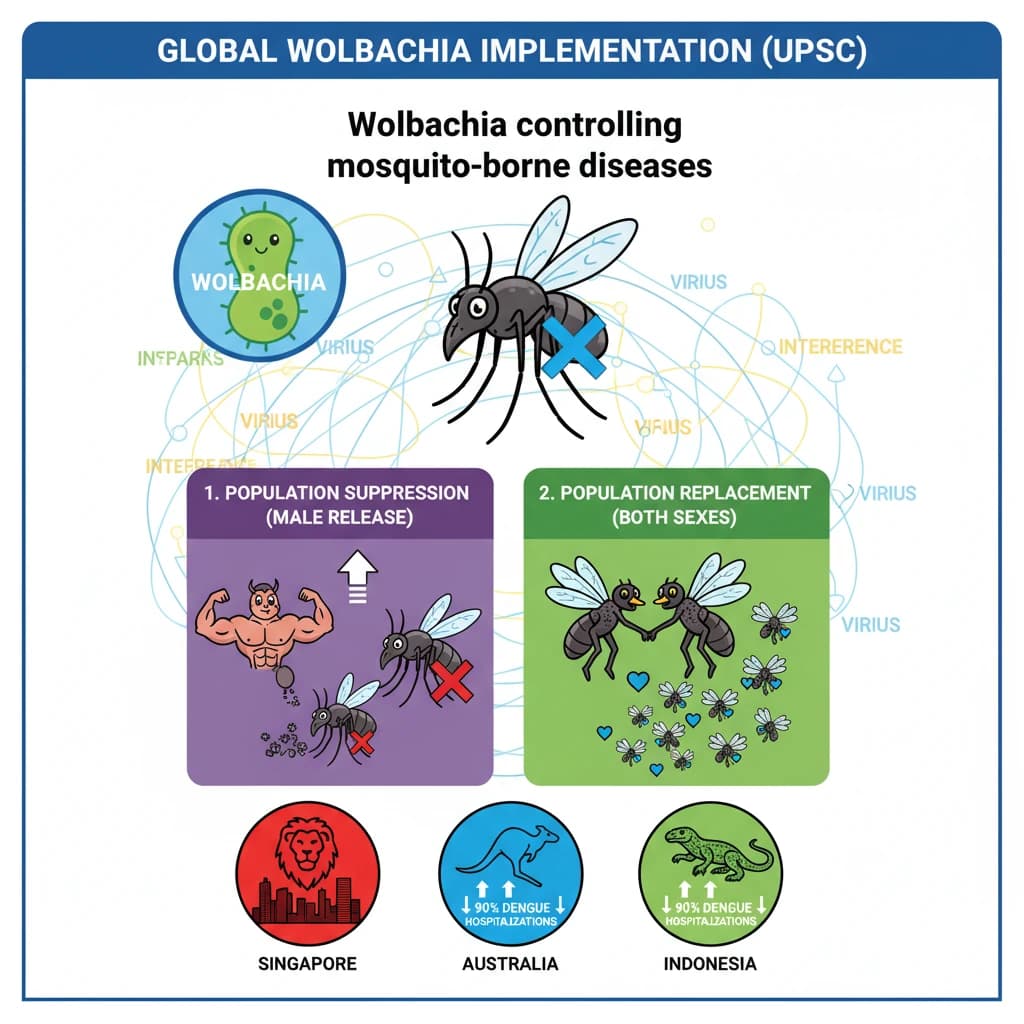
  • Two main strategies: Population Suppression (releasing infected males) and Population Replacement (releasing both sexes to spread Wolbachia).
  • Global examples (Singapore, Australia, Indonesia) show high efficacy in reducing dengue cases and hospitalizations.
  • Wolbachia interferes with virus replication in mosquitoes, making them less likely to transmit diseases.
  • It offers a sustainable, environmentally friendly alternative to traditional chemical vector control methods.
Global Examples for Wolbachia Implementation

Global Examples for Wolbachia Implementation

Medium⏱️ 8 min read✓ 98% Verified
science and technology

📖 Introduction

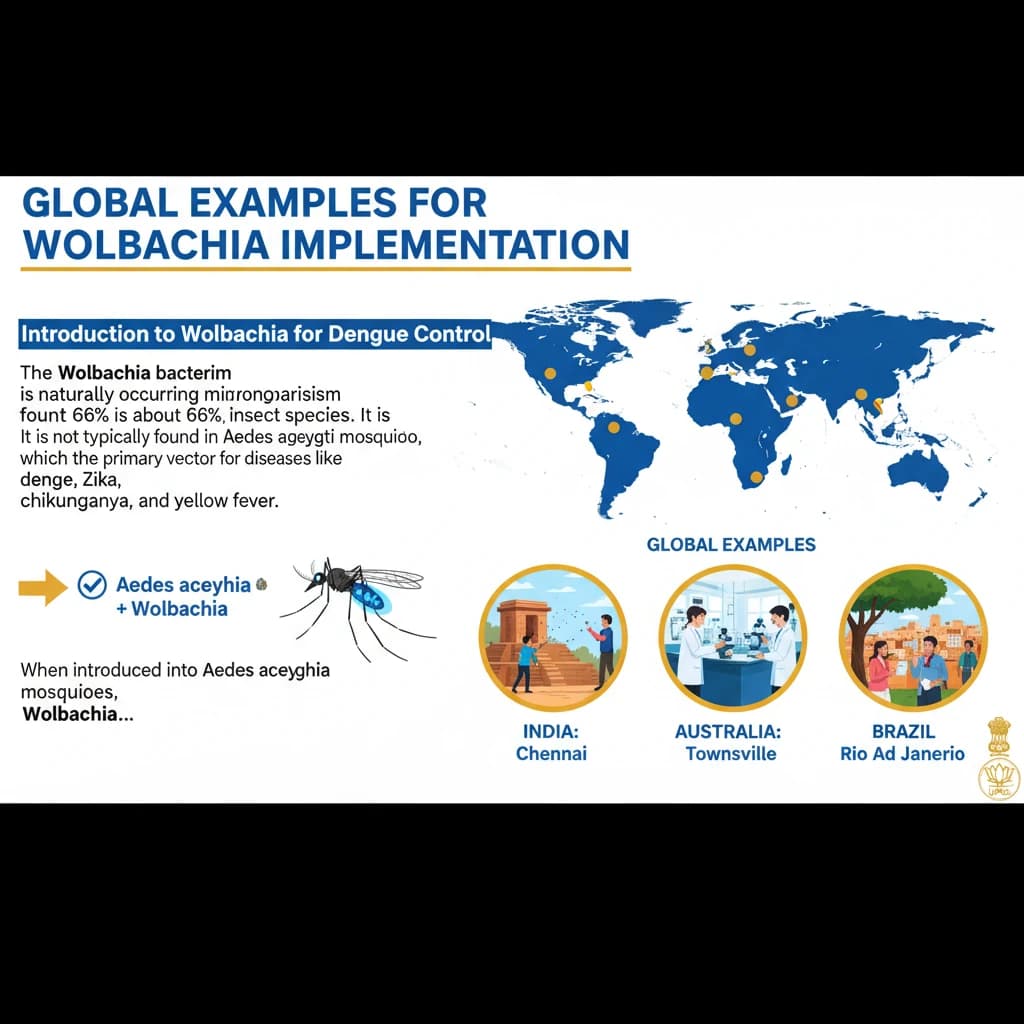
<h4>Introduction to Wolbachia for Dengue Control</h4><p>The <strong>Wolbachia</strong> bacterium is a naturally occurring microorganism found in about 60% of insect species. It is not typically found in the <strong>Aedes aegypti mosquito</strong>, which is the primary vector for diseases like <strong>dengue</strong>, <strong>Zika</strong>, <strong>chikungunya</strong>, and <strong>yellow fever</strong>.</p><p>When introduced into <strong>Aedes aegypti mosquitoes</strong>, <strong>Wolbachia</strong> can prevent the transmission of these viruses to humans. This makes it a promising biological control method for mosquito-borne diseases.</p><div class='key-point-box'><p><strong>Key Concept:</strong> <strong>Wolbachia</strong> interferes with virus replication within the mosquito, significantly reducing its ability to transmit pathogens. This offers an environmentally friendly alternative to traditional insecticide-based methods.</p></div><h4>Global Implementation Strategies</h4><p>Two main strategies are employed for <strong>Wolbachia</strong> implementation: <strong>Population Suppression</strong> and <strong>Population Replacement</strong>. Both aim to reduce disease transmission but through different mechanisms.</p><div class='info-box'><p><strong>Population Suppression:</strong> Involves releasing <strong>Wolbachia-infected male mosquitoes</strong>. When these males mate with wild females, the eggs do not hatch, leading to a reduction in the mosquito population over time. This is akin to a sterile insect technique.</p><p><strong>Population Replacement:</strong> Involves releasing <strong>Wolbachia-infected male and female mosquitoes</strong>. The <strong>Wolbachia</strong> then spreads through the wild mosquito population, making them less capable of transmitting viruses. The goal is to replace the wild, disease-carrying population with a <strong>Wolbachia-infected</strong>, non-transmitting population.</p></div><h4>Singapore's Experience with Wolbachia</h4><p><strong>Singapore</strong> has actively pursued <strong>Wolbachia</strong> implementation, primarily focusing on <strong>population suppression</strong>. The strategy involved the release of <strong>Wolbachia-infected male mosquitoes</strong> into targeted areas.</p><div class='info-box'><p><strong>Outcome:</strong> This approach led to a significant reduction in the <strong>Aedes population</strong>. Crucially, a <strong>77% decrease in dengue cases</strong> was observed in the release areas, demonstrating the effectiveness of the method.</p></div><h4>Australia's Success with Population Replacement</h4><p><strong>Australia</strong> adopted a <strong>population replacement strategy</strong> to combat <strong>dengue</strong>. This involved introducing <strong>Wolbachia-infected mosquitoes</strong> (both male and female) to establish the bacteria in the wild population.</p><div class='info-box'><p><strong>Outcome:</strong> The strategy successfully led to a stable integration of the <strong>wMel strain genome</strong> into the wild <strong>Aedes aegypti populations</strong>. This resulted in significant and sustained reductions in <strong>dengue incidence</strong> across the treated regions.</p></div><h4>Indonesia's Landmark Trial</h4><p><strong>Indonesia</strong> conducted a crucial <strong>randomised controlled trial</strong> to rigorously assess the impact of <strong>Wolbachia</strong>. This trial provided strong scientific evidence for the method's efficacy.</p><div class='info-box'><p><strong>Outcome:</strong> Areas where <strong>wMel strain mosquitoes</strong> were released experienced a remarkable <strong>77% reduction in dengue cases</strong>. Furthermore, there was an <strong>86% decrease in dengue-related hospitalizations</strong>, highlighting the public health benefit.</p></div><div class='exam-tip-box'><p><strong>UPSC Insight:</strong> These global examples are critical for <strong>GS Paper 3 (Science & Technology)</strong>. Be prepared to discuss <strong>Wolbachia technology</strong>, its mechanisms, and successful case studies as a sustainable vector control measure. Mentioning specific countries and their results adds weight to your answers.</p></div>
Concept Diagram

💡 Key Takeaways

  • •Wolbachia is a natural bacterium used to control mosquito-borne diseases like dengue.
  • •Two main strategies: Population Suppression (releasing infected males) and Population Replacement (releasing both sexes to spread Wolbachia).
  • •Global examples (Singapore, Australia, Indonesia) show high efficacy in reducing dengue cases and hospitalizations.
  • •Wolbachia interferes with virus replication in mosquitoes, making them less likely to transmit diseases.
  • •It offers a sustainable, environmentally friendly alternative to traditional chemical vector control methods.

🧠 Memory Techniques
Memory Aid
98% Verified Content

📚 Reference Sources

•World Mosquito Program (WMP) official website
•World Health Organization (WHO) reports on vector control
•The New England Journal of Medicine (NEJM) - Randomized trial of Wolbachia to control dengue in Indonesia (2020)

Related Topics

Loading related topics...
Explore:Science And Technology Topics·All Subjects·Daily Current Affairs·Editorial Analysis·Previous Year Questions·UPSC GPT
Global Examples for Wolbachia Implementation - UPSC Science And Technology