Loading page, please waitโ€ฆ
Vaidra Logo
Vaidra

Top 4 items + smart groups

UPSC GPT
New
Current Affairs
Daily Solutions
Daily Puzzle
Mains Evaluator

Version 2.0.0 โ€ข Built with โค๏ธ for UPSC aspirants

Loading...
Loading...
Loading...
Loading...
Loading...
Loading...
Loading...
Loading...
Loading...
Loading...
Loading...
Loading...
Loading...
Back
All Subjects

Topics

0 topics โ€ข 0 completed

Loading topics...
Loading...
Loading...
Loading...
Loading...
Loading...
Overall Progress0%

Key Facts About Dr. APJ Abdul Kalam - UPSC Science And Technology

What is Key Facts About Dr. APJ Abdul Kalam in UPSC Science And Technology?

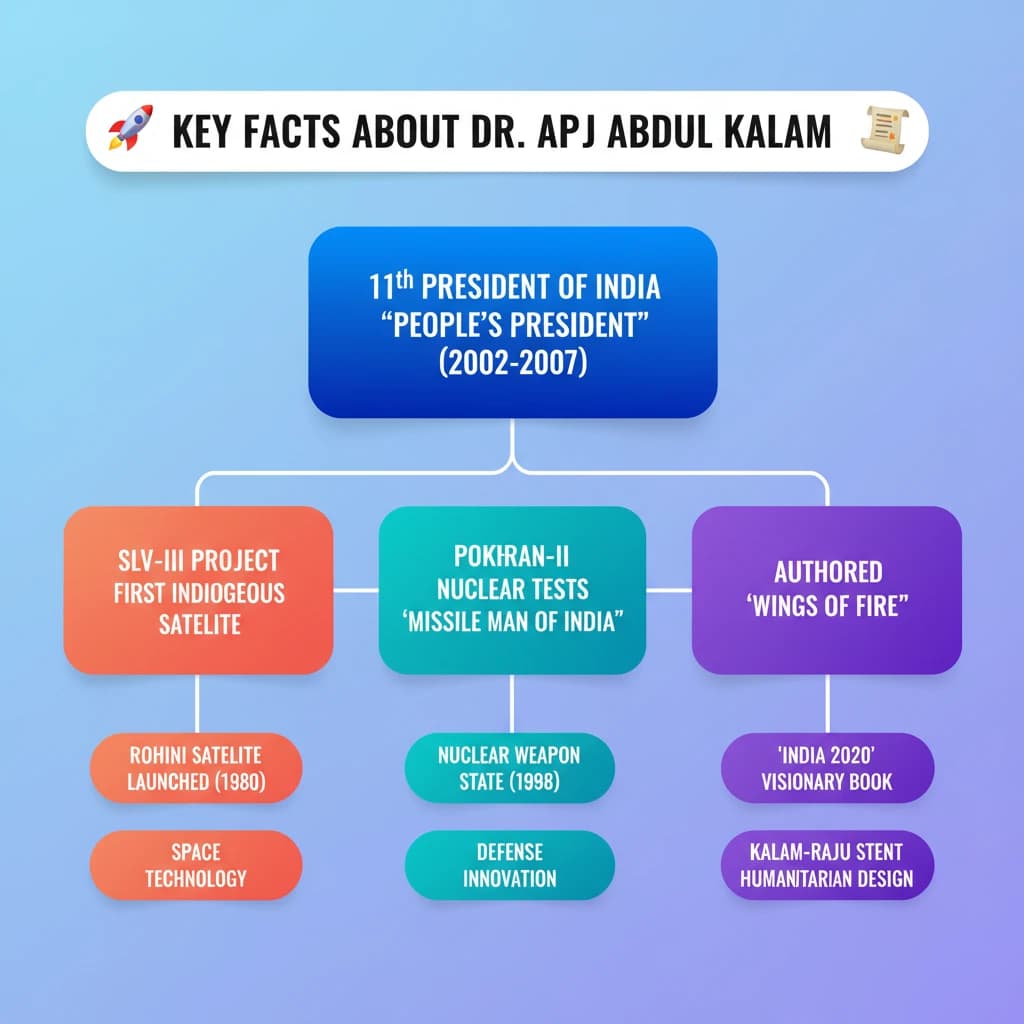
Key Facts About Dr. APJ Abdul Kalam is a key topic under Science And Technology for UPSC Civil Services Examination. Key points include: Dr. APJ Abdul Kalam served as India's 11th President (2002-2007) and was known as the 'People's President'.. He was the Project Director for India's first indigenous Satellite Launch Vehicle (SLV-III), launching the Rohini satellite in 1980.. He led the Pokhran-II nuclear tests in 1998, making India a nuclear weapon state and earning him the title 'Missile Man of India'.. Understanding this topic is essential for both UPSC Prelims and Mains preparation.

Why is Key Facts About Dr. APJ Abdul Kalam important for UPSC exam?

Key Facts About Dr. APJ Abdul Kalam is a Easy-level topic in UPSC Science And Technology. It is tested in both Prelims (factual MCQs) and Mains (analytical answer writing). Previous year UPSC questions have frequently covered aspects of Key Facts About Dr. APJ Abdul Kalam, making it essential for comprehensive IAS preparation.

How to prepare Key Facts About Dr. APJ Abdul Kalam for UPSC?

To prepare Key Facts About Dr. APJ Abdul Kalam for UPSC: (1) Study the comprehensive notes covering all key concepts on Vaidra. (2) Practice previous year questions on this topic. (3) Connect it with current affairs using daily updates. (4) Revise using key takeaways and mind maps available for Science And Technology. (5) Write practice answers linking Key Facts About Dr. APJ Abdul Kalam to related GS Paper topics.

Key takeaways of Key Facts About Dr. APJ Abdul Kalam for UPSC

  • Dr. APJ Abdul Kalam served as India's 11th President (2002-2007) and was known as the 'People's President'.
  • He was the Project Director for India's first indigenous Satellite Launch Vehicle (SLV-III), launching the Rohini satellite in 1980.
  • He led the Pokhran-II nuclear tests in 1998, making India a nuclear weapon state and earning him the title 'Missile Man of India'.
  • Authored inspiring books like 'Wings of Fire' and 'India 2020 - A Vision for the New Millennium'.
  • Co-developed the affordable Kalam-Raju Stent for coronary heart disease, demonstrating humanitarian innovation.
  • His Vision 2020 aimed to transform India into a developed nation, emphasizing self-reliance and technological advancement.
Key Facts About Dr. APJ Abdul Kalam

Key Facts About Dr. APJ Abdul Kalam

Easyโฑ๏ธ 8 min readโœ“ 99% Verified
science and technology

๐Ÿ“– Introduction

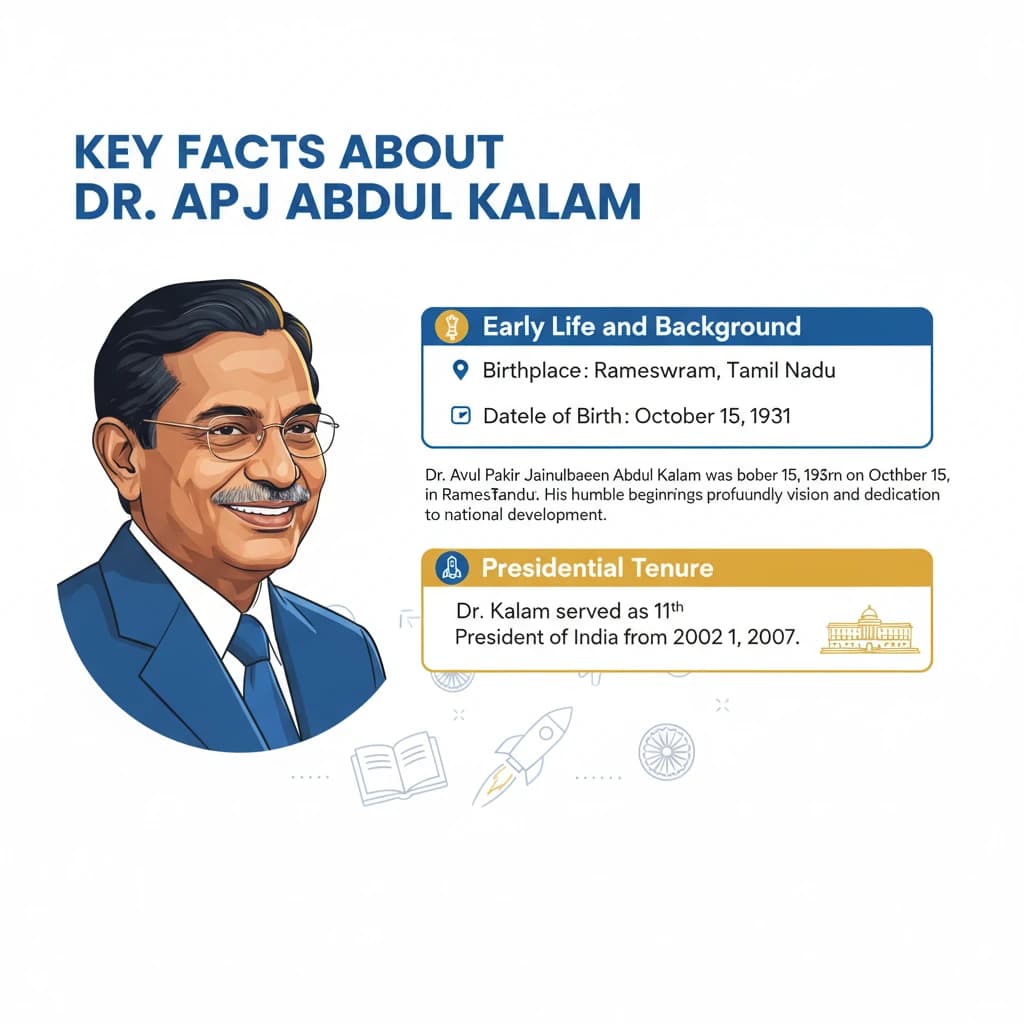
<h4>Early Life and Background</h4><p><strong>Dr. Avul Pakir Jainulabdeen Abdul Kalam</strong> was born on <strong>October 15, 1931</strong>, in <strong>Rameswaram, Tamil Nadu</strong>. His humble beginnings profoundly shaped his vision and dedication to national development.</p><div class='info-box'><p>๐Ÿ“ <strong>Birthplace:</strong> Rameswaram, Tamil Nadu</p><p>๐Ÿ“… <strong>Date of Birth:</strong> October 15, 1931</p></div><h4>Presidential Tenure</h4><p>Dr. Kalam served as the <strong>11th President of India</strong> from <strong>2002 to 2007</strong>. He was widely known as the '<strong>People's President</strong>' for his approachable nature and commitment to public service.</p><div class='info-box'><p>๐Ÿ‡ฎ๐Ÿ‡ณ <strong>Presidential Term:</strong> 2002 - 2007</p><p>๐Ÿ‘ค <strong>Designation:</strong> 11th President of India</p></div><h4>Key Awards and Recognitions</h4><p>His immense contributions to science and the nation were recognized with India's highest civilian honors. These awards reflect his unparalleled dedication and impact.</p><ul><li><strong>Padma Bhushan:</strong> Awarded in <strong>1981</strong> for his significant contributions to India's space program.</li><li><strong>Padma Vibhushan:</strong> Awarded in <strong>1990</strong>, recognizing his advanced work in defense research.</li><li><strong>Bharat Ratna:</strong> India's highest civilian award, conferred upon him in <strong>1997</strong>, cementing his status as a national icon.</li></ul><h4>Literary Contributions</h4><p>Beyond his scientific and political roles, Dr. Kalam was an inspiring author. His books often conveyed his vision for India's future and motivated millions.</p><ul><li><strong>Wings of Fire:</strong> His autobiography, detailing his journey from Rameswaram to Rashtrapati Bhavan.</li><li><strong>India 2020 - A Vision for the New Millennium:</strong> Outlined his blueprint for India to become a developed nation.</li><li><strong>My Journey:</strong> A collection of reflections on his life experiences.</li><li><strong>Ignited Minds:</strong> Focused on unleashing the power within India through knowledge and spirit.</li></ul><h4>Major Scientific Contributions: ISRO</h4><p>Dr. Kalam played a pivotal role in India's space program at the <strong>Indian Space Research Organisation (ISRO)</strong>. He was instrumental in developing indigenous rocket technology.</p><div class='key-point-box'><p>๐Ÿš€ <strong>Project Director, SLV-III:</strong> He led India's first indigenous <strong>Satellite Launch Vehicle (SLV-III)</strong> project, a significant milestone in India's space journey.</p></div><p>The successful launch of the <strong>Rohini satellite</strong> into near-earth orbit in <strong>July 1980</strong> under his leadership marked India's entry into the elite club of space-faring nations.</p><p>He also played a crucial role in evolving <strong>ISRO's launch vehicle program</strong>, particularly in developing configurations for the <strong>Polar Satellite Launch Vehicle (PSLV)</strong>, which is now a workhorse for India.</p><p>A pioneer at ISRO, Dr. Kalam led the development of <strong>fiberglass technology</strong>, a fibrous form of glass used in various aerospace applications.</p><h4>Major Scientific Contributions: Pokhran-II Nuclear Tests</h4><p>Dr. Kalam was a key figure in India's nuclear weapons program, earning him the moniker '<strong>Missile Man of India</strong>'.</p><div class='key-point-box'><p>๐Ÿ’ฃ <strong>Leader of Pokhran-II:</strong> He led India's nuclear tests, codenamed <strong>Pokhran-II</strong>, in <strong>1998</strong>. These tests were conducted in collaboration with the <strong>Department of Atomic Energy</strong>.</p></div><p>The success of <strong>Pokhran-II</strong> firmly established India as a <strong>nuclear weapon state</strong>, significantly enhancing its strategic autonomy and national security.</p><h4>Vision 2020</h4><p>Dr. Kalam articulated a compelling vision for India's future, aiming for holistic national development.</p><div class='key-point-box'><p>๐Ÿ‡ฎ๐Ÿ‡ณ <strong>National Plan:</strong> He proposed a national plan, <strong>Vision 2020</strong>, with the goal of transforming India from a developing to a <strong>developed nation by 2020</strong>. This vision encompassed economic growth, technological advancement, and societal progress.</p></div><h4>Kalam-Raju Stent</h4><p>Demonstrating his commitment to societal welfare, Dr. Kalam also contributed to affordable healthcare solutions.</p><div class='info-box'><p>โค๏ธ <strong>Affordable Healthcare:</strong> He co-developed an affordable coronary stent, the <strong>Kalam-Raju Stent</strong>, with cardiologist <strong>B. Soma Raju</strong>. This innovation aimed to make heart treatment accessible to a wider population.</p></div><div class='exam-tip-box'><p>โšก <strong>UPSC Insight:</strong> Dr. Kalam's life and work are frequently referenced in <strong>GS Paper I (Modern History/Post-Independence)</strong>, <strong>GS Paper II (Governance/Polity)</strong>, and particularly <strong>GS Paper III (Science & Technology/Economy/Security)</strong>. His vision for a developed India and his contributions to self-reliance are crucial for answer writing.</p></div>
Concept Diagram

๐Ÿ’ก Key Takeaways

  • โ€ขDr. APJ Abdul Kalam served as India's 11th President (2002-2007) and was known as the 'People's President'.
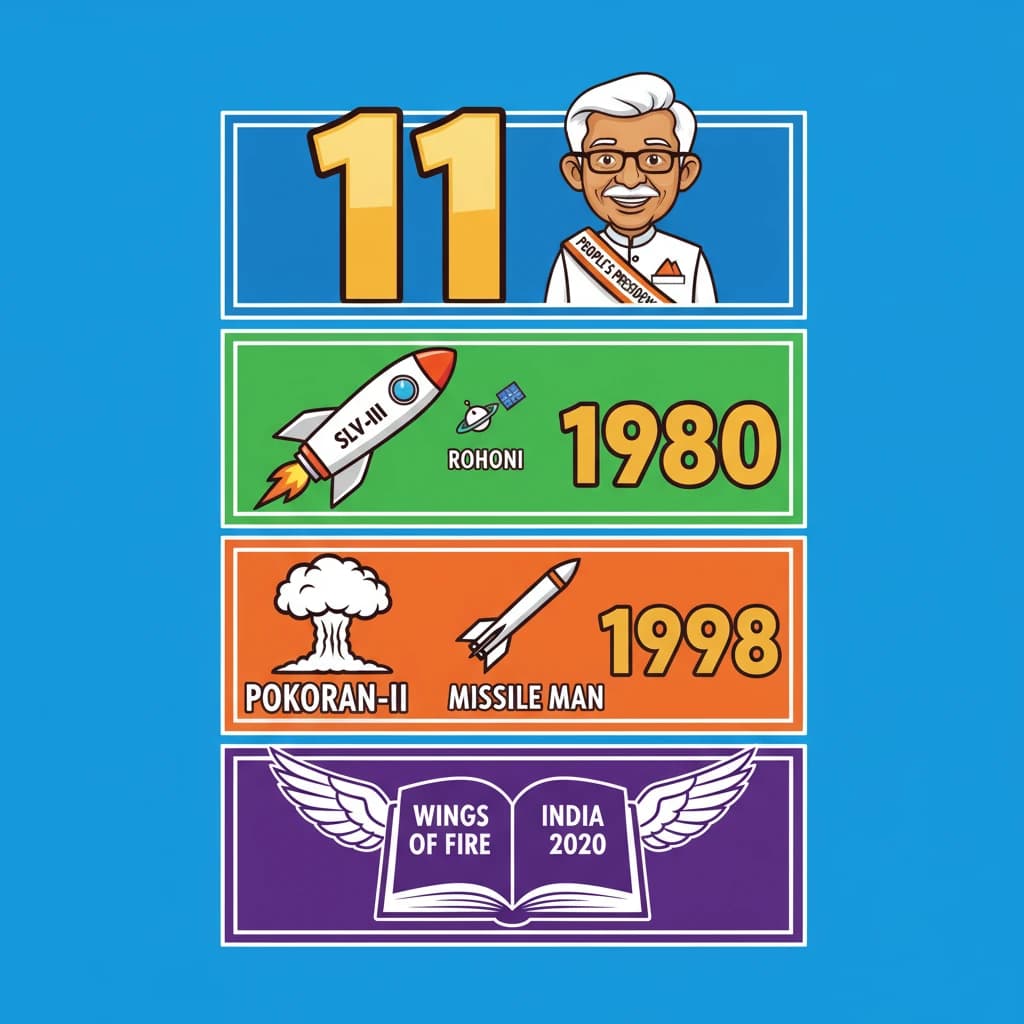
  • โ€ขHe was the Project Director for India's first indigenous Satellite Launch Vehicle (SLV-III), launching the Rohini satellite in 1980.
  • โ€ขHe led the Pokhran-II nuclear tests in 1998, making India a nuclear weapon state and earning him the title 'Missile Man of India'.
  • โ€ขAuthored inspiring books like 'Wings of Fire' and 'India 2020 - A Vision for the New Millennium'.
  • โ€ขCo-developed the affordable Kalam-Raju Stent for coronary heart disease, demonstrating humanitarian innovation.
  • โ€ขHis Vision 2020 aimed to transform India into a developed nation, emphasizing self-reliance and technological advancement.

๐Ÿง  Memory Techniques

Memory Aid
99% Verified Content

๐Ÿ“š Reference Sources

โ€ขOfficial website of Dr. APJ Abdul Kalam (abdulkalam.com)
โ€ขISRO archives and publications
โ€ขMinistry of Defence reports
โ€ขBiographies of Dr. APJ Abdul Kalam (e.g., 'Wings of Fire')

Related Topics

Loading related topics...
Explore:Science And Technology TopicsยทAll SubjectsยทDaily Current AffairsยทEditorial AnalysisยทPrevious Year QuestionsยทUPSC GPT
Key Facts About Dr. APJ Abdul Kalam - UPSC Science And Technology