Loading page, please wait…
Vaidra Logo
Vaidra

Top 4 items + smart groups

UPSC GPT
New
Current Affairs
Daily Solutions
Daily Puzzle
Mains Evaluator

Version 2.0.0 • Built with ❤️ for UPSC aspirants

Loading...
Loading...
Loading...
Loading...
Loading...
Loading...
Loading...
Loading...
Loading...
Loading...
Loading...
Loading...
Loading...
Back
All Subjects

Topics

0 topics • 0 completed

Loading topics...
Loading...
Loading...
Loading...
Loading...
Loading...
Overall Progress0%

What Discovery of microRNA led to the Nobel Prize? - UPSC Science And Technology

What is What Discovery of microRNA led to the Nobel Prize? in UPSC Science And Technology?

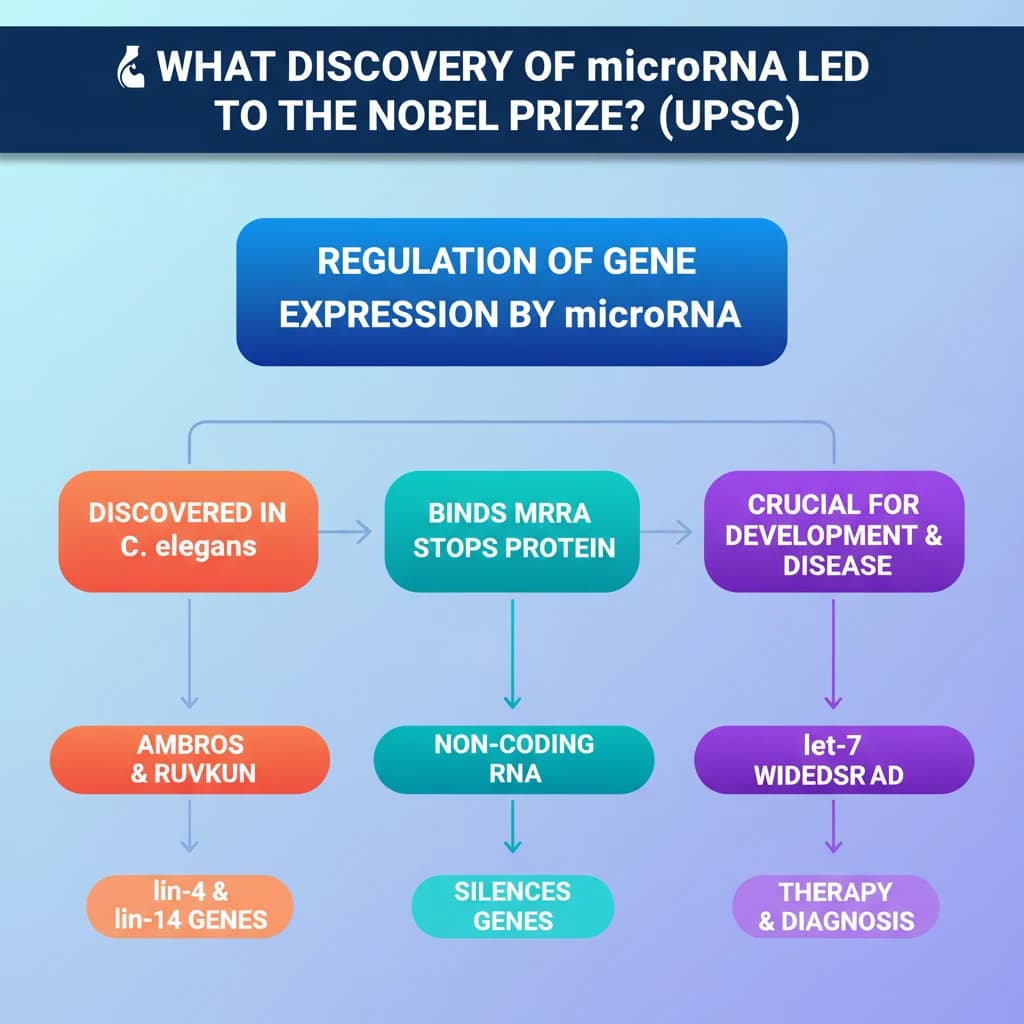
What Discovery of microRNA led to the Nobel Prize? is a key topic under Science And Technology for UPSC Civil Services Examination. Key points include: MicroRNAs are small, non-coding RNA molecules that regulate gene expression.. Discovered by Ambros and Ruvkun in <strong>C. elegans</strong> (<strong>lin-4</strong> microRNA regulating <strong>lin-14</strong>).. They act by binding to mRNA, inhibiting protein production.. Understanding this topic is essential for both UPSC Prelims and Mains preparation.

Why is What Discovery of microRNA led to the Nobel Prize? important for UPSC exam?

What Discovery of microRNA led to the Nobel Prize? is a Medium-level topic in UPSC Science And Technology. It is tested in both Prelims (factual MCQs) and Mains (analytical answer writing). Previous year UPSC questions have frequently covered aspects of What Discovery of microRNA led to the Nobel Prize?, making it essential for comprehensive IAS preparation.

How to prepare What Discovery of microRNA led to the Nobel Prize? for UPSC?

To prepare What Discovery of microRNA led to the Nobel Prize? for UPSC: (1) Study the comprehensive notes covering all key concepts on Vaidra. (2) Practice previous year questions on this topic. (3) Connect it with current affairs using daily updates. (4) Revise using key takeaways and mind maps available for Science And Technology. (5) Write practice answers linking What Discovery of microRNA led to the Nobel Prize? to related GS Paper topics.

Key takeaways of What Discovery of microRNA led to the Nobel Prize? for UPSC

  • MicroRNAs are small, non-coding RNA molecules that regulate gene expression.
  • Discovered by Ambros and Ruvkun in <strong>C. elegans</strong> (<strong>lin-4</strong> microRNA regulating <strong>lin-14</strong>).
  • They act by binding to mRNA, inhibiting protein production.
  • The discovery of <strong>let-7</strong> showed microRNAs are widespread across the animal kingdom.
  • MicroRNAs are crucial for development and are significant in disease diagnosis and therapy.
What Discovery of microRNA led to the Nobel Prize?

What Discovery of microRNA led to the Nobel Prize?

Medium⏱️ 7 min read✓ 95% Verified
science and technology

📖 Introduction

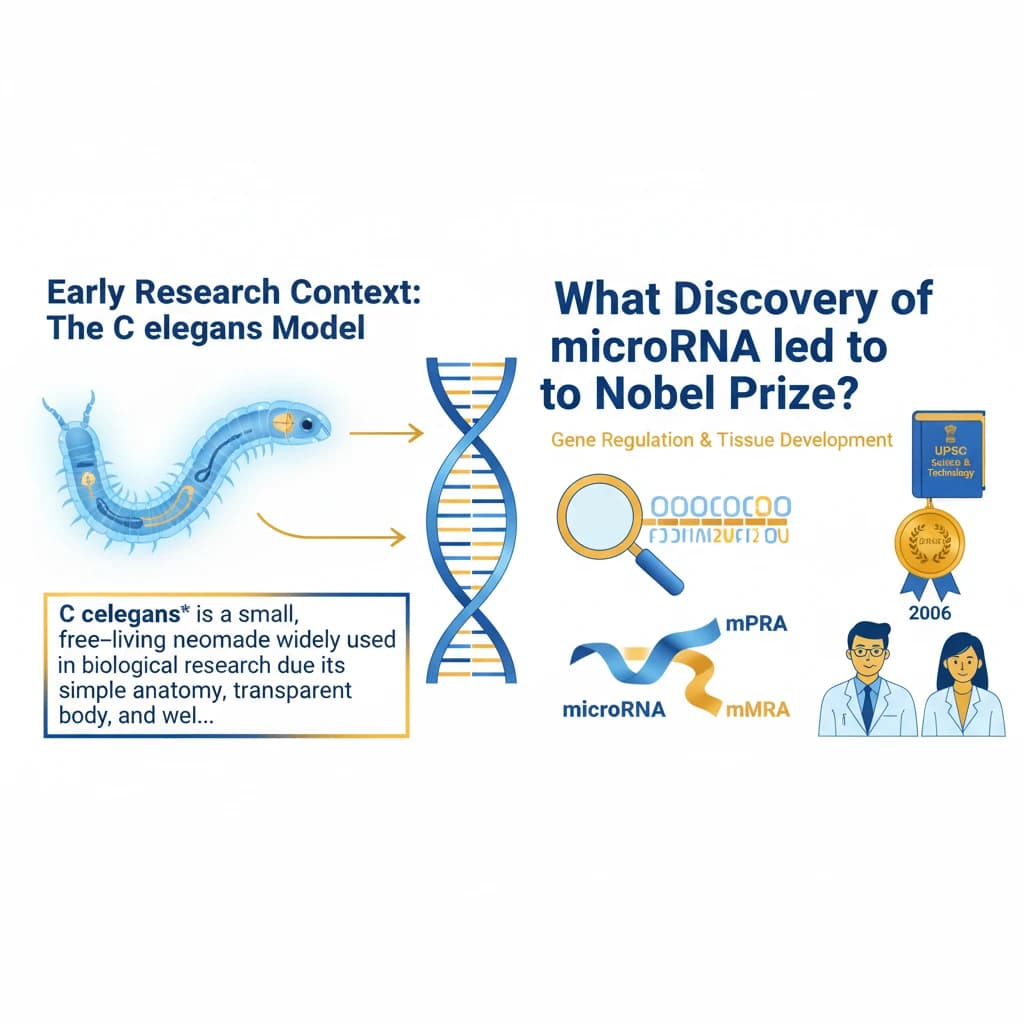
<h4>Early Research Context: The C. elegans Model</h4><p>The foundational research leading to the discovery of microRNA involved studying the roundworm, <strong>Caenorhabditis elegans (C. elegans)</strong>. Scientists aimed to understand the intricate processes of <strong>tissue development</strong> in this model organism.</p><div class='info-box'><p><strong>C. elegans</strong> is a small, free-living nematode widely used in biological research due to its simple anatomy, transparent body, and well-characterized genome, making it ideal for genetic studies.</p></div><p>Researchers focused on specific <strong>mutant strains</strong> of <strong>C. elegans</strong>, particularly those exhibiting abnormalities in their <strong>genetic programming</strong>. These mutations provided crucial clues about developmental timing.</p><h4>Ambros's Initial Discoveries</h4><p>Dr. <strong>Victor Ambros</strong> conducted significant research on the <strong>lin-4</strong> mutant strain. He observed that <strong>lin-4</strong> played a role in suppressing the activity of another gene, <strong>lin-14</strong>.</p><p>Initially, the precise mechanism of this suppression was unclear. Ambros's team cloned the <strong>lin-4</strong> gene and made a groundbreaking observation: it produced a <strong>short RNA molecule</strong>.</p><div class='key-point-box'><p>Crucially, this <strong>short RNA molecule</strong> from <strong>lin-4</strong> did not possess <strong>protein-coding potential</strong>. This suggested that the RNA itself might be directly involved in inhibiting <strong>lin-14</strong> activity.</p></div><h4>Ruvkun's Complementary Findings</h4><p>Independently, Dr. <strong>Gary Ruvkun</strong> investigated the same genetic pathway. His research revealed that <strong>lin-4</strong> did not prevent the production of <strong>lin-14 messenger RNA (mRNA)</strong>.</p><p>Instead, <strong>lin-4</strong> regulated <strong>lin-14</strong> at a later stage, specifically by inhibiting its <strong>protein production</strong>. This indicated a post-transcriptional regulatory mechanism.</p><p>Ruvkun further discovered that a short sequence within <strong>lin-4 RNA</strong> had <strong>key complementary segments</strong> that matched sequences in the <strong>lin-14 mRNA</strong>.</p><h4>The Joint Discovery: Mechanism of microRNA Action</h4><p>The combined insights of <strong>Ambros</strong> and <strong>Ruvkun</strong> led to the pivotal discovery of how <strong>microRNAs</strong> function. They concluded that the <strong>lin-4 microRNA</strong> physically attaches to the <strong>lin-14 mRNA</strong>.</p><div class='key-point-box'><p>This attachment of <strong>lin-4 microRNA</strong> to <strong>lin-14 mRNA</strong> effectively blocks the process of <strong>protein production</strong> from the <strong>lin-14 mRNA</strong>, thereby regulating gene expression.</p></div><h4>Significance and Further Discoveries</h4><p>The discovery of <strong>lin-4</strong> was monumental, identifying the first known <strong>microRNA</strong>. Its significance was further underscored by subsequent findings.</p><p>Ruvkun's group later identified another crucial microRNA named <strong>let-7</strong>. This discovery was particularly impactful because <strong>let-7</strong> was found to be present throughout the <strong>animal kingdom</strong>, highlighting the widespread importance of microRNAs.</p><div class='exam-tip-box'><p>The discovery of <strong>microRNAs</strong> revolutionized our understanding of <strong>gene regulation</strong>, moving beyond the traditional view of protein-coding genes as the sole regulators. This concept is vital for <strong>UPSC Mains GS Paper III (Science & Technology)</strong>, especially topics related to biotechnology and genetics.</p></div><h4>Understanding Key Terms</h4><ul><li><strong>Lin-4:</strong> It is a <strong>microRNA</strong>, identified from a study of <strong>developmental timing</strong> in the nematode <strong>Caenorhabditis elegans</strong>. It was the first to be discovered of the miRNAs, a class of <strong>non-coding RNAs</strong> involved in <strong>gene regulation</strong>.</li><li><strong>Lin-14:</strong> It is a <strong>heterochronic gene</strong> that controls the <strong>timing of developmental events</strong> in nematode <strong>Caenorhabditis elegans</strong>.</li><li><strong>Heterochronic genes:</strong> These are genes that control the <strong>timing of cell and tissue development</strong> in an organism.</li></ul>
Concept Diagram

💡 Key Takeaways

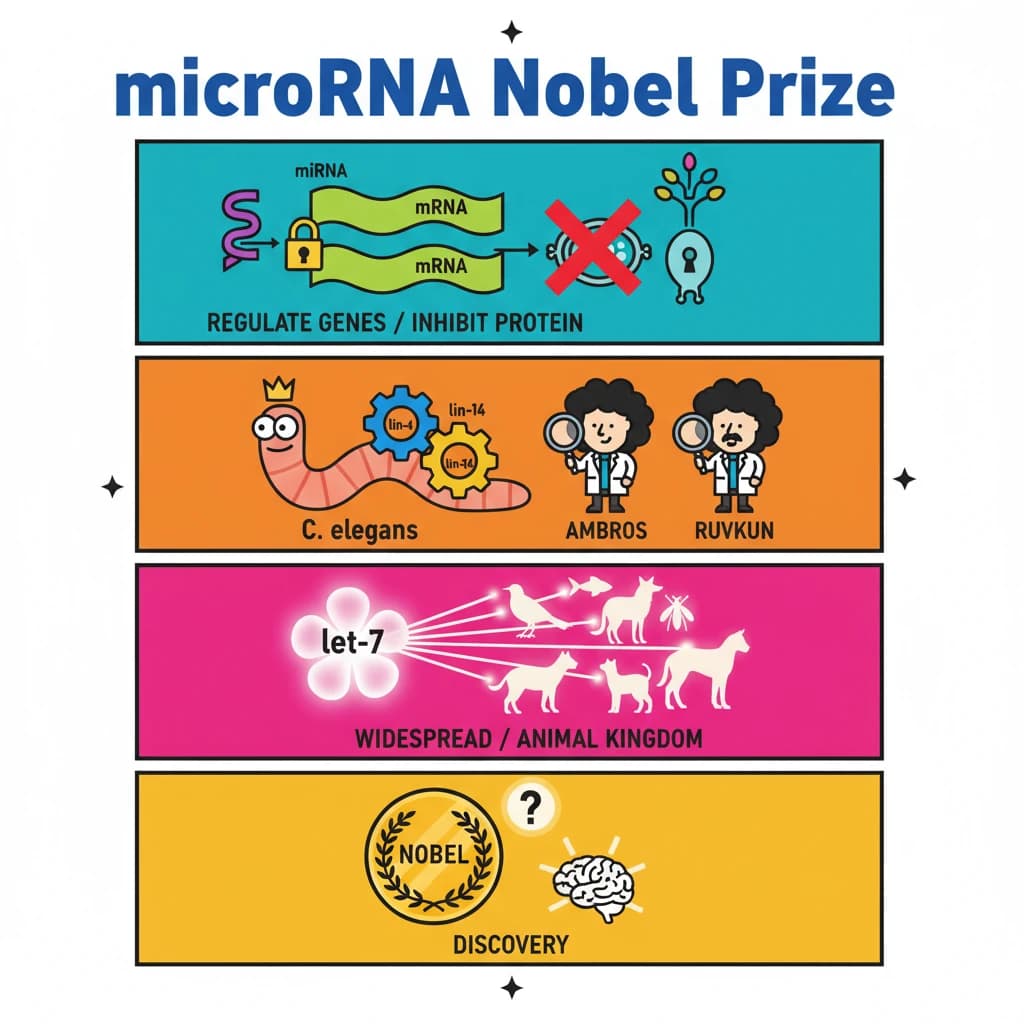
  • •MicroRNAs are small, non-coding RNA molecules that regulate gene expression.
  • •Discovered by Ambros and Ruvkun in <strong>C. elegans</strong> (<strong>lin-4</strong> microRNA regulating <strong>lin-14</strong>).
  • •They act by binding to mRNA, inhibiting protein production.
  • •The discovery of <strong>let-7</strong> showed microRNAs are widespread across the animal kingdom.
  • •MicroRNAs are crucial for development and are significant in disease diagnosis and therapy.

🧠 Memory Techniques
Memory Aid
95% Verified Content

Related Topics

Loading related topics...
Explore:Science And Technology Topics·All Subjects·Daily Current Affairs·Editorial Analysis·Previous Year Questions·UPSC GPT
What Discovery of microRNA led to the Nobel Prize? - UPSC Science And Technology