Loading page, please wait…
Vaidra Logo
Vaidra

Top 4 items + smart groups

UPSC GPT
New
Current Affairs
Daily Solutions
Daily Puzzle
Mains Evaluator

Version 2.0.0 • Built with ❤️ for UPSC aspirants

Loading...
Loading...
Loading...
Loading...
Loading...
Loading...
Loading...
Loading...
Loading...
Loading...
Loading...
Loading...
Loading...

Natural and artificial neurons - UPSC Science And Technology

What is Natural and artificial neurons in UPSC Science And Technology?

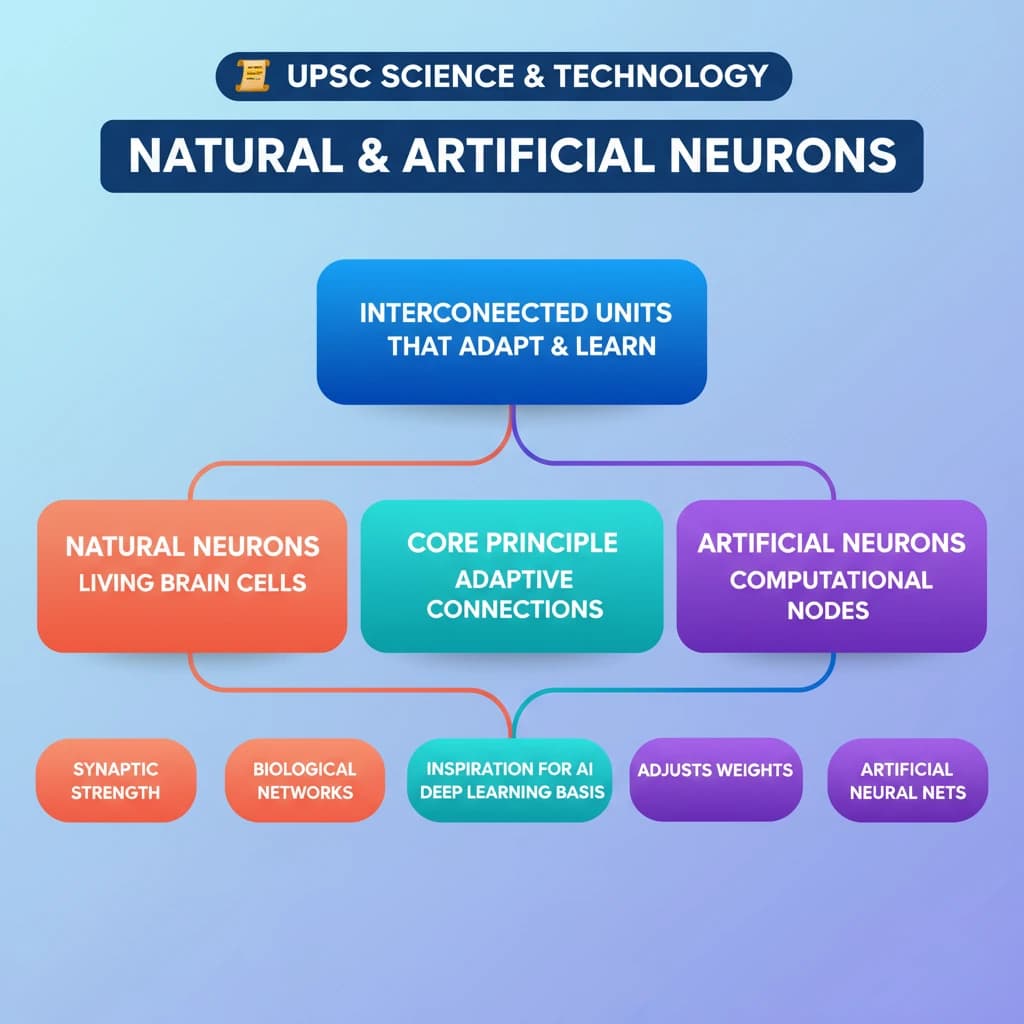
Natural and artificial neurons is a key topic under Science And Technology for UPSC Civil Services Examination. Key points include: <strong>Natural neurons</strong> are living cells in the brain, forming neural networks that learn by strengthening/weakening synaptic connections.. <strong>Artificial neurons (nodes)</strong> are computational units in ANNs, learning by adjusting connection strengths (weights) based on activity.. Both systems fundamentally rely on interconnected units that adapt their connections to process information and learn.. Understanding this topic is essential for both UPSC Prelims and Mains preparation.

Why is Natural and artificial neurons important for UPSC exam?

Natural and artificial neurons is a Medium-level topic in UPSC Science And Technology. It is tested in both Prelims (factual MCQs) and Mains (analytical answer writing). Previous year UPSC questions have frequently covered aspects of Natural and artificial neurons, making it essential for comprehensive IAS preparation.

How to prepare Natural and artificial neurons for UPSC?

To prepare Natural and artificial neurons for UPSC: (1) Study the comprehensive notes covering all key concepts on Vaidra. (2) Practice previous year questions on this topic. (3) Connect it with current affairs using daily updates. (4) Revise using key takeaways and mind maps available for Science And Technology. (5) Write practice answers linking Natural and artificial neurons to related GS Paper topics.

Key takeaways of Natural and artificial neurons for UPSC

  • <strong>Natural neurons</strong> are living cells in the brain, forming neural networks that learn by strengthening/weakening synaptic connections.
  • <strong>Artificial neurons (nodes)</strong> are computational units in ANNs, learning by adjusting connection strengths (weights) based on activity.
  • Both systems fundamentally rely on interconnected units that adapt their connections to process information and learn.
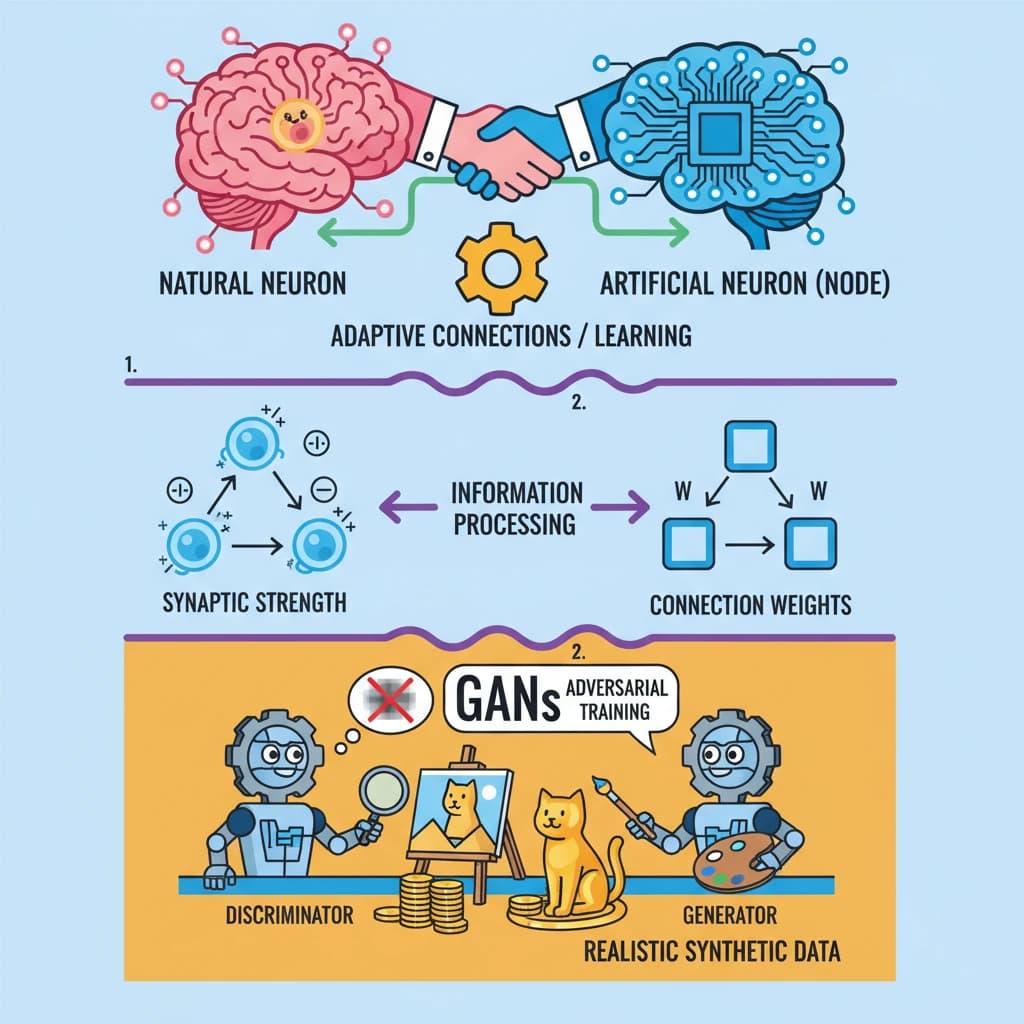
  • <strong>Generative Adversarial Networks (GANs)</strong> are advanced ANNs that use adversarial training to produce realistic synthetic data.
  • The inspiration for AI and ANNs comes from the biological brain, with a history spanning from early theoretical models to modern Deep Learning.
  • AI, powered by artificial neurons, has vast contemporary relevance in healthcare, autonomous systems, NLP, and economic transformation.
Natural and artificial neurons

Natural and artificial neurons

Medium⏱️ 7 min read✓ 95% Verified
science and technology

📖 Introduction

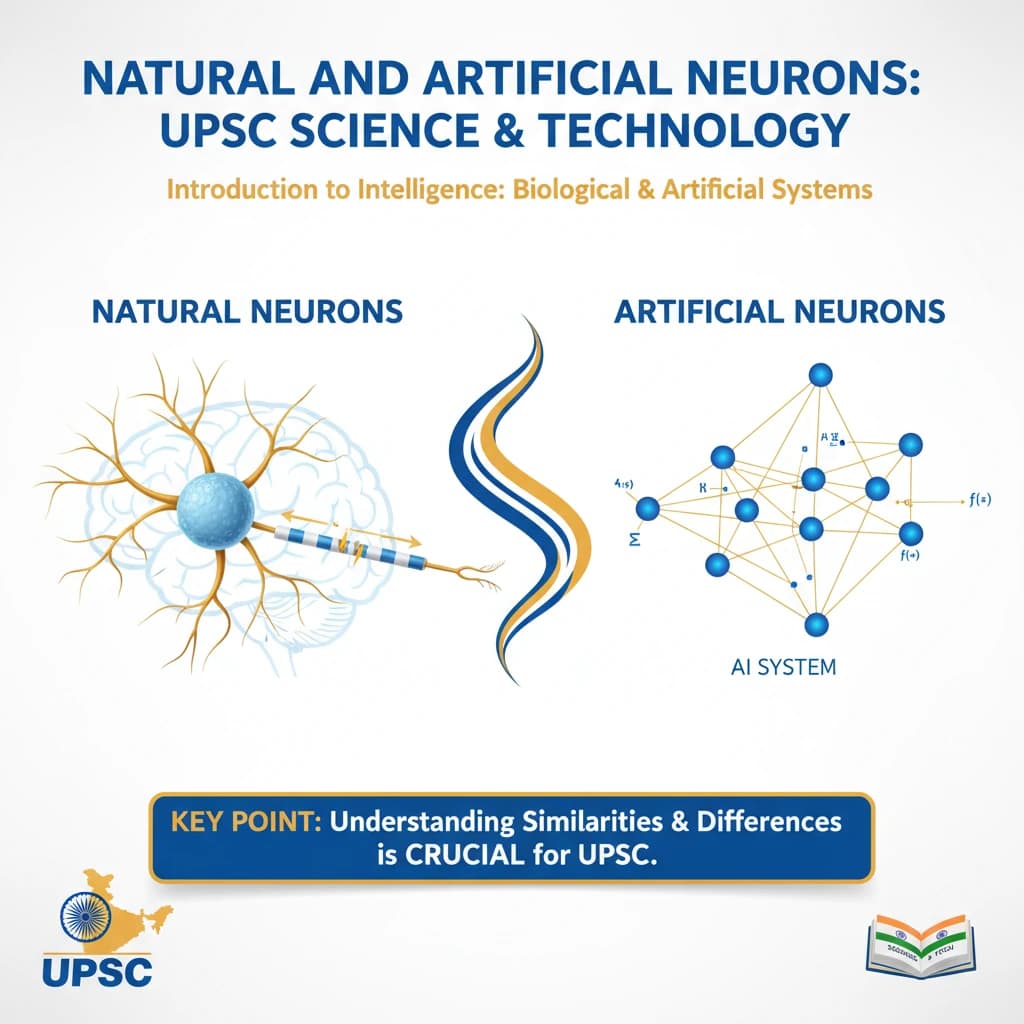
<h4>Introduction to Neurons: Natural and Artificial</h4><p>The concept of <strong>neurons</strong> is fundamental to understanding intelligence, both biological and artificial. While <strong>natural neurons</strong> form the basis of living brains, <strong>artificial neurons</strong> are the building blocks of modern <strong>Artificial Intelligence (AI)</strong> systems.</p><div class='key-point-box'><p>Understanding the similarities and differences between these two types of neurons is crucial for comprehending the advancements in <strong>Machine Learning</strong> and <strong>Deep Learning</strong>.</p></div><h4>Natural Neurons: The Brain's Living Cells</h4><p>The brain's <strong>neural network</strong> is intricately constructed from billions of <strong>living cells</strong> known as <strong>neurons</strong>. These cells possess advanced internal machinery that enables complex biological computations.</p><p><strong>Natural neurons</strong> communicate with each other by sending signals across specialized junctions called <strong>synapses</strong>. This electrochemical signaling forms the basis of all brain activity, including thought, emotion, and learning.</p><div class='info-box'><p>When we <strong>learn</strong> new information or skills, the <strong>connections</strong> between certain <strong>natural neurons</strong> in the brain become <strong>stronger</strong>. Conversely, connections that are less frequently used or are irrelevant may become <strong>weaker</strong>.</p></div><h4>Artificial Neurons: Computational Nodes</h4><p><strong>Artificial neural networks (ANNs)</strong> are computational models inspired by the structure and function of biological brains. They are built from interconnected processing units called <strong>nodes</strong>, which are the artificial counterparts of natural neurons.</p><p>Each <strong>node</strong> in an <strong>ANN</strong> is typically scaled with a numerical <strong>value</strong>, representing the strength of the signal. These nodes are connected to each other, forming layers within the network.</p><div class='info-box'><p>During the <strong>training</strong> phase of an <strong>artificial neural network</strong>, the <strong>connections</strong> (or <strong>weights</strong>) between nodes that are frequently active together become <strong>stronger</strong>. Connections between less active or unhelpful nodes become <strong>weaker</strong>, mimicking the learning process in biological brains.</p></div><h4>Generative Adversarial Networks (GANs) and Their Versatility</h4><p>The source content briefly mentions <strong>Generative Adversarial Networks (GANs)</strong>, a powerful class of <strong>AI tools</strong>. GANs utilize a unique <strong>adversarial training</strong> technique involving two competing neural networks: a <strong>generator</strong> and a <strong>discriminator</strong>.</p><p>This adversarial process allows GANs to produce highly realistic and high-quality synthetic data, such as images, text, or audio. They have revolutionized the field of <strong>generative modeling</strong>.</p><div class='exam-tip-box'><p>While <strong>GANs</strong> are an advanced application of <strong>artificial neural networks</strong>, understanding their core principle of learning and adaptation is essential for <strong>UPSC Mains GS Paper 3</strong>, particularly in the context of emerging technologies and their impact.</p></div><p><strong>GANs</strong> are incredibly versatile and find wide application in various fields. They are extensively used in <strong>image synthesis</strong>, creating new images from scratch, and <strong>style transfer</strong>, applying the artistic style of one image to another.</p><p>Furthermore, <strong>GANs</strong> are crucial in <strong>text-to-image synthesis</strong>, where textual descriptions are transformed into visual representations. This highlights the transformative potential of advanced AI architectures built upon artificial neurons.</p>
Concept Diagram

💡 Key Takeaways

  • •<strong>Natural neurons</strong> are living cells in the brain, forming neural networks that learn by strengthening/weakening synaptic connections.
  • •<strong>Artificial neurons (nodes)</strong> are computational units in ANNs, learning by adjusting connection strengths (weights) based on activity.
  • •Both systems fundamentally rely on interconnected units that adapt their connections to process information and learn.
  • •<strong>Generative Adversarial Networks (GANs)</strong> are advanced ANNs that use adversarial training to produce realistic synthetic data.
  • •The inspiration for AI and ANNs comes from the biological brain, with a history spanning from early theoretical models to modern Deep Learning.
  • •AI, powered by artificial neurons, has vast contemporary relevance in healthcare, autonomous systems, NLP, and economic transformation.

🧠 Memory Techniques
Memory Aid
95% Verified Content

📚 Reference Sources

•Goodfellow, I., Bengio, Y., & Courville, A. (2016). Deep Learning. MIT Press.
•Principles of Neural Science (Kandel, Schwartz, Jessell, Siegelbaum, Hudspeth)
•MIT Technology Review articles on AI and GANs
•Wikipedia entries for Artificial Neural Networks, Perceptron, GANs

Related Topics

Loading related topics...
Explore:Science And Technology Topics·All Subjects·Daily Current Affairs·Editorial Analysis·Previous Year Questions·UPSC GPT
Back
All Subjects

Topics

0 topics • 0 completed

Loading topics...
Loading...
Loading...
Loading...
Loading...
Loading...
Overall Progress0%
Natural and artificial neurons - UPSC Science And Technology