Loading page, please wait…
Vaidra Logo
Vaidra

Top 4 items + smart groups

UPSC GPT
New
Current Affairs
Daily Solutions
Daily Puzzle
Mains Evaluator

Version 2.0.0 • Built with ❤️ for UPSC aspirants

Loading...
Loading...
Loading...
Loading...
Loading...
Loading...
Loading...
Loading...
Loading...
Loading...
Loading...
Loading...
Loading...
Dementia: Definition, Symptoms, and Cognitive Impact - UPSC Science And Technology
Back
All Subjects

Topics

0 topics • 0 completed

Loading topics...
Loading...
Loading...
Loading...
Loading...
Loading...
Overall Progress0%

Dementia: Definition, Symptoms, and Cognitive Impact - UPSC Science And Technology

What is Dementia: Definition, Symptoms, and Cognitive Impact in UPSC Science And Technology?

Dementia: Definition, Symptoms, and Cognitive Impact is a key topic under Science And Technology for UPSC Civil Services Examination. Key points include: Dementia is a syndrome of progressive cognitive decline, not a normal part of aging.. It affects memory, thinking, language, judgment, and other cognitive functions, but consciousness remains intact.. Alzheimer's disease is the most common cause, followed by vascular dementia.. Understanding this topic is essential for both UPSC Prelims and Mains preparation.

Why is Dementia: Definition, Symptoms, and Cognitive Impact important for UPSC exam?

Dementia: Definition, Symptoms, and Cognitive Impact is a Medium-level topic in UPSC Science And Technology. It is tested in both Prelims (factual MCQs) and Mains (analytical answer writing). Previous year UPSC questions have frequently covered aspects of Dementia: Definition, Symptoms, and Cognitive Impact, making it essential for comprehensive IAS preparation.

How to prepare Dementia: Definition, Symptoms, and Cognitive Impact for UPSC?

To prepare Dementia: Definition, Symptoms, and Cognitive Impact for UPSC: (1) Study the comprehensive notes covering all key concepts on Vaidra. (2) Practice previous year questions on this topic. (3) Connect it with current affairs using daily updates. (4) Revise using key takeaways and mind maps available for Science And Technology. (5) Write practice answers linking Dementia: Definition, Symptoms, and Cognitive Impact to related GS Paper topics.

Key takeaways of Dementia: Definition, Symptoms, and Cognitive Impact for UPSC

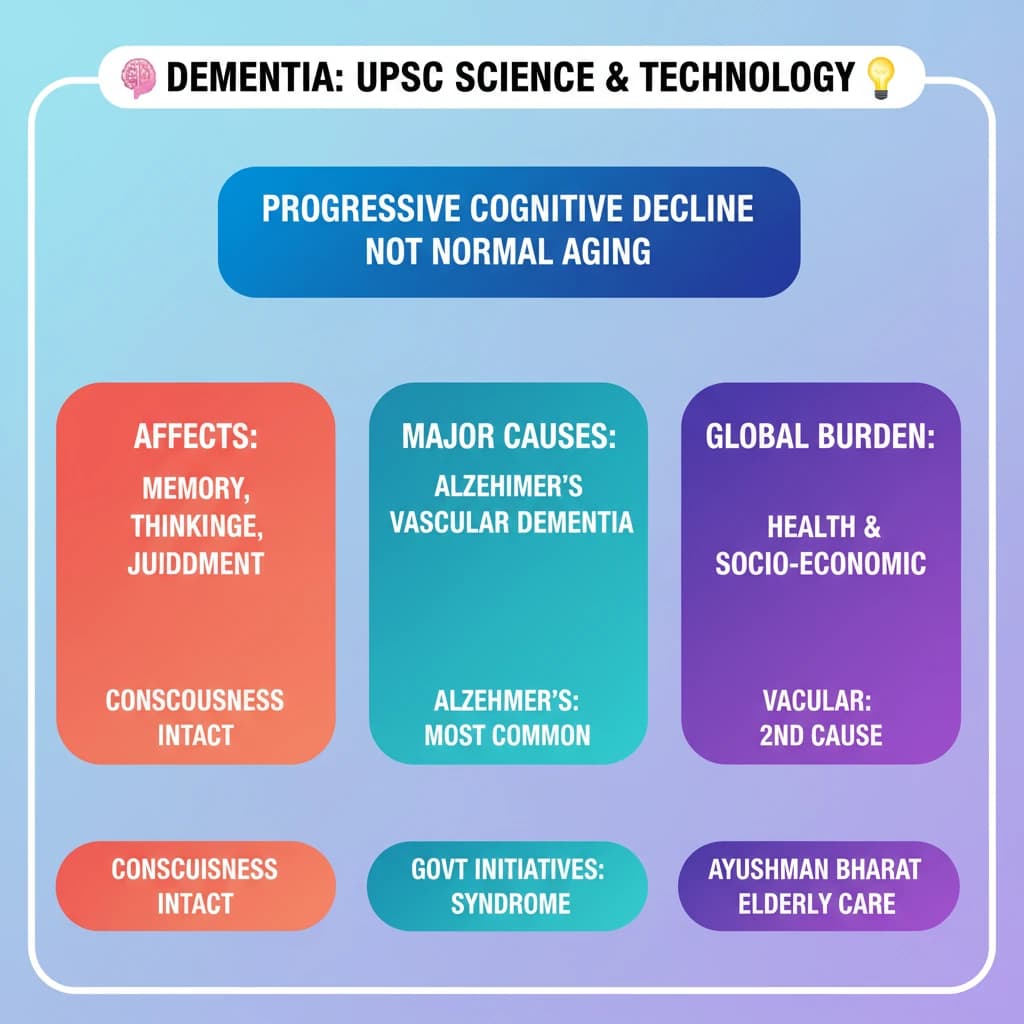
  • Dementia is a syndrome of progressive cognitive decline, not a normal part of aging.
  • It affects memory, thinking, language, judgment, and other cognitive functions, but consciousness remains intact.
  • Alzheimer's disease is the most common cause, followed by vascular dementia.
  • Dementia poses a significant global health and socio-economic burden.
  • Government programs like NPHCE and Ayushman Bharat indirectly address aspects of elderly care relevant to dementia.
  • Early diagnosis, caregiver support, and continued research are crucial for managing dementia.
Dementia: Definition, Symptoms, and Cognitive Impact

Dementia: Definition, Symptoms, and Cognitive Impact

Medium⏱️ 8 min read✓ 95% Verified
science and technology

📖 Introduction

<h4>Understanding Dementia: A Syndrome of Cognitive Decline</h4><p><strong>Dementia</strong> is not a single disease but a <strong>syndrome</strong>. It typically presents as a <strong>chronic</strong> or <strong>progressive</strong> condition, meaning its effects tend to worsen over time rather than improve.</p><div class='info-box'><p><strong>Definition:</strong> <strong>Dementia</strong> is a syndrome characterized by a deterioration in <strong>cognitive function</strong> – the ability to process thought – beyond what is considered normal for typical biological aging.</p></div><p>This deterioration significantly impacts an individual's daily life, affecting various mental capacities essential for independent functioning.</p><h4>Key Cognitive Functions Affected by Dementia</h4><p>Dementia affects a broad spectrum of cognitive abilities, leading to noticeable changes in a person's mental faculties. These impairments are often progressive and can severely hinder daily activities.</p><ul><li><strong>Memory:</strong> Difficulty recalling recent events, names, or conversations.</li><li><strong>Thinking:</strong> Challenges with problem-solving, abstract thought, and reasoning.</li><li><strong>Orientation:</strong> Confusion about time, place, or personal identity.</li><li><strong>Comprehension:</strong> Struggling to understand spoken or written language.</li><li><strong>Calculation:</strong> Impairment in basic arithmetic and financial management.</li><li><strong>Learning Capacity:</strong> Reduced ability to acquire new information or skills.</li><li><strong>Language:</strong> Difficulties with finding words, speaking, or understanding communication.</li><li><strong>Judgment:</strong> Poor decision-making and impaired ability to assess situations.</li></ul><h4>Unaffected Aspect: Consciousness</h4><div class='key-point-box'><p>An important distinction in <strong>dementia</strong> is that, despite severe cognitive decline, the individual's <strong>consciousness</strong> is generally not affected. This means they remain awake and aware of their surroundings, even if their ability to interact meaningfully is compromised.</p></div><div class='exam-tip-box'><p>For <strong>UPSC Mains GS Paper 2 (Social Justice)</strong> and <strong>GS Paper 3 (Science & Technology)</strong>, understanding <strong>dementia</strong> is crucial. It relates to public health challenges, elderly care, and advancements in neurological sciences. Differentiate it from normal aging and other neurological conditions.</p></div>
Concept Diagram

💡 Key Takeaways

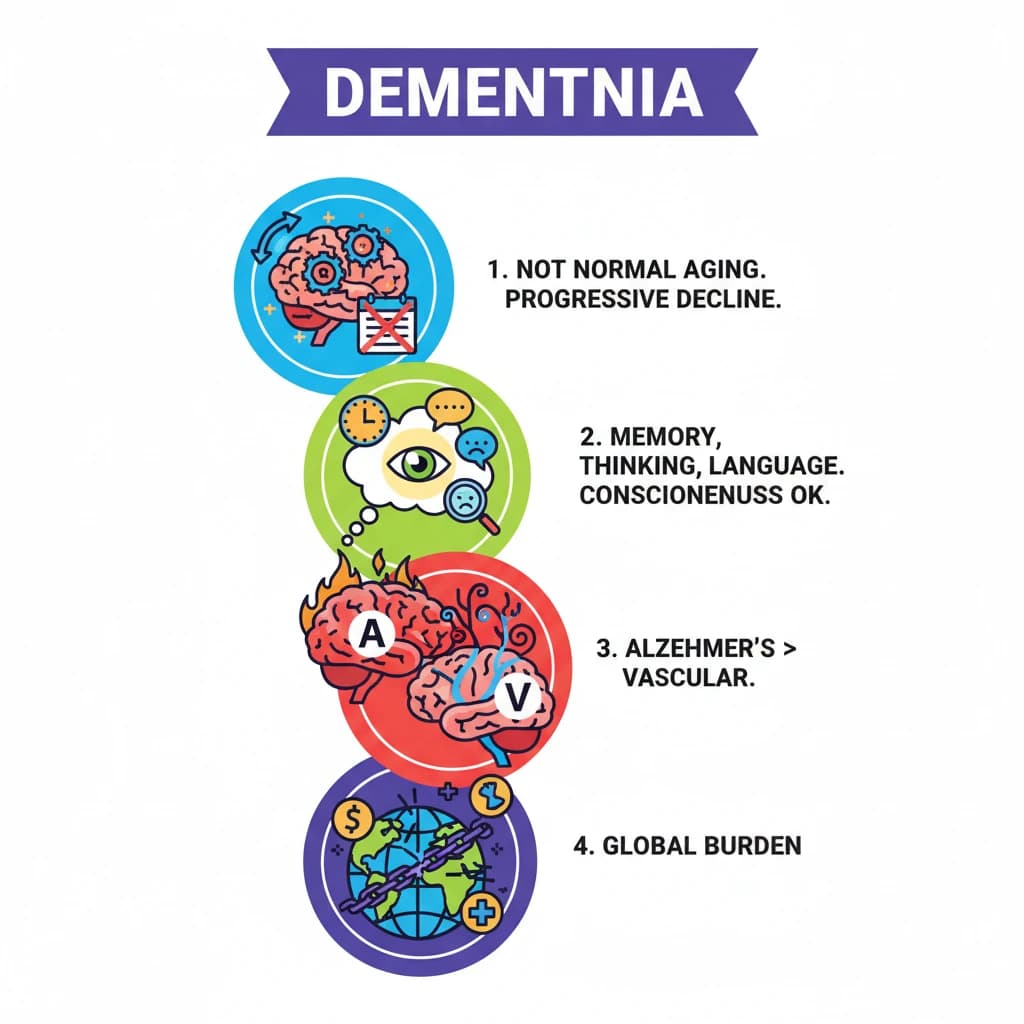
  • •Dementia is a syndrome of progressive cognitive decline, not a normal part of aging.
  • •It affects memory, thinking, language, judgment, and other cognitive functions, but consciousness remains intact.
  • •Alzheimer's disease is the most common cause, followed by vascular dementia.
  • •Dementia poses a significant global health and socio-economic burden.
  • •Government programs like NPHCE and Ayushman Bharat indirectly address aspects of elderly care relevant to dementia.
  • •Early diagnosis, caregiver support, and continued research are crucial for managing dementia.

🧠 Memory Techniques
Memory Aid
95% Verified Content

📚 Reference Sources

•National Institute of Neurological Disorders and Stroke (NINDS) - Dementia Information Page
•Ministry of Health & Family Welfare, Government of India - National Programme for Health Care of the Elderly (NPHCE) documents
•Alzheimer's Association - About Alzheimer's and Dementia

Related Topics

Loading related topics...
Explore:Science And Technology Topics·All Subjects·Daily Current Affairs·Editorial Analysis·Previous Year Questions·UPSC GPT