Loading page, please wait…
Adaptive Optics (NFIRAOS) & NIR Star Catalogue Tool for TMT - UPSC Science And Technology
What is Adaptive Optics (NFIRAOS) & NIR Star Catalogue Tool for TMT in UPSC Science And Technology?
Adaptive Optics (NFIRAOS) & NIR Star Catalogue Tool for TMT is a key topic under Science And Technology for UPSC Civil Services Examination. Key points include: Adaptive Optics System (AOS) corrects atmospheric distortions for ground-based telescopes.. TMT's NFIRAOS uses deformable mirrors and laser guide stars (LGS) for image enhancement.. Natural Guide Stars (NGS) are essential for precise atmospheric tip-tilt correction.. Understanding this topic is essential for both UPSC Prelims and Mains preparation.
Why is Adaptive Optics (NFIRAOS) & NIR Star Catalogue Tool for TMT important for UPSC exam?
Adaptive Optics (NFIRAOS) & NIR Star Catalogue Tool for TMT is a Medium-level topic in UPSC Science And Technology. It is tested in both Prelims (factual MCQs) and Mains (analytical answer writing). Previous year UPSC questions have frequently covered aspects of Adaptive Optics (NFIRAOS) & NIR Star Catalogue Tool for TMT, making it essential for comprehensive IAS preparation.
How to prepare Adaptive Optics (NFIRAOS) & NIR Star Catalogue Tool for TMT for UPSC?
To prepare Adaptive Optics (NFIRAOS) & NIR Star Catalogue Tool for TMT for UPSC: (1) Study the comprehensive notes covering all key concepts on Vaidra. (2) Practice previous year questions on this topic. (3) Connect it with current affairs using daily updates. (4) Revise using key takeaways and mind maps available for Science And Technology. (5) Write practice answers linking Adaptive Optics (NFIRAOS) & NIR Star Catalogue Tool for TMT to related GS Paper topics.
Key takeaways of Adaptive Optics (NFIRAOS) & NIR Star Catalogue Tool for TMT for UPSC
- Adaptive Optics System (AOS) corrects atmospheric distortions for ground-based telescopes.
- TMT's NFIRAOS uses deformable mirrors and laser guide stars (LGS) for image enhancement.
- Natural Guide Stars (NGS) are essential for precise atmospheric tip-tilt correction.
- A new automated online tool creates a catalogue of Near Infrared (NIR) stars by computing magnitudes from optical surveys.
- AOS significantly improves image resolution, enabling deeper astronomical observations.
- Beyond astronomy, AOS has crucial applications in medical imaging, particularly for the human retina.
Adaptive Optics (NFIRAOS) & NIR Star Catalogue Tool for TMT
Medium⏱️ 8 min read
science and technology
📖 Introduction
Introduction to Adaptive Optics System (AOS)
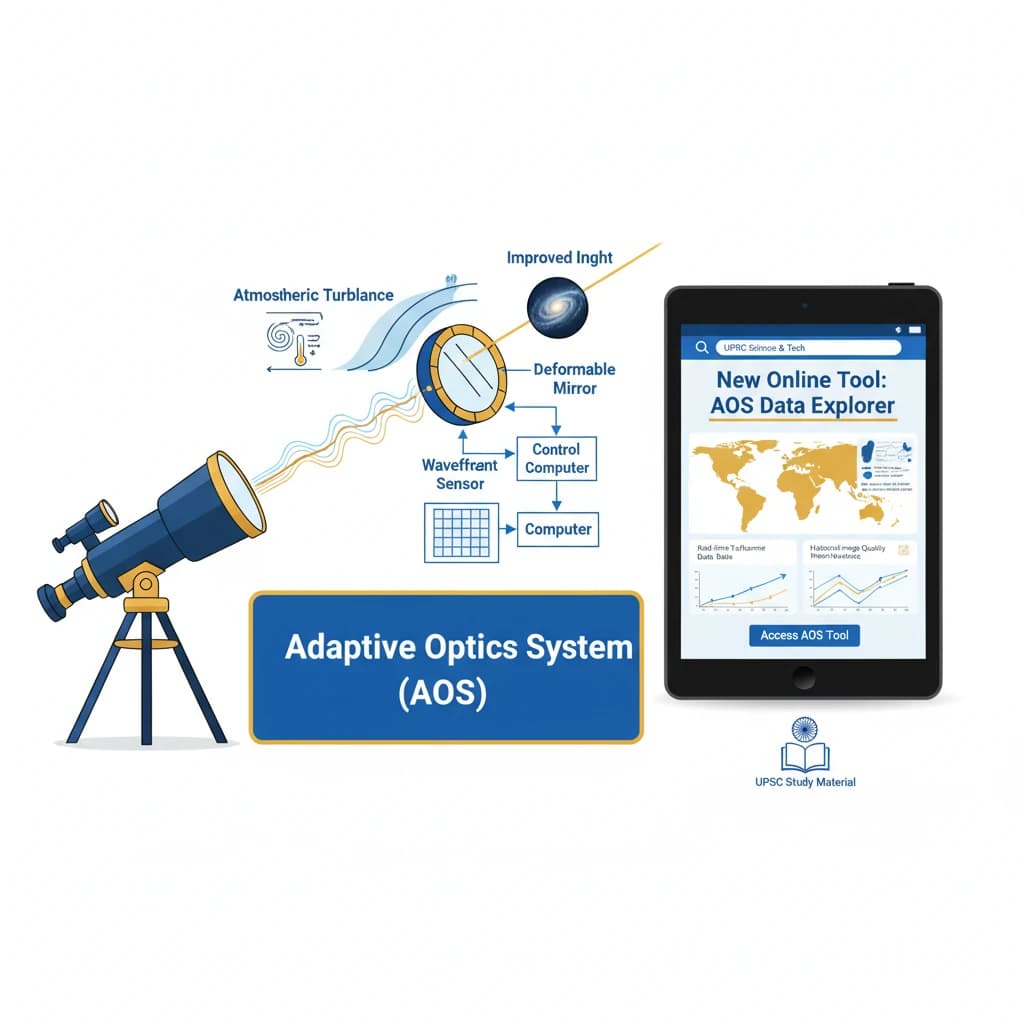
The Adaptive Optics System (AOS) is a crucial technology designed to correct distortions caused by the Earth's atmosphere. These distortions severely limit the clarity and resolution of images captured by ground-based telescopes.
Atmospheric Turbulence: This refers to the varying refractive index of air due to temperature and pressure differences, causing light from celestial objects to shimmer and blur.
NFIRAOS: The TMT's Advanced AOS
The Thirty Meter Telescope (TMT) employs a sophisticated AOS known as the Narrow Field Infrared Adaptive Optics System (NFIRAOS). This system is engineered to significantly enhance the image resolution of the telescope.
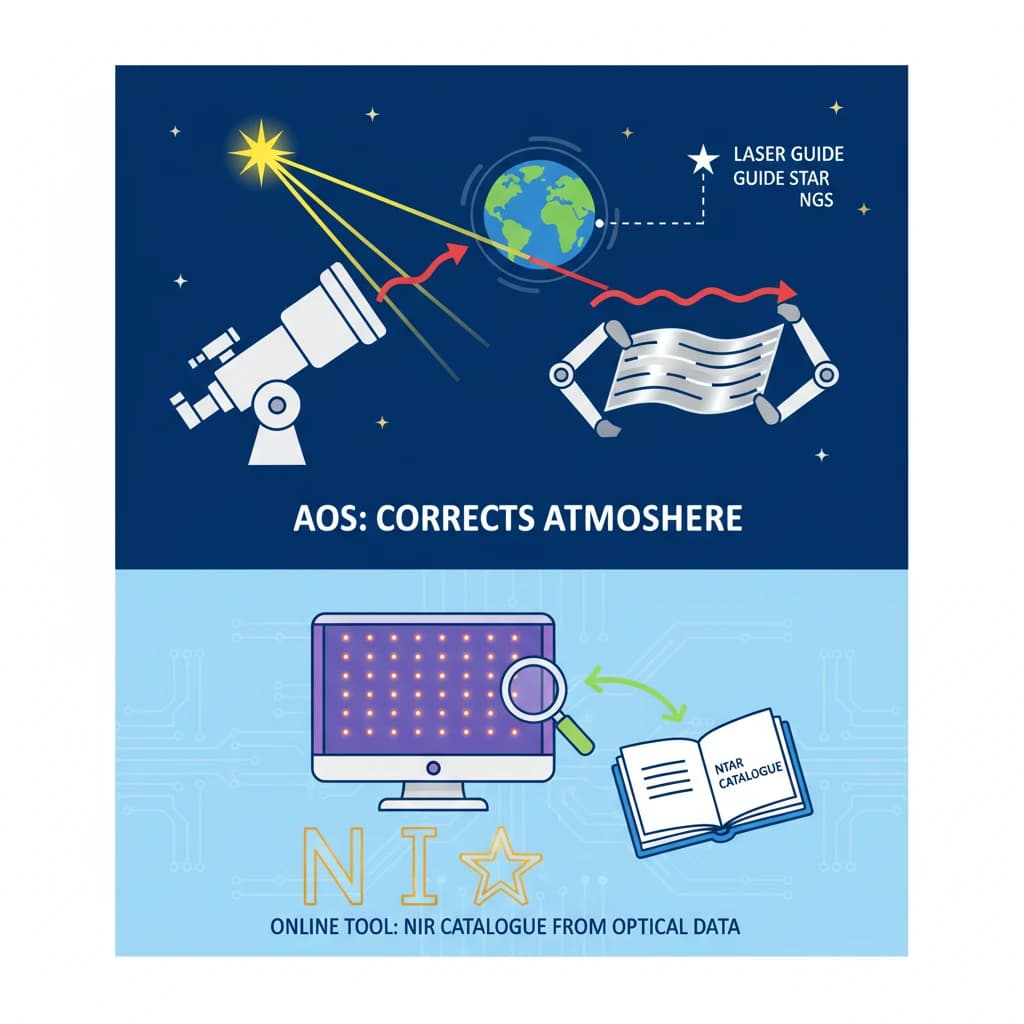
NFIRAOS achieves this by utilizing advanced components such as deformable mirrors and specialized laser guide stars (LGS). These elements work in tandem to counteract the blurring effects of atmospheric turbulence.
Functioning with Laser Guide Stars (LGS)
The NFIRAOS facility is capable of projecting up to nine powerful lasers into the night sky. These lasers create artificial points of light, effectively serving as artificial guide stars.
While laser guide stars (LGS) are effective, they are also affected by atmospheric turbulence. This makes precise measurement of the atmosphere's tip-tilt (overall image motion) uncertain using LGS alone.
Role of Natural Guide Stars (NGS)
To accurately correct the effects of atmospheric turbulence, particularly the tip-tilt, the Adaptive Optics system requires additional feedback. This feedback comes from observing three real stars, which are known as Natural Guide Stars (NGS).
These NGS provide the necessary stable reference points to calibrate the system and ensure precise atmospheric correction, working in conjunction with the LGS.
New Online Tool for Near Infrared (NIR) Stars
Recognizing the need for efficient identification of Natural Guide Stars, researchers have developed an automated code. This code functions as a new online tool.
The primary purpose of this online tool is to create a comprehensive catalogue of Near Infrared (NIR) stars. Such a catalogue is vital for selecting suitable NGS for AOS operations.
The automated code can compute the expected near-infrared magnitudes of stellar sources. It achieves this by using their known optical magnitudes, which are typically identified in various optical sky surveys.
💡 Key Takeaways
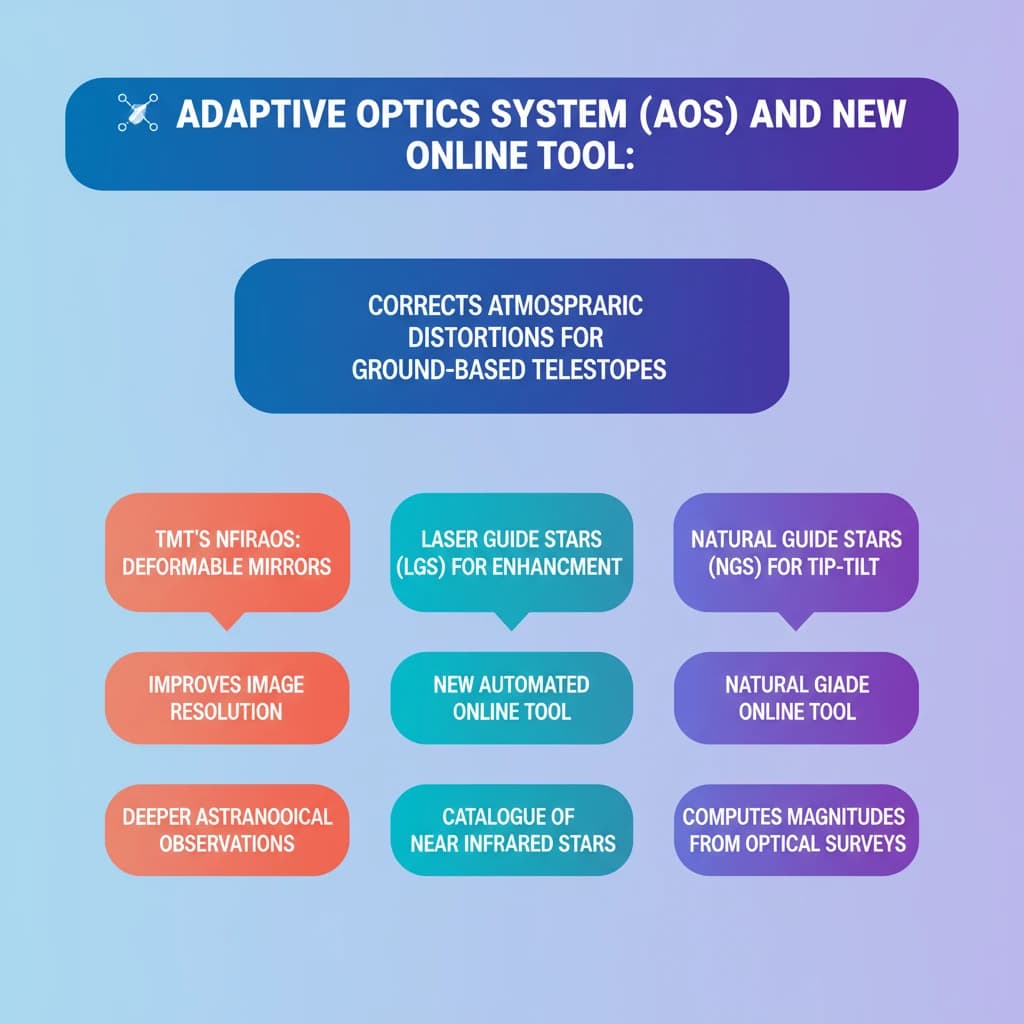
- •Adaptive Optics System (AOS) corrects atmospheric distortions for ground-based telescopes.
- •TMT's NFIRAOS uses deformable mirrors and laser guide stars (LGS) for image enhancement.
- •Natural Guide Stars (NGS) are essential for precise atmospheric tip-tilt correction.
- •A new automated online tool creates a catalogue of Near Infrared (NIR) stars by computing magnitudes from optical surveys.
- •AOS significantly improves image resolution, enabling deeper astronomical observations.
- •Beyond astronomy, AOS has crucial applications in medical imaging, particularly for the human retina.
🧠 Memory Techniques
95% Verified Content
📚 Reference Sources
•Thirty Meter Telescope (TMT) Official Website
•European Southern Observatory (ESO) Adaptive Optics Information
•NASA Adaptive Optics Resources
•Journal articles on Adaptive Optics in Astronomy and Ophthalmology