Loading page, please wait…
Vaidra Logo
Vaidra

Top 4 items + smart groups

UPSC GPT
New
Current Affairs
Daily Solutions
Daily Puzzle
Mains Evaluator

Version 2.0.0 • Built with ❤️ for UPSC aspirants

Loading...
Loading...
Loading...
Loading...
Loading...
Loading...
Loading...
Loading...
Loading...
Loading...
Loading...
Loading...
Loading...
Back
All Subjects

Topics

0 topics • 0 completed

Loading topics...
Loading...
Loading...
Loading...
Loading...
Loading...
Overall Progress0%
What are the Key Features of Thirty Meter Telescope (TMT)? - UPSC Science And Technology

What are the Key Features of Thirty Meter Telescope (TMT)? - UPSC Science And Technology

What is What are the Key Features of Thirty Meter Telescope (TMT)? in UPSC Science And Technology?

What are the Key Features of Thirty Meter Telescope (TMT)? is a key topic under Science And Technology for UPSC Civil Services Examination. Key points include: Thirty Meter Telescope (TMT) is a next-generation international astronomical observatory project.. It is planned for Mauna Kea, Hawaii, with key partners including India, US, Canada, China, and Japan.. Features a massive 30-meter primary mirror and advanced adaptive optics for unprecedented resolution and sensitivity.. Understanding this topic is essential for both UPSC Prelims and Mains preparation.

Why is What are the Key Features of Thirty Meter Telescope (TMT)? important for UPSC exam?

What are the Key Features of Thirty Meter Telescope (TMT)? is a Medium-level topic in UPSC Science And Technology. It is tested in both Prelims (factual MCQs) and Mains (analytical answer writing). Previous year UPSC questions have frequently covered aspects of What are the Key Features of Thirty Meter Telescope (TMT)?, making it essential for comprehensive IAS preparation.

How to prepare What are the Key Features of Thirty Meter Telescope (TMT)? for UPSC?

To prepare What are the Key Features of Thirty Meter Telescope (TMT)? for UPSC: (1) Study the comprehensive notes covering all key concepts on Vaidra. (2) Practice previous year questions on this topic. (3) Connect it with current affairs using daily updates. (4) Revise using key takeaways and mind maps available for Science And Technology. (5) Write practice answers linking What are the Key Features of Thirty Meter Telescope (TMT)? to related GS Paper topics.

Key takeaways of What are the Key Features of Thirty Meter Telescope (TMT)? for UPSC

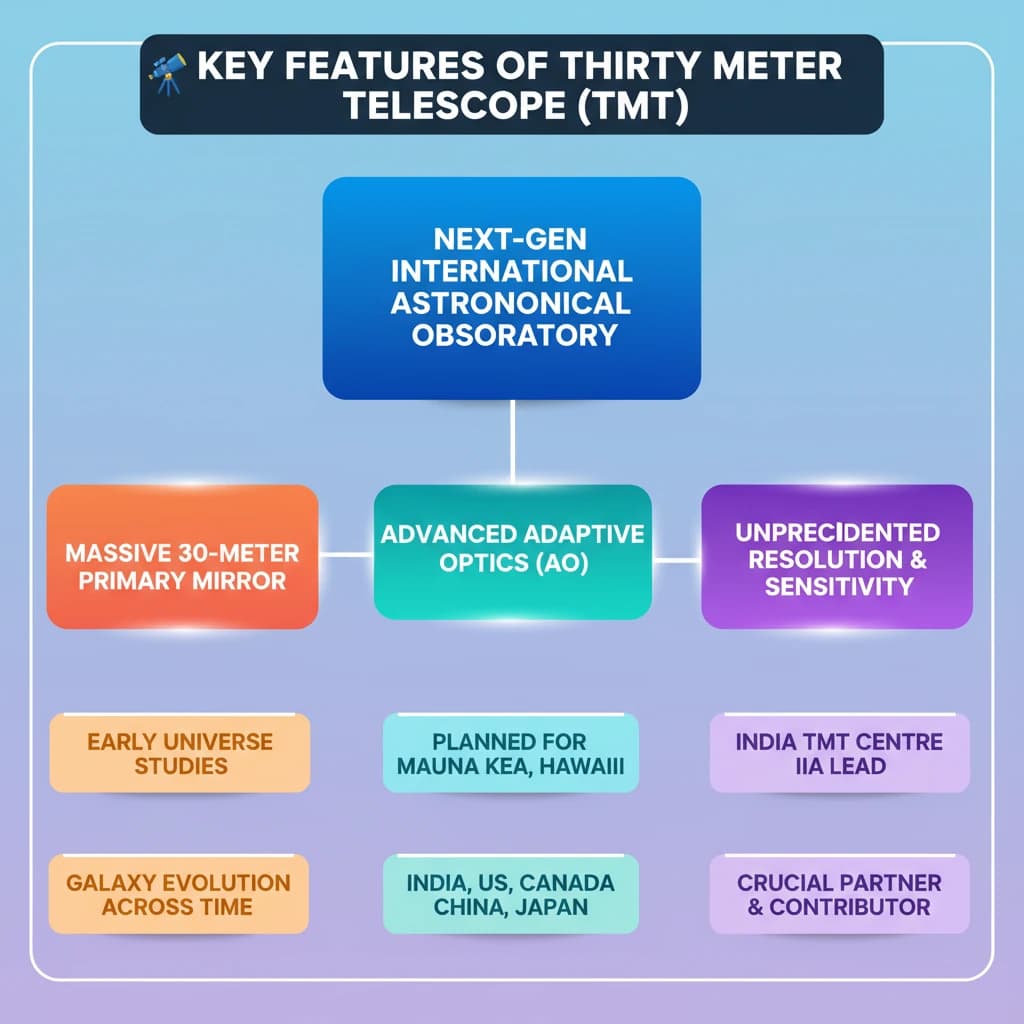
  • Thirty Meter Telescope (TMT) is a next-generation international astronomical observatory project.
  • It is planned for Mauna Kea, Hawaii, with key partners including India, US, Canada, China, and Japan.
  • Features a massive 30-meter primary mirror and advanced adaptive optics for unprecedented resolution and sensitivity.
  • Primary scientific goals are to study the early universe (post-Big Bang) and the evolution of galaxies across cosmic time.
  • India is a crucial partner, with the India TMT Centre at IIA leading the national collaboration and contributions.
  • TMT, along with GMT and ELT, represents the future of ground-based astronomy, pushing the boundaries of discovery.
What are the Key Features of Thirty Meter Telescope (TMT)?

What are the Key Features of Thirty Meter Telescope (TMT)?

Medium⏱️ 8 min read✓ 95% Verified
science and technology

📖 Introduction

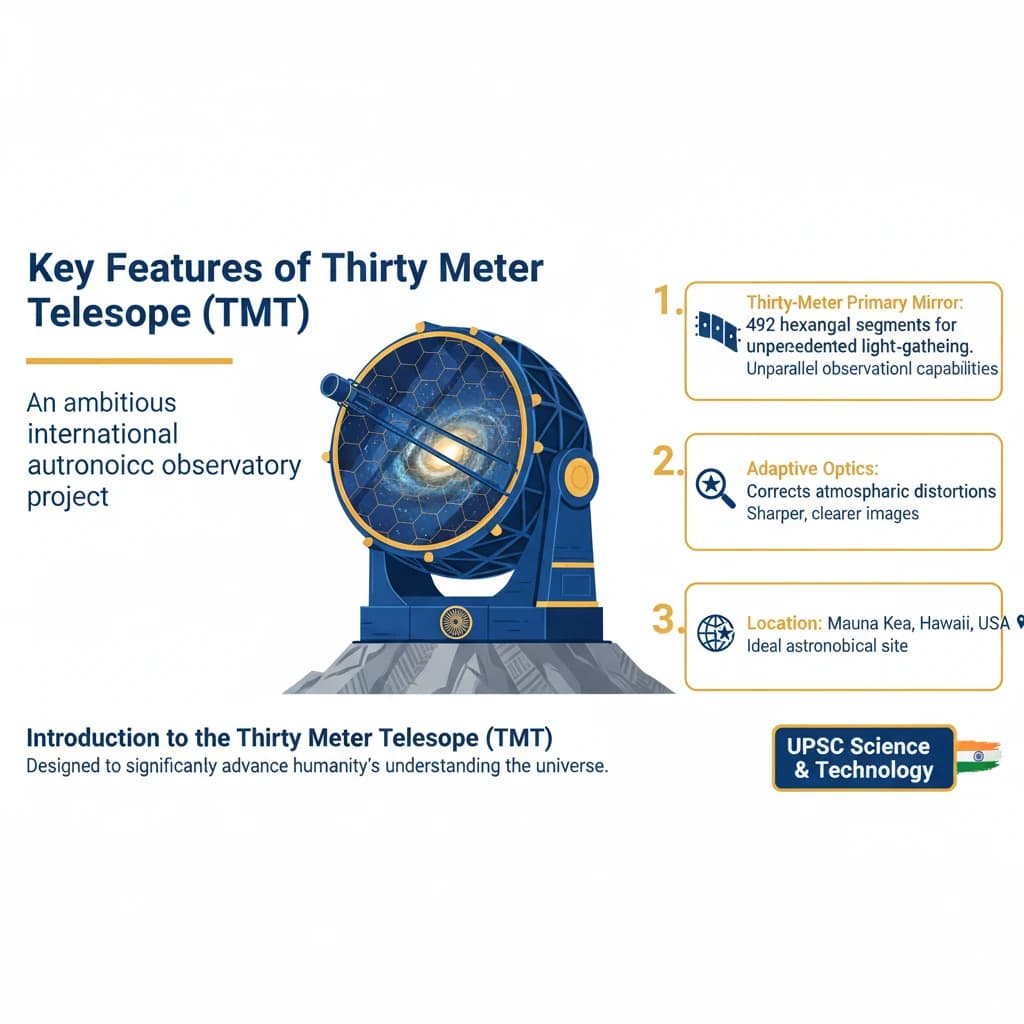
<h4>Introduction to the Thirty Meter Telescope (TMT)</h4><p>The <strong>Thirty Meter Telescope (TMT)</strong> is an ambitious international astronomical observatory project.</p><p>It is designed to significantly advance humanity's understanding of the <strong>universe</strong> through unparalleled observational capabilities.</p><div class='info-box'><p><strong>Location:</strong> The TMT is planned to be established at <strong>Mauna Kea</strong> in <strong>Hawaii</strong>, USA 📍, a site renowned for its excellent astronomical viewing conditions.</p></div><h4>International Collaboration and India's Role</h4><p>The <strong>TMT project</strong> involves a consortium of several nations working together to realize this monumental scientific endeavor.</p><p>Key partner countries contributing to this global initiative include <strong>India</strong>, the <strong>United States (US)</strong>, <strong>Canada</strong>, <strong>China</strong>, and <strong>Japan</strong>.</p><div class='key-point-box'><p><strong>India</strong> is a crucial partner in the TMT project. The <strong>India TMT Centre</strong>, primarily based at the <strong>Indian Institute of Astrophysics (IIA)</strong>, leads the national collaboration and contributions.</p></div><h4>Advanced Technical Features of TMT</h4><p>The <strong>TMT</strong> is engineered as a <strong>next-generation astronomical observatory</strong>, pushing the boundaries of ground-based astronomy.</p><p>It is designed to provide unprecedented <strong>resolution</strong> and <strong>sensitivity</strong>, allowing for detailed observations of distant and faint celestial objects.</p><ul><li><strong>Primary Mirror:</strong> It features a massive <strong>30-meter primary mirror</strong>, which is the core light-gathering component. This mirror is segmented, composed of 492 hexagonal segments.</li><li><strong>Adaptive Optics System:</strong> An advanced <strong>adaptive optics system</strong> is integral to TMT, designed to correct distortions caused by Earth's atmosphere, ensuring sharper images.</li><li><strong>State-of-the-Art Instruments:</strong> The telescope will be equipped with cutting-edge instruments optimized for various observational modes, including imaging and spectroscopy.</li></ul><h4>Primary Scientific Objectives</h4><p>The <strong>TMT</strong> has specific, ambitious scientific goals aimed at addressing fundamental questions about the cosmos.</p><ul><li><strong>Early Universe Studies:</strong> A key objective is to study the <strong>early universe</strong>, focusing on the formation and evolution of the <strong>first galaxies and stars</strong> that emerged shortly after the <strong>Big Bang</strong>.</li><li><strong>Galaxy Evolution:</strong> It will investigate the formation, structure, and evolution of <strong>galaxies across cosmic time</strong>, from their nascent stages to their mature forms.</li></ul><h4>Context in Ground-Based Astronomy</h4><p>The <strong>TMT</strong> is recognized as a cornerstone project representing the future of <strong>ground-based astronomy</strong>.</p><p>It is part of a new generation of extremely large telescopes designed to significantly surpass the capabilities of existing observatories.</p><div class='info-box'><p><strong>Peer Telescopes:</strong> The <strong>TMT</strong> stands alongside other monumental projects such as the <strong>Giant Magellan Telescope (GMT)</strong> and the <strong>European Southern Observatory’s Extremely Large Telescope (ELT)</strong>, collectively shaping the future of astronomical discovery.</p></div>
Concept Diagram

💡 Key Takeaways

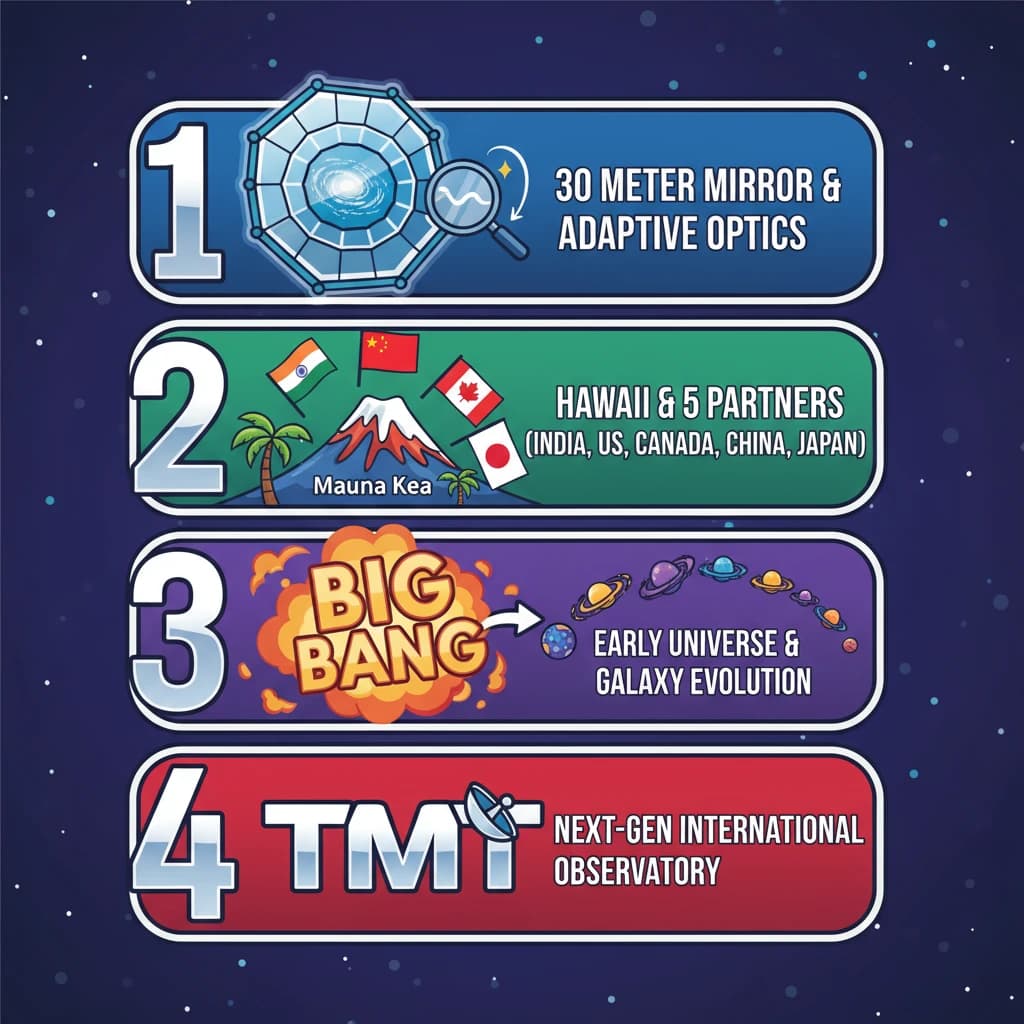
  • •Thirty Meter Telescope (TMT) is a next-generation international astronomical observatory project.
  • •It is planned for Mauna Kea, Hawaii, with key partners including India, US, Canada, China, and Japan.
  • •Features a massive 30-meter primary mirror and advanced adaptive optics for unprecedented resolution and sensitivity.
  • •Primary scientific goals are to study the early universe (post-Big Bang) and the evolution of galaxies across cosmic time.
  • •India is a crucial partner, with the India TMT Centre at IIA leading the national collaboration and contributions.
  • •TMT, along with GMT and ELT, represents the future of ground-based astronomy, pushing the boundaries of discovery.

🧠 Memory Techniques
Memory Aid
95% Verified Content

📚 Reference Sources

•Official Thirty Meter Telescope (TMT) Project Website (tmt.org)
•Indian Institute of Astrophysics (IIA) publications and project pages related to TMT

Related Topics

Loading related topics...
Explore:Science And Technology Topics·All Subjects·Daily Current Affairs·Editorial Analysis·Previous Year Questions·UPSC GPT