Loading page, please wait…
Vaidra Logo
Vaidra

Top 4 items + smart groups

UPSC GPT
New
Current Affairs
Daily Solutions
Daily Puzzle
Mains Evaluator

Version 2.0.0 • Built with ❤️ for UPSC aspirants

Loading...
Loading...
Loading...
Loading...
Loading...
Loading...
Loading...
Loading...
Loading...
Loading...
Loading...
Loading...
Loading...
Stem Cell Transplants - UPSC Science And Technology
Back
All Subjects

Topics

0 topics • 0 completed

Loading topics...
Loading...
Loading...
Loading...
Loading...
Loading...
Overall Progress0%

Stem Cell Transplants - UPSC Science And Technology

What is Stem Cell Transplants in UPSC Science And Technology?

Stem Cell Transplants is a key topic under Science And Technology for UPSC Civil Services Examination. Key points include: Recent study highlights low mutation rates in transplanted hematopoietic stem cells, suggesting stable long-term engraftment.. Clonal hematopoiesis, while common in donors, poses a potential risk for recipients developing blood cancers or chronic diseases.. Hematopoietic Stem Cell Transplants (HSCT) are crucial for treating blood cancers and genetic disorders by replacing diseased bone marrow.. Understanding this topic is essential for both UPSC Prelims and Mains preparation.

Why is Stem Cell Transplants important for UPSC exam?

Stem Cell Transplants is a Medium-level topic in UPSC Science And Technology. It is tested in both Prelims (factual MCQs) and Mains (analytical answer writing). Previous year UPSC questions have frequently covered aspects of Stem Cell Transplants, making it essential for comprehensive IAS preparation.

How to prepare Stem Cell Transplants for UPSC?

To prepare Stem Cell Transplants for UPSC: (1) Study the comprehensive notes covering all key concepts on Vaidra. (2) Practice previous year questions on this topic. (3) Connect it with current affairs using daily updates. (4) Revise using key takeaways and mind maps available for Science And Technology. (5) Write practice answers linking Stem Cell Transplants to related GS Paper topics.

Key takeaways of Stem Cell Transplants for UPSC

  • Recent study highlights low mutation rates in transplanted hematopoietic stem cells, suggesting stable long-term engraftment.
  • Clonal hematopoiesis, while common in donors, poses a potential risk for recipients developing blood cancers or chronic diseases.
  • Hematopoietic Stem Cell Transplants (HSCT) are crucial for treating blood cancers and genetic disorders by replacing diseased bone marrow.
  • Stem cells are the body's raw materials, capable of self-renewal and differentiation into specialized cells.
  • Ongoing research aims to improve HSCT outcomes, personalize post-transplant care, and address associated risks.
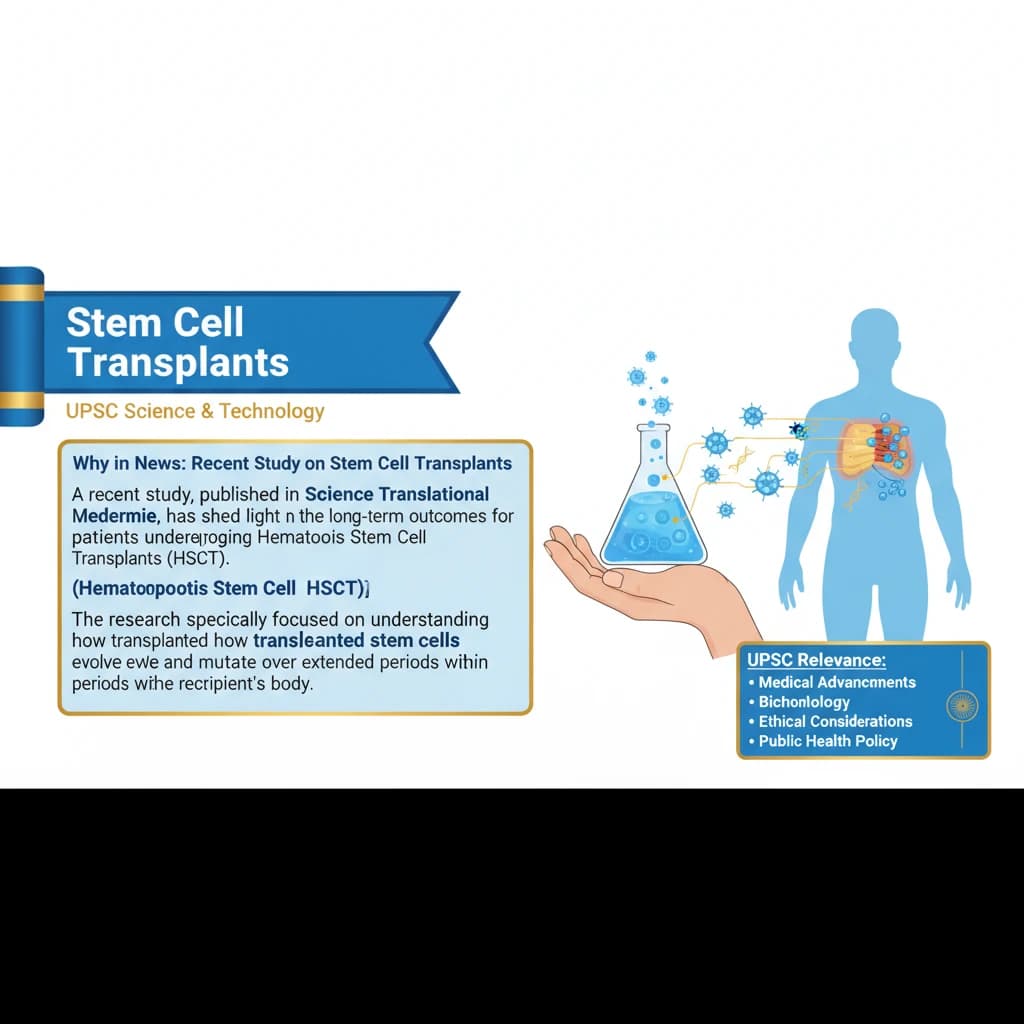
Stem Cell Transplants

Stem Cell Transplants

Medium⏱️ 8 min read✓ 95% Verified
science and technology

📖 Introduction

<h4>Why in News: Recent Study on Stem Cell Transplants</h4><p>A recent study, published in <strong>Science Translational Medicine</strong>, has shed light on the long-term outcomes for patients undergoing <strong>Hematopoietic Stem Cell Transplants (HSCT)</strong>.</p><p>The research specifically focused on understanding how transplanted <strong>stem cells</strong> evolve and mutate over extended periods within the recipient's body.</p><div class='exam-tip-box'><p><strong>UPSC Relevance:</strong> Studies like these are important for <strong>Science & Technology (GS Paper III)</strong>, particularly in the domain of <strong>Biotechnology</strong> and <strong>Health</strong>. Understanding recent advancements and their implications is crucial for both prelims and mains.</p></div><h4>Key Findings of the Study</h4><p>The study involved a cohort of <strong>16 pairs of donors and recipients</strong>, providing a unique insight into the dynamics of transplanted stem cells.</p><p>A significant finding was the surprisingly <strong>low mutation rates</strong> observed in both groups: an average of <strong>2% annually in donors</strong> and <strong>2.4% annually in recipients</strong>.</p><div class='key-point-box'><p>This low mutation rate suggests a <strong>stable clonal expansion</strong> of stem cells, indicating their ability to regenerate and maintain function over several decades post-transplant.</p></div><p>While all donors exhibited some level of <strong>clonal hematopoiesis</strong>, the absence of widespread clonal expansion pointed towards a <strong>robust regenerative capacity</strong> of the <strong>bone marrow</strong>.</p><h4>Implications of the Research</h4><p>The findings from this study are crucial for significantly improving the <strong>long-term outcomes</strong> of stem cell transplants.</p><p>However, the presence of <strong>clonal hematopoiesis</strong> in recipients raises a potential concern regarding the increased risk of developing <strong>blood cancers</strong> or other <strong>chronic diseases</strong>.</p><div class='info-box'><h4>Understanding Clonal Hematopoiesis</h4><p><strong>Clonal hematopoiesis</strong> occurs when one specific type of <strong>blood cell</strong> increases disproportionately in number compared to other blood cell types within the blood system.</p><p>Common examples of conditions associated with or resulting from clonal hematopoiesis include <strong>chronic myeloid leukemia</strong> and <strong>myelodysplastic syndromes (MDS)</strong>.</p></div>
Concept Diagram

💡 Key Takeaways

  • •Recent study highlights low mutation rates in transplanted hematopoietic stem cells, suggesting stable long-term engraftment.
  • •Clonal hematopoiesis, while common in donors, poses a potential risk for recipients developing blood cancers or chronic diseases.
  • •Hematopoietic Stem Cell Transplants (HSCT) are crucial for treating blood cancers and genetic disorders by replacing diseased bone marrow.
  • •Stem cells are the body's raw materials, capable of self-renewal and differentiation into specialized cells.
  • •Ongoing research aims to improve HSCT outcomes, personalize post-transplant care, and address associated risks.

🧠 Memory Techniques
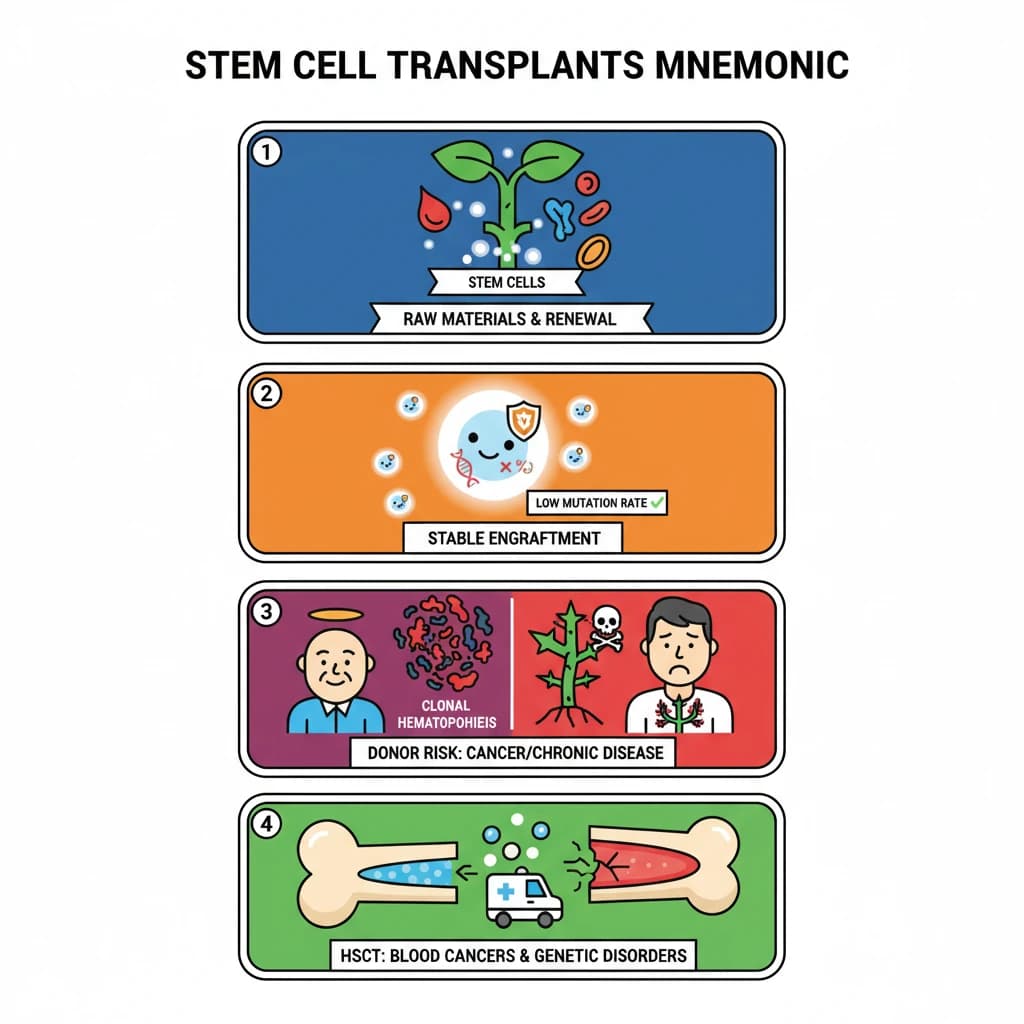
Memory Aid
95% Verified Content

📚 Reference Sources

•Drishti IAS Summary (initial source)
•NCERT Biology Textbooks (for basic stem cell concepts)
•Reputable medical journals/websites (for HSCT history and applications)

Related Topics

Loading related topics...
Explore:Science And Technology Topics·All Subjects·Daily Current Affairs·Editorial Analysis·Previous Year Questions·UPSC GPT