Loading page, please wait…
Vaidra Logo
Vaidra

Top 4 items + smart groups

UPSC GPT
New
Current Affairs
Daily Solutions
Daily Puzzle
Mains Evaluator

Version 2.0.0 • Built with ❤️ for UPSC aspirants

Loading...
Loading...
Loading...
Loading...
Loading...
Loading...
Loading...
Loading...
Loading...
Loading...
Loading...
Loading...
Loading...

ESA and Twelve Countries Sign the Zero Debris Charter - UPSC Science And Technology

What is ESA and Twelve Countries Sign the Zero Debris Charter in UPSC Science And Technology?

ESA and Twelve Countries Sign the Zero Debris Charter is a key topic under Science And Technology for UPSC Civil Services Examination. Key points include: Zero Debris Charter signed by ESA and 12 nations at EU Space Council.. Goal: Achieve debris-neutrality in Earth orbit by 2030.. Unveiled at ESA Space Summit, Seville, November 2023.. Understanding this topic is essential for both UPSC Prelims and Mains preparation.

Why is ESA and Twelve Countries Sign the Zero Debris Charter important for UPSC exam?

ESA and Twelve Countries Sign the Zero Debris Charter is a Medium-level topic in UPSC Science And Technology. It is tested in both Prelims (factual MCQs) and Mains (analytical answer writing). Previous year UPSC questions have frequently covered aspects of ESA and Twelve Countries Sign the Zero Debris Charter, making it essential for comprehensive IAS preparation.

How to prepare ESA and Twelve Countries Sign the Zero Debris Charter for UPSC?

To prepare ESA and Twelve Countries Sign the Zero Debris Charter for UPSC: (1) Study the comprehensive notes covering all key concepts on Vaidra. (2) Practice previous year questions on this topic. (3) Connect it with current affairs using daily updates. (4) Revise using key takeaways and mind maps available for Science And Technology. (5) Write practice answers linking ESA and Twelve Countries Sign the Zero Debris Charter to related GS Paper topics.

Key takeaways of ESA and Twelve Countries Sign the Zero Debris Charter for UPSC

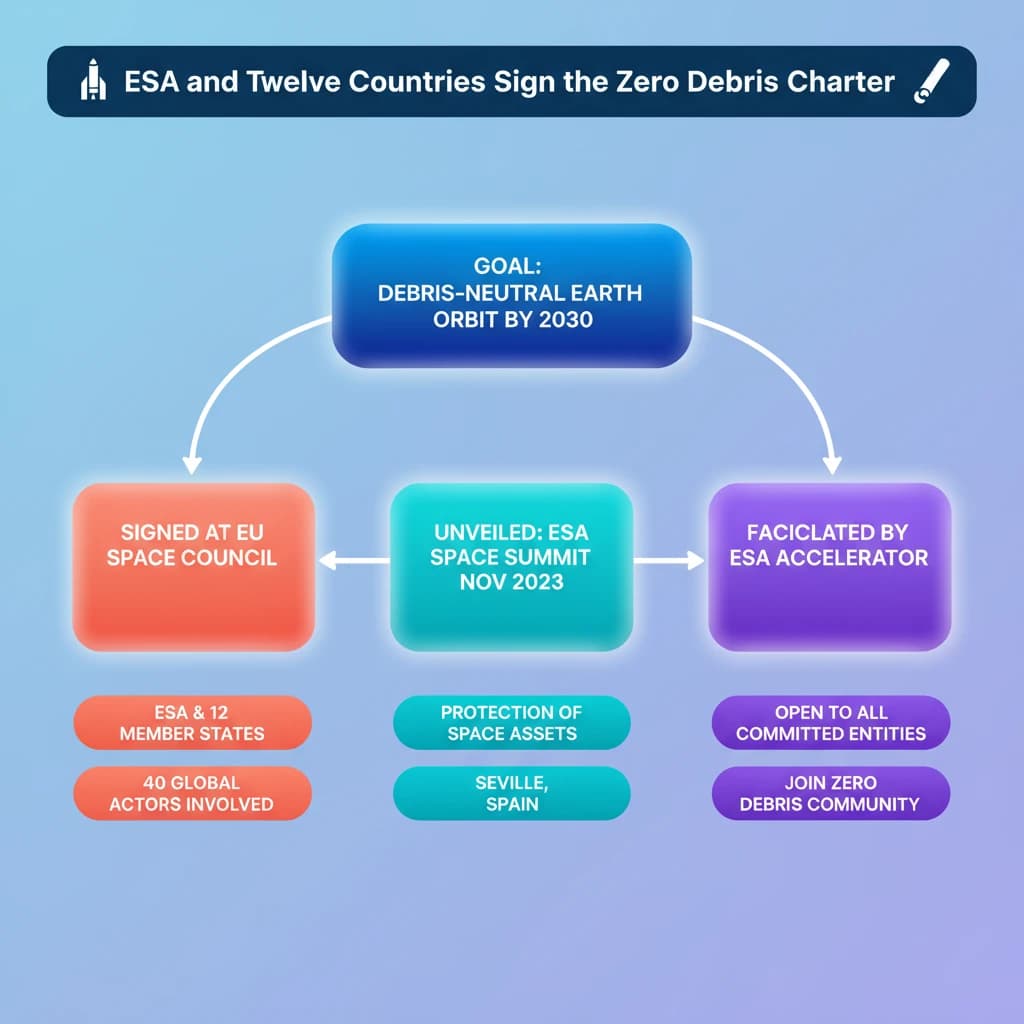
  • Zero Debris Charter signed by ESA and 12 nations at EU Space Council.
  • Goal: Achieve debris-neutrality in Earth orbit by 2030.
  • Unveiled at ESA Space Summit, Seville, November 2023.
  • Facilitated by ESA’s ‘Protection of Space Assets’ accelerator, created by 40 global space actors.
  • Open for any entity committed to space safety and sustainability to join the Zero Debris Community.
  • Crucial for long-term space sustainability and preventing Kessler Syndrome.
ESA and Twelve Countries Sign the Zero Debris Charter

ESA and Twelve Countries Sign the Zero Debris Charter

Medium⏱️ 7 min read✓ 95% Verified
science and technology

📖 Introduction

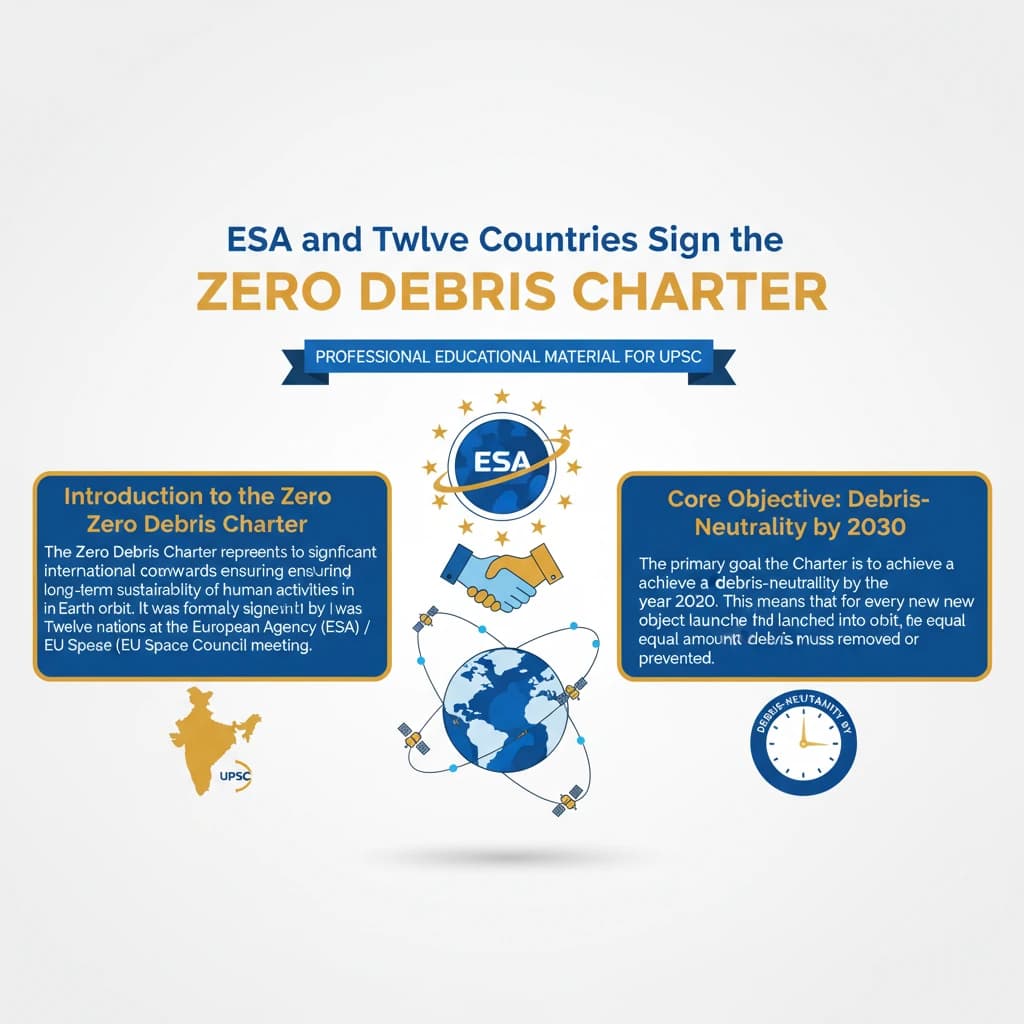
<h4>Introduction to the Zero Debris Charter</h4><p>The <strong>Zero Debris Charter</strong> represents a significant international commitment towards ensuring the <strong>long-term sustainability</strong> of human activities in <strong>Earth orbit</strong>.</p><p>It was formally signed by <strong>Twelve nations</strong> at the <strong>European Space Agency (ESA)</strong> / <strong>EU Space Council</strong> meeting.</p><h4>Core Objective: Debris-Neutrality by 2030</h4><p>The primary goal of the <strong>Zero Debris Charter</strong> is to achieve <strong>debris-neutrality</strong> in space.</p><div class='info-box'><p>This ambitious target is set for the year <strong>2030</strong>, aiming to ensure that space activities do not add to the existing space debris problem.</p></div><h4>Unveiling and Facilitation</h4><p>The <strong>Zero Debris Charter</strong> was initially unveiled at the <strong>ESA Space Summit</strong> held in <strong>Seville</strong> in <strong>November 2023</strong>.</p><p>Its development was facilitated by <strong>ESA’s ‘Protection of Space Assets’ accelerator</strong> program.</p><div class='info-box'><p>The charter itself was a collaborative effort, created by a broad group of <strong>40 global space actors</strong>.</p></div><h4>Open Participation and Community</h4><p>A key feature of the <strong>Zero Debris Charter</strong> is its open invitation for participation.</p><p>Any entity dedicated to advancing <strong>space safety</strong> and <strong>sustainability</strong> is welcome to sign the Charter.</p><div class='key-point-box'><p>Signing the Charter allows entities to join the <strong>Zero Debris Community</strong> without requiring approval from existing partners, promoting widespread adoption.</p></div><h4>Significance for Space Sustainability</h4><div class='exam-tip-box'><p>This initiative is crucial for <strong>UPSC aspirants</strong> as it highlights international efforts in <strong>space governance</strong> and <strong>environmental protection</strong> within the space domain, relevant for <strong>GS Paper III (Science & Technology)</strong>.</p></div>
Concept Diagram

💡 Key Takeaways

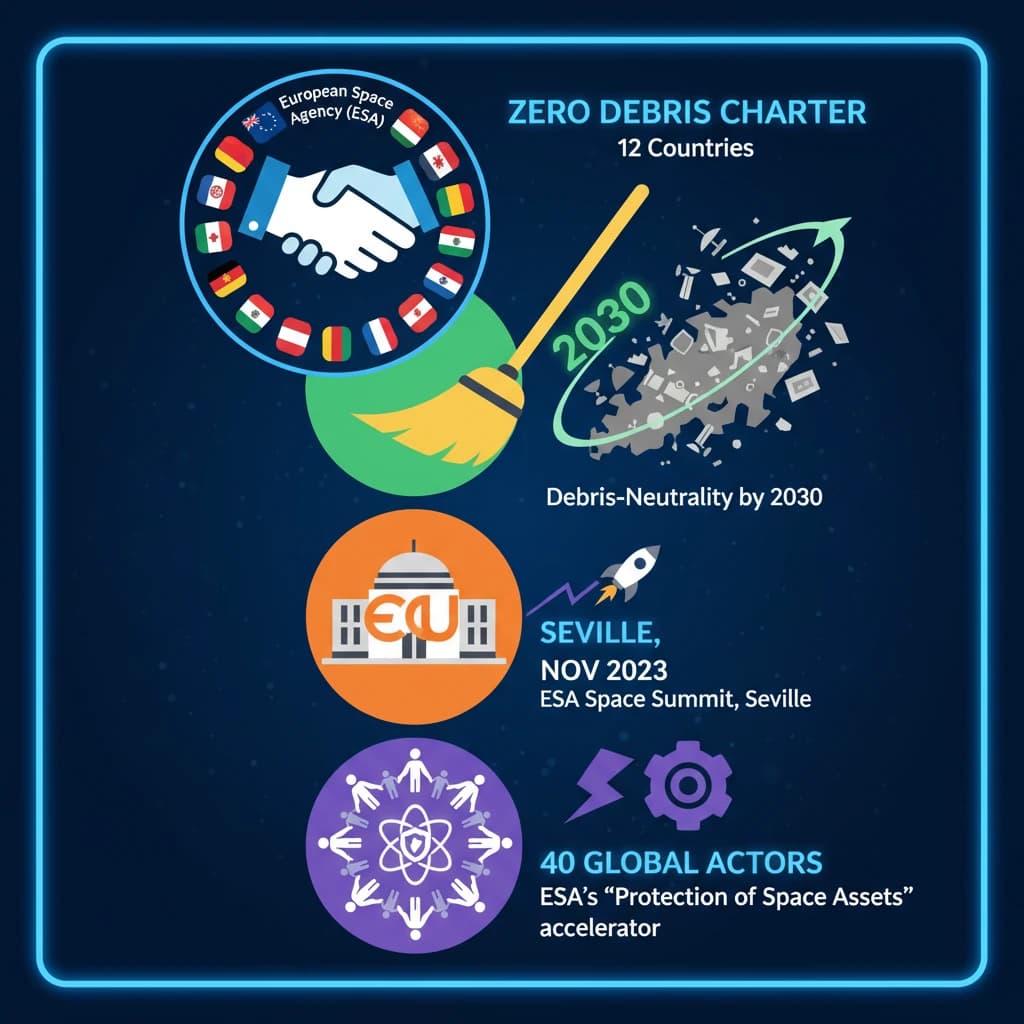
  • •Zero Debris Charter signed by ESA and 12 nations at EU Space Council.
  • •Goal: Achieve debris-neutrality in Earth orbit by 2030.
  • •Unveiled at ESA Space Summit, Seville, November 2023.
  • •Facilitated by ESA’s ‘Protection of Space Assets’ accelerator, created by 40 global space actors.
  • •Open for any entity committed to space safety and sustainability to join the Zero Debris Community.
  • •Crucial for long-term space sustainability and preventing Kessler Syndrome.

🧠 Memory Techniques
Memory Aid
95% Verified Content

📚 Reference Sources

•European Space Agency (ESA) Official Communications

Related Topics

Loading related topics...
Explore:Science And Technology Topics·All Subjects·Daily Current Affairs·Editorial Analysis·Previous Year Questions·UPSC GPT
Back
All Subjects

Topics

0 topics • 0 completed

Loading topics...
Loading...
Loading...
Loading...
Loading...
Loading...
Overall Progress0%