Loading page, please wait…
Vaidra Logo
Vaidra

Top 4 items + smart groups

UPSC GPT
New
Current Affairs
Daily Solutions
Daily Puzzle
Mains Evaluator

Version 2.0.0 • Built with ❤️ for UPSC aspirants

Loading...
Loading...
Loading...
Loading...
Loading...
Loading...
Loading...
Loading...
Loading...
Loading...
Loading...
Loading...
Loading...
What is Machine Learning? - UPSC Science And Technology
Back
All Subjects

Topics

0 topics • 0 completed

Loading topics...
Loading...
Loading...
Loading...
Loading...
Loading...
Overall Progress0%

What is Machine Learning? - UPSC Science And Technology

What is What is Machine Learning? in UPSC Science And Technology?

What is Machine Learning? is a key topic under Science And Technology for UPSC Civil Services Examination. Key points include: Machine Learning (ML) is a subset of AI enabling computers to learn from data.. ML operates via a decision process, error function, and iterative model optimization.. AI > ML > Deep Learning > Neural Networks is the hierarchy of these technologies.. Understanding this topic is essential for both UPSC Prelims and Mains preparation.

Why is What is Machine Learning? important for UPSC exam?

What is Machine Learning? is a Medium-level topic in UPSC Science And Technology. It is tested in both Prelims (factual MCQs) and Mains (analytical answer writing). Previous year UPSC questions have frequently covered aspects of What is Machine Learning?, making it essential for comprehensive IAS preparation.

How to prepare What is Machine Learning? for UPSC?

To prepare What is Machine Learning? for UPSC: (1) Study the comprehensive notes covering all key concepts on Vaidra. (2) Practice previous year questions on this topic. (3) Connect it with current affairs using daily updates. (4) Revise using key takeaways and mind maps available for Science And Technology. (5) Write practice answers linking What is Machine Learning? to related GS Paper topics.

Key takeaways of What is Machine Learning? for UPSC

  • Machine Learning (ML) is a subset of AI enabling computers to learn from data.
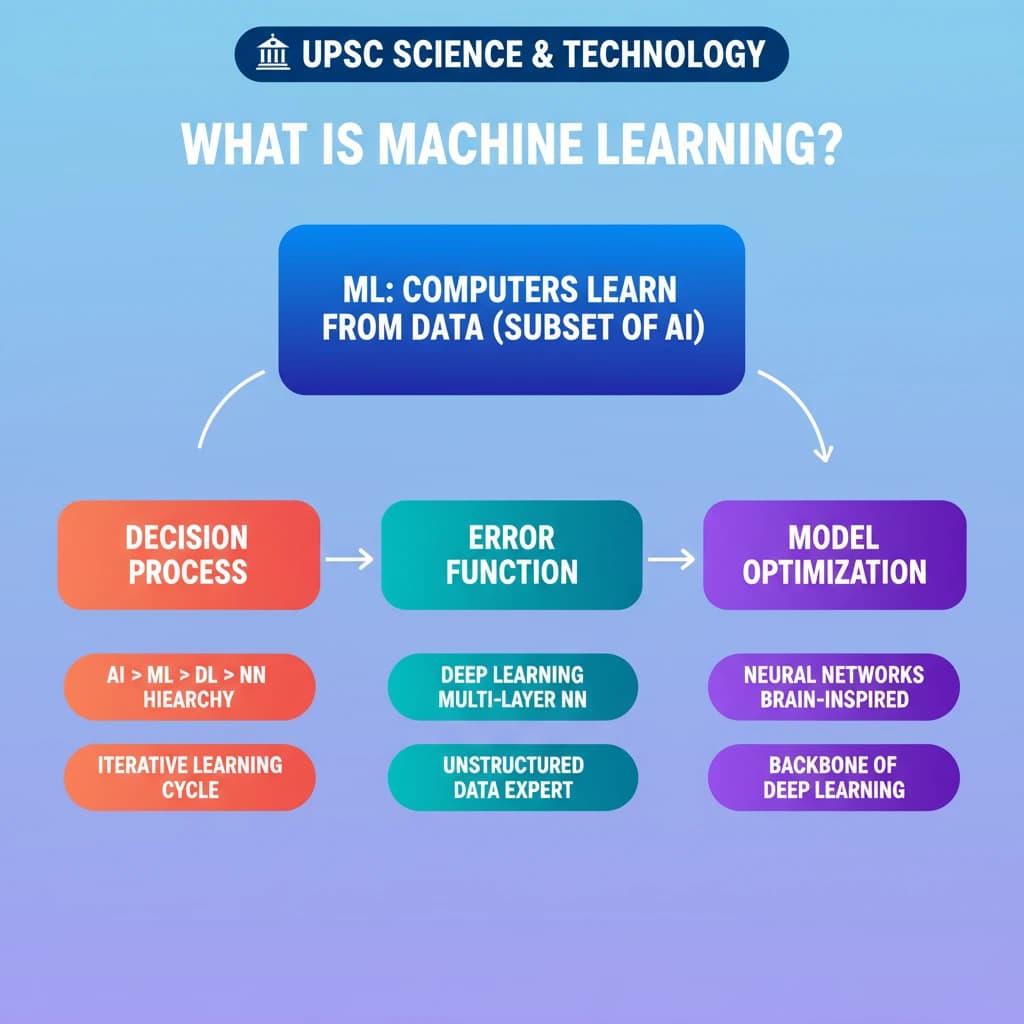
  • ML operates via a decision process, error function, and iterative model optimization.
  • AI > ML > Deep Learning > Neural Networks is the hierarchy of these technologies.
  • Deep Learning uses multi-layered neural networks and excels with unstructured data.
  • Neural Networks are brain-inspired models forming the backbone of Deep Learning.
  • ML is transforming sectors like healthcare, finance, and e-commerce globally.
  • India has initiatives like #AIforAll to leverage ML for national development.
What is Machine Learning?

What is Machine Learning?

Medium⏱️ 10 min read✓ 98% Verified
science and technology

📖 Introduction

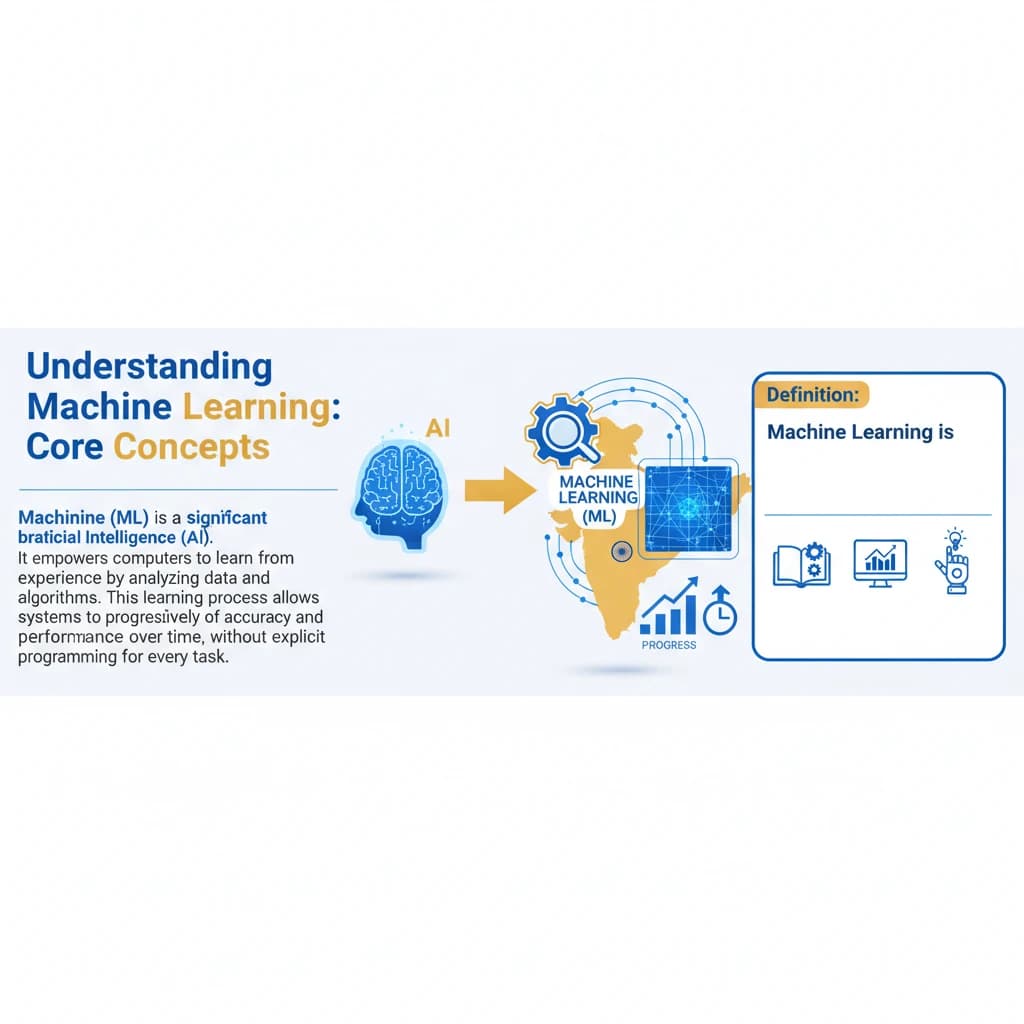
<h4>Understanding Machine Learning: Core Concepts</h4><p><strong>Machine Learning (ML)</strong> is a significant branch of <strong>Artificial Intelligence (AI)</strong>. It empowers computers to learn from experience by analyzing data and algorithms.</p><p>This learning process allows systems to progressively enhance their accuracy and performance over time, without explicit programming for every task.</p><div class='info-box'><p><strong>Definition:</strong> <strong>Machine Learning</strong> is a subset of <strong>AI</strong> that enables systems to learn from data, identify patterns, and make decisions with minimal human intervention.</p></div><h4>Operating Mechanism of Machine Learning</h4><p>The functioning of a <strong>Machine Learning model</strong> involves a cyclical process of prediction, evaluation, and optimization. This iterative approach refines the model's capabilities.</p><p>It continuously adjusts its internal parameters based on feedback, striving for higher accuracy in its predictions.</p><h5>1. Decision Process</h5><p>In the initial stage, <strong>algorithms</strong> within the ML model analyze input data. Based on this analysis, they either predict an outcome or classify the data into predefined categories.</p><p>The input data can be either <strong>labelled</strong>, meaning it comes with associated target outputs, or <strong>unlabelled</strong>, requiring the model to find inherent structures.</p><h5>2. Error Function (Loss Function)</h5><p>Following a prediction, an <strong>error function</strong>, also known as a <strong>loss function</strong>, comes into play. Its purpose is to quantify the discrepancy between the model's prediction and the actual, known outcome.</p><div class='key-point-box'><p>The <strong>error function</strong> is crucial as it provides a measure of how 'wrong' the model's current predictions are, guiding subsequent adjustments.</p></div><h5>3. Model Optimization Process</h5><p>The final step in the cycle is <strong>model optimization</strong>. Here, the model iteratively adjusts its internal parameters, often called <strong>weights</strong>, to minimize the error identified by the error function.</p><p>This process continues until the model achieves an acceptable level of accuracy, meaning its predictions are consistently close to the actual outcomes.</p><h4>ML vs. Deep Learning vs. Neural Networks</h4><p>Understanding the hierarchical relationship between these terms is vital for grasping the landscape of AI. They represent progressively specialized areas within the broader field.</p><div class='exam-tip-box'><p>UPSC often tests conceptual clarity on these distinctions. A clear understanding of the hierarchy is key for both Prelims and Mains.</p></div><h5>Hierarchy of AI Technologies</h5><ul><li><strong>Artificial Intelligence (AI)</strong>: The broadest field, aiming to create intelligent machines that can reason, learn, and act.</li><li><strong>Machine Learning (ML)</strong>: A subset of <strong>AI</strong>, focusing on enabling systems to learn from data without explicit programming.</li><li><strong>Deep Learning (DL)</strong>: A specialized subset of <strong>ML</strong>, characterized by the use of multi-layered <strong>neural networks</strong>.</li><li><strong>Neural Networks (NN)</strong>: The underlying architecture that <strong>Deep Learning</strong> models rely upon.</li></ul><h5>Deep Learning Explained</h5><p><strong>Deep Learning</strong> is a powerful subset of <strong>Machine Learning</strong>. It distinguishes itself by employing <strong>neural networks</strong> that have a large number of layers, often referred to as <strong>deep neural networks</strong>.</p><div class='info-box'><p><strong>Key Feature:</strong> <strong>Deep Learning</strong> can effectively process <strong>unstructured data</strong>, such as images, audio, and text, often without the need for extensive <strong>labelled datasets</strong> in its initial stages.</p></div><h5>Neural Networks Explained</h5><p><strong>Neural Networks</strong> are a specific type of <strong>Machine Learning model</strong> inspired by the structure and function of the human brain. They consist of interconnected layers of nodes.</p><p>These layers typically include an <strong>input layer</strong>, one or more <strong>hidden layers</strong>, and an <strong>output layer</strong>, allowing for complex pattern recognition.</p><h5>Complexity and Specialization</h5><p>As one moves from the general concept of <strong>AI</strong> towards <strong>Neural Networks</strong>, the complexity and specificity of the tasks that can be addressed tend to increase.</p><div class='key-point-box'><p><strong>Deep Learning</strong> and <strong>Neural Networks</strong> are highly specialized tools designed for intricate problems, operating within the larger framework of <strong>Artificial Intelligence</strong>.</p></div>
Concept Diagram

💡 Key Takeaways

  • •Machine Learning (ML) is a subset of AI enabling computers to learn from data.
  • •ML operates via a decision process, error function, and iterative model optimization.
  • •AI > ML > Deep Learning > Neural Networks is the hierarchy of these technologies.
  • •Deep Learning uses multi-layered neural networks and excels with unstructured data.
  • •Neural Networks are brain-inspired models forming the backbone of Deep Learning.
  • •ML is transforming sectors like healthcare, finance, and e-commerce globally.
  • •India has initiatives like #AIforAll to leverage ML for national development.

🧠 Memory Techniques

Memory Aid
98% Verified Content

📚 Reference Sources

•NITI Aayog's National Strategy for Artificial Intelligence
•IndiaAI Portal (indiaai.gov.in)
•General knowledge on AI/ML concepts and history

Related Topics

Loading related topics...
Explore:Science And Technology Topics·All Subjects·Daily Current Affairs·Editorial Analysis·Previous Year Questions·UPSC GPT