Loading page, please wait…
Bhartiya Antriksh Station, Moon & Venus Mission and NGLV - UPSC Science And Technology
What is Bhartiya Antriksh Station, Moon & Venus Mission and NGLV in UPSC Science And Technology?
Bhartiya Antriksh Station, Moon & Venus Mission and NGLV is a key topic under Science And Technology for UPSC Civil Services Examination. Key points include: Union Cabinet approved four major ISRO projects: Chandrayaan-4, VOM, BAS, and NGLV.. Chandrayaan-4 is India's first lunar sample return mission, involving complex docking/undocking.. Venus Orbiter Mission (VOM) aims to study Venus's atmosphere and surface.. Understanding this topic is essential for both UPSC Prelims and Mains preparation.
Why is Bhartiya Antriksh Station, Moon & Venus Mission and NGLV important for UPSC exam?
Bhartiya Antriksh Station, Moon & Venus Mission and NGLV is a Medium-level topic in UPSC Science And Technology. It is tested in both Prelims (factual MCQs) and Mains (analytical answer writing). Previous year UPSC questions have frequently covered aspects of Bhartiya Antriksh Station, Moon & Venus Mission and NGLV, making it essential for comprehensive IAS preparation.
How to prepare Bhartiya Antriksh Station, Moon & Venus Mission and NGLV for UPSC?
To prepare Bhartiya Antriksh Station, Moon & Venus Mission and NGLV for UPSC: (1) Study the comprehensive notes covering all key concepts on Vaidra. (2) Practice previous year questions on this topic. (3) Connect it with current affairs using daily updates. (4) Revise using key takeaways and mind maps available for Science And Technology. (5) Write practice answers linking Bhartiya Antriksh Station, Moon & Venus Mission and NGLV to related GS Paper topics.
Key takeaways of Bhartiya Antriksh Station, Moon & Venus Mission and NGLV for UPSC
- Union Cabinet approved four major ISRO projects: Chandrayaan-4, VOM, BAS, and NGLV.
- Chandrayaan-4 is India's first lunar sample return mission, involving complex docking/undocking.
- Venus Orbiter Mission (VOM) aims to study Venus's atmosphere and surface.
- Bhartiya Antriksh Station (BAS) is India's planned independent space station.
- Next Generation Launch Vehicle (NGLV) will be a heavy-lift, potentially reusable rocket for future space access.
- These projects signify India's ambitious stride towards becoming a global leader in advanced space exploration and technology.
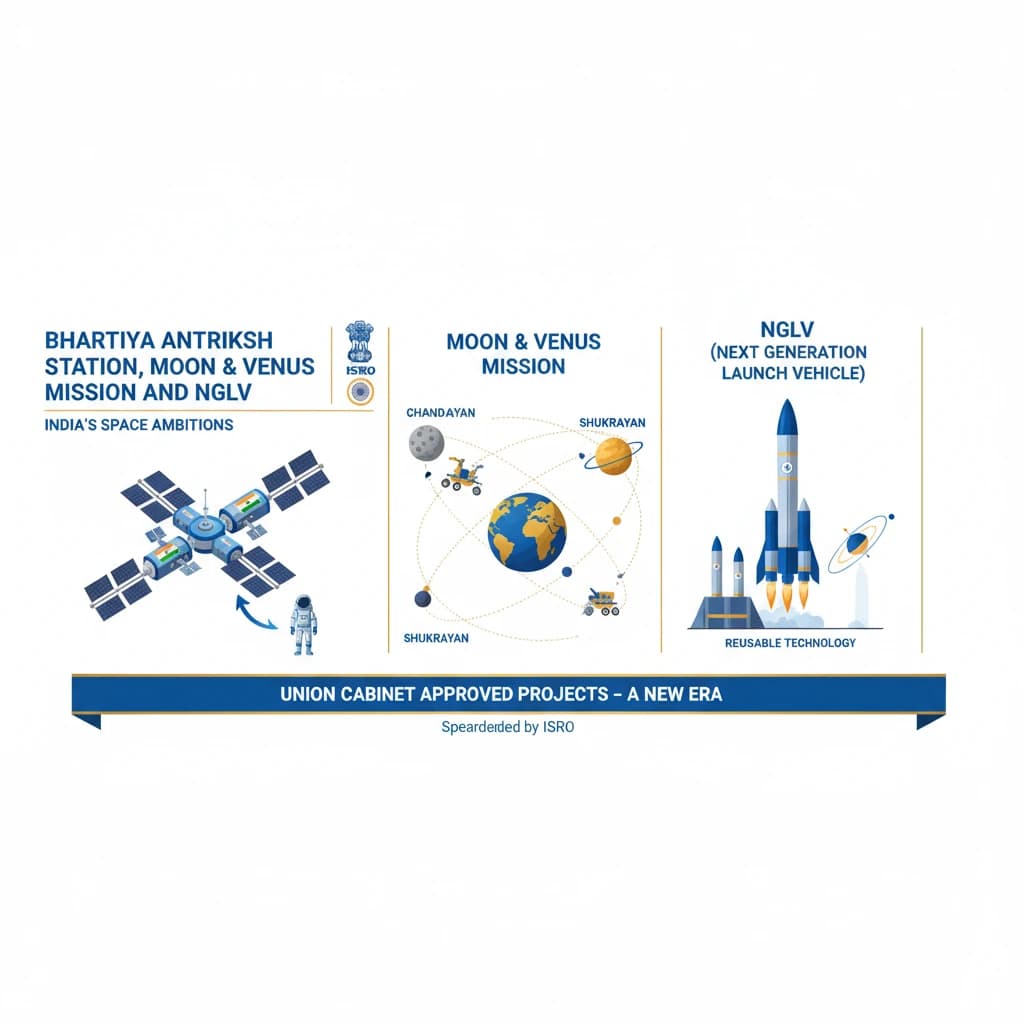
Bhartiya Antriksh Station, Moon & Venus Mission and NGLV
Medium⏱️ 7 min read
science and technology
📖 Introduction
Introduction to India's Space Ambitions
India's space program, spearheaded by the Indian Space Research Organisation (ISRO), continues to achieve significant milestones.
Recently, the Union Cabinet approved four major space projects, signaling a new era of advanced space exploration and technological development for the nation.
Overview of Newly Approved Space Projects
The approved projects are ambitious and diverse, covering lunar exploration, interplanetary missions, orbital infrastructure, and advanced launch capabilities.
These projects include:
- Chandrayaan-4 (Lunar Sample Return Mission)
- Venus Orbiter Mission (VOM)
- Bhartiya Antriksh Station (BAS)
- Next Generation Launch Vehicle (NGLV)
Chandrayaan-4: India's Lunar Sample Return Mission
Chandrayaan-4 is designed to be a highly complex and multi-faceted mission focused on lunar sample return.
Its primary objective is to land on the lunar surface, collect geological samples, store them in a vacuum container, and safely return them to Earth for scientific analysis.
Key aspects of Chandrayaan-4 include:
- Development of a soft craft for precise lunar landing.
- Utilisation of two different Launch Vehicle Mk III launches, indicating significant payload requirements.
- Extensive support from the deep space network for communication and tracking.
- Conducting specialized tests to ensure mission success.
A crucial technological advancement for this mission will be docking and undocking operations in orbit.
This involves two spacecraft aligning and coming together, a capability that India has not yet attempted in space.
UPSC Insight: The docking and undocking capability is a significant leap for ISRO, crucial for future human spaceflight and orbital assembly missions, making it a high-priority topic for Science & Technology (GS-III).
Venus Orbiter Mission (VOM): Exploring Earth's Sister Planet
The Venus Orbiter Mission (VOM) aims to study the atmosphere and surface of Venus, often referred to as Earth's "sister planet" due to its similar size.
This mission will contribute to understanding planetary evolution and the extreme conditions on Venus.
VOM will likely carry instruments to analyze:
- Atmospheric composition and dynamics.
- Surface features and subsurface geology using radar.
- Solar wind interaction with the Venusian atmosphere.
Bhartiya Antriksh Station (BAS): India's Own Space Outpost
The approval for the Bhartiya Antriksh Station (BAS) marks India's commitment to establishing an independent human presence in space.
A space station serves as a long-duration orbiting laboratory for scientific research, technology demonstration, and future deep-space missions.
The development of BAS is a critical step towards India's long-term goal of sustained human spaceflight capabilities, building upon the Gaganyaan mission.
Next Generation Launch Vehicle (NGLV): Future of Indian Space Access
The Next Generation Launch Vehicle (NGLV) is envisioned as a heavy-lift, reusable rocket designed to enhance India's space launch capabilities significantly.
It aims to reduce launch costs and increase launch frequency, making space access more affordable and sustainable.
Key features expected from NGLV:
- Increased payload capacity for heavier satellites and future manned missions.
- Potential for reusability of stages, similar to global trends in space launch.
- Support for future missions like BAS and deep-space probes.
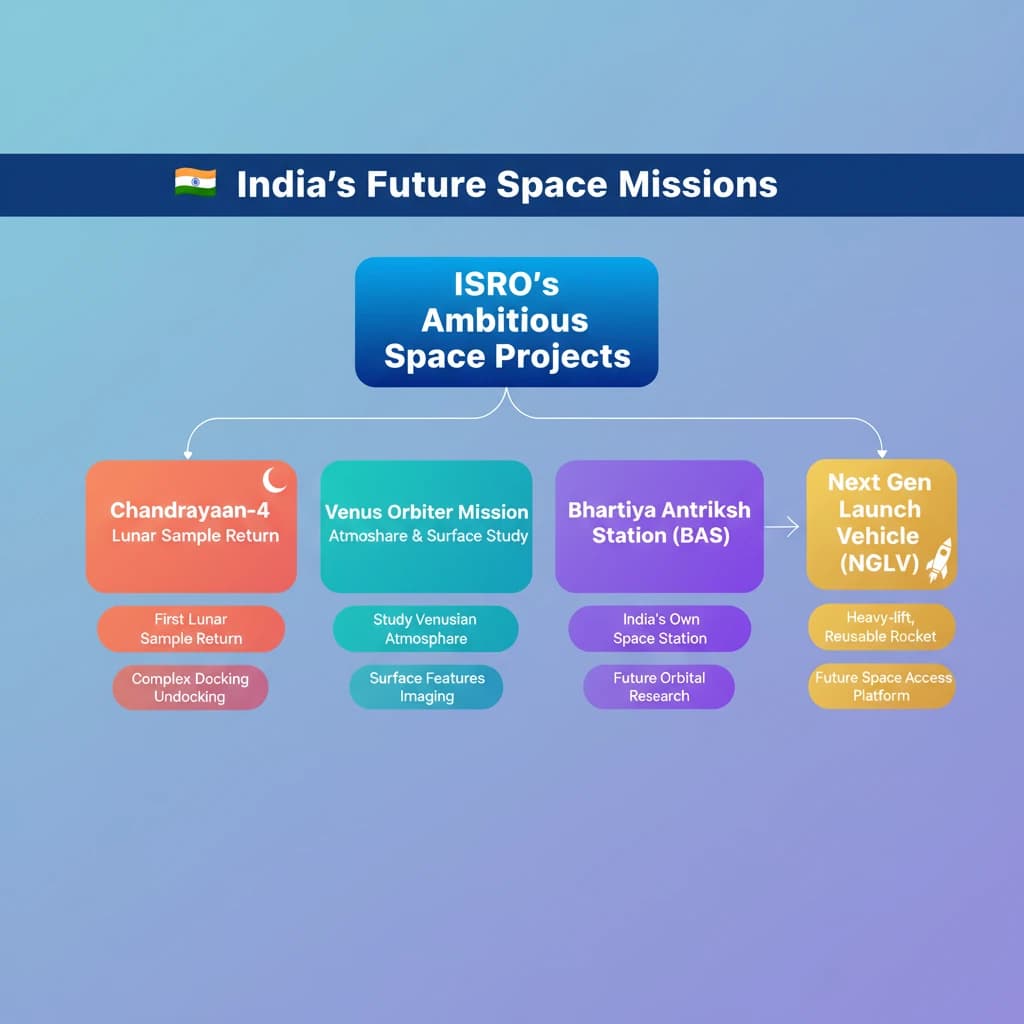
💡 Key Takeaways
- •Union Cabinet approved four major ISRO projects: Chandrayaan-4, VOM, BAS, and NGLV.
- •Chandrayaan-4 is India's first lunar sample return mission, involving complex docking/undocking.
- •Venus Orbiter Mission (VOM) aims to study Venus's atmosphere and surface.
- •Bhartiya Antriksh Station (BAS) is India's planned independent space station.
- •Next Generation Launch Vehicle (NGLV) will be a heavy-lift, potentially reusable rocket for future space access.
- •These projects signify India's ambitious stride towards becoming a global leader in advanced space exploration and technology.
🧠 Memory Techniques

95% Verified Content
📚 Reference Sources
•ISRO Official Website (General information on past missions and future goals)
•Press Information Bureau (PIB) releases (For Union Cabinet approvals and project details)