Loading page, please wait…
Black Hole Triple System - UPSC Science And Technology
What is Black Hole Triple System in UPSC Science And Technology?
Black Hole Triple System is a key topic under Science And Technology for UPSC Civil Services Examination. Key points include: First black hole triple system discovered 8,000 LY away, featuring a central black hole and two orbiting stars.. Formed via 'direct collapse' or 'failed supernova', a gentler process avoiding violent ejection of matter.. Challenges traditional black hole formation models and highlights complex gravitational dynamics.. Understanding this topic is essential for both UPSC Prelims and Mains preparation.
Why is Black Hole Triple System important for UPSC exam?
Black Hole Triple System is a Medium-level topic in UPSC Science And Technology. It is tested in both Prelims (factual MCQs) and Mains (analytical answer writing). Previous year UPSC questions have frequently covered aspects of Black Hole Triple System, making it essential for comprehensive IAS preparation.
How to prepare Black Hole Triple System for UPSC?
To prepare Black Hole Triple System for UPSC: (1) Study the comprehensive notes covering all key concepts on Vaidra. (2) Practice previous year questions on this topic. (3) Connect it with current affairs using daily updates. (4) Revise using key takeaways and mind maps available for Science And Technology. (5) Write practice answers linking Black Hole Triple System to related GS Paper topics.
Key takeaways of Black Hole Triple System for UPSC
- First black hole triple system discovered 8,000 LY away, featuring a central black hole and two orbiting stars.
- Formed via 'direct collapse' or 'failed supernova', a gentler process avoiding violent ejection of matter.
- Challenges traditional black hole formation models and highlights complex gravitational dynamics.
- A light-year is a unit of distance (approx. 9.5 trillion km), not time.
- Significantly advances understanding of stellar evolution and multi-body gravitational systems.
Black Hole Triple System
Medium⏱️ 8 min read
science and technology
📖 Introduction
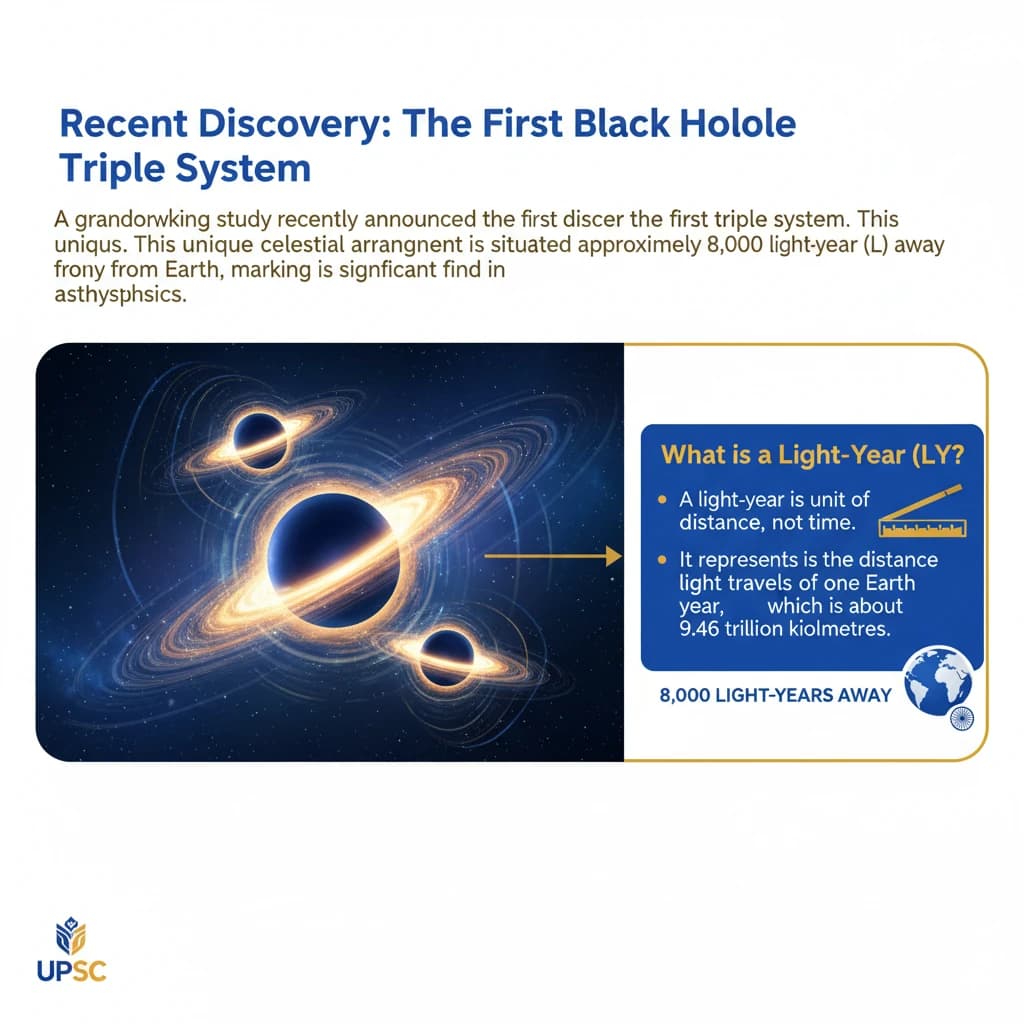
Recent Discovery: The First Black Hole Triple System
A groundbreaking study recently announced the discovery of the first black hole triple system. This unique celestial arrangement is situated approximately 8,000 light-years (LY) away from Earth, marking a significant find in astrophysics.
What is a Light-Year (LY)?
- A light-year is a unit of distance, not time.
- It represents the distance that light travels in one Earth year.
- This distance is approximately 5.9 trillion miles (9.5 trillion km).
Defining a Black Hole Triple System
Unlike typical black holes, which are often found in isolation or as part of a binary system (two gravitationally bound objects), a black hole triple system is far more complex.
It comprises a central black hole that is gravitationally bound to two orbiting stars. These three components are held together by their mutual gravitational forces, creating a stable, intricate dance.
Formation Mechanism: Direct Collapse
The formation of this triple system is attributed to a unique process known as “direct collapse”. This mechanism is crucial for understanding how such a complex system can form and remain intact.
Direct Collapse (Failed Supernova) Explained:
- A massive star collapses inwards under its own gravity.
- Crucially, this collapse occurs without undergoing a supernova explosion.
- This gentler formation mechanism means that nearby stars are not violently ejected.
- Instead, they remain gravitationally attached to the newly formed black hole.
This process is also referred to as a “failed supernova”. It avoids the violent expulsion of surrounding matter that typically accompanies a supernova, thus preserving the gravitational bonds with nearby stellar companions.
Significance and Challenges to Traditional Models
The discovery of this black hole triple system is profoundly significant for several reasons. It challenges many of the traditional models that describe how black holes form and evolve within stellar systems.
UPSC Insight: Implications for Astrophysics
Understanding such unique structures is vital for advancements in astrophysics. It provides empirical data that can refine our theories on stellar evolution, gravitational dynamics, and the prevalence of different types of black hole systems in the universe. This topic could appear in GS Paper III (Science & Technology) under Space Technology or Developments in Physics.
It demonstrates the intricate and complex gravitational dynamics that can exist in stellar environments, pushing the boundaries of our current astrophysical understanding.
💡 Key Takeaways
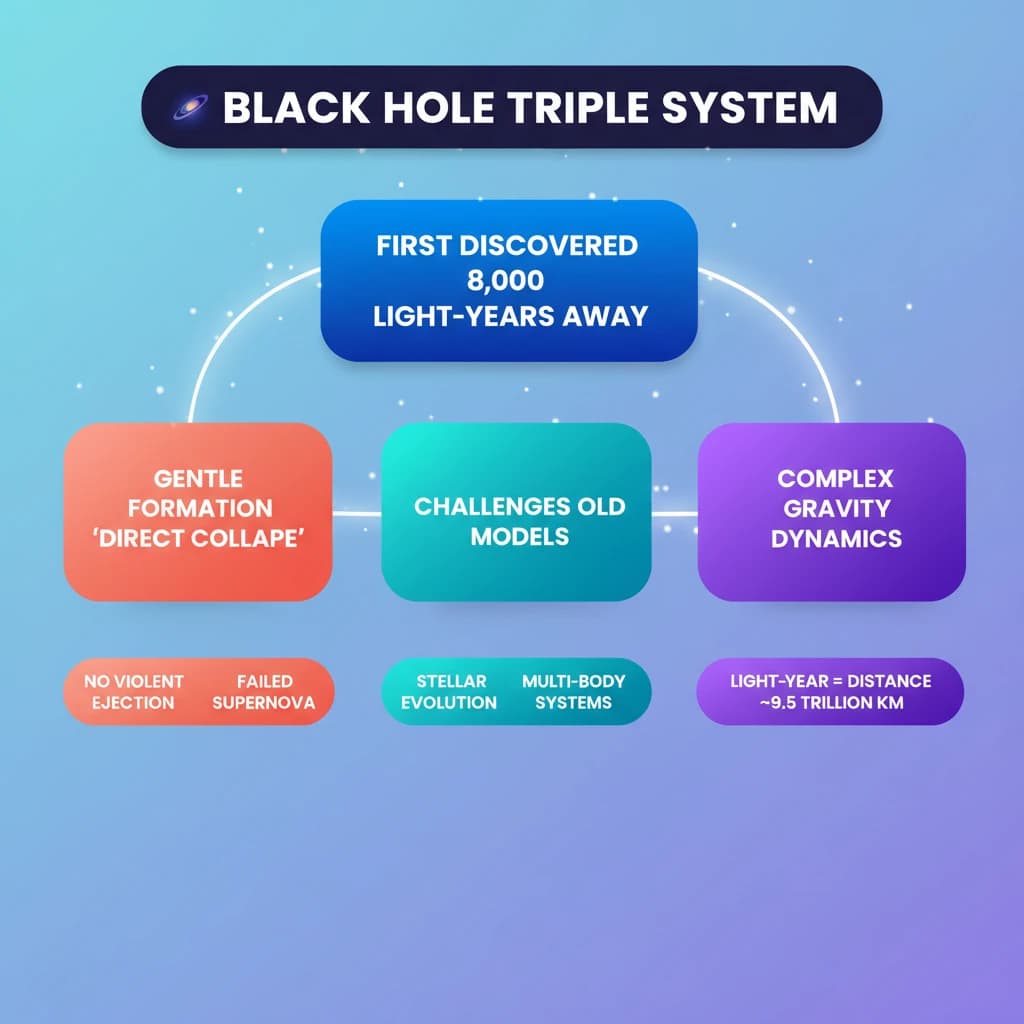
- •First black hole triple system discovered 8,000 LY away, featuring a central black hole and two orbiting stars.
- •Formed via 'direct collapse' or 'failed supernova', a gentler process avoiding violent ejection of matter.
- •Challenges traditional black hole formation models and highlights complex gravitational dynamics.
- •A light-year is a unit of distance (approx. 9.5 trillion km), not time.
- •Significantly advances understanding of stellar evolution and multi-body gravitational systems.
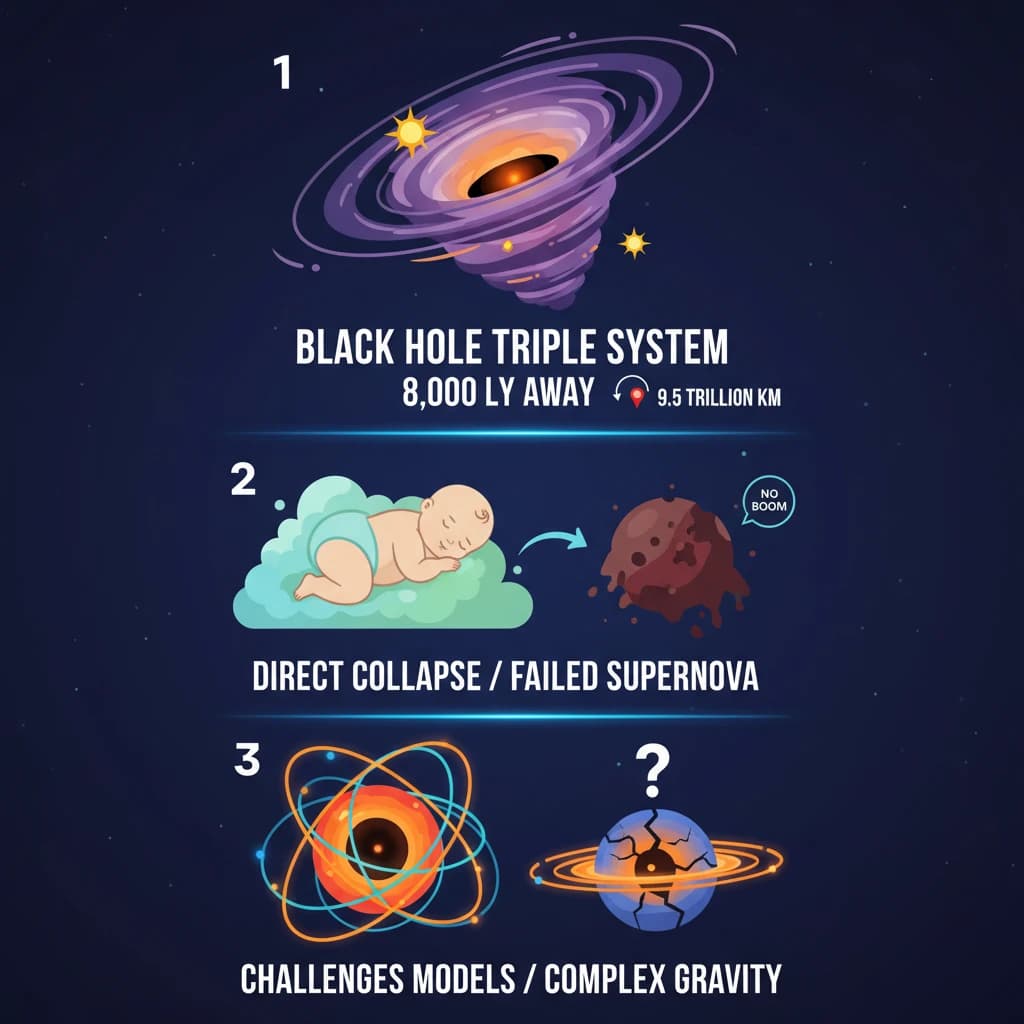
🧠 Memory Techniques
95% Verified Content
📚 Reference Sources
•General Astrophysical Research on Black Holes and Stellar Systems (for historical context and conceptual framework)