Loading page, please wait…
Vaidra Logo
Vaidra

Top 4 items + smart groups

UPSC GPT
New
Current Affairs
Daily Solutions
Daily Puzzle
Mains Evaluator

Version 2.0.0 • Built with ❤️ for UPSC aspirants

Loading...
Loading...
Loading...
Loading...
Loading...
Loading...
Loading...
Loading...
Loading...
Loading...
Loading...
Loading...
Loading...
Back
All Subjects

Topics

0 topics • 0 completed

Loading topics...
Loading...
Loading...
Loading...
Loading...
Loading...
Overall Progress0%
Security Alert System Based on Piezoelectric Polymer Nanocomposite - UPSC Science And Technology

Security Alert System Based on Piezoelectric Polymer Nanocomposite - UPSC Science And Technology

What is Security Alert System Based on Piezoelectric Polymer Nanocomposite in UPSC Science And Technology?

Security Alert System Based on Piezoelectric Polymer Nanocomposite is a key topic under Science And Technology for UPSC Civil Services Examination. Key points include: Piezoelectric polymer nanocomposites convert mechanical energy into electrical energy.. Developed by CeNS and CSIR-NCL, Pune, for pressure sensing and energy harvesting.. Key application: Security alert systems (e.g., intrusion detection mats).. Understanding this topic is essential for both UPSC Prelims and Mains preparation.

Why is Security Alert System Based on Piezoelectric Polymer Nanocomposite important for UPSC exam?

Security Alert System Based on Piezoelectric Polymer Nanocomposite is a Medium-level topic in UPSC Science And Technology. It is tested in both Prelims (factual MCQs) and Mains (analytical answer writing). Previous year UPSC questions have frequently covered aspects of Security Alert System Based on Piezoelectric Polymer Nanocomposite, making it essential for comprehensive IAS preparation.

How to prepare Security Alert System Based on Piezoelectric Polymer Nanocomposite for UPSC?

To prepare Security Alert System Based on Piezoelectric Polymer Nanocomposite for UPSC: (1) Study the comprehensive notes covering all key concepts on Vaidra. (2) Practice previous year questions on this topic. (3) Connect it with current affairs using daily updates. (4) Revise using key takeaways and mind maps available for Science And Technology. (5) Write practice answers linking Security Alert System Based on Piezoelectric Polymer Nanocomposite to related GS Paper topics.

Key takeaways of Security Alert System Based on Piezoelectric Polymer Nanocomposite for UPSC

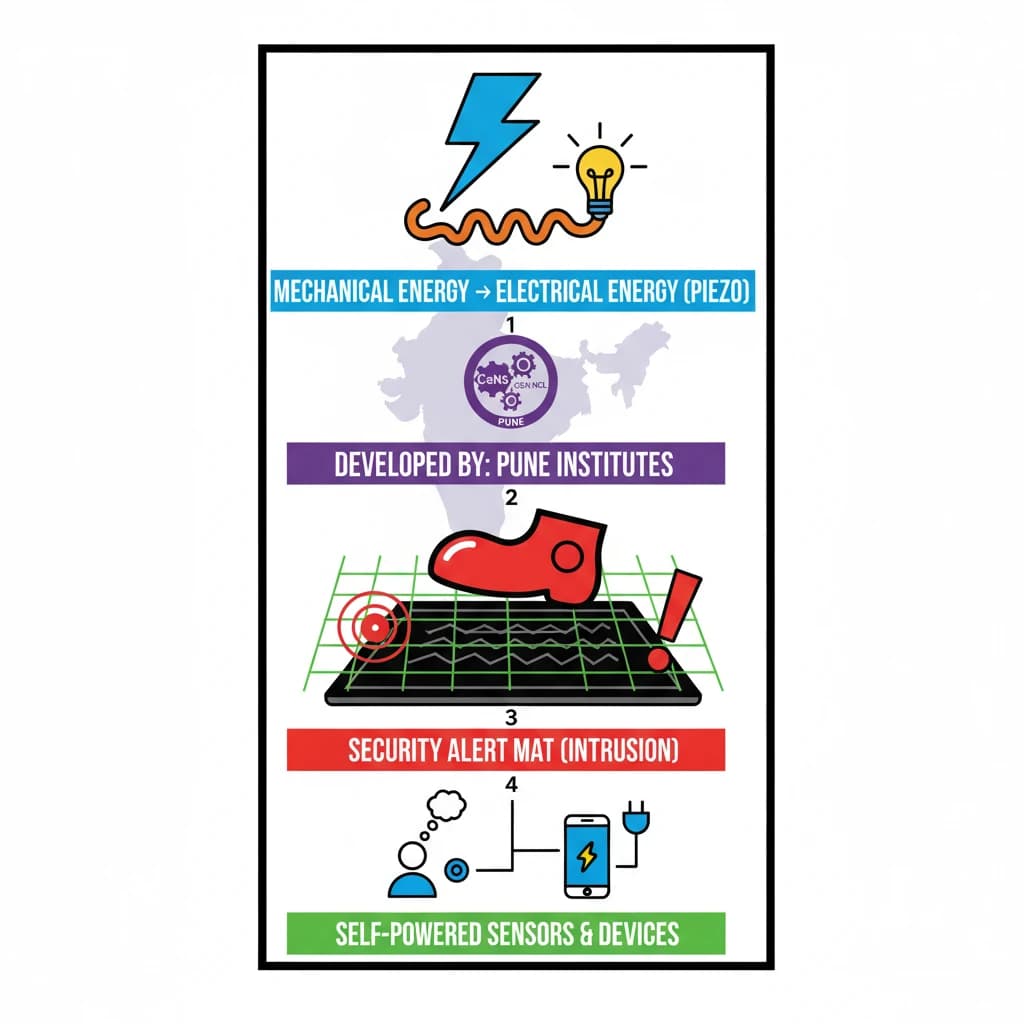
  • Piezoelectric polymer nanocomposites convert mechanical energy into electrical energy.
  • Developed by CeNS and CSIR-NCL, Pune, for pressure sensing and energy harvesting.
  • Key application: Security alert systems (e.g., intrusion detection mats).
  • Also useful for self-powered sensors and small electronic devices.
  • Leverages piezoelectric effect, combining polymer flexibility with nanoscale material enhancement.
  • Relevant for smart cities, sustainable energy, and internal security.
Security Alert System Based on Piezoelectric Polymer Nanocomposite

Security Alert System Based on Piezoelectric Polymer Nanocomposite

Medium⏱️ 8 min read✓ 95% Verified
science and technology

📖 Introduction

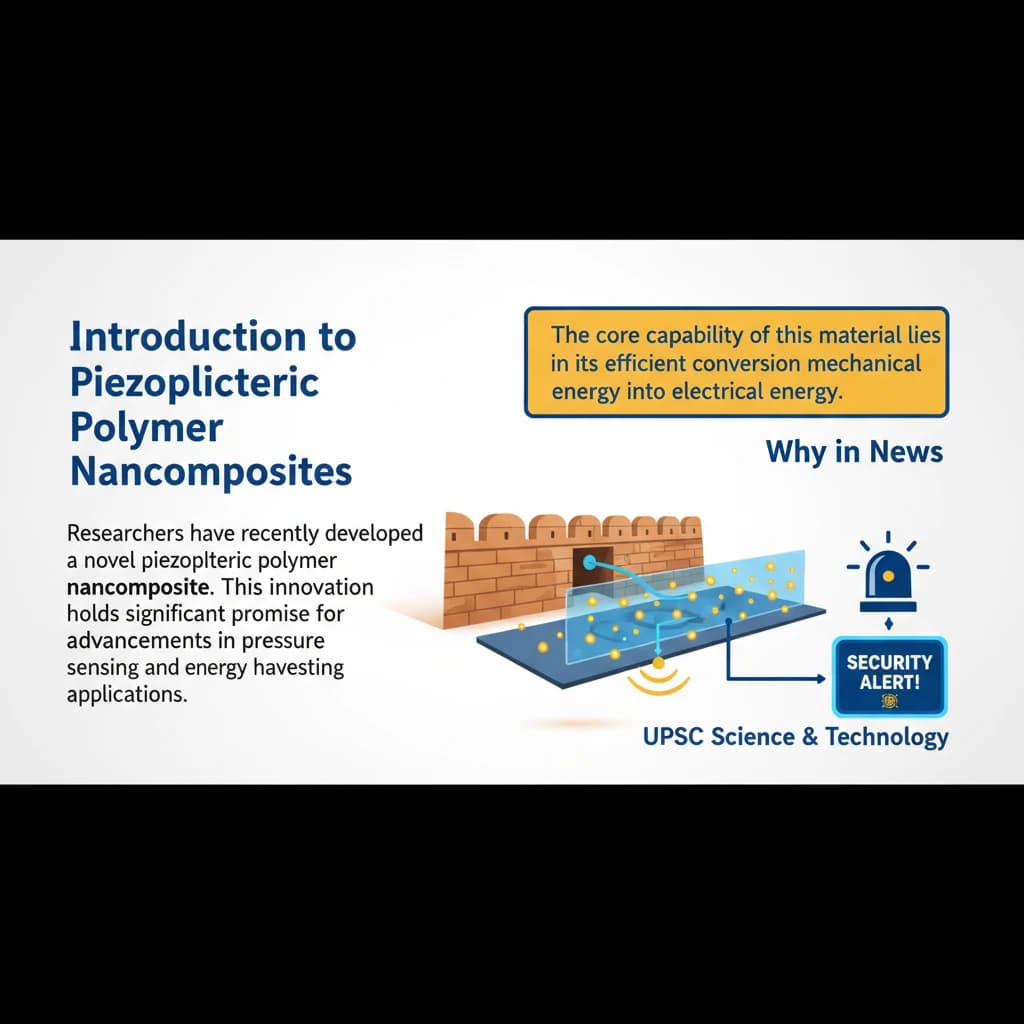
<h4>Introduction to Piezoelectric Polymer Nanocomposites</h4><p>Researchers have recently developed a novel <strong>piezoelectric polymer nanocomposite</strong>. This innovation holds significant promise for advancements in <strong>pressure sensing</strong> and <strong>energy harvesting</strong> applications.</p><div class='key-point-box'><p>The core capability of this material lies in its efficient conversion of <strong>mechanical energy into electrical energy</strong>.</p></div><h4>Why in News?</h4><p>The development was spearheaded by researchers from the <strong>Centre for Nano and Soft Matter Sciences (CeNS)</strong> and the <strong>National Chemical Laboratory (CSIR-NCL)</strong>, Pune. Their collaborative effort has opened new avenues for practical applications.</p><div class='info-box'><p><strong>Research Institutions:</strong></p><ul><li><strong>Centre for Nano and Soft Matter Sciences (CeNS)</strong></li><li><strong>National Chemical Laboratory (CSIR-NCL), Pune</strong></li></ul></div><h4>Understanding Piezoelectric Materials and Effect</h4><p><strong>Piezoelectric materials</strong> are a class of smart materials that exhibit a unique property: they can generate an electrical charge when subjected to mechanical stress or pressure. Conversely, they deform when an electric field is applied.</p><div class='info-box'><p><strong>Piezoelectric Effect:</strong> The phenomenon where certain materials produce an <strong>electric potential</strong> in response to applied <strong>mechanical stress</strong> (direct piezoelectric effect) or undergo a mechanical strain in response to an applied electric field (converse piezoelectric effect).</p></div><p>This direct conversion of <strong>mechanical energy into electrical energy</strong> is fundamental to their function in various sensors and energy harvesting devices.</p><h4>What are Piezoelectric Polymer Nanocomposites?</h4><p>A <strong>piezoelectric polymer nanocomposite</strong> combines the flexibility and processability of polymers with the enhanced piezoelectric properties achieved by incorporating <strong>nanoscale fillers</strong>. These fillers are often ceramic piezoelectric materials like <strong>lead zirconate titanate (PZT)</strong> or <strong>barium titanate (BaTiO3)</strong>.</p><div class='key-point-box'><p>The term 'nanocomposite' signifies the integration of materials at the <strong>nanometer scale</strong>, which often leads to superior performance compared to traditional composites.</p></div><p>The synergy between the polymer matrix and the <strong>nanoparticles</strong> results in a material that is both mechanically robust and highly efficient in converting mechanical stimuli into electrical signals.</p><h4>Applications in Security and Energy Harvesting</h4><p>The developed nanocomposite is particularly suited for a <strong>security alert system</strong>. When integrated into a mat or a surface, any pressure exerted (e.g., by an intruder's footsteps) can generate an electrical signal, triggering an alarm.</p><div class='exam-tip-box'><p><strong>UPSC Insight:</strong> Questions on <strong>smart materials</strong> and their applications in <strong>security</strong> or <strong>sustainable energy</strong> are common in <strong>GS3 Science & Technology</strong>. Understanding the underlying principle of <strong>piezoelectricity</strong> is crucial.</p></div><p>Beyond security, its ability to harvest mechanical energy means it can be used to power small electronic devices from ambient vibrations, human movement, or even vehicle traffic. This contributes to the development of <strong>self-powered sensors</strong> and <strong>IoT devices</strong>.</p>
Concept Diagram

💡 Key Takeaways

  • •Piezoelectric polymer nanocomposites convert mechanical energy into electrical energy.
  • •Developed by CeNS and CSIR-NCL, Pune, for pressure sensing and energy harvesting.
  • •Key application: Security alert systems (e.g., intrusion detection mats).
  • •Also useful for self-powered sensors and small electronic devices.
  • •Leverages piezoelectric effect, combining polymer flexibility with nanoscale material enhancement.
  • •Relevant for smart cities, sustainable energy, and internal security.

🧠 Memory Techniques
Memory Aid
95% Verified Content

📚 Reference Sources

•General knowledge on Piezoelectricity, Polymers, Nanocomposites, CeNS, CSIR-NCL

Related Topics

Loading related topics...
Explore:Science And Technology Topics·All Subjects·Daily Current Affairs·Editorial Analysis·Previous Year Questions·UPSC GPT