Loading page, please wait…
Centenary of Bose-Einstein Statistics - UPSC Science And Technology
What is Centenary of Bose-Einstein Statistics in UPSC Science And Technology?
Centenary of Bose-Einstein Statistics is a key topic under Science And Technology for UPSC Civil Services Examination. Key points include: Centenary of Bose-Einstein statistics celebrates S.N. Bose's work on particle indistinguishability.. Bose's 1924 paper introduced a new way of counting photons as indistinguishable entities.. Albert Einstein recognized and expanded Bose's ideas, leading to Bose-Einstein statistics and BEC prediction.. Understanding this topic is essential for both UPSC Prelims and Mains preparation.
Why is Centenary of Bose-Einstein Statistics important for UPSC exam?
Centenary of Bose-Einstein Statistics is a Medium-level topic in UPSC Science And Technology. It is tested in both Prelims (factual MCQs) and Mains (analytical answer writing). Previous year UPSC questions have frequently covered aspects of Centenary of Bose-Einstein Statistics, making it essential for comprehensive IAS preparation.
How to prepare Centenary of Bose-Einstein Statistics for UPSC?
To prepare Centenary of Bose-Einstein Statistics for UPSC: (1) Study the comprehensive notes covering all key concepts on Vaidra. (2) Practice previous year questions on this topic. (3) Connect it with current affairs using daily updates. (4) Revise using key takeaways and mind maps available for Science And Technology. (5) Write practice answers linking Centenary of Bose-Einstein Statistics to related GS Paper topics.
Key takeaways of Centenary of Bose-Einstein Statistics for UPSC
- Centenary of Bose-Einstein statistics celebrates S.N. Bose's work on particle indistinguishability.
- Bose's 1924 paper introduced a new way of counting photons as indistinguishable entities.
- Albert Einstein recognized and expanded Bose's ideas, leading to Bose-Einstein statistics and BEC prediction.
- Bose-Einstein statistics distinguishes between bosons (can occupy same quantum state) and fermions (obey Pauli Exclusion Principle).
- Bosons are named after S.N. Bose.
- This work forms the basis for phenomena like Bose-Einstein Condensates, superfluidity, and laser operation, shaping modern physics and technology.
Centenary of Bose-Einstein Statistics
Medium⏱️ 8 min read
science and technology
📖 Introduction
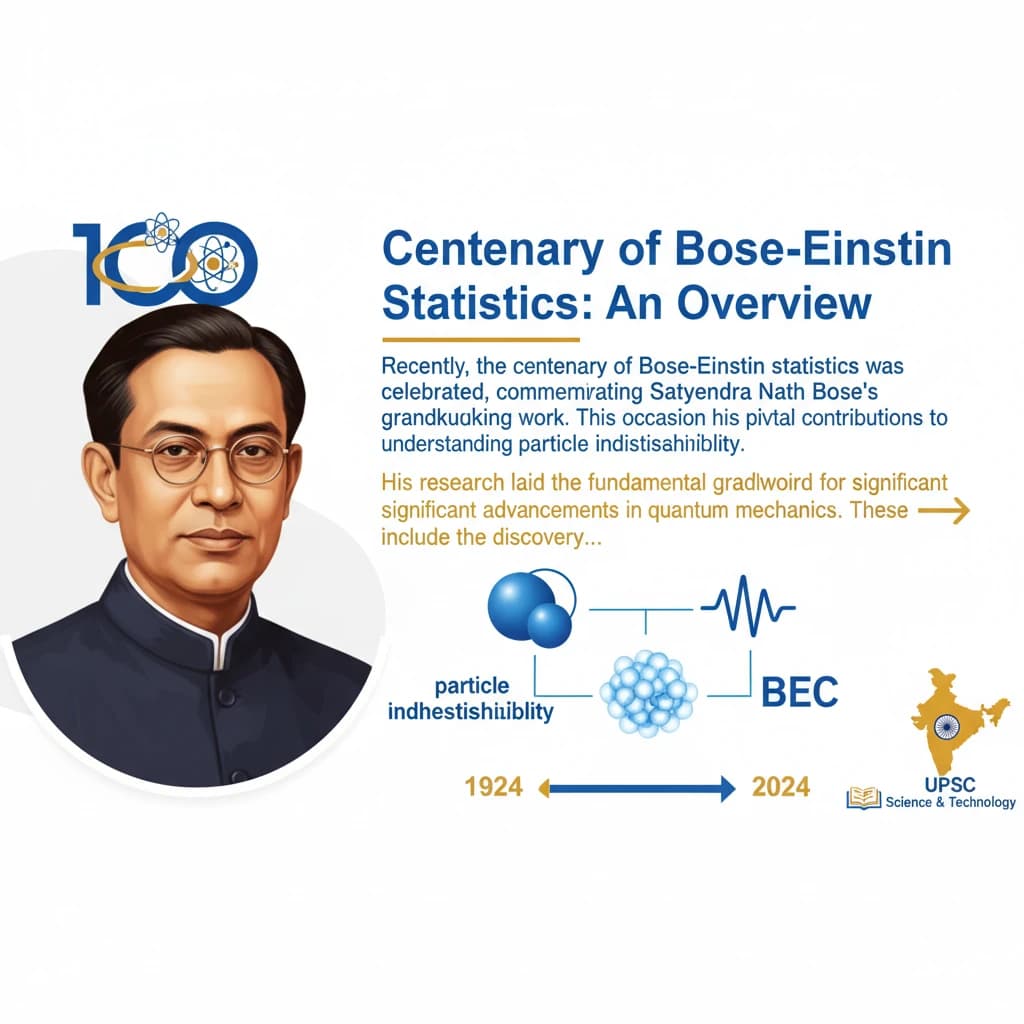
Centenary of Bose-Einstein Statistics: An Overview
Recently, the centenary of Bose-Einstein statistics was celebrated, commemorating Satyendra Nath Bose’s groundbreaking work. This occasion highlights his pivotal contributions to understanding particle indistinguishability.
His research laid the fundamental groundwork for significant advancements in quantum mechanics. These include the discovery and study of the Bose-Einstein Condensate (BEC), which continues to influence and shape modern physics research and applications.
Who was Satyendra Nath Bose?
Satyendra Nath Bose was a brilliant Indian physicist, born on 1st January 1894, in Calcutta (now Kolkata). From a young age, he demonstrated exceptional talent, particularly in mathematics.
Bose drew inspiration from pioneering scientists like Jagadish Chandra Bose, renowned for his work in radio wave research. This inspiration propelled S.N. Bose into the complex realm of quantum mechanics, where he made his most significant contributions.
Born: 1st January 1894, Calcutta (Kolkata)
Field: Theoretical Physics, Quantum Mechanics
Known for: Bose-Einstein statistics, Bose-Einstein Condensate
Bose's Groundbreaking Contribution: Bose-Einstein Statistics
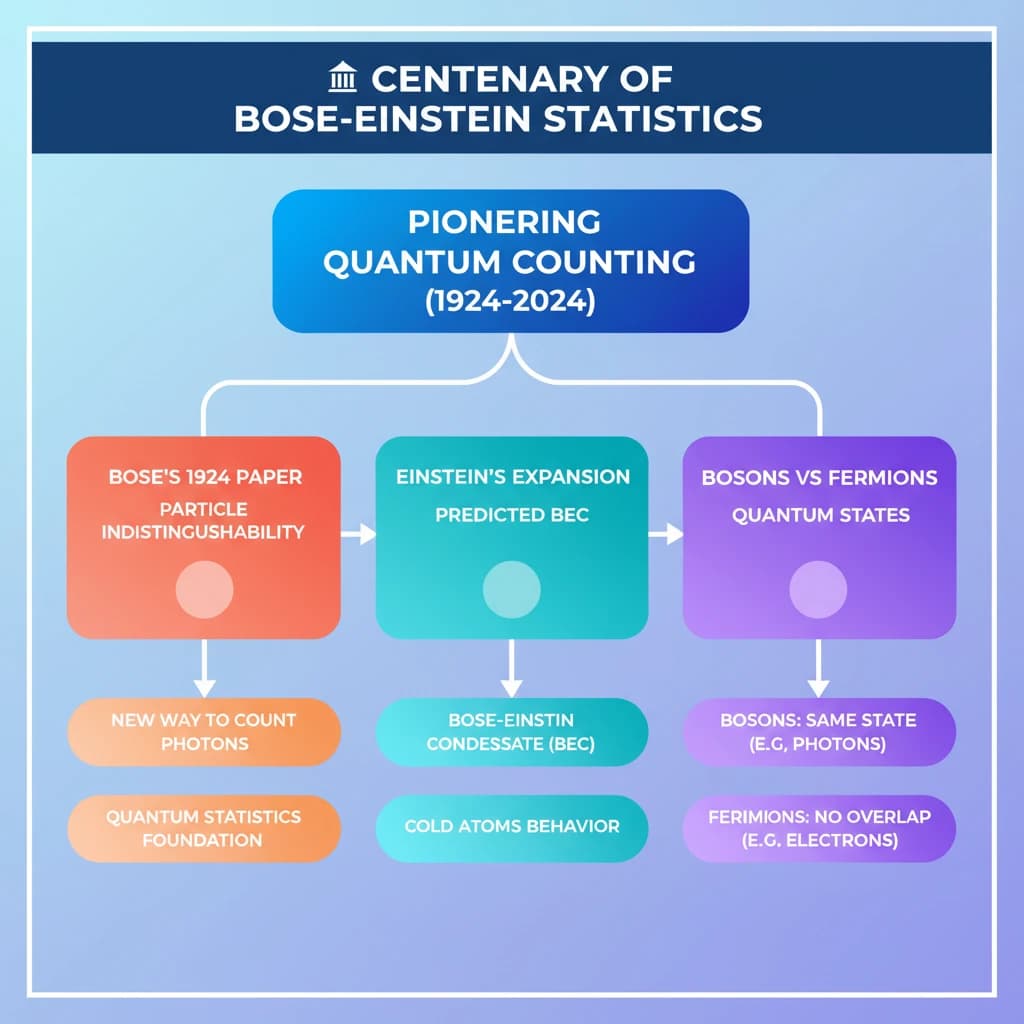
In 1924, Satyendra Nath Bose published a seminal paper titled “Planck’s Law and the Hypothesis of Light Quanta.” In this work, he introduced a revolutionary method for counting particles, specifically photons, by treating them as indistinguishable entities.
This novel approach challenged the prevailing assumptions of classical mechanics. Classical theory posited that particles are always distinguishable, meaning each particle could be uniquely identified and tracked over time.
Bose-Einstein Statistics: A quantum statistical framework describing the behavior of a collection of indistinguishable particles called bosons.
The profound significance of Bose’s paper was recognized by none other than Albert Einstein. Einstein expanded upon Bose’s original ideas, leading to the full development of Bose-Einstein statistics and the theoretical prediction of Bose-Einstein condensates.
Distinguishing Particles: Bosons and Fermions
Bose-Einstein statistics provides a crucial distinction between two fundamental classes of particles within quantum mechanics:
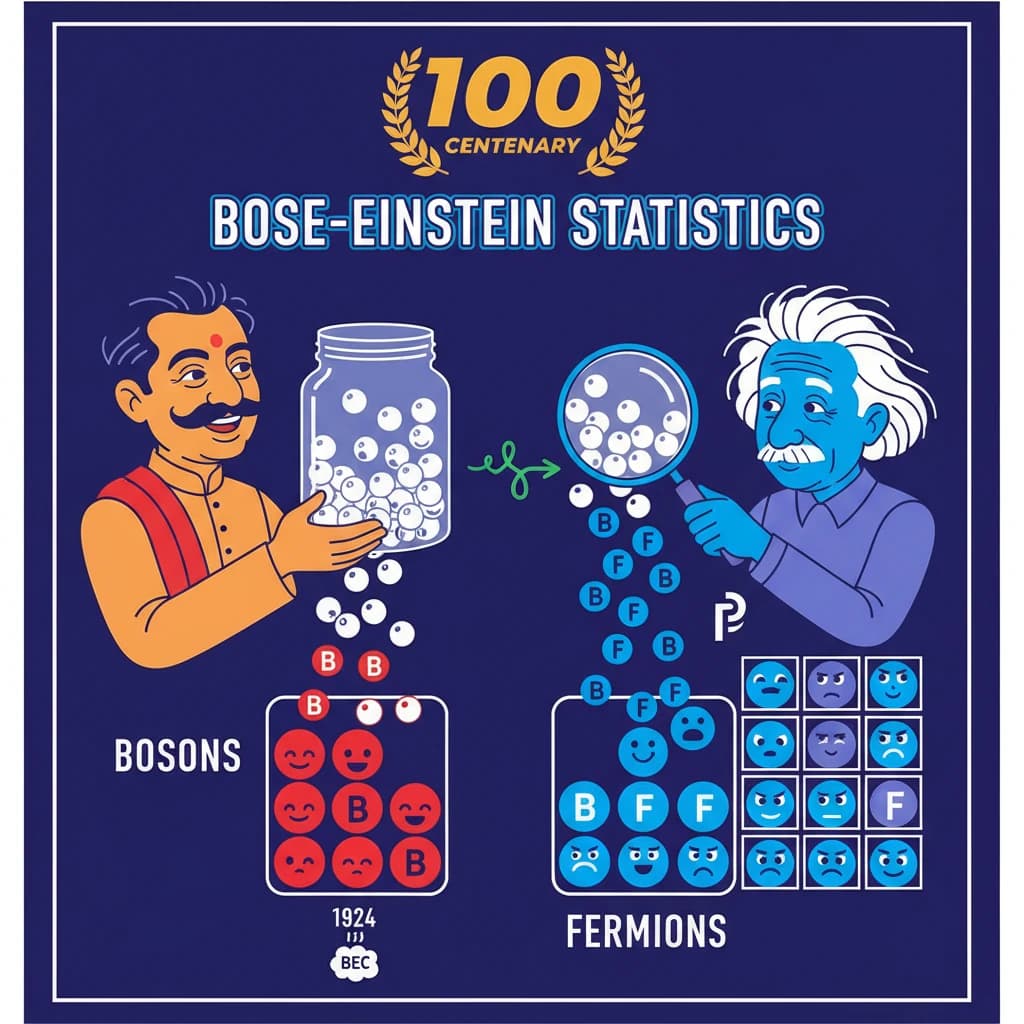
- Bosons: Named in honor of Satyendra Nath Bose, these particles are characterized by their ability to occupy the same quantum state. This property makes them inherently indistinguishable from one another. Examples include photons, gluons, and helium-4 atoms.
- Fermions: These particles, in contrast to bosons, obey the Pauli Exclusion Principle, meaning no two identical fermions can occupy the exact same quantum state simultaneously. Examples include electrons, protons, and neutrons.
UPSC Insight: Understanding the distinction between bosons and fermions is crucial for topics related to quantum mechanics, condensed matter physics, and the fundamental structure of matter. Questions may relate to their properties or applications.
💡 Key Takeaways
- •Centenary of Bose-Einstein statistics celebrates S.N. Bose's work on particle indistinguishability.
- •Bose's 1924 paper introduced a new way of counting photons as indistinguishable entities.
- •Albert Einstein recognized and expanded Bose's ideas, leading to Bose-Einstein statistics and BEC prediction.
- •Bose-Einstein statistics distinguishes between bosons (can occupy same quantum state) and fermions (obey Pauli Exclusion Principle).
- •Bosons are named after S.N. Bose.
- •This work forms the basis for phenomena like Bose-Einstein Condensates, superfluidity, and laser operation, shaping modern physics and technology.
🧠 Memory Techniques
98% Verified Content