Loading page, please wait…
Deep-Sea Mining: India's Interests, Exploration, and Environmental Concerns - UPSC Science And Technology
What is Deep-Sea Mining: India's Interests, Exploration, and Environmental Concerns in UPSC Science And Technology?
Deep-Sea Mining: India's Interests, Exploration, and Environmental Concerns is a key topic under Science And Technology for UPSC Civil Services Examination. Key points include: India was the first 'Pioneer Investor' in deep-sea mining (1987) with rights in CIOB.. India's CIOB polymetallic nodule exploration rights were extended in 2017 for five years.. In 2024, India applied for rights to explore the Indian Ocean Seabed, including AN Seamount.. Understanding this topic is essential for both UPSC Prelims and Mains preparation.
Why is Deep-Sea Mining: India's Interests, Exploration, and Environmental Concerns important for UPSC exam?
Deep-Sea Mining: India's Interests, Exploration, and Environmental Concerns is a Medium-level topic in UPSC Science And Technology. It is tested in both Prelims (factual MCQs) and Mains (analytical answer writing). Previous year UPSC questions have frequently covered aspects of Deep-Sea Mining: India's Interests, Exploration, and Environmental Concerns, making it essential for comprehensive IAS preparation.
How to prepare Deep-Sea Mining: India's Interests, Exploration, and Environmental Concerns for UPSC?
To prepare Deep-Sea Mining: India's Interests, Exploration, and Environmental Concerns for UPSC: (1) Study the comprehensive notes covering all key concepts on Vaidra. (2) Practice previous year questions on this topic. (3) Connect it with current affairs using daily updates. (4) Revise using key takeaways and mind maps available for Science And Technology. (5) Write practice answers linking Deep-Sea Mining: India's Interests, Exploration, and Environmental Concerns to related GS Paper topics.
Key takeaways of Deep-Sea Mining: India's Interests, Exploration, and Environmental Concerns for UPSC
- India was the first 'Pioneer Investor' in deep-sea mining (1987) with rights in CIOB.
- India's CIOB polymetallic nodule exploration rights were extended in 2017 for five years.
- In 2024, India applied for rights to explore the Indian Ocean Seabed, including AN Seamount.
- The 'Deep Ocean Mission' includes the 'Samudrayaan Mission' for deep-sea resource exploration.
- Limited scientific knowledge of abyssal ecosystems poses a significant challenge to deep-sea mining.
Deep-Sea Mining: India's Interests, Exploration, and Environmental Concerns
Medium⏱️ 7 min read
science and technology
📖 Introduction
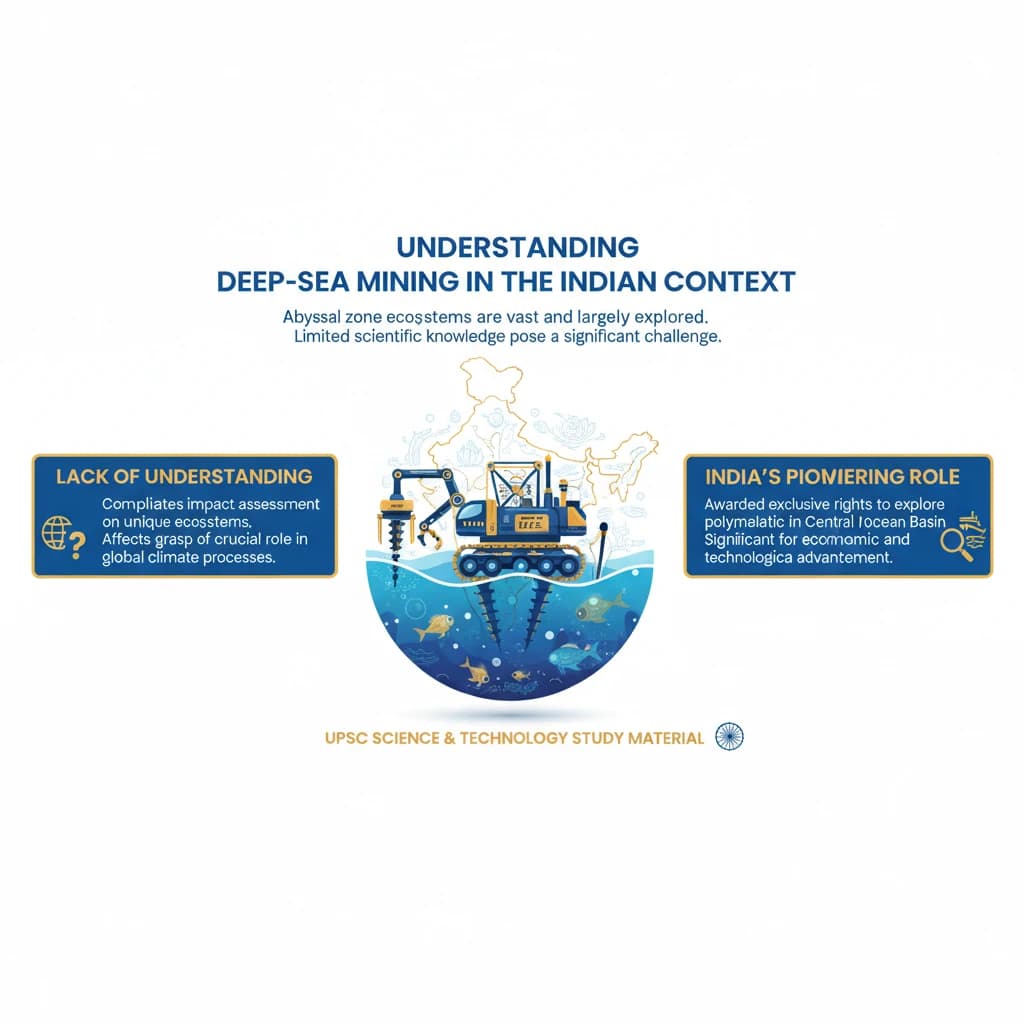
Understanding Deep-Sea Mining in the Indian Context
The abyssal zone ecosystems are vast and largely unexplored. Our limited scientific knowledge of these deep-sea environments poses a significant challenge.
This lack of understanding complicates efforts to assess the potential impact of deep-sea mining on these unique ecosystems. It also affects our grasp of their crucial role in global climate processes.
India's Pioneering Role in Deep-Sea Exploration
India has been a proactive player in the realm of deep-sea exploration. The nation holds a distinguished position in the global deep-sea mining landscape.
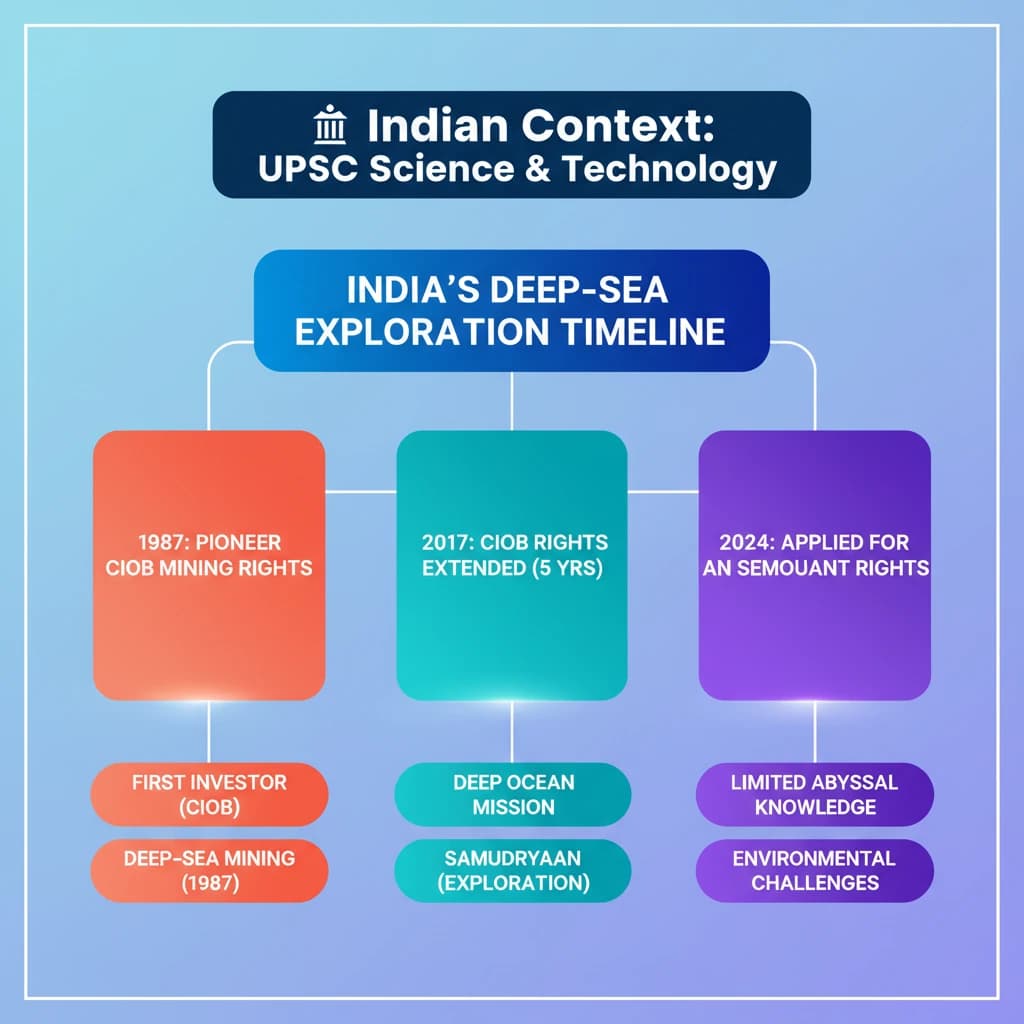
India was the first country to receive the status of a ‘Pioneer Investor’ in 1987. This recognition was granted by the International Seabed Authority (ISA).
Following this status, India was allocated an extensive area of approximately 75,000 sq. km in the Central Indian Ocean Basin (CIOB). This area was designated specifically for polymetallic nodule exploration.
India's exclusive rights to explore polymetallic nodules from the seabed in the Central Indian Ocean Basin were subsequently extended. The most recent extension was in 2017 for a period of five years.
Expanding Horizons: Recent Initiatives and Future Plans
India continues to expand its deep-sea exploration footprint. There are plans to apply for licenses to explore deep-sea minerals in the Pacific Ocean, indicating a broader strategic interest.
In 2024, India officially applied for rights to explore the Indian Ocean Seabed beyond its national jurisdiction. This includes the strategically important Cobalt-Rich Afanasy Nikitin Seamount (AN Seamount).
These applications underscore India's commitment to securing critical mineral resources for its future economic and industrial needs.
Deep Ocean Mission and Samudrayaan Project
The Ministry of Earth Sciences is spearheading the ambitious ‘Deep Ocean Mission’. This mission aims to explore and utilize ocean resources sustainably.
A key component of this mission is the development of a manned submersible vehicle, known as the Samudrayaan Mission. This vehicle is designed to search for and mine similar deep-sea resources in the Indian Ocean.
The Samudrayaan project signifies India's advanced technological capabilities and its resolve to become a leader in deep-sea technology and resource management.
💡 Key Takeaways
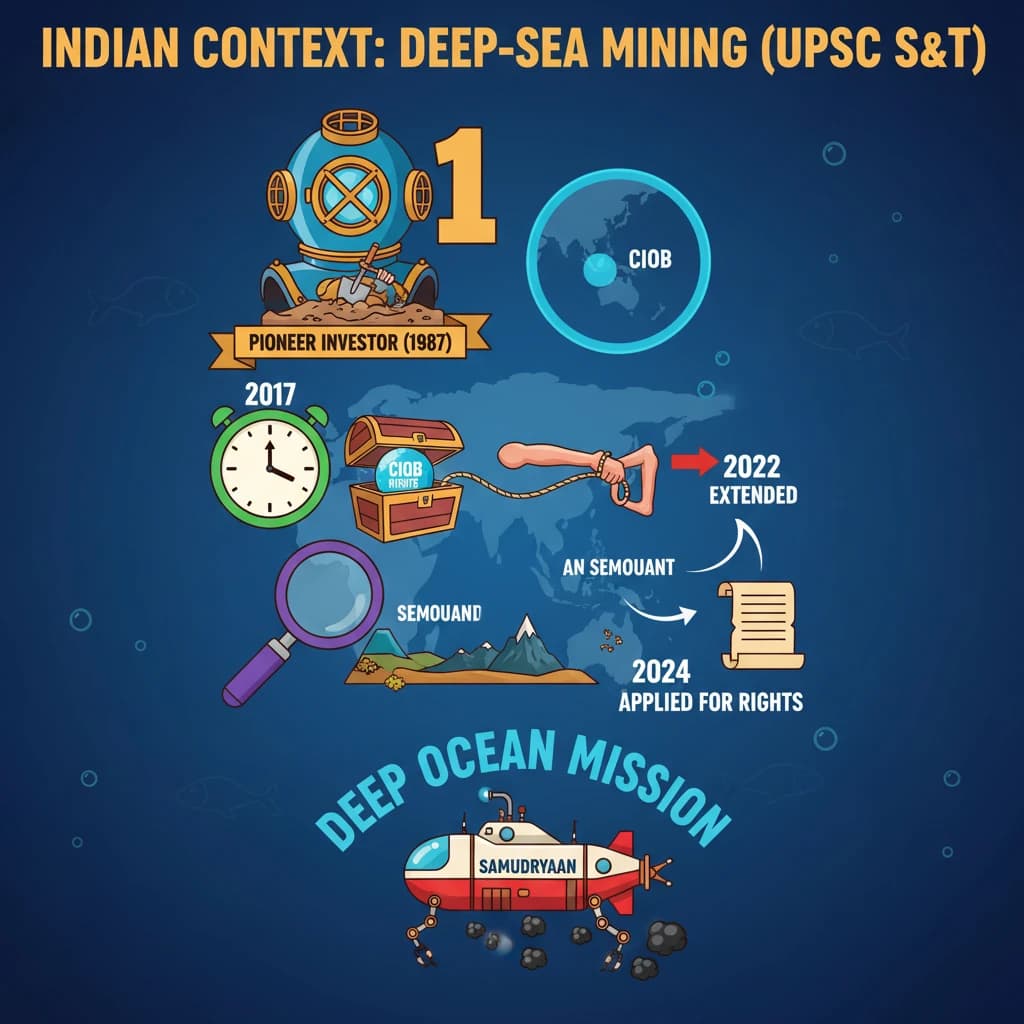
- •India was the first 'Pioneer Investor' in deep-sea mining (1987) with rights in CIOB.
- •India's CIOB polymetallic nodule exploration rights were extended in 2017 for five years.
- •In 2024, India applied for rights to explore the Indian Ocean Seabed, including AN Seamount.
- •The 'Deep Ocean Mission' includes the 'Samudrayaan Mission' for deep-sea resource exploration.
- •Limited scientific knowledge of abyssal ecosystems poses a significant challenge to deep-sea mining.
🧠 Memory Techniques
95% Verified Content
📚 Reference Sources
•Ministry of Earth Sciences (MoES) official reports on Deep Ocean Mission
•International Seabed Authority (ISA) publications regarding Pioneer Investors