Loading page, please wait…
Vaidra Logo
Vaidra

Top 4 items + smart groups

UPSC GPT
New
Current Affairs
Daily Solutions
Daily Puzzle
Mains Evaluator

Version 2.0.0 • Built with ❤️ for UPSC aspirants

Loading...
Loading...
Loading...
Loading...
Loading...
Loading...
Loading...
Loading...
Loading...
Loading...
Loading...
Loading...
Loading...
Back
All Subjects

Topics

0 topics • 0 completed

Loading topics...
Loading...
Loading...
Loading...
Loading...
Loading...
Overall Progress0%

MACE Telescope in Ladakh - UPSC Science And Technology

What is MACE Telescope in Ladakh in UPSC Science And Technology?

MACE Telescope in Ladakh is a key topic under Science And Technology for UPSC Civil Services Examination. Key points include: MACE (Major Atmospheric Cherenkov Experiment) telescope is located in Hanle, Ladakh.. It is a ground-based observatory for very high-energy gamma-ray astronomy.. MACE detects gamma rays with energies exceeding 20 billion electron volts (eV).. Understanding this topic is essential for both UPSC Prelims and Mains preparation.

Why is MACE Telescope in Ladakh important for UPSC exam?

MACE Telescope in Ladakh is a Medium-level topic in UPSC Science And Technology. It is tested in both Prelims (factual MCQs) and Mains (analytical answer writing). Previous year UPSC questions have frequently covered aspects of MACE Telescope in Ladakh, making it essential for comprehensive IAS preparation.

How to prepare MACE Telescope in Ladakh for UPSC?

To prepare MACE Telescope in Ladakh for UPSC: (1) Study the comprehensive notes covering all key concepts on Vaidra. (2) Practice previous year questions on this topic. (3) Connect it with current affairs using daily updates. (4) Revise using key takeaways and mind maps available for Science And Technology. (5) Write practice answers linking MACE Telescope in Ladakh to related GS Paper topics.

Key takeaways of MACE Telescope in Ladakh for UPSC

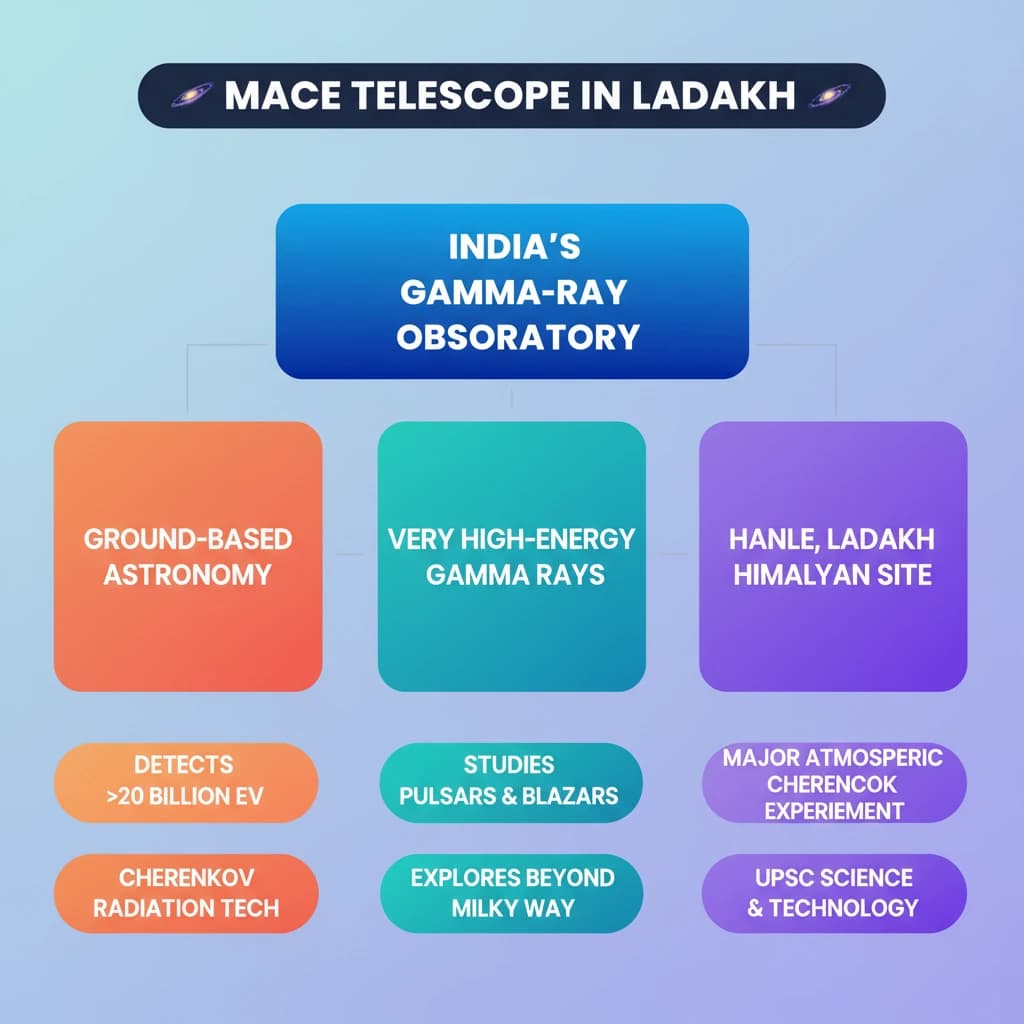
  • MACE (Major Atmospheric Cherenkov Experiment) telescope is located in Hanle, Ladakh.
  • It is a ground-based observatory for very high-energy gamma-ray astronomy.
  • MACE detects gamma rays with energies exceeding 20 billion electron volts (eV).
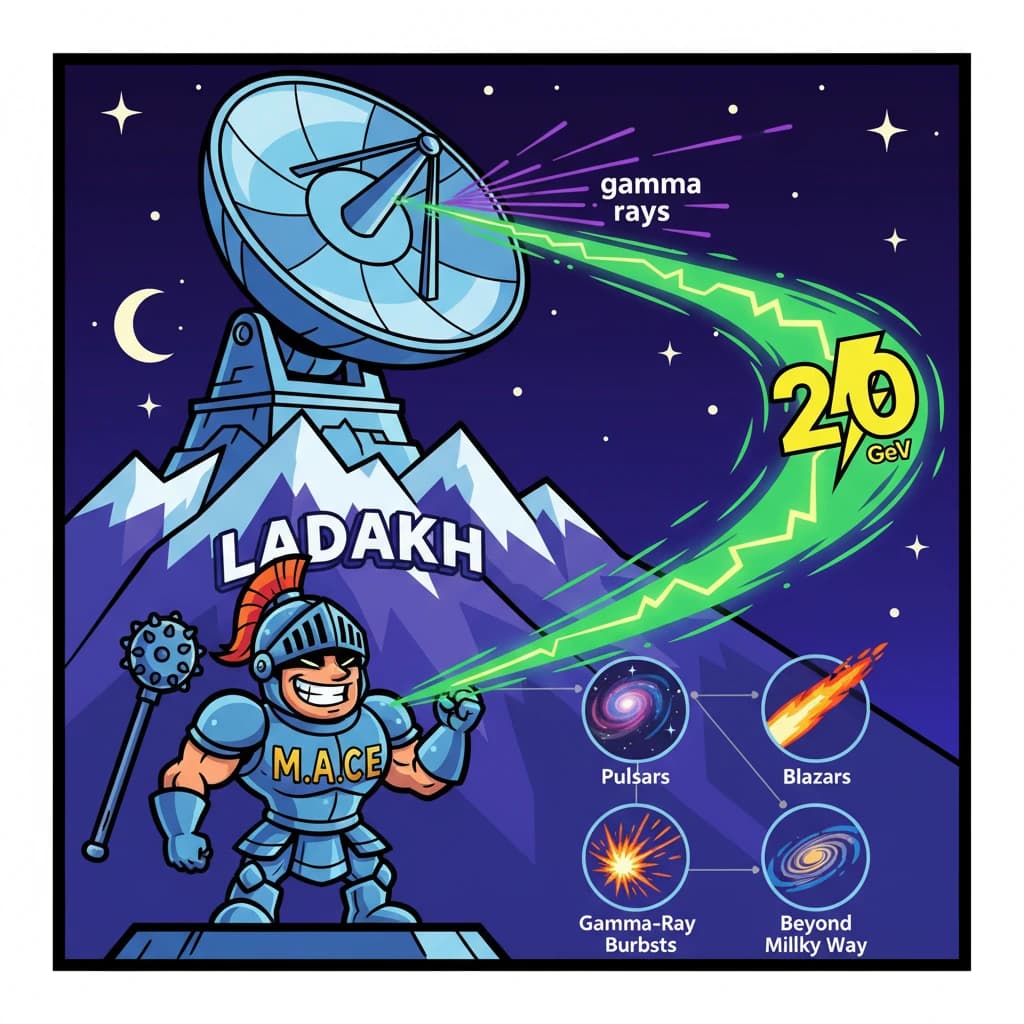
  • It observes celestial sources like pulsars, blazars, and gamma-ray bursts from beyond the Milky Way.
  • The telescope uses Cherenkov radiation technique to detect gamma rays indirectly.
  • MACE signifies a major advancement for India's capabilities in high-energy astrophysics.
  • It contributes to understanding extreme cosmic phenomena and fundamental physics.
MACE Telescope in Ladakh

MACE Telescope in Ladakh

Medium⏱️ 8 min read✓ 98% Verified
science and technology

📖 Introduction

<h4>Introduction to the MACE Telescope</h4><p>The <strong>Major Atmospheric Cherenkov Experiment (MACE) telescope</strong> represents a significant leap in <strong>gamma-ray astronomy</strong>. Its recent inauguration marks a pivotal moment for India's capabilities in exploring the high-energy universe.</p><div class='key-point-box'><p>The <strong>MACE telescope</strong> is designed to detect <strong>gamma rays</strong>, which are the most energetic form of electromagnetic radiation. These observations provide crucial insights into extreme cosmic phenomena.</p></div><h4>Location and Inauguration</h4><p>The <strong>MACE telescope</strong> has been strategically inaugurated in <strong>Hanle, Ladakh</strong>. This high-altitude location offers excellent conditions for astronomical observations, particularly for ground-based gamma-ray detection.</p><div class='info-box'><p><strong>Location:</strong> <strong>Hanle</strong>, <strong>Ladakh</strong> 📍<br><strong>Significance:</strong> One of the highest astronomical sites globally, providing clear skies and minimal atmospheric interference.</p></div><h4>Purpose and Scientific Capabilities</h4><p>The primary purpose of the <strong>MACE telescope</strong> is to enable scientists to explore <strong>gamma rays</strong>. It is specifically tuned to detect gamma rays with extremely high energies.</p><p>These energies <strong>exceed 20 billion electron volts (eV)</strong>. This capability allows researchers to probe some of the most powerful processes in the cosmos.</p><h4>Sources of Observation</h4><p>The telescope is designed to study <strong>gamma rays</strong> emitted from various sources located <strong>beyond the Milky Way galaxy</strong>. These distant objects are often associated with highly energetic events.</p><div class='info-box'><p><strong>Key Sources Observed by MACE:</strong><ul><li><strong>Pulsars:</strong> Rapidly rotating neutron stars emitting beams of radiation.</li><li><strong>Blazars:</strong> Active galactic nuclei with relativistic jets pointed towards Earth.</li><li><strong>Gamma-Ray Bursts (GRBs):</strong> The most luminous electromagnetic events known, associated with supernovae or neutron star mergers.</li></ul></p></div><div class='exam-tip-box'><p><strong>UPSC Relevance:</strong> Understanding the <strong>MACE telescope</strong> is important for <strong>Science & Technology</strong> (GS Paper 3). Questions may focus on its location, purpose, or the types of cosmic phenomena it studies.</p></div>
Concept Diagram

💡 Key Takeaways

  • •MACE (Major Atmospheric Cherenkov Experiment) telescope is located in Hanle, Ladakh.
  • •It is a ground-based observatory for very high-energy gamma-ray astronomy.
  • •MACE detects gamma rays with energies exceeding 20 billion electron volts (eV).
  • •It observes celestial sources like pulsars, blazars, and gamma-ray bursts from beyond the Milky Way.
  • •The telescope uses Cherenkov radiation technique to detect gamma rays indirectly.
  • •MACE signifies a major advancement for India's capabilities in high-energy astrophysics.
  • •It contributes to understanding extreme cosmic phenomena and fundamental physics.

🧠 Memory Techniques
Memory Aid
98% Verified Content

📚 Reference Sources

•Official websites of Indian astronomical observatories (e.g., IIA, BARC)
•General astrophysics resources for definitions of gamma rays, pulsars, blazars, GRBs
•News reports on the inauguration of MACE Telescope

Related Topics

Loading related topics...
Explore:Science And Technology Topics·All Subjects·Daily Current Affairs·Editorial Analysis·Previous Year Questions·UPSC GPT
MACE Telescope in Ladakh - UPSC Science And Technology