Loading page, please wait…
Vaidra Logo
Vaidra

Top 4 items + smart groups

UPSC GPT
New
Current Affairs
Daily Solutions
Daily Puzzle
Mains Evaluator

Version 2.0.0 • Built with ❤️ for UPSC aspirants

Back
All Subjects

Topics

0 topics • 0 completed

Loading topics...
Loading...
Loading...
Loading...
Loading...
Loading...
Overall Progress0%

What are the Biofortified Seed Varieties Developed by ICAR? - UPSC Science And Technology

What is What are the Biofortified Seed Varieties Developed by ICAR? in UPSC Science And Technology?

What are the Biofortified Seed Varieties Developed by ICAR? is a key topic under Science And Technology for UPSC Civil Services Examination. Key points include: ICAR has launched 61 biofortified seed varieties, including 34 field and 27 horticultural crops.. Biofortification increases nutrient density in food crops via breeding, agronomy, or biotechnology.. Key examples include CR Dhan 416 (salt-tolerant, pest-resistant rice) and Durum Wheat (high zinc, iron, protein).. Understanding this topic is essential for both UPSC Prelims and Mains preparation.

Why is What are the Biofortified Seed Varieties Developed by ICAR? important for UPSC exam?

What are the Biofortified Seed Varieties Developed by ICAR? is a Medium-level topic in UPSC Science And Technology. It is tested in both Prelims (factual MCQs) and Mains (analytical answer writing). Previous year UPSC questions have frequently covered aspects of What are the Biofortified Seed Varieties Developed by ICAR?, making it essential for comprehensive IAS preparation.

How to prepare What are the Biofortified Seed Varieties Developed by ICAR? for UPSC?

To prepare What are the Biofortified Seed Varieties Developed by ICAR? for UPSC: (1) Study the comprehensive notes covering all key concepts on Vaidra. (2) Practice previous year questions on this topic. (3) Connect it with current affairs using daily updates. (4) Revise using key takeaways and mind maps available for Science And Technology. (5) Write practice answers linking What are the Biofortified Seed Varieties Developed by ICAR? to related GS Paper topics.

Key takeaways of What are the Biofortified Seed Varieties Developed by ICAR? for UPSC

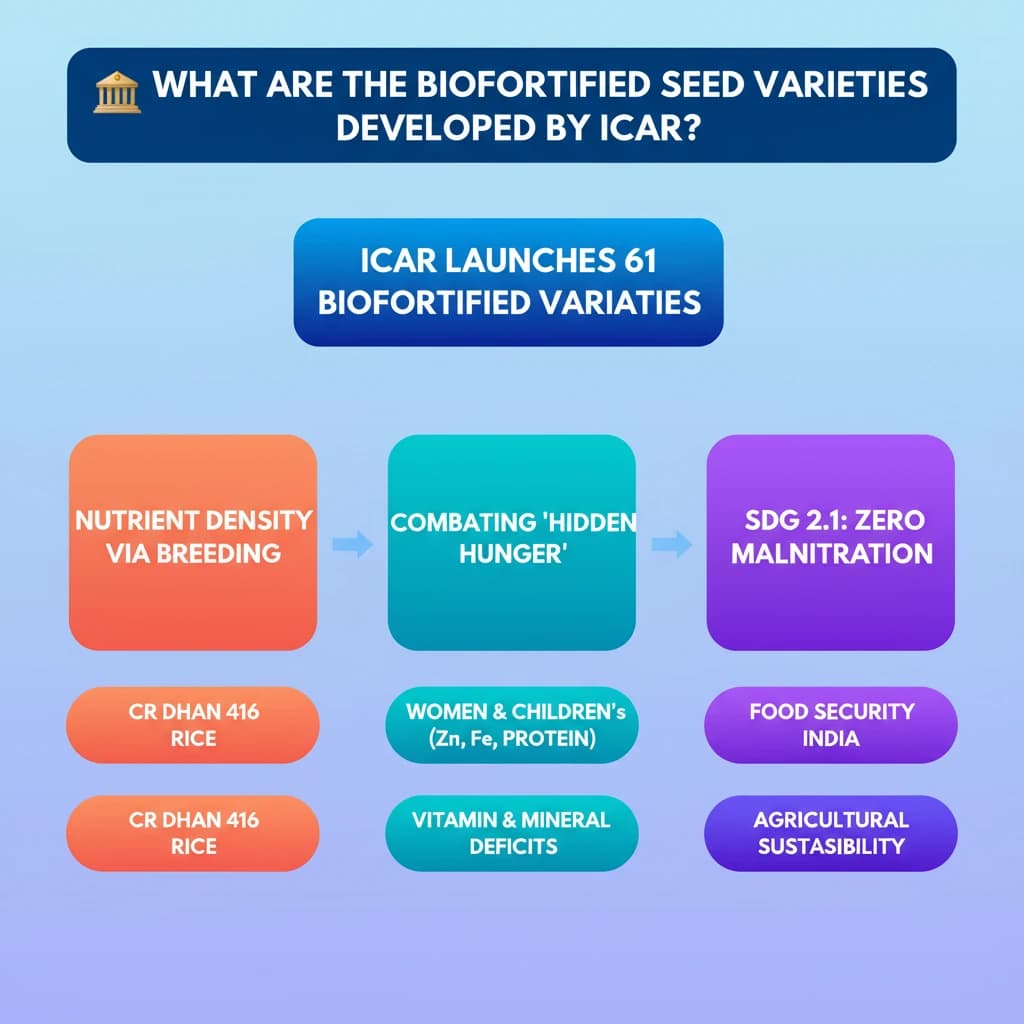
  • ICAR has launched 61 biofortified seed varieties, including 34 field and 27 horticultural crops.
  • Biofortification increases nutrient density in food crops via breeding, agronomy, or biotechnology.
  • Key examples include CR Dhan 416 (salt-tolerant, pest-resistant rice) and Durum Wheat (high zinc, iron, protein).
  • Biofortification aims to reduce vitamin and mineral deficiencies, combating 'hidden hunger'.
  • It is a critical intervention for India to tackle malnutrition among women and children and achieve SDGs.
What are the Biofortified Seed Varieties Developed by ICAR?

What are the Biofortified Seed Varieties Developed by ICAR?

Medium⏱️ 7 min read✓ 95% Verified
science and technology

📖 Introduction

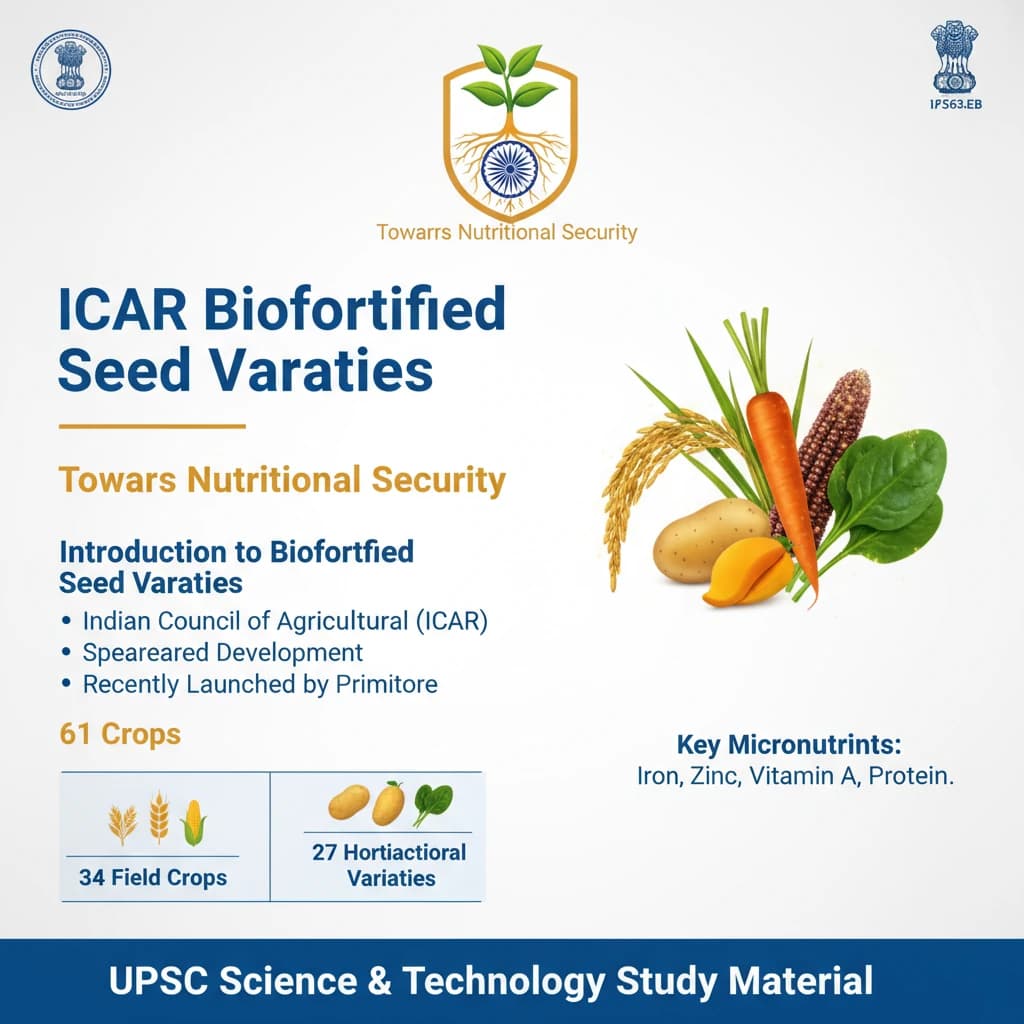
<h4>Introduction to Biofortified Seed Varieties</h4><p>The Indian Council of Agricultural Research (<strong>ICAR</strong>) has spearheaded the development of numerous <strong>biofortified seed varieties</strong>. These varieties were recently launched by the Prime Minister, marking a significant step towards nutritional security in India.</p><p>The initiative covers a total of <strong>61 crops</strong>. This includes <strong>34 field crops</strong> and <strong>27 horticultural varieties</strong>, showcasing a broad approach to addressing malnutrition.</p><div class='info-box'><p><strong>Scope of Biofortified Crops:</strong></p><ul><li><strong>Field Crops:</strong> Cereals, Millets, Forage Crops, Oilseeds, Pulses, Sugarcane, Cotton, Fibre Crops.</li><li><strong>Horticultural Varieties:</strong> Fruits, Vegetables, Plantation Crops, Tubers, Spices, Flowers, Medicinal Plants.</li></ul></div><h4>Spotlight on Key Biofortified Varieties</h4><h5>CR Dhan 416: A Resilient Rice Variety</h5><p><strong>CR Dhan 416</strong> is a specific rice variety developed by ICAR. It is particularly well-suited for cultivation in <strong>coastal saline areas</strong>, which are often challenging for conventional rice cultivation.</p><p>This variety exhibits moderate resistance to several common diseases. These include <strong>brown spot</strong>, <strong>blast</strong>, <strong>sheath rot</strong>, <strong>rice tungro disease</strong>, and <strong>glume discoloration</strong>. This resilience reduces crop losses and enhances farmer income.</p><div class='info-box'><p><strong>Pest Resistance of CR Dhan 416:</strong></p><ul><li><strong>Full resistance</strong> to <strong>brown plant hopper</strong>.</li><li><strong>Full resistance</strong> to <strong>grasshopper</strong>.</li><li><strong>Full resistance</strong> to <strong>stem borer</strong>.</li></ul></div><h5>Durum Wheat Variety: High Zinc & Iron Content</h5><p>A notable <strong>Durum Wheat Variety</strong> has been developed, adapted for <strong>irrigated conditions</strong>. It is particularly suitable for cultivation in states like <strong>Maharashtra</strong>, <strong>Karnataka</strong>, and certain parts of <strong>Tamil Nadu</strong>.</p><p>This wheat variety demonstrates tolerance to <strong>terminal heat</strong>, a critical factor in many wheat-growing regions. It is also resistant to both <strong>stem rust</strong> and <strong>leaf rusts</strong>, ensuring healthier crops and better yields.</p><div class='info-box'><p><strong>Nutrient Profile of Durum Wheat Variety:</strong></p><ul><li><strong>Zinc:</strong> 41.1 ppm (parts per million)</li><li><strong>Iron:</strong> 38.5 ppm</li><li><strong>Protein:</strong> 12%</li></ul><p>This high nutrient density makes it a powerful tool against micronutrient deficiencies.</p></div><h4>Understanding Biofortification</h4><p><strong>Biofortification</strong> is a transformative process aimed at enhancing the nutritional value of food crops. It focuses on increasing the <strong>nutrient density</strong> of staple foods consumed by large populations.</p><div class='info-box'><p><strong>Definition of Biofortification:</strong></p><p>Biofortification is the process by which the <strong>nutrient density</strong> of food crops is increased through <strong>conventional plant breeding</strong>, <strong>improved agronomic practices</strong>, and <strong>modern biotechnology</strong>, without sacrificing any characteristic preferred by consumers.</p></div><p>This approach is widely recognized as a <strong>nutrition-sensitive agriculture intervention</strong>. Its primary goal is to effectively reduce <strong>vitamin and mineral deficiencies</strong>, also known as 'hidden hunger', in vulnerable populations.</p><div class='key-point-box'><p><strong>Examples of Biofortification Projects:</strong></p><ul><li><strong>Iron-biofortification:</strong> Rice, Beans, Sweet Potato, Cassava, Legumes.</li><li><strong>Zinc-biofortification:</strong> Wheat, Rice, Beans, Sweet Potato, Maize.</li><li><strong>Provitamin A carotenoid-biofortification:</strong> Sweet Potato, Maize, Cassava.</li><li><strong>Amino acid and protein-biofortification:</strong> Sorghum, Cassava.</li></ul></div><h4>The Imperative for Biofortification</h4><p>India faces significant challenges related to <strong>malnutrition</strong>, particularly among women and children. High levels of deficiencies in essential vitamins and minerals persist across various demographics.</p><p>Biofortification offers a sustainable and cost-effective strategy to combat this widespread issue. By integrating higher nutrient content directly into staple crops, it reaches a broad segment of the population without requiring significant dietary changes.</p><div class='exam-tip-box'><p><strong>UPSC Insight:</strong> The 'Need for Biofortification' is a crucial topic for <strong>GS-II (Health & Nutrition)</strong> and <strong>GS-III (Agriculture & Food Security)</strong>. Focus on linking it to India's malnutrition statistics and sustainable development goals.</p></div>
Concept Diagram

💡 Key Takeaways

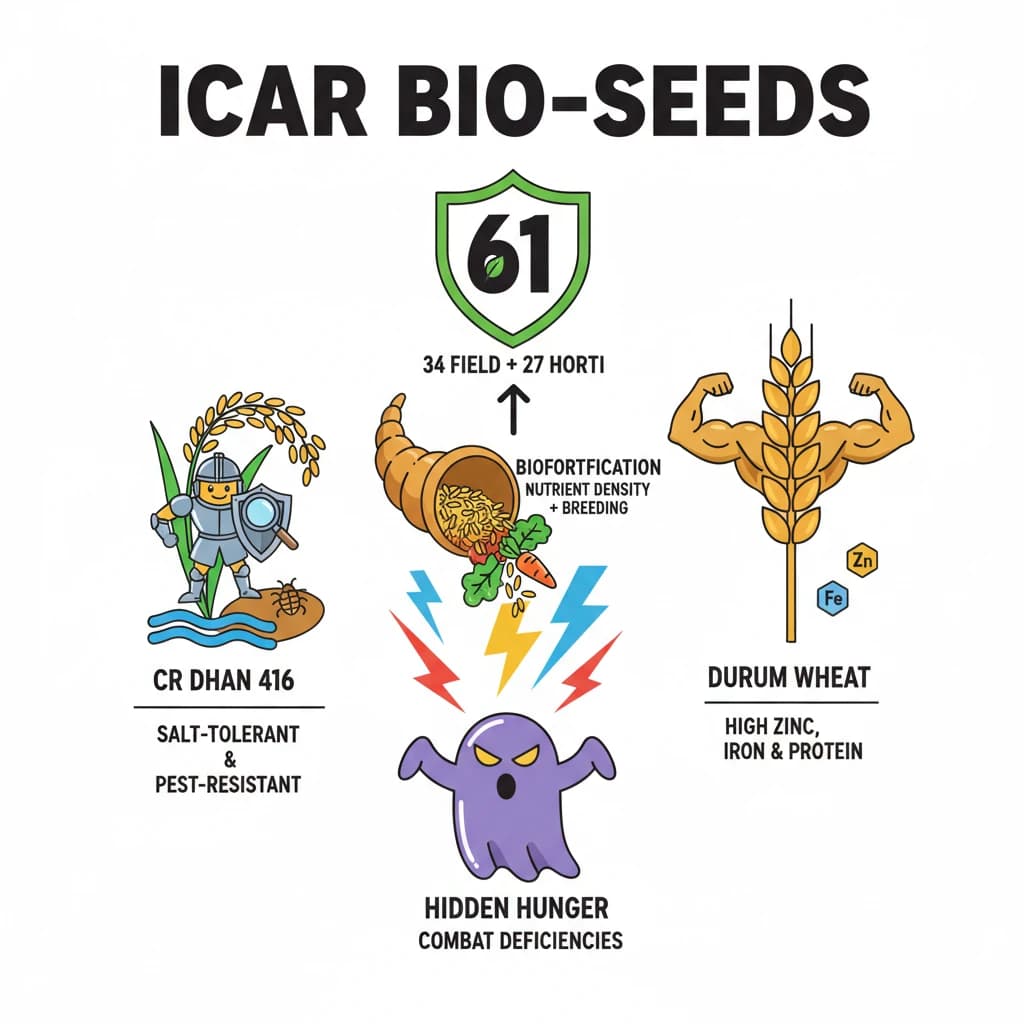
  • •ICAR has launched 61 biofortified seed varieties, including 34 field and 27 horticultural crops.
  • •Biofortification increases nutrient density in food crops via breeding, agronomy, or biotechnology.
  • •Key examples include CR Dhan 416 (salt-tolerant, pest-resistant rice) and Durum Wheat (high zinc, iron, protein).
  • •Biofortification aims to reduce vitamin and mineral deficiencies, combating 'hidden hunger'.
  • •It is a critical intervention for India to tackle malnutrition among women and children and achieve SDGs.

🧠 Memory Techniques
Memory Aid
95% Verified Content

📚 Reference Sources

•ICAR (Indian Council of Agricultural Research) Official Publications (assumed reference for specific varieties)
•Ministry of Agriculture & Farmers Welfare Reports (assumed reference for policy context)

Related Topics

Loading related topics...
Explore:Science And Technology Topics·All Subjects·Daily Current Affairs·Editorial Analysis·Previous Year Questions·UPSC GPT