Loading page, please wait…
Eliminating Kala-azar - UPSC Science And Technology
What is Eliminating Kala-azar in UPSC Science And Technology?
Eliminating Kala-azar is a key topic under Science And Technology for UPSC Civil Services Examination. Key points include: India is close to achieving WHO certification for Kala-azar elimination, needing one more year of sustained low incidence.. Kala-azar (visceral leishmaniasis) is caused by Leishmania donovani and transmitted by infected female sandflies.. It is the second deadliest parasitic disease after malaria, fatal in over 95% of untreated cases.. Understanding this topic is essential for both UPSC Prelims and Mains preparation.
Why is Eliminating Kala-azar important for UPSC exam?
Eliminating Kala-azar is a Medium-level topic in UPSC Science And Technology. It is tested in both Prelims (factual MCQs) and Mains (analytical answer writing). Previous year UPSC questions have frequently covered aspects of Eliminating Kala-azar, making it essential for comprehensive IAS preparation.
How to prepare Eliminating Kala-azar for UPSC?
To prepare Eliminating Kala-azar for UPSC: (1) Study the comprehensive notes covering all key concepts on Vaidra. (2) Practice previous year questions on this topic. (3) Connect it with current affairs using daily updates. (4) Revise using key takeaways and mind maps available for Science And Technology. (5) Write practice answers linking Eliminating Kala-azar to related GS Paper topics.
Key takeaways of Eliminating Kala-azar for UPSC
- India is close to achieving WHO certification for Kala-azar elimination, needing one more year of sustained low incidence.
- Kala-azar (visceral leishmaniasis) is caused by Leishmania donovani and transmitted by infected female sandflies.
- It is the second deadliest parasitic disease after malaria, fatal in over 95% of untreated cases.
- WHO criteria require less than one case per 10,000 population at sub-district level for three consecutive years.
- India will be the second country after Bangladesh to achieve this milestone, contributing to WHO's 2030 NTD roadmap.
Eliminating Kala-azar
Medium⏱️ 7 min read
science and technology
📖 Introduction
India's Progress Towards Elimination
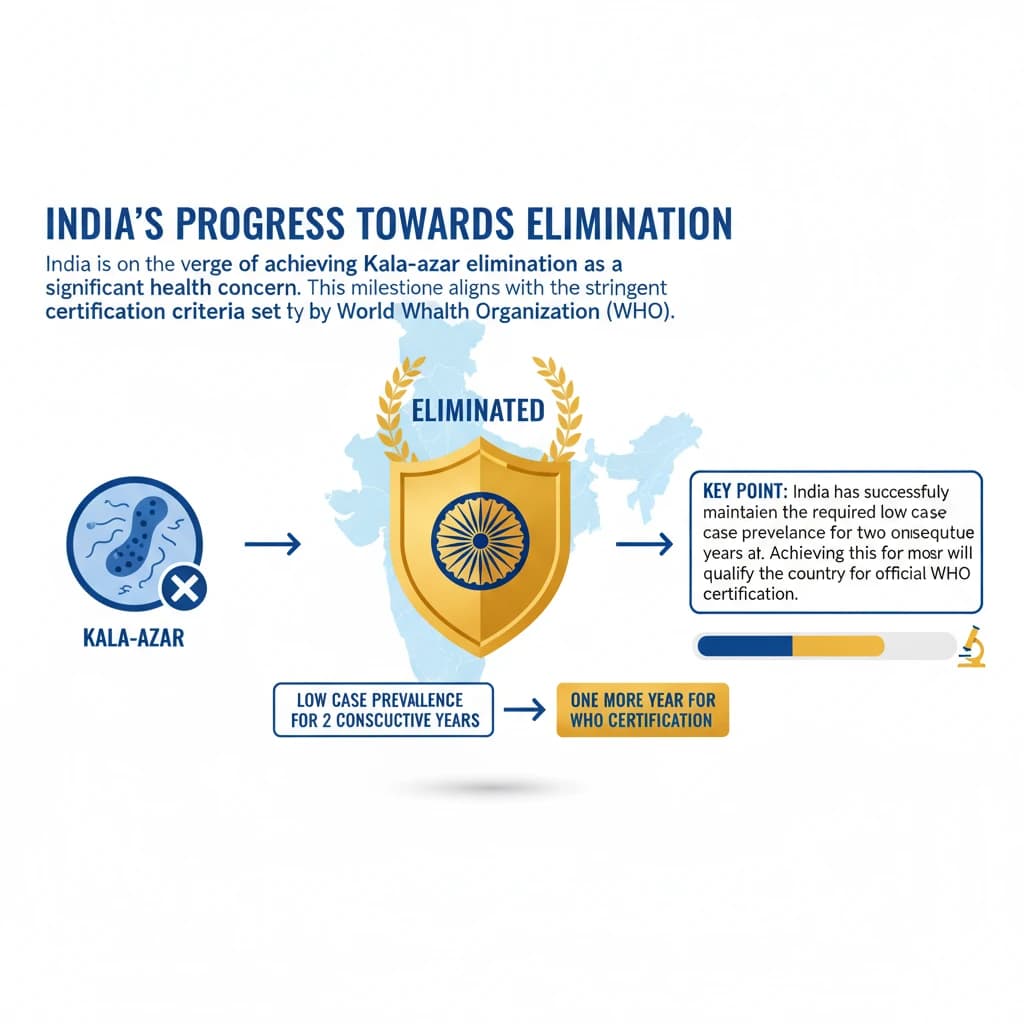
India is on the verge of achieving Kala-azar elimination as a significant public health concern. This milestone aligns with the stringent certification criteria set by the World Health Organization (WHO).
India has successfully maintained the required low case prevalence for two consecutive years. Achieving this for one more year will qualify the country for official certification.
WHO Certification Criteria
To receive WHO certification for eliminating Kala-azar, a country must meet specific public health benchmarks. These criteria ensure sustained control and prevention of re-emergence.
Key Criteria:
- Maintain less than one case per 10,000 population at the sub-district level.
- Sustain this low prevalence for three consecutive years.
- Demonstrate interruption of local transmission for a set period.
- Establish a robust system to prevent disease re-emergence.
Disease Overview: Kala-azar (Visceral Leishmaniasis)
Kala-azar, also known as visceral leishmaniasis or black fever, is a severe parasitic disease. It represents a significant health challenge, particularly in endemic regions.
Causative Agent: The disease is caused by the protozoan parasite Leishmania donovani.
Transmission: It is transmitted through the bite of an infected female sandfly.
Severity: If left untreated, Kala-azar is fatal in over 95% of cases.
Globally, Kala-azar is the second deadliest parasitic disease after malaria. Its elimination is crucial for public health and socio-economic development.
Global and National Elimination Targets
India had initially set an ambitious target to eliminate Kala-azar by 2020. While this target was slightly missed, significant progress has been made.
UPSC Insight: Note the difference between national and global targets. India's progress is a testament to focused public health interventions, relevant for GS2 (Health).
The WHO aims for global elimination of Kala-azar by 2030. This is part of its broader roadmap for addressing Neglected Tropical Diseases (NTDs).
Upon achieving certification, India will become the second country in the world, after Bangladesh, to eliminate Kala-azar as a public health problem.
💡 Key Takeaways
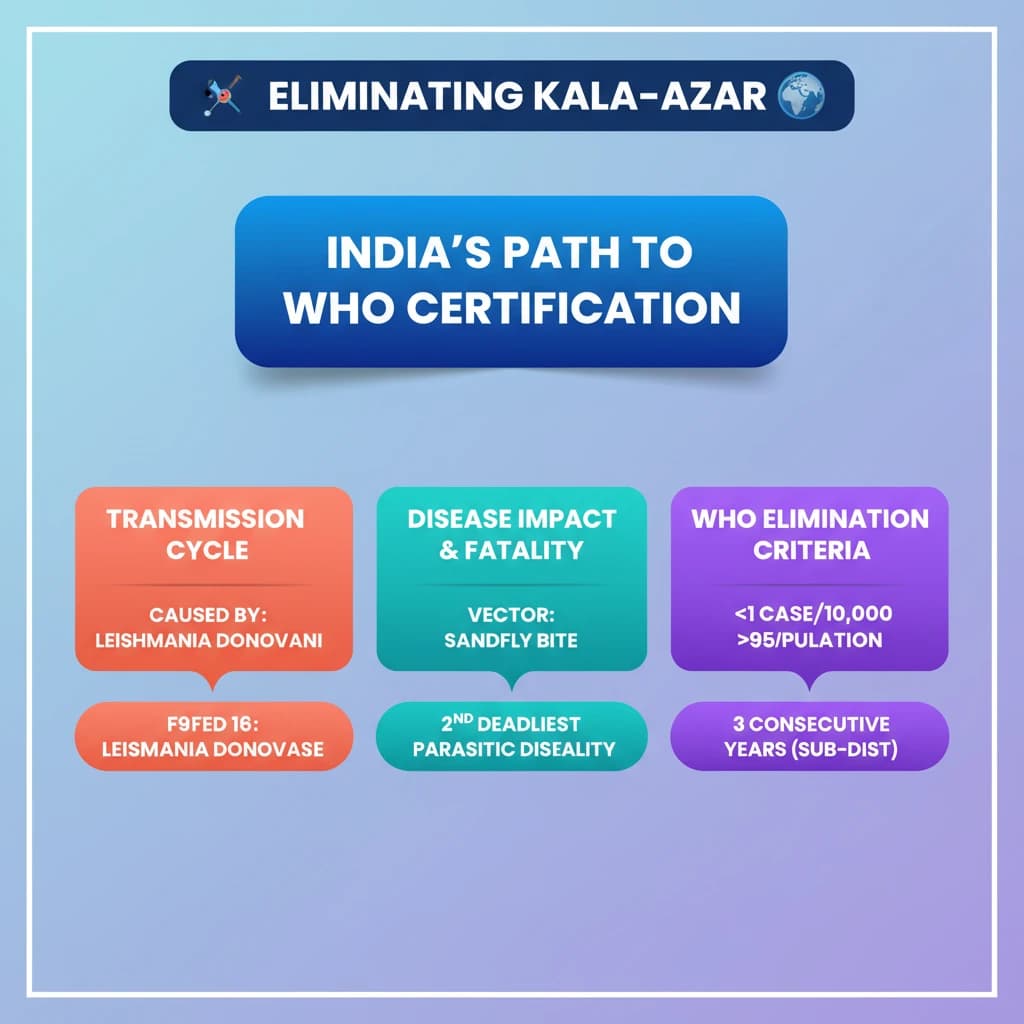
- •India is close to achieving WHO certification for Kala-azar elimination, needing one more year of sustained low incidence.
- •Kala-azar (visceral leishmaniasis) is caused by Leishmania donovani and transmitted by infected female sandflies.
- •It is the second deadliest parasitic disease after malaria, fatal in over 95% of untreated cases.
- •WHO criteria require less than one case per 10,000 population at sub-district level for three consecutive years.
- •India will be the second country after Bangladesh to achieve this milestone, contributing to WHO's 2030 NTD roadmap.
🧠 Memory Techniques
95% Verified Content
📚 Reference Sources
•World Health Organization (WHO) website - Neglected Tropical Diseases (NTDs)
•Ministry of Health & Family Welfare, Government of India - National Health Programs