Loading page, please wait…
Vaidra Logo
Vaidra

Top 4 items + smart groups

UPSC GPT
New
Current Affairs
Daily Solutions
Daily Puzzle
Mains Evaluator

Version 2.0.0 • Built with ❤️ for UPSC aspirants

Loading...
Loading...
Loading...
Loading...
Loading...
Loading...
Loading...
Loading...
Loading...
Loading...
Loading...
Loading...
Loading...
What is PRATUSH? - UPSC Science And Technology
Back
All Subjects

Topics

0 topics • 0 completed

Loading topics...
Loading...
Loading...
Loading...
Loading...
Loading...
Overall Progress0%

What is PRATUSH? - UPSC Science And Technology

What is What is PRATUSH? in UPSC Science And Technology?

What is PRATUSH? is a key topic under Science And Technology for UPSC Civil Services Examination. Key points include: PRATUSH is an Indian radio telescope designed for the far side of the Moon.. It is built by Raman Research Institute (RRI) and ISRO.. Its main objective is to study the 'Cosmic Dawn' – the formation of the first stars and galaxies.. Understanding this topic is essential for both UPSC Prelims and Mains preparation.

Why is What is PRATUSH? important for UPSC exam?

What is PRATUSH? is a Medium-level topic in UPSC Science And Technology. It is tested in both Prelims (factual MCQs) and Mains (analytical answer writing). Previous year UPSC questions have frequently covered aspects of What is PRATUSH?, making it essential for comprehensive IAS preparation.

How to prepare What is PRATUSH? for UPSC?

To prepare What is PRATUSH? for UPSC: (1) Study the comprehensive notes covering all key concepts on Vaidra. (2) Practice previous year questions on this topic. (3) Connect it with current affairs using daily updates. (4) Revise using key takeaways and mind maps available for Science And Technology. (5) Write practice answers linking What is PRATUSH? to related GS Paper topics.

Key takeaways of What is PRATUSH? for UPSC

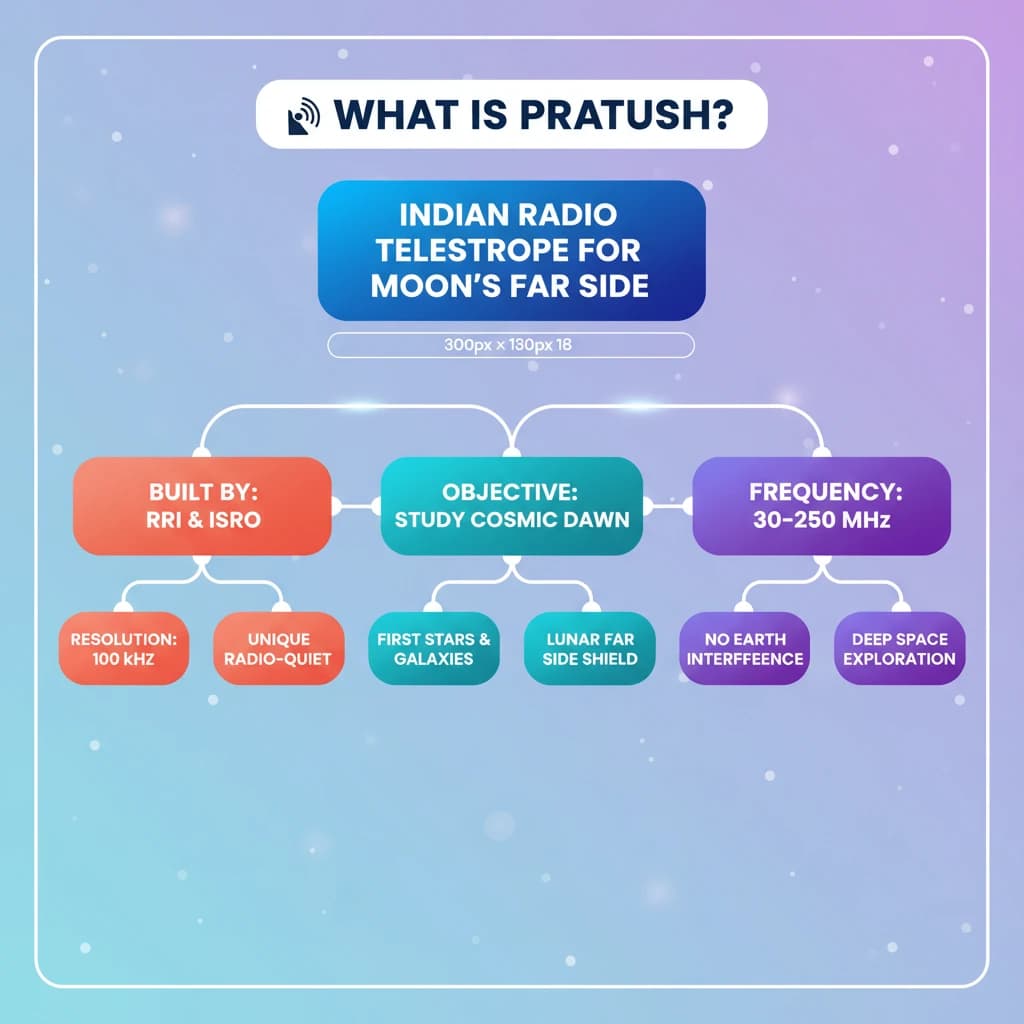
  • PRATUSH is an Indian radio telescope designed for the far side of the Moon.
  • It is built by Raman Research Institute (RRI) and ISRO.
  • Its main objective is to study the 'Cosmic Dawn' – the formation of the first stars and galaxies.
  • It operates in the 30-250 MHz frequency range with 100 kHz resolution.
  • Placement on the lunar far side provides a unique radio-quiet environment, shielded from Earth's interference.
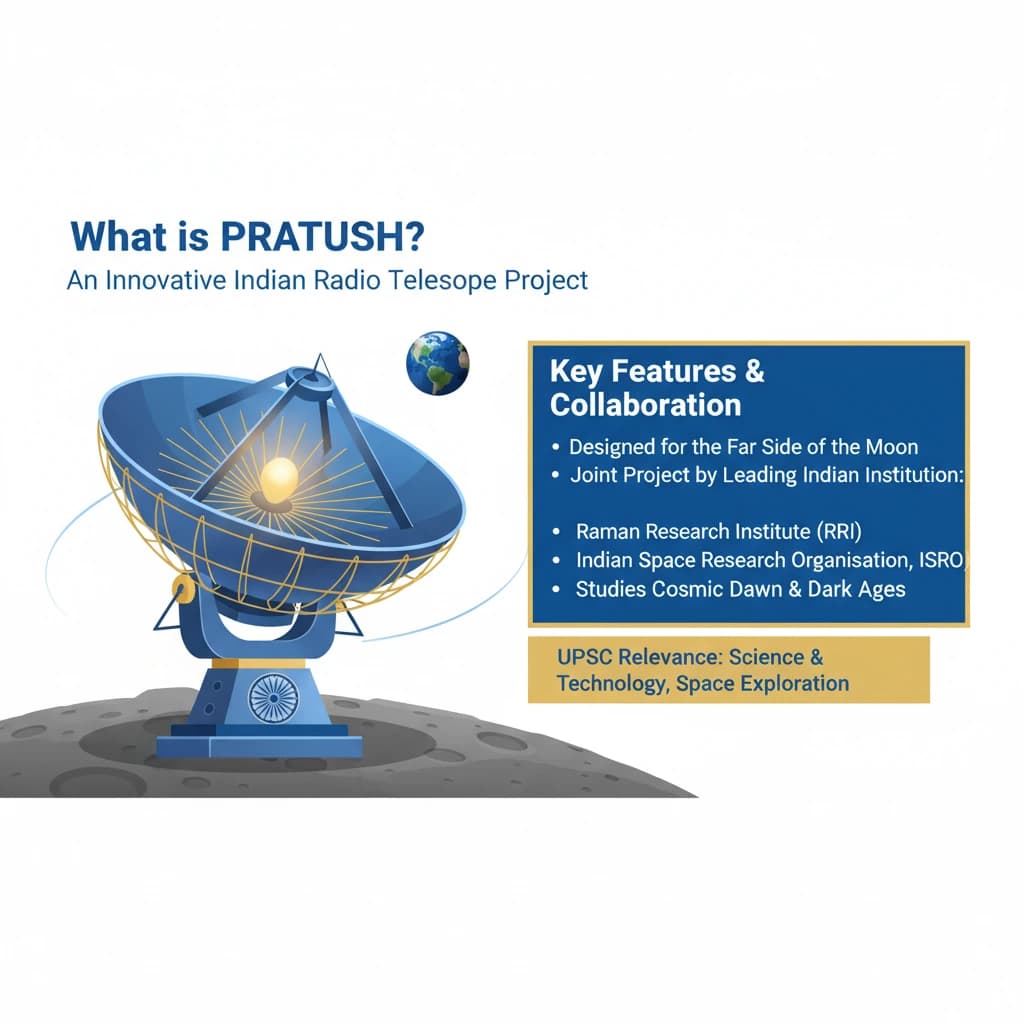
What is PRATUSH?

What is PRATUSH?

Medium⏱️ 6 min read✓ 95% Verified
science and technology

📖 Introduction

<h4>What is PRATUSH?</h4><p><strong>PRATUSH</strong> is an innovative Indian project, conceptualized as a specialized <strong>radio telescope</strong>. Its unique design specifies its placement on the <strong>far side of the Moon</strong>, a location chosen for its scientific advantages.</p><div class='info-box'><p><strong>PRATUSH</strong> is a collaborative endeavor, developed jointly by two leading Indian scientific organizations:</p><ul><li>The <strong>Raman Research Institute (RRI)</strong>, based in Bengaluru.</li><li>The <strong>Indian Space Research Organisation (ISRO)</strong>.</li></ul></div><h4>Core Objective: Unveiling Cosmic Dawn</h4><p>The primary scientific objective of <strong>PRATUSH</strong> is to explore the mysteries of the <strong>early universe</strong>. It specifically targets the epoch known as <strong>Cosmic Dawn</strong>.</p><div class='key-point-box'><p>The <strong>Cosmic Dawn</strong> represents a crucial period in universal history. It marks the time when the <strong>first sources of radiation</strong>, including the very first <strong>stars</strong> and <strong>galaxies</strong>, began to form.</p></div><p><strong>PRATUSH</strong> aims to precisely determine the <strong>timing</strong> and fundamental <strong>characteristics</strong> of these inaugural star formations. This includes understanding the specific <strong>colour of the light</strong> emitted during this profound era.</p><p>Ultimately, the mission seeks to trace the universe's evolution. It aims to map its journey from an initial state of <strong>cold gas</strong>, following the <strong>Big Bang</strong>, to the complex structure of <strong>stars</strong>, <strong>galaxies</strong>, and the cosmos we observe today.</p><h4>Advanced Capabilities of PRATUSH</h4><p>To achieve its ambitious scientific goals, <strong>PRATUSH</strong> is equipped with highly sophisticated <strong>radio equipment</strong>, tailored for deep space observation.</p><div class='info-box'><ul><li><strong>Frequency Range:</strong> It is designed to operate across a broad frequency spectrum, specifically from <strong>30 to 250 MHz</strong>.</li><li><strong>Observation Strategy:</strong> The telescope will continuously monitor <strong>large areas of the sky</strong>.</li><li><strong>Data Acquisition:</strong> It will record highly detailed <strong>radio spectra</strong>.</li><li><strong>Spectral Resolution:</strong> It boasts an impressive resolution of <strong>100 kHz</strong> for precise spectral analysis.</li></ul></div><p>The system incorporates several custom-engineered components essential for its performance:</p><ul><li>A specially designed <strong>antenna</strong> to capture faint radio signals.</li><li>An advanced <strong>analog receiver</strong> for initial signal processing.</li><li>A sophisticated <strong>digital correlator</strong>, crucial for high-resolution spectral analysis of the collected data.</li></ul>
Concept Diagram

💡 Key Takeaways

  • •PRATUSH is an Indian radio telescope designed for the far side of the Moon.
  • •It is built by Raman Research Institute (RRI) and ISRO.
  • •Its main objective is to study the 'Cosmic Dawn' – the formation of the first stars and galaxies.
  • •It operates in the 30-250 MHz frequency range with 100 kHz resolution.
  • •Placement on the lunar far side provides a unique radio-quiet environment, shielded from Earth's interference.

🧠 Memory Techniques

Memory Aid
95% Verified Content

📚 Reference Sources

•Information related to Raman Research Institute (RRI) projects
•Information related to Indian Space Research Organisation (ISRO) missions

Related Topics

Loading related topics...
Explore:Science And Technology Topics·All Subjects·Daily Current Affairs·Editorial Analysis·Previous Year Questions·UPSC GPT